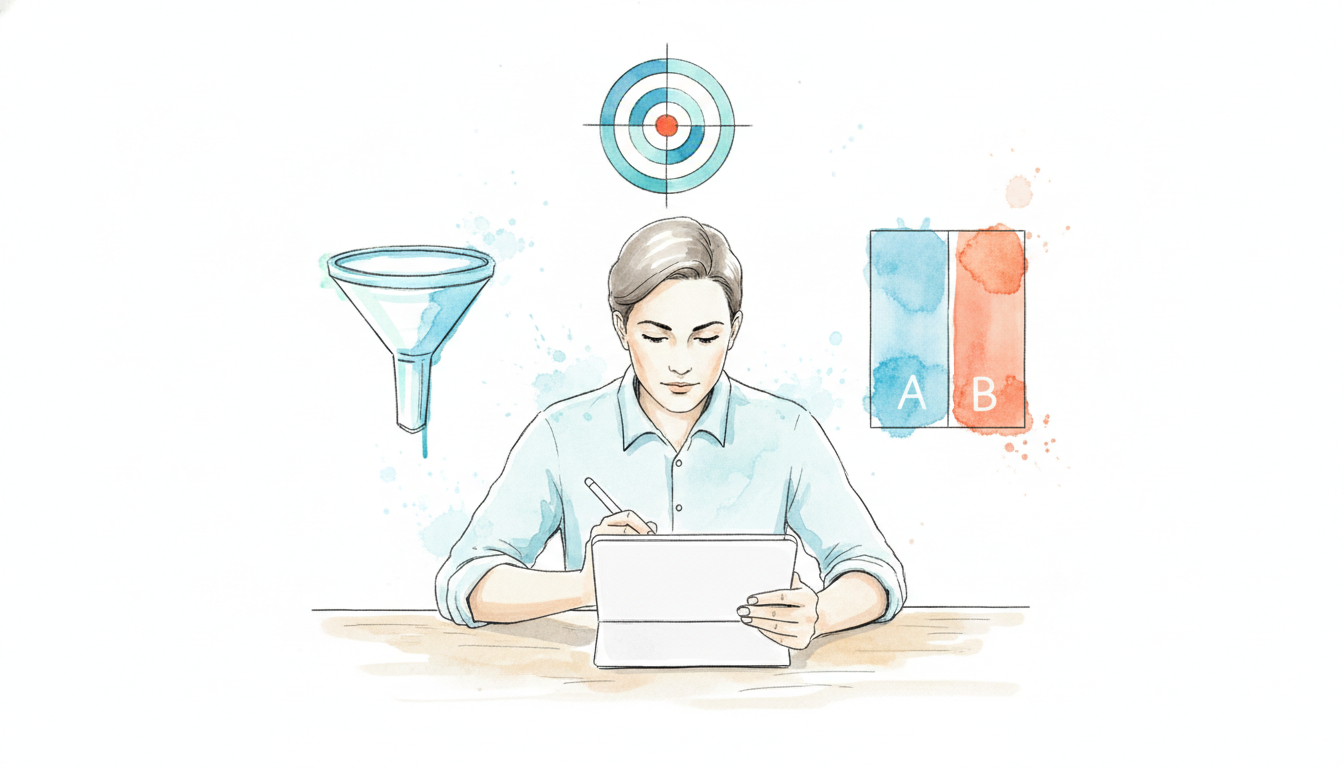
Everyone wants to know the magic number. What’s a good conversion rate?
While you'll often hear numbers like 2-5% thrown around, the real answer is always: it depends. What you're selling, who you're selling to, and where your traffic comes from will completely change the definition of "good." Let's move past the vague averages and find the benchmarks that actually matter for your business.
Your Quick Guide To Conversion Rate Benchmarks
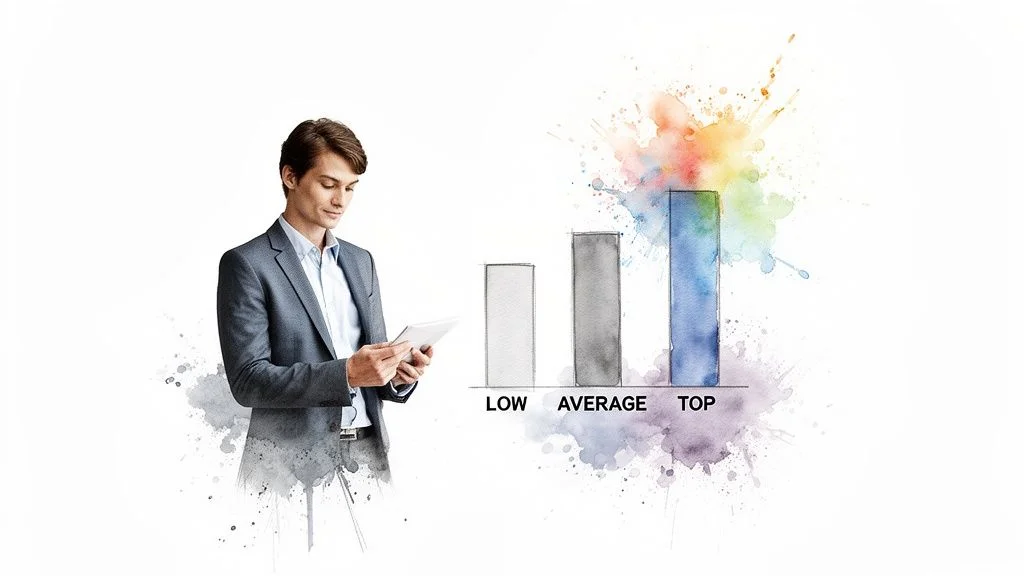
Think of your conversion rate as your website's pulse. It's a vital sign that tells you how well you’re persuading visitors to take action, whether that's buying a product, starting a trial, or booking a call. A weak pulse signals friction in the customer journey, while a strong one shows you're giving people exactly what they want.
But a number on its own is just noise. A 1% conversion rate might be fantastic for a business selling high-ticket B2B software, but a 4% rate could be a major red flag for an ecommerce store selling low-cost apparel. The only way to know is by comparing your performance to relevant benchmarks, not some universal, one-size-fits-all average.
Understanding Performance Tiers
Looking at the big picture, most studies show the global average for ecommerce conversion rates hovers around 2-3%. One of the most frequently cited figures puts the average right at 2.79%.
The real story, though, is in the top performers. The top 20% of online stores aren't just hitting the average; they're consistently converting between 3.5% and 5%. If your rate is already above 3%, you're doing better than most. To get a more detailed look, you can dig into what makes a good average ecommerce conversion rate across different product types.
To give you a general idea of where you stand, here’s a quick breakdown of performance tiers.
Conversion Rate Performance Tiers (2026 General Benchmark)
This table offers a simple framework for interpreting your conversion rate in the broader market.
| Performance Tier | Average Conversion Rate | What It Means For Your Business |
|---|---|---|
| Needs Improvement | Below 1% | You likely have significant friction in your user journey that needs attention. |
| Average | 1% - 3% | You're on par with most, but there's a clear opportunity to grow. |
| Good | 3% - 5% | You're ahead of the curve and effectively meeting visitor needs. |
| Excellent | Above 5% | You're a top performer with a highly optimized experience. |
While these tiers are helpful, remember the most important benchmark is your own.
A truly "good" conversion rate is one that is always getting better. The goal isn't to hit a static number and stop. It's to build a system of continuous optimization that raises your own baseline, month after month.
Now that we've set the stage and have a general feel for the numbers, it's time to get our hands dirty. In the sections ahead, we’ll break down exactly how to measure, interpret, and, most importantly, improve your conversion rate with practical, proven strategies.
Once you know your baseline, see our guide on how to increase your website conversion rate for the specific tactics to move the needle.
How To Calculate Your True Conversion Rate
Before you can start boosting your conversion rate, you need a rock-solid way to measure it. The basic idea is simple, but getting the details right is what separates good data from guesswork.
Think of it like an old-school brick-and-mortar shop. You can count how many people walk through the front door (visitors) and how many walk out with a shopping bag (conversions). The percentage of people who bought something is your conversion rate. It's the exact same principle online.
Conversion Rate = (Total Conversions ÷ Total Visitors) x 100
So, if 1,000 people landed on your product page last month and 30 of them actually bought the product, your math looks like this: (30 ÷ 1,000) x 100 = 3%. That 3% is your benchmark, the number you’ll be working to improve.
First, What Counts as a "Conversion"?
The formula itself is straightforward, but the numbers you plug into it are what really matter. The most common mistake is not clearly defining what a “conversion” is for your specific goal. It’s not always a sale.
A conversion is simply the most valuable action you want a user to take on a given page.
Depending on your business, a conversion could be any of these:
- E-commerce Store: A completed checkout or even just adding an item to the cart.
- SaaS Company: Someone starting a free trial or booking a demo call.
- Online Course Creator: A student enrolling in a course or downloading a free guide.
- Webinar Host: A successful registration for your live event.
If you don't lock this down first, you're measuring noise, not progress. You can't improve what you aren't tracking accurately.
Next, Who Counts as a "Visitor"?
Once you know what you’re measuring, you have to define who you’re measuring against. Most analytics tools, including Google Analytics, give you two main ways to count visitors: users and sessions.
- Users: This is the number of unique people who came to your site. If one person visits ten times, they're still just one user.
- Sessions: This is the total number of visits. If that same person visits ten times, that counts as ten sessions.
For calculating your main conversion rate, most people stick with users. It gives you a clearer picture of how many unique individuals you're successfully persuading. However, calculating a session-based rate can also be useful for understanding how repeat visits influence behavior. The trick is to pick one method for your core reporting and use it consistently.
Having a central place to see all this data makes a world of difference. To get a better handle on this, check out how an analytics dashboard can help you monitor all your key metrics in one spot.
No matter what you're selling, consistent measurement is the foundation for growth. Once you have your definitions set, you'll have reliable data you can use to make real, meaningful improvements.
What’s a Good Conversion Rate, Really? Benchmarks by Industry and Channel
So, we get to the million-dollar question: what’s a “good” conversion rate for your business? You’ll often hear a global average of 2-3% thrown around, but honestly, that number is so broad it's almost useless. A good rate is all about context, the industry you’re in, how much your product costs, and where your customers are coming from.
Think about it this way: a 2% conversion rate could be fantastic for a B2B software company selling a high-ticket subscription with a six-month sales cycle. But for an ecommerce store slinging trendy, inexpensive t-shirts? That same 2% might be a sign that something is seriously wrong. This is exactly why you need to look at benchmarks for your specific industry and traffic channels. They're the only way to set realistic goals and figure out what’s actually working.
The image below breaks down the simple math behind your conversion rate. It's all about how many people took the action you wanted versus how many people had the chance to.
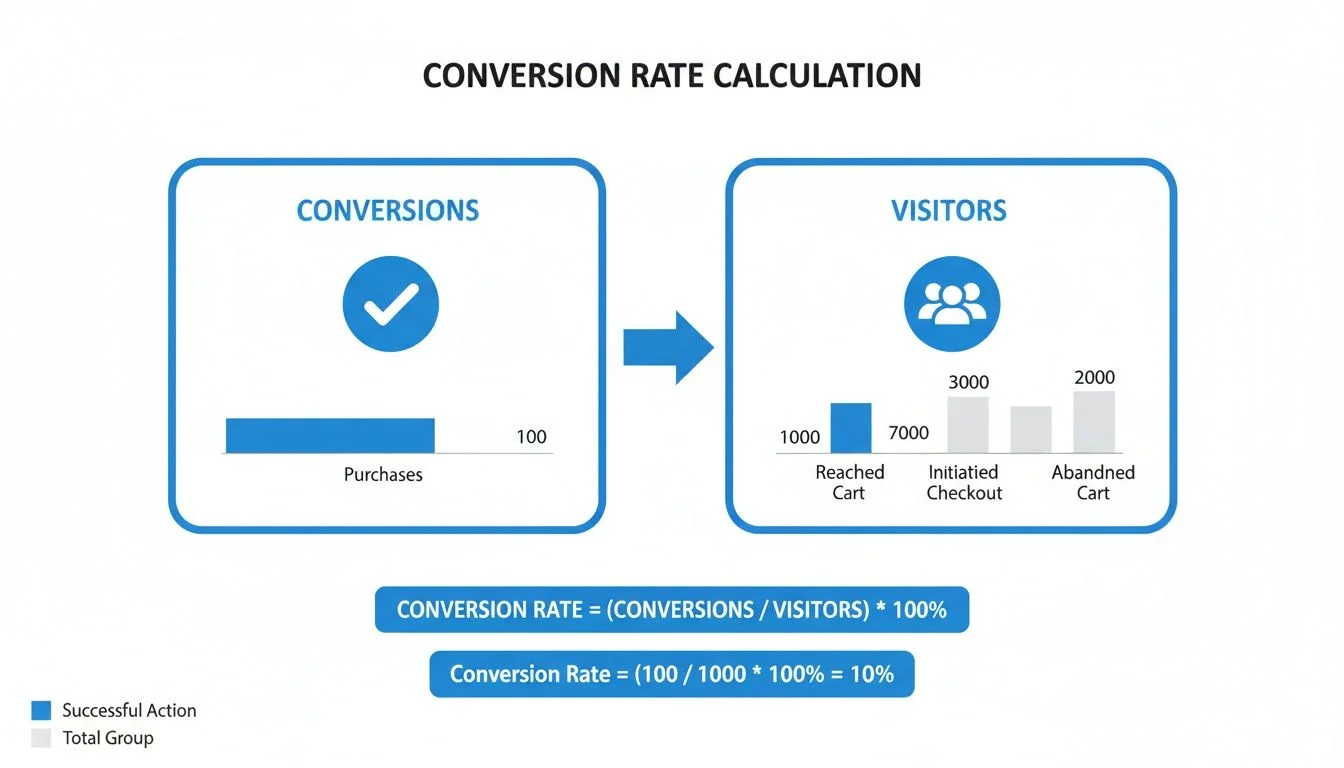
It’s a straightforward formula, but the story behind the numbers is what truly matters.
2026 Average Conversion Rate Benchmarks by Industry
Even within a single category like ecommerce, conversion rates can be all over the map. The difference usually comes down to things like how often people buy, the price tag, and how much thought goes into a purchase. Deciding on a new lipstick is a much faster, lower-stakes decision than buying a new living room sofa.
To give you a clearer picture, we've pulled together the latest 2026 benchmark data. This table shows you the typical conversion rate ranges you can expect across different sectors, helping you see how you stack up against your direct competition.
| Industry | Average Conversion Rate Range | Key Influencing Factors |
|---|---|---|
| Personal Care | 5.5% - 7.0% | High purchase frequency, brand loyalty, lower price points. |
| Food & Beverage | 4.0% - 5.5% | Subscription models, impulse buys, strong visual appeal. |
| Apparel & Fashion | 1.5% - 3.0% | Trend cycles, high return rates, intense competition. |
| Home Decor & Furnishings | 1.0% - 2.0% | High-ticket items, long consideration phase, complex logistics. |
| Luxury & Jewelry | 0.5% - 1.5% | Very high price points, need for trust, longer sales cycles. |
| Electronics | 1.0% - 2.5% | Product specs, comparison shopping, brand reputation. |
As you can see, a personal care brand converting at 6.8% is doing great, while a luxury brand hitting 0.9% might also be right on track for its category. The biggest mistake you can make is comparing your performance to a generic, site-wide average. If you sell electronics, your yardstick is other electronics stores, not fashion boutiques.
Trust is one of the most direct drivers of conversion. Our guide on how to build trust with customers covers the specific signals buyers look for.
How Different Traffic Channels Affect Conversions
It’s not just what you sell, but where your visitors come from that dramatically shapes your conversion rate. Someone who Googled your brand by name is worlds away from a person who just happened to see your ad while scrolling through their social feed.
Breaking down your conversion rate by channel is one of the best ways to see which marketing efforts are actually paying off.
- Email Marketing: This is almost always the champion, with conversion rates often hitting 3% to 5% or even higher. These are your people, they know you, they trust you, and they’ve already given you permission to pop into their inbox.
- Organic Search (SEO): Traffic from search engines is a solid performer, typically converting between 2% and 4%. When you nail the search intent for valuable keywords, you’re basically handing a solution to someone who is actively looking for it.
- Paid Search (PPC): Ads on platforms like Google can bring in conversion rates of 2% to 3%. Success here is all about tight keyword targeting, compelling ad copy, and a landing page that delivers on the ad's promise.
- Direct Traffic: These are your loyal fans, people who type your URL straight into their browser. They’re often returning customers or have great brand recall, so they convert at a high rate, much like your email list.
- Social Media: This channel tends to have the lowest conversion rates, usually between 0.5% and 1.5%. People on social media are typically in discovery mode, not buying mode, so it’s a tougher sell.
Understanding this breakdown is critical. If your overall conversion rate suddenly tanks, don't panic and assume your site is broken. It might just be that your latest viral TikTok video drove a ton of low-converting (but high-awareness!) traffic. For more practical tips on turning visitors into customers, our team shares tons of actionable advice on the FomoChat blog.
The Hidden Factors That Influence Your Conversion Rate
It's easy to get lost in A/B testing button colors and headline tweaks. But often, the biggest wins for your conversion rate aren't found in these minor changes. They're hidden in foundational elements that can make or break your performance before someone even reads a single word.
Think of it this way: the most persuasive copy in the world doesn't matter if the page takes forever to load or looks completely broken on a phone. Focusing on these core pillars is how you move from small tweaks to big, meaningful improvements.
Page Load Speed Is Everything
We live in a world of instant gratification, and on the web, every second, even every millisecond, counts. A slow-loading page is a conversion-killer, plain and simple. It creates friction and frustration right away, and most visitors just don't have the patience to wait. They'll bounce before you ever get a chance to make your pitch.
Exit-intent popups are one of the highest-impact tools for rescuing near-conversions. Our exit intent popup guide walks through how to implement them effectively.
This isn't a small problem. The data is clear: e-commerce sites that load in just 1 second see conversion rates that are 3x higher than slower sites. With over 70% of global online retail now happening on mobile devices, a lightning-fast experience isn't a luxury; it's absolutely essential.
If you're using third-party tools, like social proof widgets, make sure they aren't secretly dragging your site down. A tool meant to build trust shouldn't end up costing you sales because it hurts performance.
FOMOchat is designed to move these numbers by combining real-time social proof with an AI chat widget that answers visitor objections instantly, targeting the exact friction points that suppress conversion rates.
The Device Divide: Desktop vs. Mobile
Not all website visits are the same. Someone browsing on a desktop at their office behaves very differently than someone scrolling on their phone while waiting for a coffee. This "device divide" is critical for understanding why your conversion numbers look the way they do.
As a general rule, desktop conversion rates are significantly higher than mobile rates. Desktop users are often in a more focused, research-driven mindset. They're ready to fill out complex forms or make a carefully considered purchase.
Mobile users, on the other hand, are often on the go, distracted, and dealing with a smaller screen. If your checkout process is clunky or your forms are a pain to fill out on a phone, you're practically throwing money away.
Traffic Source Quality Matters
Where your visitors come from has a huge impact on how likely they are to convert. A user who Googled your brand by name is coming in with a completely different mindset than someone who casually clicked a display ad while reading the news.
Think about the intent behind different traffic sources:
- High-Intent Traffic: These visitors are your best bet. They come from your email list, type your URL directly into their browser, or search for your brand. They already know you and often arrive ready to act.
- Medium-Intent Traffic: This group is actively looking for a solution like yours but might not know your brand yet. They typically find you through non-branded organic search or targeted paid ads.
- Low-Intent Traffic: Visitors from social media feeds or broad display ad campaigns are usually in "discovery" mode, not "buying" mode. They're browsing, not shopping, and are unlikely to convert on their first visit.
Knowing your traffic mix helps you set realistic conversion goals for each channel instead of judging everything against one blended average.
Pricing and Your Offer
This might sound obvious, but it's the most fundamental factor of all: how good is your offer? A truly irresistible deal will always convert better than a confusing or overpriced one, no matter how clever your marketing is.
The most effective conversion strategy isn't a clever tactic; it's an offer so good that visitors feel like they can't say no. This is about aligning your product, price, and promise perfectly with your audience's needs.
A higher price point naturally creates more friction, leading to a longer sales cycle and a lower immediate conversion rate. In contrast, offering a free trial or a low-cost introductory product can dramatically boost conversions by lowering the barrier to entry. Optimizing your forms for these high-value offers is key, and our guide on collecting visitor information can show you how to do it effectively.
Actionable Strategies to Increase Your Conversion Rate
So, you know your conversion rate. That's the easy part. The real work, and where the growth happens, is figuring out how to make that number go up.
Boosting conversions isn't about throwing spaghetti at the wall or chasing the latest trends. It’s about getting into your customer's head, spotting the roadblocks in their path, and then clearing them away, one by one.
Think of it as a blend of psychology, smart design, and just plain-old clear communication. Your job is to make saying "yes" to what you offer feel both easy and obvious. Let’s walk through some of the most effective ways to do just that.
Optimize Your Landing Page and Copy
Your landing page is your 24/7 salesperson. It has one job: convince visitors to take action. For it to do its job well, your words need to be sharp, speak directly to your audience's problems, and squash their biggest doubts before they even fully form.
Put yourself in the shoes of a skeptical visitor. They're asking themselves: Is this too expensive? Is it going to be a pain to set up? Can I even trust this company? Your page needs to answer these questions with confidence.
Here’s how to make your copy hit harder:
- Nail Your Value Prop: A visitor should know exactly what you do and why you're the best choice within five seconds. No jargon, no fluff.
- Talk Benefits, Not Just Features: "Automated workflows" is a feature. "Get back 10 hours a week" is a benefit. Guess which one is more convincing?
- Use Your Customer's Own Words: Dig through reviews and customer service emails. When you use the same language your customers use to describe their pain points, it shows you genuinely get it.
The best copy doesn't sound like a sales pitch. It feels like a trusted friend guiding you to the exact solution you've been looking for. It builds trust by showing you understand.
To get really serious about this, you'll want to dive into the world of Conversion Rate Optimization (CRO). It’s the framework for making data-driven changes instead of just guessing what works.
Simplify Your Forms and Checkout Process
Friction is the ultimate conversion killer. And nowhere does it pop up more than in your forms and checkout. Every extra field, every confusing question, every last-minute surprise is another reason for a potential customer to walk away.
With the average cart abandonment rate hovering around 70%, a clunky checkout is just leaving money on the table. Your mission is to create the path of least resistance.
Follow these simple rules to smooth things out:
- Be Ruthless with Form Fields: Do you really need a phone number for a newsletter signup? Cut everything that isn't absolutely essential.
- Offer a Guest Checkout: Forcing people to create an account is one of the fastest ways to lose a sale. Let them buy as a guest.
- Show People the Finish Line: Use a progress bar on multi-step forms. Knowing you're on "Step 2 of 3" is much less daunting than flying blind.
- No Last-Minute Surprises: Show all costs, including shipping and taxes, as early as possible. Nobody likes a nasty surprise on the final payment screen.
Fixing these final steps can instantly rescue sales from people who were ready to buy but got frustrated by the process.
Use Social Proof and Urgency
We're all wired to follow the crowd. We look to others to figure out what's safe, what's good, and what's popular. This principle is called social proof, and it's one of the most powerful persuasion tools you have.
When a visitor sees other people buying from you, they instantly feel more at ease. It's the digital version of choosing the restaurant with a line out the door over the empty one next to it. You just assume the food must be better.
Here’s how to put social proof to work on your site:
- Show Recent Activity: Small, pop-up notifications like "Sarah from New York just purchased!" make your site feel alive and busy.
- Display Visitor Counts: On a popular product page, showing that "217 people are currently looking at this item" creates a powerful sense of demand and urgency.
- Feature Real Reviews and Testimonials: This is the gold standard. Authentic customer reviews are incredibly powerful, studies show they can lift conversions by more than 250%.
Even an AI-powered chat widget can provide a form of social proof by answering common questions in real-time. When a new visitor sees that the questions they have in their head are being addressed, it builds their confidence to move forward. Of course, getting the tone right is critical; you can learn more about improving AI responses to make sure they sound helpful, not robotic.
Common Questions About Conversion Rates
Even after you get the hang of conversion rates, a few common questions always seem to pop up once you start digging into your own data. Let’s tackle some of the most frequent ones to clear up any confusion and help you read your metrics like a pro.
How Often Should I Check My Conversion Rate?
It's tempting to hit refresh on your analytics all day long, but this usually does more harm than good. The key is finding a rhythm that works for you without getting lost in the noise. Tiny daily dips and spikes are almost always just statistical static, not a real trend.
Think of it this way:
- For high-traffic sites (like a busy ecommerce store), a weekly review is perfect. It’s frequent enough to catch major issues but keeps you from overreacting to a single slow morning.
- For lower-traffic sites (think niche B2B services), a monthly analysis gives you a much clearer and more reliable picture. You need more time to gather enough data to see what's actually happening.
Your goal is to spot a pattern over time. A single bad day is just a blip. A steady downward slide over several weeks? That's your signal to start investigating.
What Is a Good Conversion Rate for a SaaS Free Trial?
For any SaaS business, turning free trial users into paying customers is the name of the game. But what’s a "good" rate? Honestly, it varies quite a bit depending on who you're selling to and how complex your product is.
Here are some solid benchmarks to aim for:
- Complex B2B Tools: If you’re converting 2-5% of trial users to paid, you’re doing well. These tools often have a steeper learning curve and a longer sales cycle, so a lower rate is normal.
- Simple B2C or Prosumer Apps: For these, it’s not unusual to see rates of 10% or even higher. When a tool is easy to grasp and delivers value quickly, more people are willing to pull out their credit card.
What really moves the needle here is your trial length, how well you onboard new users, and how fast they have that "aha." moment where your product's value just clicks for them.
Can a Conversion Rate Be Too High?
It sounds crazy, but yes, it absolutely can. If you suddenly see your conversion rate jump to something absurd like 50%, your first reaction shouldn't be to celebrate, it should be to get skeptical and start digging.
An impossibly high conversion rate is almost never a sign of a marketing miracle. More often than not, it’s a warning that your tracking is broken, you're being flooded with bots, or your offer is simply too good to be true.
An astronomical rate often points to a technical glitch, like a goal that fires on every page load. It could also mean bots are spamming a form. In other cases, it might mean your offer (like a 99% off discount) is unsustainable and attracting the wrong kind of customer. Always double-check your data to make sure your wins are real.
How Does Social Proof Directly Impact Conversion Rate?
Social proof is more than just a fancy widget on your site; it’s a direct line to a visitor's brain. It works by tackling the biggest conversion killer: hesitation.
By showing that other real people are buying from you, signing up, or leaving reviews, you build instant trust. It reduces that nagging uncertainty every new visitor feels and creates a subtle sense of community. It’s a powerful way to reassure someone that they’re in the right place and making a smart choice.
Ready to turn your website's visitors into confident buyers? FOMOchat uses the power of AI-driven social proof to build trust and answer questions in real-time, helping you increase signups and sales effortlessly. See how it works.