
Let's get straight to it: building customer trust isn't about a clever marketing campaign. It’s about being consistently reliable, operating with an almost uncomfortable level of transparency, and genuinely listening to what your customers need.
Modern buyers are smart, skeptical, and can smell a sales pitch a mile away. They value authenticity over slick promises. The foundation of any lasting, profitable relationship is simple: do what you say you're going to do. Every single time.
Why Customer Trust Is Your Most Valuable Asset

In a world overflowing with noise and competing claims, trust isn't just a nice-to-have. It’s the single most valuable asset your business can own. The best part? It doesn't depreciate. Today’s customers are more informed than ever, and their default setting is skepticism. This shift has made trust the new currency.
When people trust your brand, they buy from you, stick with you, and tell their friends about you. The data backs this up. A Salsify report found that a staggering 87% of shoppers are willing to pay more for a product if it comes from a brand they truly trust.
This isn't about fluffy metrics or feel-good marketing. It's a core business strategy with a real, measurable return.
The Growing Crisis of Consumer Confidence
Here's the challenge: earning that trust is getting harder. People are growing more and more wary of how companies use their data, conduct business, and communicate their real intentions. This isn't just a hunch; it's a well-documented global trend.
Just look at the 2026 Edelman Trust Barometer Global Report. It’s a bit of a wake-up call. The report revealed that only 39% of people across 28 countries actually trust businesses to do the right thing. That number represents a major double-digit drop in 20 of those markets, pointing to a serious erosion of confidence. You can dig into the specifics in the full Edelman report. (For the visual signals that reinforce credibility, check out our guide on symbols of trustworthiness.)
What this means for you is that your audience is probably showing up with their guard up. Every exaggerated claim or piece of vague marketing copy only feeds their suspicion.
But this crisis of confidence is also a massive opportunity. The brands that decide to operate differently, with genuine transparency and a real commitment to their customers' success, are the ones that will win.
For course creators and SaaS marketers, this means shifting focus from simply telling prospects what to believe to showing them why your brand is worthy of their confidence.
The Tangible Impact on Your Bottom Line
Let’s be clear: learning how to build trust with customers directly affects your bottom line. This isn’t an abstract concept; it has a very real impact on the numbers you track every day.
When you've earned that trust, here’s what happens:
- Higher Conversion Rates: A prospect who trusts you is far more likely to click "buy now" or "start my trial." Trust removes that hesitation and anxiety that kills sales.
- Increased Customer Lifetime Value (LTV): Trust is the glue that creates loyalty. Happy, confident customers stick around longer, upgrade their plans, and buy more from you over time.
- Improved Brand Resilience: Brands built on trust can weather storms. When you inevitably make a mistake, a trusting customer base is much more likely to give you the chance to make it right.
- Stronger Word-of-Mouth Marketing: People love sharing things they believe in. A customer who trusts you becomes your most authentic (and cheapest) marketing channel.
Ultimately, every strategy we'll cover in this guide is designed to drive sustainable growth. By making trust your top priority, you’re making a direct investment in the long-term health and profitability of your business.
Build Credibility with Transparency and Social Proof
Let's face it, your customers are skeptical. In a world full of hype, they don't automatically trust your marketing claims. You can't just tell them you're trustworthy. You have to show them, right from their very first visit to your site.
The fastest way to do this? Get radically transparent and layer on authentic social proof. This means being upfront, even when it’s a little uncomfortable.
Embrace Radical Transparency
Radical transparency is more than just a marketing trend; it’s a strategy. When you openly share information that your competitors might hide, you instantly signal confidence and a deep respect for your customer's intelligence.
Put yourself in your customer's shoes. What doubts or questions pop into your head as you browse your own site? Answer them before they even have to ask.
Here’s how to put this into practice:
- No-Nonsense Pricing: Stop hiding your pricing behind a "Contact Us" form unless it’s absolutely unavoidable. Lay it all out there. If you use consumption-based pricing, give them a calculator to play with. Clarity builds confidence.
- Admit Who You're Not For: This one feels scary, but it works wonders. Create a section on your site that directly answers, "Is this product a bad fit for me?" This level of honesty not only builds massive trust but also filters out poorly-fit customers who would have churned anyway.
- Share Your Progress: A public roadmap or a changelog shows you’re alive and kicking. It proves you’re constantly improving your product and, more importantly, that you’re listening to the people who use it.
Data privacy is another area where transparency is non-negotiable. Being crystal clear about how you handle data can turn a major concern into a reason for a customer to trust you more. We take this seriously, and you can see our entire approach in our privacy policy.
Showcase Authentic Social Proof
Once you've laid a foundation of transparency, you need to show visitors that other people just like them are already finding value in what you offer. This is social proof, but not the stale, cherry-picked kind. Your customers can spot a fake testimonial a mile away. For a deeper look at what actually works, see our roundup of real social proof examples that move the needle.
The most powerful social proof isn't a perfect 5-star review. It's an honest question from a real person, followed by a transparent, helpful answer. This shows prospects that you're not afraid of tough questions and that others share their same concerns.
To make this happen, you have to move beyond just posting static reviews. People trust what other people are doing right now. While it's still crucial to get testimonials from customers to use in your marketing, showing live interest is far more compelling.
Turning Conversations Into Credibility
Imagine a potential student lands on your course sales page. Instead of a static wall of text, a small widget pops up, showing real (but anonymous) questions from other recent visitors, with your AI answering them instantly.
This is exactly how a tool like FOMOchat can completely change the dynamic. It shifts a visitor from passively browsing to actively seeing your credibility in action.
Instead of just telling them your webinar is amazing, you're showing them that:
- Other people are clearly interested and asking smart questions.
- The exact objections they have are being addressed for others in real-time.
- You're confident enough to put these conversations out in the open.
For instance, a visitor might see a pop-up: "Does the course cover advanced SEO tactics, or is it mainly for beginners?" Your AI, trained on all your course materials, gives a detailed, honest answer right then and there. That single, live interaction can do more to dissolve doubt than a dozen polished reviews because it’s real, relevant, and happens right at the moment of decision. It proves they aren't the only one with questions and calms that last-minute purchase anxiety.
Turn Customer Support Into a Trust-Building Engine
The moments right after a customer clicks "buy" are where real, long-term trust is built. Too many businesses treat customer support and onboarding as a necessary expense. That's a huge mistake. These early interactions are your golden opportunity to turn a new buyer into a lifelong fan, proving they made the right call.
A great onboarding experience isn't just a series of setup tasks; it's a warm welcome. It’s your chance to show them you’re invested in their success, making them feel confident in their purchase long before they ever run into a problem.
Onboarding That Builds Immediate Confidence
Your new customer just took a chance on you. Those first few hours and days will either confirm their decision was a smart one or plant a seed of buyer's remorse. A thoughtful, proactive onboarding flow is one of the most powerful ways to start the relationship off on the right foot.
Instead of just firing off a generic "welcome" email, think about creating a guided journey that anticipates their questions and delivers value right away. It shows you've walked in their shoes and you're ready to help them succeed.
Here's how to build a trust-centric onboarding process:
- The Welcome Sequence: Don't just say "thanks for signing up." Send a few short emails or in-app messages that introduce one core feature at a time. Link out to your best tutorials and set clear expectations for what they can accomplish in their first week.
- Proactive Check-ins: Use simple automation to reach out after a few days. A quick message like, "Hey, how are you finding the [X feature]? Lots of new folks have questions about that part," shows you're paying attention and makes it okay for them to feel like a beginner.
- Celebrating Small Wins: When someone hits a key milestone (like publishing their first course video or connecting their first integration), celebrate it! This little bit of positive reinforcement builds momentum and makes them feel like they're already winning.
The table below breaks down these touchpoints, showing you how to infuse trust-building actions at every stage of the onboarding journey.
Onboarding Touchpoints to Build Customer Trust
| Onboarding Stage | Trust-Building Action | Example Implementation |
|---|---|---|
| Initial Sign-up | Provide immediate value and reassurance. | Send a welcome email from the founder that includes a quick-start guide and a link to a "first steps" video tutorial. |
| First 24-48 Hours | Guide them to their first "aha!" moment. | Trigger an in-app message pointing them toward the single most important feature for new users to get value. |
| First Week | Show you're proactive and available. | Automate a check-in email asking if they've run into any questions yet. Normalize the learning curve. |
| Ongoing Usage | Reinforce their progress and success. | Send a congratulatory message when they complete a key task, like "Congrats on publishing your first sales page!" |
By thoughtfully designing these interactions, you guide customers toward success and demonstrate your commitment right from the start.
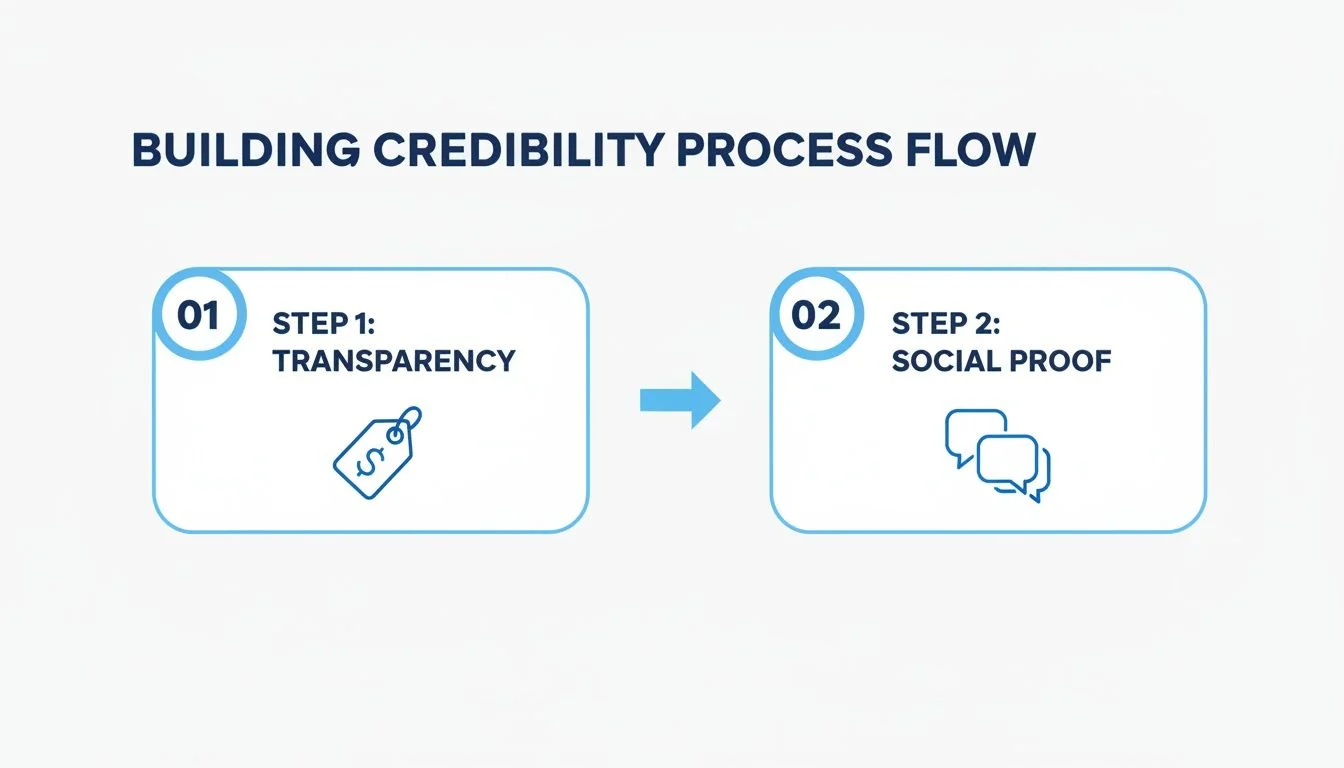
This simple model gets to the heart of it: when you're open and honest, and you can back it up with proof that other people are happy, you create an incredibly strong foundation for trust.
Blending Smart Automation with a Human Touch
People want answers now. But when the stakes are high, they also want to talk to a real person. This isn't a new idea, but it's becoming a deal-breaker for customer loyalty.
A recent Capgemini report found that the desire for human help is on the rise. 74% of people want it for in-store service, and 66% want it during the purchase process. It's a clear signal that to earn loyalty, you need a smart mix of digital and human support.
The secret is to deliver this balance without hiring a massive team. You can use smart automation to handle the frequent, easy-to-answer questions. This frees up your human experts to step in for the complex issues where empathy and creative problem-solving really matter.
For instance, a course creator running a live webinar could use a tool like FOMOchat to give instant answers to questions about pricing, course materials, or the refund policy. This keeps the audience engaged while the creator stays focused. If a tricky question comes up, the AI can flag it for a personal reply after the presentation. You can get tips on setting this up in our guide on improving AI responses.
To keep getting better, you can use conversation intelligence tools to spot trends in what your customers are asking. This data is gold. It tells you exactly what information is missing from your website or where your automated replies fall short, helping you fix issues before they become frustrating problems.
Crafting Content and Messaging That Radiates Honesty

Every word on your website, every email you send, and every chat interaction is a chance to either build or break trust. It’s easy to say "be authentic," but what does that actually look like in your copy? For people who are naturally skeptical, the right messaging makes all the difference.
Think of it this way: each piece of content is a small promise. When your marketing promises one thing and the customer's experience delivers exactly that (or more), you've laid a powerful foundation of trust. It all begins with setting expectations that are both exciting and achievable.
Set Realistic Expectations in Marketing
We’ve all seen it: marketing copy that promises the moon but delivers a bit of dust. This kind of hype is one of the fastest ways to breed distrust and create disappointed customers. A much better approach is to ground your claims in reality and let your product’s true value shine.
For a course creator, that means ditching "Become an Expert Overnight" for something like "Master the Fundamentals in 30 Days with Guided Practice." For a SaaS product, it’s the difference between "Eliminate All Manual Work" and "Reduce Manual Data Entry by up to 80%." Specific, believable claims just hit differently.
The goal isn't to downplay your product's strengths. It's about framing them in a way that is both impressive and completely attainable. This simple shift shows you respect your customer's intelligence and sets them up for a win, which makes you look good too.
There's a reason the old "under-promise and over-deliver" mantra sticks around: it works. You shift the customer's feeling from potential disappointment to pleasant surprise, which goes a long way in cementing their belief in your brand.
Use Confidence Qualifiers in AI Chat
When you're using an AI chatbot for support, a response that's too certain can feel robotic and, ironically, less trustworthy. The key is to build a more human-like persona by teaching your AI to express confidence appropriately, especially when it’s pulling answers from a knowledge base.
Instead of a blunt statement like, "The price is $49," you can program your AI to use what I call confidence qualifiers. These are just subtle phrases that make the whole exchange feel more like a genuine conversation.
A few examples of confidence qualifiers:
- "Based on the information I have, the Pro plan is listed at $49 per month."
- "I'm seeing that the course includes lifetime access, but it's always a good idea to double-check the latest terms."
- "As far as I know, the integration with that software is in beta."
This little tweak does two things: it manages expectations and adds a dose of humility. You can actually embed these qualifiers and other persona traits right into your AI’s programming using tools like FOMOchat. By setting up these guardrails, you can be sure your AI assistant consistently reflects your brand’s honest voice.
Address Weaknesses and Data Usage Openly
Here’s a bold move that builds massive trust: talk about your product's limitations. It might feel counterintuitive, but it's incredibly disarming. Try adding a "Who is this NOT for?" section to your sales page or writing a blog post about a feature you decided not to build, explaining the "why" behind your decision.
The same goes for how you use AI and customer data. With privacy being a huge concern, transparency isn't just nice; it's necessary. A recent Qualtrics report found that 46% of customers are more willing to share personal data if a business is transparent about how it’s used. This is especially true as 53% of consumers are worried about AI-related privacy risks. You can dive into the full analysis in their 2026 Global Consumer Experience Trends report.
Don’t bury your data policies in a tiny footer link. Make it a selling point. Create a clear, easy-to-read page explaining what you collect, why you need it, and how it directly benefits the customer. This turns a potential point of friction into another opportunity to prove you’re on their side.
How to Measure and Optimize Trust for Better Conversions
You can spend all day implementing trust-building strategies, but if you can't see the impact, you're just guessing. To really know what’s working, you have to look beyond the big numbers like signups and sales. The real story is in the subtle signals people send when they’re deciding whether or not to stick around.
This is also how you prove the value of your work. It’s not just about making people feel warm and fuzzy; it’s about showing your team how a small boost in confidence can lead to real, measurable gains. When you can connect trust to revenue, it stops being a "soft" skill and becomes a core growth strategy.
What to Track Besides the Obvious
Your conversion rate is the end result, but it doesn't tell you why things are happening. To get ahead of the curve, you need to watch for the little behavioral clues that show a customer is feeling confident enough to move forward.
These metrics paint a much richer picture:
- Hesitation Time: How long is someone just sitting on your pricing or checkout page? You can track this with simple event analytics. A long pause is a classic sign of doubt. They’re looking for hidden fees, scanning for a catch, or just feeling uncertain.
- Repeat Question Rate: Are you getting the same questions in your support chat or email over and over? This is a huge red flag that your messaging isn't landing. Unclear communication kills trust fast.
- Social Proof Engagement: Are people actually clicking to expand testimonials or watch your case study videos? What about interacting with a social proof widget? If engagement is low, your proof might not be compelling or visible enough to do its job.
Monitoring these metrics gives you a powerful diagnostic tool. A drop in hesitation time after you clarify your pricing model is a clear sign that your transparency efforts are working.
Watching these numbers helps you pinpoint exactly where friction exists in your customer journey. You stop guessing and start making targeted improvements that actually move the needle.
Putting Trust to the Test: A/B Ideas That Work
Once you're tracking the right things, you can start running experiments. A/B testing is perfect for validating which trust-building elements truly resonate with your specific audience. It's about so much more than button colors.
Here are a few A/B test ideas you can run right away:
The Guarantee Showdown
Test a page with a prominent, risk-reversing guarantee (like a "30-Day Money-Back Guarantee") against a version without one. Keep an eye on both your overall conversion rate and the hesitation time on the checkout page. Does removing the risk make people decide faster?
Radical Transparency vs. Standard Copy
On your pricing page, try testing a version with a blunt, honest section titled "Who This is NOT For" against your standard feature list. This kind of transparency can build incredible credibility and attract customers who are a much better fit for your product in the long run.
Static Testimonials vs. Live Conversations
Compare a page with traditional, polished customer reviews to one featuring a dynamic chat widget like FOMOchat. The widget can surface real-time, authentic questions from other visitors, showing that people are actively engaged. This creates a sense of immediacy and authenticity that a static quote often can't match.
Each test is designed to answer a question: What makes my audience feel more secure? Does seeing other people’s live questions reduce purchase anxiety more than a curated review? Only testing will tell you for sure.
Tying It All Back to the Bottom Line
Okay, so how do you prove all this is worth the effort? You connect your trust metrics to what everyone in the company understands: return on investment (ROI).
It’s actually simpler than it sounds. You can build a rock-solid business case by drawing a straight line from your trust-building activities to revenue.
For instance, let's say your A/B test shows that adding a clearer refund policy increases your trial-to-paid conversion rate by 10%. You can easily calculate the extra monthly revenue that one change generated.
Or maybe you find that improving your onboarding flow reduces support tickets by 20%. That’s a quantifiable cost saving you can show in terms of your team's time and resources. Digging into your support analytics can reveal even more. If you want to see how this works, check out our guide on using the FOMOchat analytics dashboard to find these kinds of insights.
Ultimately, measuring trust isn’t some abstract exercise. It’s about making smarter, data-driven decisions that build stronger customer relationships and drive sustainable growth.
Common Questions About Building Customer Trust
Even with a solid plan, you’re bound to hit a few roadblocks when you get serious about building trust. Let's walk through some of the most common questions I hear from SaaS marketers and course creators and get you some practical answers.
How Can I Build Trust if My Product Is New with No Customers?
This is a tough spot. You have no customers, so you have no social proof. But without that proof, getting those first few customers feels impossible.
The trick is to stop worrying about customer proof for a minute and focus on founder proof and process proof.
Get comfortable being transparent about your journey. Share the behind-the-scenes on social media. Write a detailed blog post about the problem that kept you up at night, the one you’re trying to solve. Talk about your mission. This builds a real connection and shows there’s a passionate human behind the logo.
For a product just starting out, the most convincing proof is the founder’s own expertise and drive. When people believe in your mission and see you know what you're talking about, they’re far more willing to take a chance on the product itself.
To get those first brave souls on board, you have to make the decision feel completely safe.
- Offer a Rock-Solid Guarantee: A no-questions-asked, 30-day money-back guarantee is non-negotiable. It takes all the financial risk off the table.
- Give an Extended Free Trial: Let them use the product long enough to truly see its value before asking for a credit card.
- Be Proactively Transparent: You can even use a tool like FOMOchat to create simulated, yet realistic, conversations that answer the questions you know people have. By programming the AI with honest answers about your roadmap and why you built this, you create an atmosphere of transparency before you even have a crowd.
Isn't Using an AI Chatbot the Opposite of Being Authentic?
This is a great point, and the answer really boils down to honesty. An AI assistant only feels fake if you’re trying to pass it off as a real person. Seeing a bot named "Jessica" pretend to be human is an instant trust-killer.
Authenticity isn't about shunning technology; it's about being upfront in how you use it. When a chat widget is clearly marked as an AI-powered assistant trained on official company info, it becomes a powerful tool for instant, reliable support. It sets the right expectation from the start.
The real social proof comes from showing that other actual visitors are asking similar questions. That's a genuinely authentic snapshot of the customer journey. You're not faking a human; you're highlighting real human interest. Frame it as a helpful resource, not a person. You can find more on handling this by checking out these common questions and best practices.
What Is the Most Effective Way to Build Trust on a Tight Budget?
If you're strapped for cash, the most powerful thing you can do costs nothing but your time: radical honesty.
Go through your product descriptions and pricing pages. Rewrite them to be painfully clear and simple. Take it a step further and create a section answering, "Who is this product NOT for?" This shows incredible confidence and actually helps you attract better-fit customers who are less likely to churn.
Here are a few zero-cost actions you can start today:
- Publish a changelog. Regular updates about new features and bug fixes prove your product is alive and getting better.
- Write about a mistake. Share a story about a blunder and what you learned. A little vulnerability goes a long way.
- Be Brutally Honest: If a feature is still in beta or has known limitations, just say so. People appreciate knowing exactly what they’re getting into.
These actions build a deep well of credibility. Once you have that foundation, a small investment in showing dynamic social proof on your key pages can amplify that trust, proving you aren’t afraid to address concerns out in the open.
How Do I Balance Building Trust with Creating Urgency?
Trust and urgency aren't opposites; they actually boost each other when you do it right. The friction only appears when the urgency is manufactured. A fake countdown timer or a false "Only 2 left!" banner is a textbook example of unethical urgency, and it's a surefire way to obliterate trust.
Ethical urgency is always rooted in real-world constraints and total transparency.
First, build the trust by explaining why the urgency exists. A course creator, for instance, could say, "We cap enrollment at 100 students per group to make sure everyone gets personal feedback." That isn't a pushy sales tactic; it’s a feature that benefits the customer.
Then, you can use social proof to make that urgency feel real and shared. During a live webinar, a host can use a tool like FOMOchat to show real-time notifications as people sign up. This creates a powerful, trust-based form of urgency. For a potential customer, the feeling shifts from, "I'm being pressured," to "Wow, other people are jumping on this. I might miss out if I wait."
Ready to turn your website’s visitor curiosity into a powerful conversion tool? FOMOchat combines authentic social proof with an AI assistant to answer objections and build trust, helping you increase signups and sales. See how it works at https://fomochat.com.