

Ever walked past two restaurants, one packed with a lively crowd and the other completely empty? You probably felt an instant pull toward the busy one. That gut feeling, the assumption that a crowd must mean good food, is the essence of social proof.
It's a simple, powerful shortcut our brains use to make decisions. When we're unsure, we look to what others are doing.
Decoding Social Proof in Modern Marketing
In the online world, where we can't see the "crowd" in person, social proof becomes even more critical. It's the digital equivalent of a packed restaurant, guiding uncertain customers and giving them the confidence to click "buy." It's the invisible hand that makes a product feel like a safe, smart, and popular choice.
The Foundation of Trust and Influence
At its heart, what is social proof in marketing is a strategy that taps into our basic human instinct to follow the herd. We constantly seek validation from others to minimize the risk of making a bad choice. This idea was famously broken down by psychologist Robert Cialdini in his 1984 book, Influence: The Psychology of Persuasion, where he named it one of the six pillars of influence.
The numbers back this up. A staggering 92% of consumers hesitate to make a purchase if there are no customer reviews. As these recent social proof statistics on datapins.com show, the absence of social validation is a major roadblock for any business.
Why Social Proof Is Non-Negotiable
For any marketer today, mastering social proof is no longer optional. Here's why:
- It builds instant credibility. Seeing that real people have bought and loved your product creates a layer of trust that no flashy ad ever could.
- It calms buyer nerves. The fear of buyer's remorse is real. Social proof, whether it's a glowing testimonial or a simple user count, eases that anxiety by showcasing a track record of satisfaction.
- It ignites FOMO. When people see others getting great results, it triggers a powerful urge to get in on the action, speeding up their decision to buy.
Social proof isn't just a marketing tactic; it's a core part of how we make choices. By showcasing genuine positive experiences, you can turn a skeptical visitor into a confident customer.
Ultimately, social proof lets your happy customers do the selling for you. It's the difference between telling people your product is great and showing them that everyone else already thinks so. For a deeper dive into creative ways to implement this, check out this guide on finding a Proof alternative for educational social proof.
Breaking Down the 6 Powerful Types of Social Proof
Social proof isn't a one-size-fits-all tactic. It's more like a versatile toolkit, filled with different instruments designed to build trust in very specific ways. Think of it like a chef's spice rack. Each type adds its own unique flavor of credibility to your marketing mix. Knowing the difference helps you pick the perfect one to connect with your audience at just the right moment.
Some forms of social proof lean on popularity, while others draw their power from authority or sheer relatability. By understanding the six core types, you can build a far more convincing brand presence that speaks to all the different reasons a customer might choose to buy. For real-world examples of each type in action, see our guide to social proof examples.
This map helps visualize the core idea: various forms of social proof (expert validation, user feedback, and the wisdom of the crowd) all work together to build a foundation of customer trust.
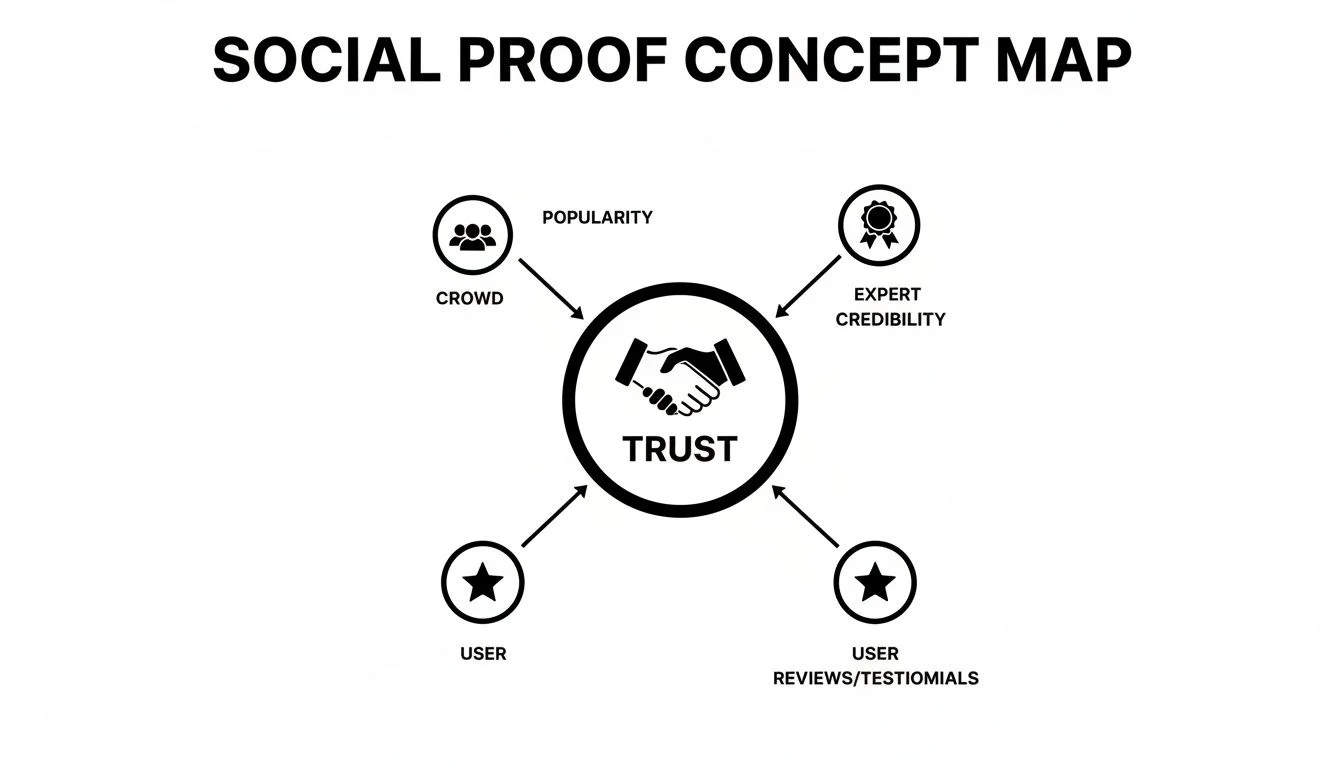
The key takeaway is that trust isn't built from a single source. It's the combined effect of multiple signals that, together, tell a potential customer they're making a safe and smart choice.
1. User Proof: Voices of Real Customers
This is social proof in its purest and, arguably, most powerful form. It comes straight from the people who have already paid for your product or service and are happy they did. When a potential buyer sees that others just like them have had a great experience, it instantly lowers their guard and makes the purchase feel less risky.
You see user proof in a few common forms:
- Testimonials: These are short, punchy quotes from happy customers. You'll often find them sprinkled across key pages like the homepage or right before checkout to nudge a hesitant buyer over the finish line.
- Reviews and Ratings: This is more detailed feedback, often found on platforms like Google, Capterra, or right on your product pages. The numbers don't lie: one study found that products with at least five reviews have a 270% higher chance of being purchased than those with none.
- User-Generated Content (UGC): Think of authentic photos, videos, or social media posts your customers create that show your product in action in their real lives.
A great example is a skincare brand that reshares an Instagram story from a customer raving about their clear skin. That single, unpolished post feels far more genuine and trustworthy than any slick, professional ad ever could.
2. Expert and Celebrity Proof: The Stamp of Authority
When a recognized authority figure or a famous personality gives your product their seal of approval, their credibility instantly rubs off on your brand. This works because we're wired to trust the judgment of people we admire or see as experts in a particular field.
Expert proof is like getting a glowing recommendation from the most respected person in the room. It cuts through the noise and skepticism by borrowing from an already established reputation.
A software company might feature a powerful quote from a well-known industry analyst on its website. It's the same principle behind why Nike has partnered with top athletes for decades. Their products become associated with peak performance and excellence. This makes customers feel confident that they're choosing a high-quality, professionally vetted option. Beyond endorsements, even visual cues like badges and certifications play a role. Our guide to symbols of trustworthiness breaks down how they work.
3. The Wisdom of the Crowd: Safety in Numbers
This type of social proof taps into a simple human instinct: if a lot of people are doing something, it's probably a good idea. It's the digital version of walking past a restaurant with a long line out the door. Your first thought is, "Wow, that place must be amazing."
You can signal this "wisdom of the crowd" by highlighting big numbers:
- Large User Counts: "Join over 1 million happy customers worldwide."
- Big Social Media Followings: "Become part of our 50,000+ community on Instagram."
- Impressive Usage Stats: "More than 10 million designs created with our tool."
When a SaaS platform puts "Trusted by 25,000 teams" on its pricing page, it's using this principle to signal reliability and popularity. That number makes a new team feel much safer about signing up.
4. Peer Proof and Case Studies: The "They're Just Like Me" Effect
Peer proof is incredibly effective because it's all about relatability. When a prospect sees a success story from a person or company with the exact same challenges they're facing, it helps them vividly imagine their own success.
The undisputed champion of peer proof is the case study. A case study goes way beyond a short testimonial to tell a complete story. It lays out the customer's problem before they found you, explains exactly how your product solved it, and, most importantly, shows off the measurable, positive results.
This narrative format makes the value you offer feel concrete and believable. It transforms an abstract promise into a documented, real-world success.
The Psychology Driving Social Proof's Effectiveness
Have you ever been at a fancy dinner and felt that split-second of panic when you see more than one fork? Your first move is almost always to sneak a peek at your neighbor and copy what they do. That simple, subconscious reaction is the secret to why social proof is one of the most powerful forces in marketing.
At its heart, social proof isn't some clever marketing gimmick. It's a fundamental part of how we're wired. It's a mental shortcut our brains use to make decisions faster and with less stress. This behavior is fueled by two powerful, deep-seated psychological needs.
First, we all have an intense desire to be correct. This is called informational social influence. When we're faced with an uncertain situation, like picking new software or deciding if an online course is worth the money, we look to others for clues, assuming they know more than we do. If thousands of people have already bought a product and left rave reviews, our brain quickly concludes, "They must know something I don't. This is probably the right move."
The Need for Belonging
But it's not just about being right. We are social animals with a profound need to belong. This second driver is known as normative social influence. We often follow the actions of a group to fit in, gain approval, and avoid being the odd one out.
When a potential customer sees that their friends, colleagues, or people they look up to are all using a particular service, something powerful clicks. The decision is no longer just about features; it's about joining a community and being part of the "in-crowd."
Social proof works by answering two critical subconscious questions for a potential buyer: "Is this the smart choice?" and "Is this what people like me do?" By satisfying both, you dramatically lower the psychological barrier to purchase.
Together, these two forces shape what people buy.
Reducing Risk and Triggering FOMO
Every purchase, no matter how big or small, comes with a little bit of risk. Will this actually work as promised? Am I going to regret spending this money? Social proof is the perfect antidote to this buyer's anxiety.
- It de-risks the decision. Seeing that hundreds or thousands of others have already taken the plunge and had a good experience creates a powerful safety net. It shifts the burden of risk from the individual buyer to the collective wisdom of the crowd.
- It activates FOMO. When we see other people getting great results, saving time, or enjoying an experience with a product, a sense of urgency kicks in. We don't want to be left in the dust while everyone else gets ahead. This fear can be a far stronger motivator than any list of features.
For instance, putting "8,452 students have enrolled this month!" on a course sales page does more than just show it's popular. It sends a clear message to a visitor that they risk being left out of a valuable opportunity their peers are jumping on right now. This is a perfect example of what is social proof in marketing and how it taps into basic human psychology to drive action.
How to Put Social Proof to Work in Your Business
Knowing what social proof is and actually using it to grow your business are two different things. The real trick is placing the right kind of proof in front of your customer at the right time. This isn't about just scattering a few testimonials around your site and hoping for the best. It's about strategically turning social validation into a growth engine.
Your job is to answer your visitor's unspoken questions right when they have them. Whether someone is on your homepage, looking at pricing, or about to check out, a well-placed piece of social proof can be the nudge they need to take the next step. Here are some proven ways to make this happen for different types of businesses.
For SaaS and Software Companies
In the SaaS world, it's all about building trust and showing a clear return on investment. People are making a big decision, both financially and for their team's workflow, so your job is to make them feel confident and secure. Your social proof needs to scream reliability and results.
Here are a few high-impact tactics:
- Display your customer logos. Displaying the logos of well-known companies using your software is a visual shortcut to credibility. Stick them right on your homepage where no one can miss them.
- Put case studies next to your pricing. A detailed case study with hard numbers, like "Increased team productivity by 40%," is incredibly powerful when placed right next to your pricing plans. It connects the cost to a tangible outcome.
- Show your user count. A simple line like, "Trusted by over 50,000 product managers," instantly makes a new user feel like they're joining a winning team, not taking a risky bet.
By layering these different types of proof, you're building a strong case that your software isn't just a good idea, but a safe and popular choice in their industry.
For Online Courses and Digital Products
When you're selling a course or an ebook, you're selling a transformation, not just information. Your social proof has to help potential students see themselves achieving their goals. It's all about showing them that you deliver on your promises and that their investment of time and money will pay off.
The best social proof for educational products doesn't just say the course is great; it shows the real-world results students got. This turns an abstract promise into something concrete and attainable.
Here's how to do it:
- Get it on video. A video of a former student talking about how your course helped them land a promotion or start a new business is way more convincing than a text quote.
- Display enrollment numbers. Seeing "Join 3,500+ students who have already enrolled!" creates a powerful fear of missing out and adds a dose of urgency.
- Celebrate student wins. Get permission to share student success stories on your social media and in your email newsletters. This creates a constant, living stream of social proof that keeps building trust.
For Product Launches and Webinars
For a time-sensitive event like a launch or a webinar, social proof is your best friend for building buzz and driving sign-ups. The goal is to create an atmosphere of excitement and make people feel like your event is something they can't afford to miss.
- Show off your waitlist. Before you even open the doors, build a waitlist and let everyone know how many people are on it. "Over 10,000 people are on the VIP list!" creates a ton of anticipation.
- Feature influencer shout-outs. Get quotes or short video clips from respected people in your industry who are excited about what you're launching. Their endorsement adds a layer of expert validation.
- Use real-time sign-up notifications. During the registration period, pop-ups that say "Jessica from New York just signed up!" show real-time activity and can seriously boost conversions. For more tips on getting more sign-ups, check out our guide on landing page optimization best practices.
The Role of AI in Modern Social Proof
Gathering and displaying all this proof manually can be a huge time sink. This is where tools like FOMOchat come in. FOMOchat can create dynamic social proof that goes beyond a static testimonial.
Instead of just showing a past review, a tool like this can generate realistic conversations where AI personas discuss common questions and highlight key benefits. It makes the social proof feel alive and interactive, directly engaging visitors and easing their specific concerns in the moment.
How to Know if Your Social Proof is Actually Working
Adding social proof to your site feels like a win, but how can you be sure it's actually moving the needle? If you're not measuring its impact, you're flying blind. You have to connect the dots between that glowing testimonial and your bottom line.
A customer review isn't just a nice quote to fill space; it's a tool you've placed specifically to boost conversions. That big "10,000+ users" banner isn't just a vanity metric; it's there to stop new visitors from bouncing off your homepage. To prove the value of these efforts, you need to track the right numbers.
Key Performance Indicators to Watch
To get a clear picture of what's working, you'll want to keep an eye on a few crucial Key Performance Indicators (KPIs). These are the hard numbers that show you how people are responding to your social proof.
- Conversion Rate is the big one. Are more people buying, signing up, or taking that key action after you've implemented social proof? A bump here is the ultimate proof that you're on the right track.
- Click-Through Rate (CTR). If you place a testimonial right next to a "Get Started" button, is that button getting more clicks? A higher CTR tells you the social proof is making your call-to-action more persuasive.
- Cart Abandonment Rate. For ecommerce sites, this is huge. Adding customer reviews or trust seals to the checkout page can give hesitant buyers the final nudge they need, keeping them from ditching their cart.
- Time on Page. When people stick around longer on a page, it's a great sign. If they're spending more time on pages featuring case studies or detailed testimonials, it means they're genuinely engaged and considering your offer more seriously.
Practical Ways to Measure the Results
Getting this data isn't as hard as it sounds. The gold standard for measuring impact is A/B testing. It's simple, really: you create two versions of a page: one with social proof (the "challenger") and one without (the "control")-and see which one performs better. You could test a landing page with video testimonials against the original and get a definitive answer on what works.
The goal isn't just to confirm that social proof works. It's to figure out which kind of social proof resonates most with your audience and drives your specific goals. That's what separates good marketing from truly great marketing.
Tools like Google Analytics are your best friend here. You can analyze user behavior to see if people who engage with your social proof elements, like clicking to read more reviews, are more likely to convert down the line. To dive even deeper into boosting these metrics, check out our guide on how to increase website conversion rates for some actionable tips.
Mapping Social Proof Types to Key Marketing KPIs
Not all social proof is created equal. Different types are better suited for different jobs. This table helps you match the right tool to your specific goal, ensuring you're not just throwing things at the wall and hoping they stick.
| Type of Social Proof | Primary KPI Impacted | Best Use Case |
|---|---|---|
| Testimonials & Reviews | Conversion Rate | On product pages and near "buy now" buttons to overcome last-minute hesitation. |
| User & Customer Counts | Bounce Rate | On homepages and landing pages to quickly establish credibility and popularity. |
| Case Studies | Lead Quality | In B2B marketing funnels to show deep, evidence-backed value to serious prospects. |
| Expert Endorsements | Brand Trust | On "About Us" pages or in press sections to build authority in your industry. |
By aligning your social proof strategy with the KPIs you care about most, you can create a powerful, measurable engine for growth.
Avoiding Common Social Proof Pitfalls
Social proof can seriously boost conversions, but when it's done wrong, it can backfire badly. A clumsy approach doesn't just fail to persuade. It actively erodes the trust you're working so hard to build. That's because social proof in marketing only works when it's rooted in authenticity, and today's buyers have a sixth sense for anything that feels forced, fake, or out of place.
Getting this right means sidestepping some common traps. Most mistakes aren't malicious; they usually come from a simple eagerness to show off popularity. But without a careful, thoughtful strategy, that enthusiasm can do more harm than good.
The Dangers of Fake or Low-Quality Proof
Want to tank your brand's credibility overnight? Use fake testimonials. It might seem like a quick fix for a new product, but it's a huge gamble. Modern consumers can spot a phony review from a mile away, and the fallout from being exposed is far worse than any temporary lift you might get.
Instead of faking it, put your energy into gathering real feedback.
- Automate Your Requests: A simple, automated email sent a week or two after purchase can work wonders. Just ask for a review and make it easy for them to do it.
- Offer a Small Incentive: A small discount on a future purchase is a great way to thank customers for their time and encourage them to share their thoughts.
- Get Personal: Reach out to your power users or most successful clients. Ask if they'd be open to sharing their story for a case study. Many will be flattered you asked.
Avoiding Negative Social Proof
In an effort to be transparent, it's surprisingly easy to create "negative social proof." This is what happens when you showcase numbers that are, well, not so impressive. It accidentally highlights a lack of popularity, which can scare off potential buyers before they even give you a chance.
Think about a product page that proudly states, "0 people have purchased this item," or a blog post with a lonely "Be the first to comment!" CTA. These messages don't inspire confidence; they scream "nobody wants this."
If you don't have impressive numbers yet, it's better to say nothing at all. Instead, lean on quality over quantity. A powerful testimonial from one happy customer is far better than showing a tiny user count.
You can always shift the focus. Instead of displaying a low subscriber count, feature a glowing quote from a single, enthusiastic user. This puts the spotlight on the quality of their experience, not the quantity of your audience.
Overwhelming Visitors with Irrelevant Proof
More isn't always better. Blasting visitors with a constant stream of pop-ups-"John from Ohio just bought X!"-can feel desperate and distracting. If the notifications aren't even related to what the person is looking at, they just become noise. This kind of aggressive approach creates a frustrating user experience and can drive people away.
The trick is to be strategic and contextual. Place your social proof where it makes the most sense and directly supports the decision someone is trying to make. A specific, highly relevant testimonial placed right next to a "Buy Now" button will always be more powerful than a dozen random pop-ups. Always put a clean, helpful user experience first. This is one reason why many marketers are moving from traditional notification popups to conversational approaches that answer questions instead of just flashing names.
Common Questions (and Straight Answers) About Social Proof
As you start weaving social proof into your marketing, you're bound to run into a few practical questions. Here are the ones that come up most often so you can move forward confidently and sidestep some common pitfalls.
Consider this your final gut-check before you go live.
How Much Social Proof Is Too Much?
There's no magic number here, but a good rule of thumb is to be helpful, not hysterical. The goal is to guide a decision, not shout at a customer. I always recommend placing one or two high-impact pieces of social proof at crucial moments, like a killer testimonial right next to your checkout button.
When you start cluttering a page with a dozen pop-ups, logos, and counters, it can backfire. It starts to look desperate, which erodes the very trust you're trying to build. The best way to find your sweet spot? A/B test different amounts and placements to see what actually helps your audience, rather than just adding noise.
Can I Use Social Proof for a Brand New Product?
You absolutely can, and you should. You just have to get a little creative. Since you don't have a long list of customer reviews yet, lean on other forms of proof.
Try getting a few well-known experts in your field to endorse your product. That's instant credibility. Or, you can build up "wisdom of the crowd" proof by launching a waitlist and showing off how many people have signed up. It builds anticipation.
Another great tactic is to give your product to a small beta group in exchange for their honest feedback. You'll get fantastic, detailed testimonials you can use for the official launch. The trick is to shift the narrative from "look how many people have bought this" to "look at the momentum and expert validation we already have."
One of the biggest mistakes I see is founders waiting for hundreds of customers to start using social proof. A single, powerful quote from the right person often carries more weight than fifty generic reviews. Authenticity and relevance always beat sheer volume.
What's the Difference Between Social Proof and a Case Study?
A case study is actually a specific, super-powered form of social proof.
Think of "social proof" as the big-picture strategy, using outside influence to build trust. A simple testimonial or a five-star rating is a quick hit of social proof.
A case study, on the other hand, tells a complete story. It takes a potential customer by the hand and walks them through a real client's journey: here was their problem, here's how our product solved it, and here are the concrete, data-backed results. They are absolute gold for B2B or high-ticket items because they provide the deep, detailed evidence that skeptical buyers need to see.
Ready to turn your website visitors into confident buyers with automated, trustworthy social proof? FOMOchat uses AI to create realistic, engaging conversations that answer questions and build credibility in real time.