

Why do we trust a crowded restaurant more than an empty one? It's human nature. We look to others for cues on what to do, what to buy, and who to trust. In marketing, this psychological shortcut is called social proof, and it’s the invisible force guiding your visitors' decisions from skepticism to purchase. Yet, many businesses either ignore it or implement generic, outdated tactics that fail to connect with modern consumers.
This guide moves beyond theory, diving deep into a catalog of powerful and replicable social proof example types. We will showcase the specific tools and platforms that make implementation seamless, including FOMOchat, UseProof, Fomo, and others. For each platform, you'll find a strategic breakdown, screenshots, and direct links to see them in action. We'll analyze everything from on-page widgets that display recent purchases to timed webinar reactions that create a sense of shared experience.
Prepare to learn not just what to use, but precisely how and why it works to boost conversions. We will dissect the strategy behind each example, providing actionable takeaways for SaaS marketers, course creators, and growth teams. To truly understand how effective these elements can be when combined, exploring actionable testimonial web page examples reveals practical ways to build a foundation of trust. This curated list is your blueprint for turning passive website browsers into confident, decisive customers.
1. FOMOchat
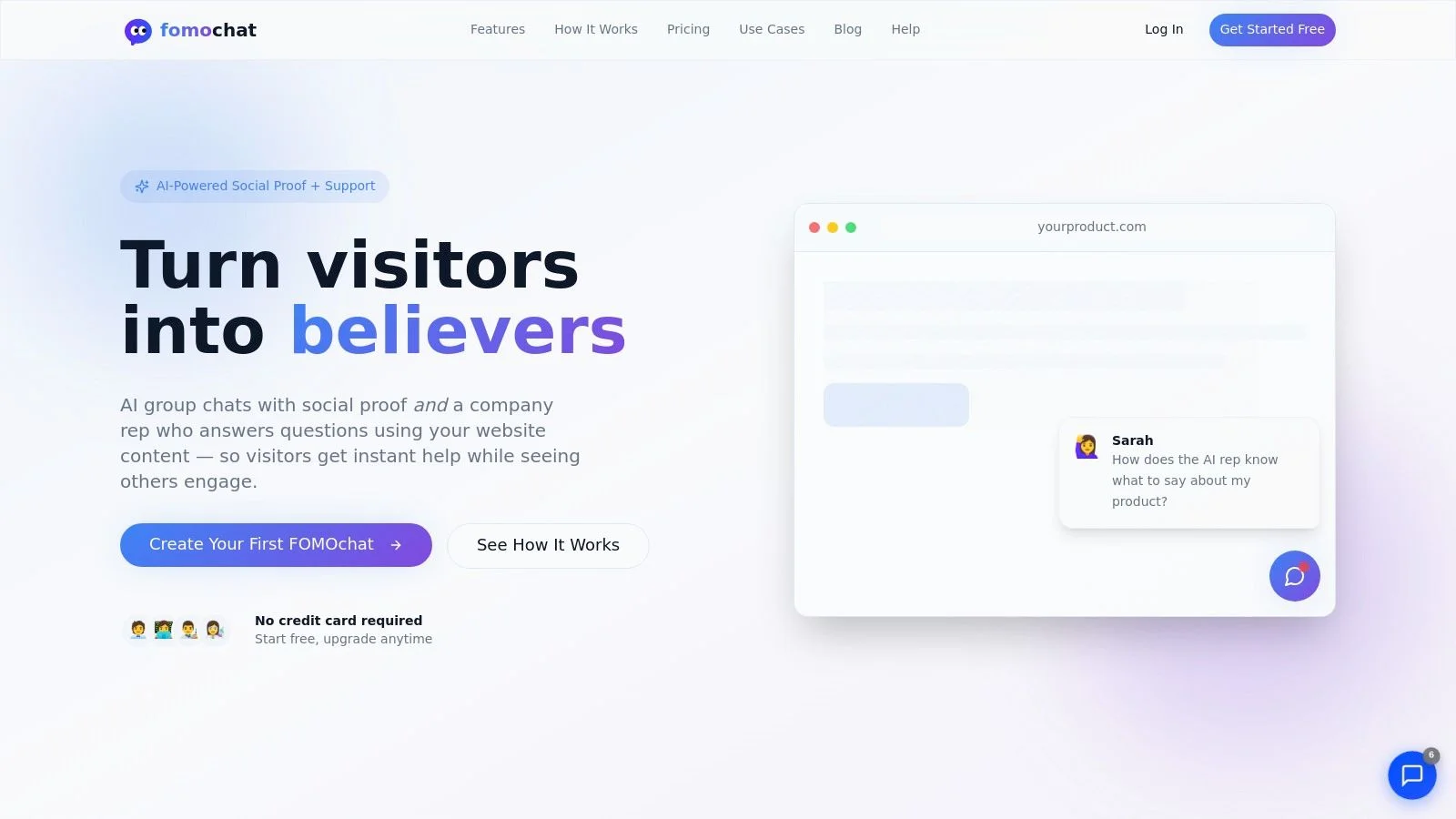
FOMOchat earns its place as our top social proof example by pioneering a new category of dynamic, AI-driven engagement. It moves beyond static testimonials and passive pop-ups, creating an interactive, multi-person chat environment that simulates a live, engaged audience directly on your page. This unique approach combines the credibility of social proof with the utility of an AI support agent, addressing visitor questions in real-time while showcasing peer interest and validation.
The platform's core innovation is its ability to generate realistic, multi-person group conversations. An AI "company rep," trained on your website's content, engages with AI-generated "visitors" who ask common questions, raise objections, and share positive reactions. This creates a powerful and authentic social proof example for new visitors, who see their own concerns being addressed and validated by others, building trust and reducing purchase anxiety.
Strategic Analysis: Key Differentiators
What sets FOMOchat apart is its active, rather than passive, application of social proof. Instead of simply showing that others have purchased, it demonstrates why they are interested and helps visitors overcome the same hurdles.
- Objection Handling at Scale: The AI can be configured to surface and resolve common sales objections (e.g., "Is this worth the price?", "How is this different from competitor X?"). When new visitors see these concerns being confidently addressed in a public-style forum, it preemptively neutralizes their own doubts.
- Video & Webinar Timeline Sync: A standout feature is the ability to sync chat conversations with video timelines. For a webinar or sales video, you can trigger specific reactions, questions, or positive comments at key moments. This simulates a live, interactive event, dramatically boosting engagement and holding viewer attention through critical pitch points.
- Hyper-Relevant, Contextual AI: The AI company rep is trained specifically on your site content. This, combined with customizable guardrails and confidence qualifiers, ensures that the answers are not only accurate but also stay on-brand. This targeted approach provides immediate, reliable support that feels both personal and credible.
Practical Applications & Use Cases
FOMOchat is exceptionally versatile, but it delivers the most significant impact for specific conversion goals. SaaS companies report lifts of over 30% in trial signups by using it to answer feature questions and build trust on pricing pages. Similarly, course creators have seen enrollment boosts by simulating student Q&A sessions, and product launch teams use it to drive urgency and waitlist signups by over 40%. You can learn more about the psychology behind these tactics by exploring what social proof is in marketing and its core principles.
Pricing and Access
FOMOchat offers a scalable pricing model suitable for different stages of growth. A free Preview plan allows users to test the platform with up to 100 lifetime visitors. For a one-time fee of $1, you can launch a "Production" widget that removes branding.
Monthly plans are based on traffic volume and start with:
- Silver: $29/month (500 visitors/month)
- Gold: $49/month (1,500 visitors/month)
- Higher tiers (Platinum, Diamond, Elite, Premier) are available for sites with more traffic, offering advanced analytics to measure conversion lift.
The setup is code-light and designed for marketers, requiring only a small code snippet to be pasted on your site. This accessibility, combined with its powerful blend of AI support and dynamic social proof, makes FOMOchat a definitive and forward-thinking choice for any team focused on conversion rate optimization.
Website: https://fomochat.com
2. UseProof (Proof)
UseProof is a powerful platform that excels at delivering two key conversion-boosting experiences: real-time social proof notifications and advanced on-site personalization. Its flagship product, Pulse, is a classic social proof example that allows marketers to quickly add dynamic notifications to their sites, showcasing recent signups, live visitor counts, and purchase activity to build trust and urgency.

What makes Proof a standout choice is its seamless integration of analytics and testing. Unlike tools that simply display notifications, Proof includes built-in A/B testing and conversion tracking, allowing teams to measure the precise impact of their social proof campaigns. This data-driven approach removes the guesswork, providing clear insights into what resonates with your audience.
Strategic Breakdown & Key Features
Proof's offering is split into two distinct products designed for different levels of marketing maturity.
- Pulse: This is their core social proof tool. It’s incredibly fast to set up (often just a single line of code) and uses proven notification templates like Recent Activity, Live Visitor Count, and Hot Streaks to create an environment of active engagement.
- Experiences: Aimed at advanced CRO teams, this product enables deep website personalization. Marketers can tailor headlines, CTAs, and images based on visitor segments, firmographic data, or on-site behavior, effectively turning the entire website into a dynamic conversion engine.
- A/B Testing & Analytics: Both products come with robust analytics. You can run tests, identify winning variations, and see exactly how many conversions are directly attributable to Proof, which is critical for justifying ROI.
Pricing & Implementation
Proof's pricing is tiered based on unique monthly visitors, making it scalable but potentially costly for very high-traffic sites.
| Plan Tier | Key Focus | Best For |
|---|---|---|
| Pulse | Real-time social proof notifications | Teams wanting a fast, proven way to add urgency and trust. |
| Experiences | Full-site personalization & A/B testing | Mature CRO and demand generation teams with clear segmentation goals. |
The user interface is clean and user-friendly, guiding you through campaign setup with minimal friction. For teams looking for actionable ways to lift conversions, implementing a tool like Proof is a direct strategy. If you want to dive deeper into the tactics behind this, you can learn more about how to increase website conversion rates with a variety of proven on-page elements.
Adapting with FOMOchat
FOMOchat can replicate Proof's core Pulse functionality with its on-page widgets. Configure a "Recent Activity" widget to show real-time signups from a webinar or course. Combine this with the "User Counter" widget to display how many others are currently viewing your offer, effectively recreating the "Live Visitor Count" feature and amplifying the sense of a busy, popular platform.
3. Fomo
Fomo is a highly flexible social proof platform designed for teams that need granular control over how and when notifications appear. While it delivers the classic pop-up notifications showing recent purchases or signups, its real strength lies in its extensive customization rules and powerful integrations. This makes Fomo an excellent social proof example for ecommerce and SaaS businesses with complex user journeys or specific targeting needs.
What sets Fomo apart is its developer-friendly approach and scalability. With full API access, agency-specific dashboards, and the ability to handle massive notification volumes, it caters to high-growth companies that have outgrown simpler tools. The platform empowers marketers to create nuanced social proof campaigns that feel native to the user experience rather than just layered on top.
Strategic Breakdown & Key Features
Fomo’s feature set is built around flexibility, control, and integration, allowing for highly tailored social proof strategies.
- Pop-up & Inline Notifications: Fomo provides both the standard corner pop-ups and inline elements that can be embedded directly into a page. This allows you to show social proof right next to a CTA button or within a pricing section for maximum impact.
- Advanced Display Rules: This is Fomo’s core advantage. You can control notification visibility based on visitor location, page URL, time on site, and even Shopify cart value. This ensures the social proof is always relevant to the user’s context.
- Extensive Integrations & API Access: With over 100 native integrations and a robust API, Fomo can pull data from virtually any source, including CRMs, email platforms, and custom databases, to power your notifications.
- Agency & High-Volume Features: Fomo is built to scale. It offers agency-specific dashboards for managing multiple clients and white-labeling options, making it a go-to for marketing service providers.
Pricing & Implementation
Fomo's pricing is primarily based on notification volume, with higher-tier plans unlocking more advanced features like inline social proof.
| Plan Tier | Key Focus | Best For |
|---|---|---|
| Starter & Essential | Core pop-up notifications & integrations | Small to mid-sized businesses needing classic social proof. |
| Plus & Advanced | High notification volume & inline social proof | Growing ecommerce stores and SaaS companies with advanced funnels. |
The user interface is clean, and setting up integrations is straightforward for most popular platforms. However, getting the most out of its API and custom rules may require some developer assistance. For teams that need precise control over their social proof messaging, Fomo offers an unmatched level of customization.
Adapting with FOMOchat
You can mirror Fomo’s core functionality by using FOMOchat’s on-page widgets with smart display rules. Create a "Recent Purchase" widget and configure it to only appear on product pages for items in a specific category, mimicking Fomo’s page-level targeting. Additionally, use the "Live User Counter" widget but set it to only display when a user has been on your pricing page for more than 30 seconds, creating contextual urgency just as a visitor shows high purchase intent.
4. Nudgify
Nudgify specializes in making social proof accessible and effective through a library of pre-built "nudges." It’s designed to show real-time activity like recent sales, low-stock alerts, and review highlights, making it a powerful social proof example for e-commerce and SaaS sites. The platform's core strength is its simplicity, allowing even non-technical teams to quickly add trust-building elements to their pages.
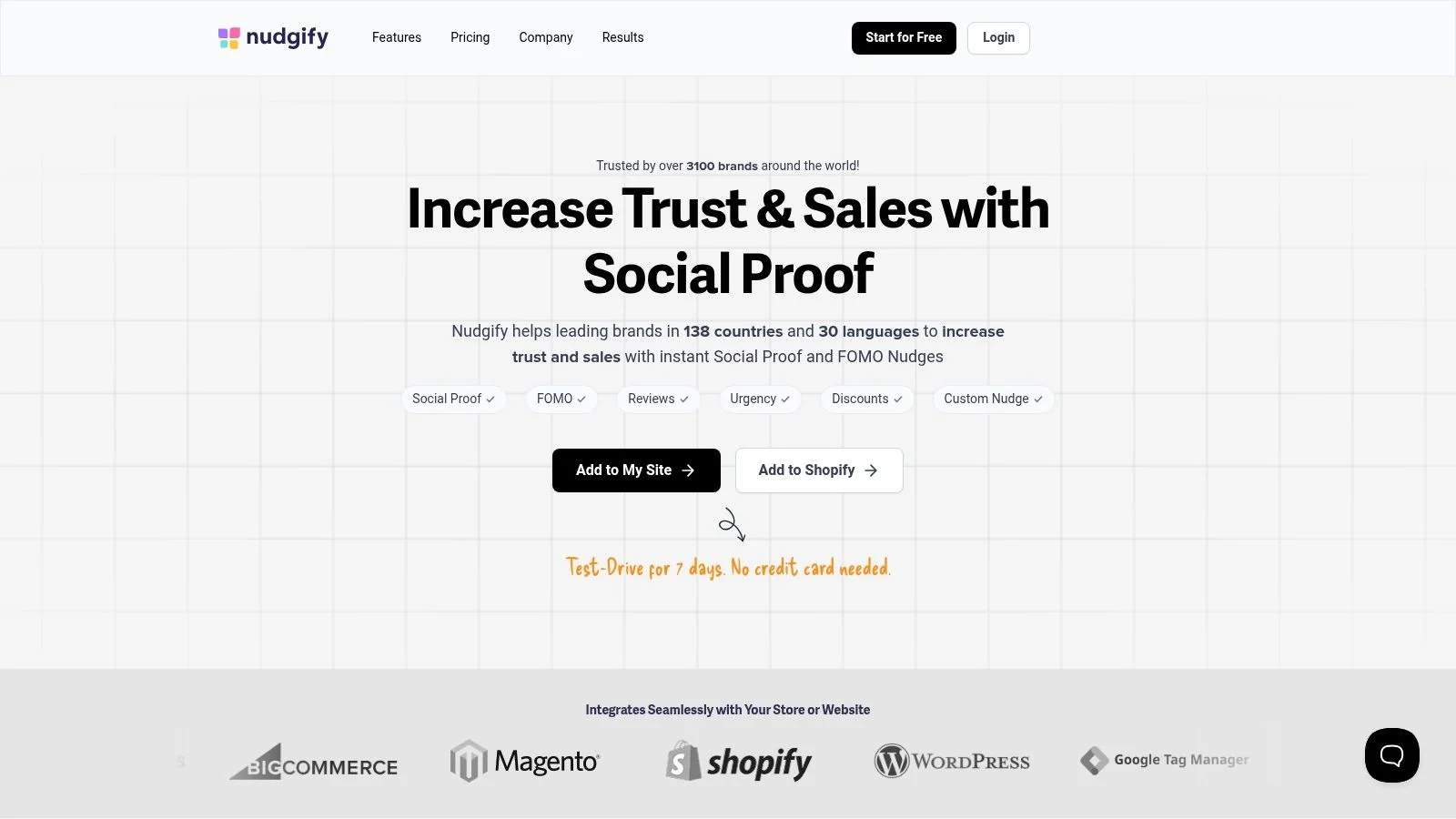
What sets Nudgify apart is its broad library of nudges that go beyond just sales notifications. It includes friction-reduction nudges (e.g., "Free delivery on orders over $50") and urgency nudges (e.g., "Order in the next 15 minutes for same-day dispatch"). This variety allows marketers to deploy targeted psychological triggers at different stages of the customer journey, from building initial trust to closing the final sale.
Strategic Breakdown & Key Features
Nudgify’s approach is centered on an extensive library of notification types that cater to specific conversion goals.
- Social Proof Nudges: These are the classic notifications, including Recent Sales, Popularity (live visitor counts), and Review nudges that integrate with sources like Google, Trustpilot, and Capterra to display real customer feedback.
- FOMO & Urgency Nudges: Designed to combat hesitation, these include Low Stock alerts, Order Soon countdowns, and Selling Fast notifications. They create a sense of scarcity that encourages immediate action.
- Friction-Reduction Nudges: These nudges proactively address common customer concerns. Examples include Free Delivery, Money-Back Guarantee, and Secure Checkout notifications that build confidence and reduce cart abandonment.
- Native Shopify App: For e-commerce stores, Nudgify offers a seamless Shopify integration with a dedicated free plan, making it one of the easiest ways for new merchants to start using social proof.
Pricing & Implementation
Nudgify’s pricing is based on the number of monthly impressions (how many times a nudge is shown), with all plans including unlimited websites and notifications.
| Plan Tier | Key Focus | Best For |
|---|---|---|
| Free | Basic Social Proof Nudges | New Shopify stores or low-traffic sites testing the waters. |
| Plus | More Nudge Types & Styling | Growing businesses needing more customization and urgency features. |
| Pro | Advanced Integrations & A/B Testing | Established e-commerce and SaaS companies focused on optimization. |
The setup process is incredibly straightforward, especially with its Shopify app and integrations for platforms like WordPress and Squarespace. The user interface is clean and guides you through selecting and customizing your nudges, making it a low-friction tool for quick wins.
Adapting with FOMOchat
You can replicate Nudgify’s multi-faceted approach using FOMOchat’s flexible on-page widgets. Create a "Recent Activity" widget to show new signups or purchases, mimicking the Recent Sales nudge. Use a "Custom Message" widget with a countdown timer to create a Low Stock or Order Soon alert. By combining these widgets, you can strategically place different types of social proof and urgency triggers across key pages, just as you would with Nudgify’s library.
5. Senja
Senja specializes in making customer testimonials the star of your marketing. It’s a comprehensive platform designed to help businesses collect, manage, and showcase both text and video testimonials with beautiful, no-code widgets. For SaaS companies and course creators, Senja offers a powerful way to use customer voice as a core social proof example, turning happy users into a primary sales asset.
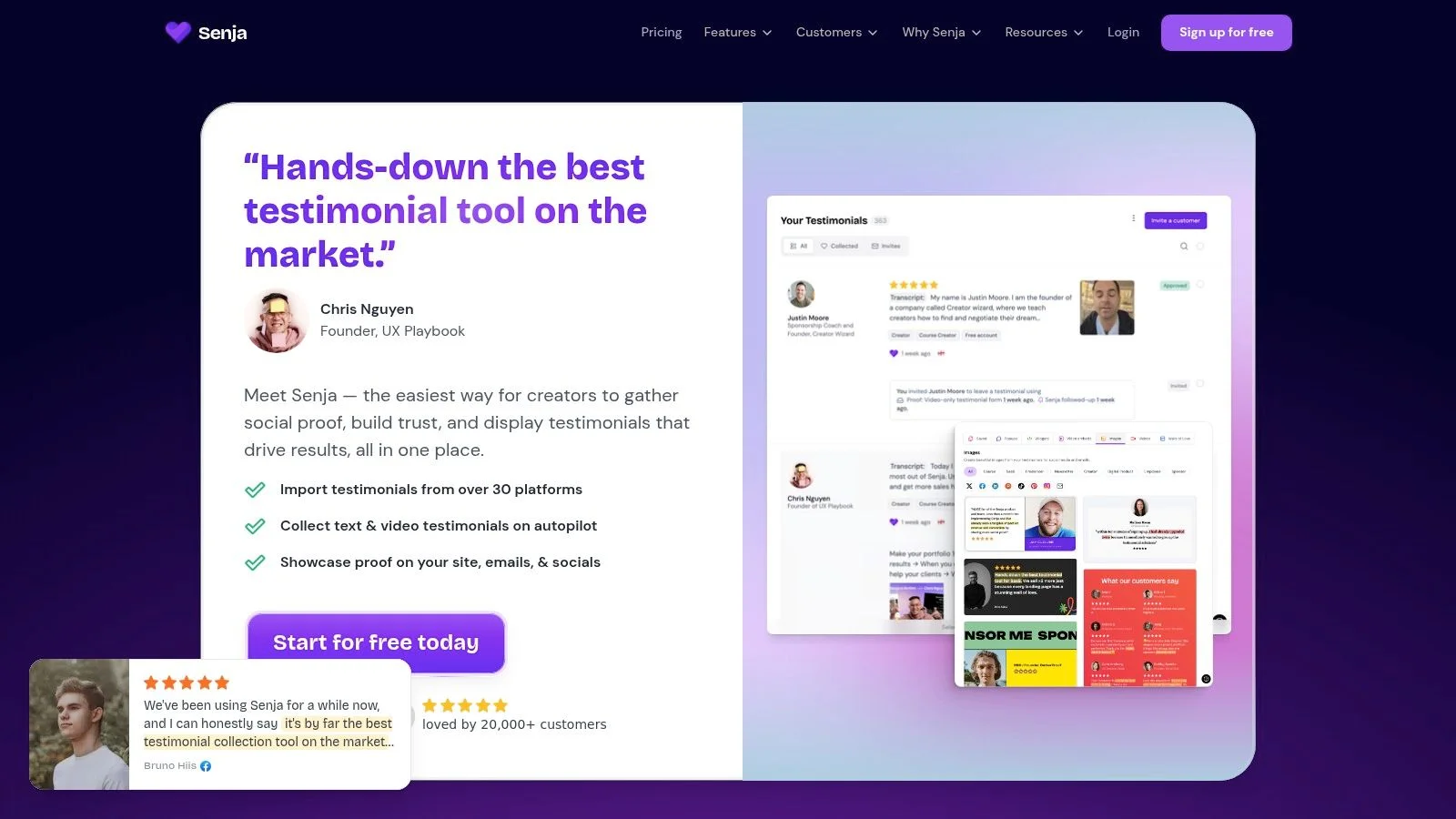
What sets Senja apart is its focus on the entire testimonial lifecycle, from collection to display. The platform simplifies gathering feedback with customizable forms and can import existing reviews from over 18 sources like G2, Capterra, and Twitter. This creates a centralized hub for all your social proof, making it easy to deploy authentic customer stories across your website and marketing funnels.
Strategic Breakdown & Key Features
Senja’s features are built to streamline the process of using customer feedback as a conversion tool.
- Testimonial Collection: Create custom forms to request text or video testimonials. You can automate invites and follow-ups to maximize response rates and import existing social proof from popular third-party review sites.
- Widget & "Wall of Love" Library: Senja provides over 20 embeddable widgets, including carousels, pop-ups, and grids. The "Wall of Love" feature allows you to create a dedicated, shareable page showcasing your best testimonials in an engaging format.
- Management & Analytics: All collected testimonials are stored in a central dashboard. You can tag, search, and filter them to find the perfect quote for any campaign. The platform also provides analytics to track widget views and interactions.
- Video Hosting: A standout feature is the included video hosting, which eliminates the need for a separate service like YouTube or Vimeo to display video testimonials, keeping visitors on your site.
Pricing & Implementation
Senja’s pricing is structured to be accessible, with a generous free tier that makes it easy to start.
| Plan Tier | Key Focus | Best For |
|---|---|---|
| Starter (Free) | Basic collection & display | Solo founders and early-stage projects wanting to test testimonial marketing. |
| Pro | More testimonials, widgets & no branding | Growing businesses needing to scale their social proof efforts professionally. |
| Business | Multiple projects, team seats & API access | Agencies and larger companies managing several brands or products. |
Implementation is incredibly straightforward. You customize your collection forms and display widgets within the Senja dashboard and then simply copy-paste the embed code onto your website. This no-code approach makes it accessible for non-technical team members to manage and update.
Adapting with FOMOchat
You can recreate the testimonial showcase effect of Senja’s widgets using FOMOchat’s features. Use the "Conversation Starter" widget to pose a question like "What's one thing you love about our product?" in a live chat on a thank-you or post-purchase page. When users respond, screenshot their positive replies and manually add them to a "Recent Activity" or custom notification widget, effectively creating a dynamic, real-time testimonial feed that adds authenticity and encourages new customers.
6. Trustpilot (Business)
Trustpilot is one of the most recognized third-party review platforms. Its widespread consumer recognition gives businesses a powerful form of social proof. While anyone can be reviewed, its business plans transform the platform from a passive reputation hub into an active marketing tool. This service is a prime social proof example for brands that need to build credibility through verified, independent customer feedback and showcase it directly on their own websites.
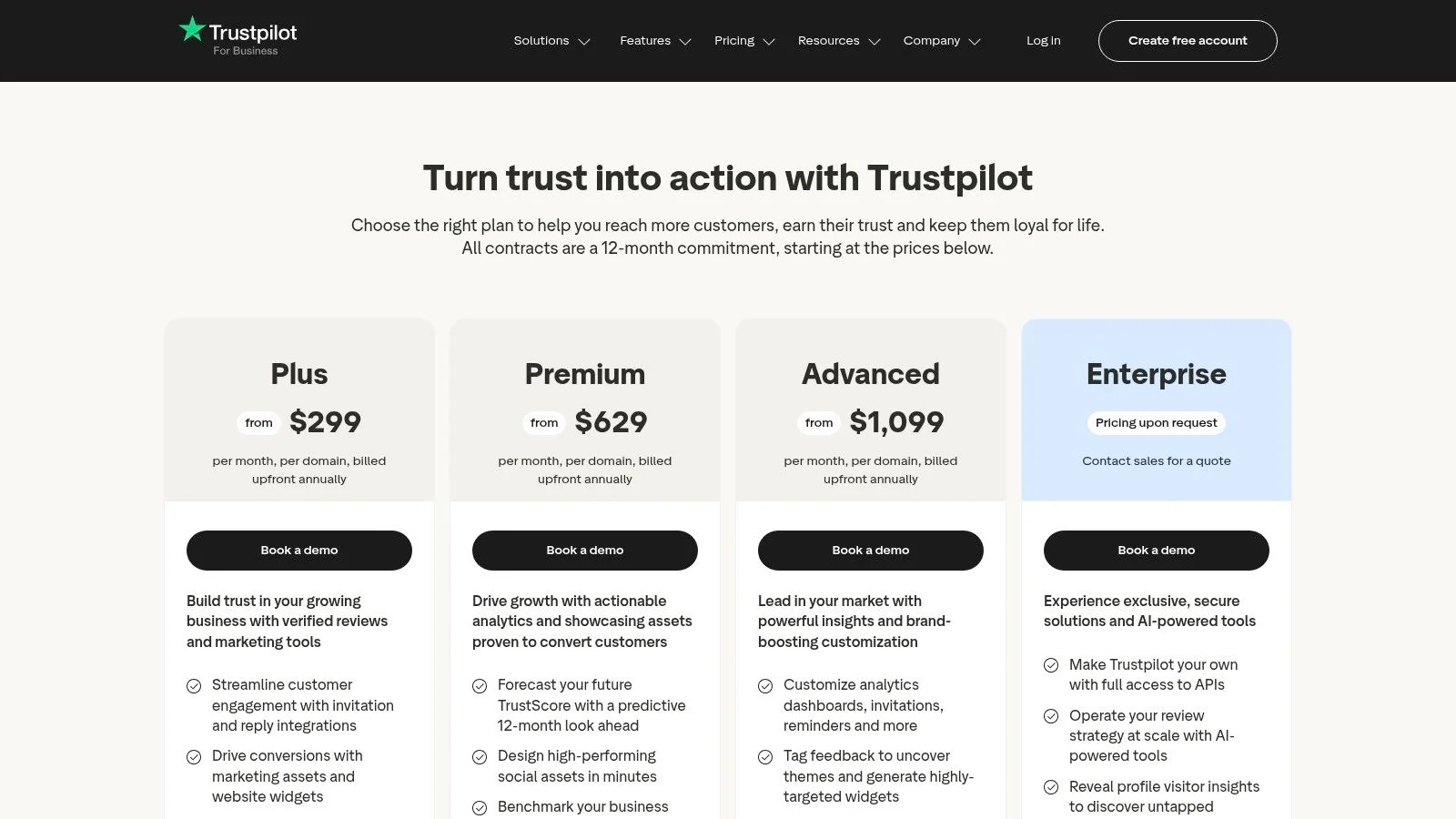
What distinguishes Trustpilot is its authority and brand recognition. Displaying the familiar Trustpilot star rating on a product page or checkout is an instant signal of authenticity that many internally-built testimonial sections cannot replicate. The platform's business tools automate the review collection process, ensuring a steady stream of fresh feedback that keeps social proof current and relevant, which is crucial for maintaining trust over time.
Strategic Breakdown & Key Features
Trustpilot's business offering focuses on systematically collecting, managing, and displaying customer reviews to boost conversions.
- Automated Review Invites: The platform integrates with e-commerce and CRM systems to automatically send review invitations to customers after a purchase or interaction. This systematic approach is key to building a large, representative body of reviews.
- On-site TrustBox Widgets: Businesses can embed a variety of customizable widgets directly on their websites. These can showcase the overall star rating, highlight specific positive reviews, or display a carousel of recent feedback, placing social proof at critical conversion points. For a broader look at what builds trust with new visitors, the guide to symbols of trustworthiness covers the full picture.
- Analytics & Benchmarking: Paid plans provide access to a rich analytics dashboard. Teams can track their review performance, understand customer sentiment trends, and even benchmark their reputation against key competitors to identify strategic advantages.
Pricing & Implementation
Trustpilot's business plans are priced based on features and the scale of review invitations, starting with a free plan for basic profile management and moving to multi-hundred dollar monthly tiers for advanced features.
| Plan Tier | Key Focus | Best For |
|---|---|---|
| Free | Basic profile claiming and organic review management | New businesses wanting to establish a presence on the platform. |
| Standard | Automated review collection and on-site widgets | Growing businesses looking to proactively build and display social proof. |
| Enterprise | Advanced analytics, API access, and custom integrations | Large-scale organizations needing deep customer insights and brand reputation management. |
Implementation is straightforward for the core features, especially the on-site widgets which can often be added with a simple code snippet. While the platform has faced public scrutiny over its moderation practices, its high consumer recognition makes it a powerful asset for conversion lift when managed properly.
Adapting with FOMOchat
While FOMOchat can't replicate a third-party review platform, it can be used to showcase similar social proof from other sources. Use the "Quote" or "Review" widget to manually display standout customer testimonials from sources like G2, Capterra, or even positive tweets. By adding the customer's name and a star rating, you can create a visually similar element that highlights positive feedback directly on your key landing pages, borrowing the high-impact format of a Trustpilot widget.
7. Shopify App Store — Social Proof Category
For e-commerce entrepreneurs, the Shopify App Store is less a single tool and more of a powerful marketplace dedicated to deploying social proof tactics quickly. It’s a vast ecosystem of applications designed specifically for Shopify stores, allowing merchants to implement everything from sales pop-ups and user-generated content (UGC) galleries to review widgets and trust badges with just a few clicks. This makes it a fantastic social proof example of an aggregated platform where merchants can experiment without needing custom development.
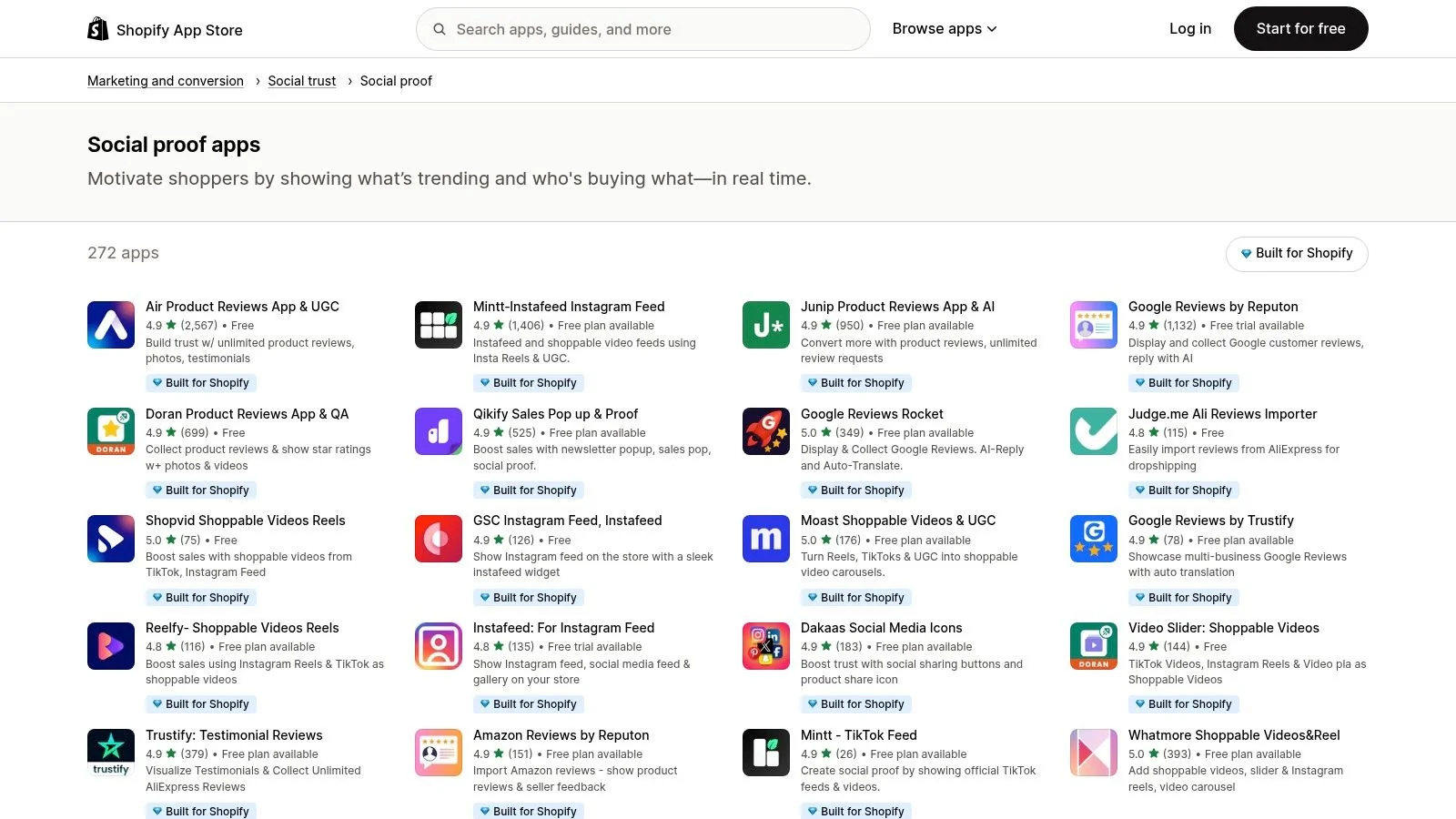
What makes the Shopify App Store stand out is its speed to value and the built-in validation from other merchants. With over 270 apps in the social proof category alone, users can filter by ratings, price, and special Shopify-curated collections to de-risk their selection. This accessibility empowers even non-technical store owners to test sophisticated conversion strategies that were once the domain of large, well-resourced e-commerce teams.
Strategic Breakdown & Key Features
The marketplace's strength lies in its diversity, offering a plug-and-play solution for nearly every type of social proof imaginable.
- Vast App Selection: The store includes apps for every need: sales pop-ups (e.g., "Someone in New York just bought..."), review aggregators (like Yotpo or Loox), UGC galleries for Instagram feeds, visitor counters, and trust badge installers.
- One-Click Installs & Free Trials: Most apps can be installed and tested with a single click, and many offer free plans or trial periods. This allows merchants to experiment with different approaches to see what resonates with their audience before committing financially.
- User Reviews & Curation: Each app is accompanied by detailed reviews and ratings from other Shopify merchants. This transparent feedback loop is a form of social proof itself, guiding users toward high-quality, effective tools and away from those that are buggy or unsupported.
Pricing & Implementation
Pricing is determined by individual app developers, not Shopify, leading to a wide range of models. This includes free, freemium, flat monthly fees, and usage-based tiers.
| App Category | Common Pricing Model | Best For |
|---|---|---|
| Sales Pop-ups | Freemium / Tiered by traffic | Creating urgency and activity on product pages. |
| Reviews & UGC | Tiered by orders or features | Building deep product trust and showcasing authentic customer experiences. |
| Trust Badges | Often Free / One-time fee | Reducing checkout friction and reinforcing security. |
Implementation is famously simple. Finding an app, clicking "Add app," and following the in-app setup guide is often all that's required. For merchants looking to boost sales, using these tools is one of the most direct ways to act on insights about how to improve ecommerce conversion rate.
Adapting with FOMOchat
FOMOchat can be a powerful, all-in-one alternative to installing multiple separate Shopify apps. Instead of one app for pop-ups and another for counters, you can configure FOMOchat's on-page widgets to do both. Use the "Recent Activity" widget to show recent purchases and the "User Counter" widget to display live visitor numbers. This consolidates functionality, reduces potential site bloat from multiple apps, and keeps your social proof strategy managed in one central dashboard.
Top 7 Social Proof Tools Comparison
| Product | Implementation 🔄 (Complexity) | Resource Needs ⚡ (Dev / Cost / Time) | Expected Outcomes 📊 (Impact) | Ideal Use Cases 💡 | Key Advantages ⭐ |
|---|---|---|---|---|---|
| FOMOchat | Low — code‑light embed; persona/config steps | Moderate — setup time for prompts; paid tiers scale with visibility | 📊 High — case lifts cited (+28–52% on examples) | Webinars, launches, SaaS pages, course sales | ⭐ Combines social proof + AI chat; timeline sync; customizable guardrails |
| UseProof (Proof) | Very low — plug‑and‑play notifications | Low→Moderate — visitor‑based pricing can grow with traffic | 📊 Moderate — proven notification patterns; measurable via A/B | Quick social‑proof signals for SaaS/ecommerce; CRO testing | ⭐ Fast setup, built‑in A/B testing and analytics |
| Fomo | Low–Moderate — flexible rule setup for complex displays | Moderate–High — higher tiers for inline widgets and volume | 📊 Moderate–High — scalable notifications for high volume sites | Ecommerce & SaaS with complex funnels; agencies | ⭐ Granular display logic, API access, white‑label options |
| Nudgify | Very low — prebuilt nudges, easy installs (Shopify native) | Low — low entry price; pricing tied to impressions | 📊 Moderate — urgency & nudge patterns increase conversions | Small merchants, non‑technical teams, Shopify stores | ⭐ Large nudge library, translations, straightforward setup |
| Senja | Low — no‑code collection forms and widgets | Low–Moderate — video hosting included; paid tiers for branding/limits | 📊 Moderate — improves testimonial visibility and trust | SaaS and course creators showcasing customer voices | ⭐ Easy testimonial collection, video support, many widget options |
| Trustpilot (Business) | Moderate — integration, invite workflows, moderation | High — business plans are relatively expensive | 📊 High — strong trust lift from verified ratings (consumer‑recognized) | Brands wanting third‑party verified reviews at scale | ⭐ High consumer recognition, analytics, benchmarking |
| Shopify App Store — Social proof category | Varies by app — often one‑click install | Low–Varies — app fees differ; many free trials | 📊 Varies — fastest way to experiment with patterns | Shopify merchants testing multiple social‑proof approaches | ⭐ Wide selection, curated reviews, rapid experimentation |
Choosing Your Social Proof Strategy: The Final Verdict
We've journeyed through a comprehensive catalog of social proof tactics, from the dynamic, AI-powered group conversations of FOMOchat to the foundational trust signals provided by platforms like Trustpilot and Senja. Each social proof example we've dissected offers a unique mechanism to build visitor confidence, but the true power lies not in the tool itself, but in its strategic application.
The core lesson is this: social proof is not a one-size-fits-all solution. A real-time sales notification from Fomo might be the perfect catalyst on a high-traffic e-commerce product page, while a detailed case study snippet is far more persuasive on a B2B service pricing page. Your task is to match the method to the specific moment of hesitation in your customer's journey.
From Examples to a Cohesive Strategy
Simply dropping a widget onto your site is a rookie mistake. A powerful social proof strategy is a thoughtful blend of different signals working in harmony. Think of it as a layered approach to building unshakable trust.
- First, Diagnose Your Leaks: Where are users dropping off? Is it on the pricing page, during checkout, or before they even sign up for a demo? Use your analytics to pinpoint these areas of friction. Low sign-ups for a webinar could signal a lack of perceived value, a perfect place for a timed social proof chat.
- Second, Match the Proof to the Problem: Once you've identified a weak point, select the right type of proof. For complex SaaS products, "wisdom of the experts" in the form of testimonials or industry leader endorsements can overcome technical skepticism. For online courses, "wisdom of the crowd" shown through live enrollment numbers can create urgency and validation.
- Third, Test and Iterate: Never assume you got it right on the first try. A/B test different placements, messaging, and even types of social proof. Does a subtle notification widget outperform an embedded testimonial wall? Only data can give you the definitive answer.
Key Factors in Your Tool Selection
As you evaluate the tools we've covered, from UseProof to the various Shopify apps, consider these critical factors beyond the feature list:
- Audience Engagement Level: Are you looking for passive validation (like a star rating) or active, dynamic engagement? Tools like FOMOchat excel at creating an interactive experience, making them ideal for high-consideration events like product launches and webinars where community and real-time buzz are paramount.
- Implementation Complexity: How much technical overhead are you willing to take on? Some tools require minimal setup with a simple script, while others may demand more integration with your CRM or marketing automation platforms for maximum impact.
- Authenticity and Control: How important is it to curate the displayed proof? While automated feeds provide a constant stream of activity, platforms like Senja give you granular control to highlight your most compelling testimonials. The key is to maintain authenticity while showcasing your best-ever social proof example.
Ultimately, the most effective social proof feels less like a marketing tactic and more like a genuine, helpful guidepost for your prospects. It's the digital equivalent of a friend's recommendation or a busy restaurant that signals quality. By moving from a checklist of widgets to a strategic framework for building trust, you transform passive website visitors into confident, decisive customers. If you want to go deeper on where to place these elements for maximum effect, the guide to landing page optimization best practices is a practical next step.
Ready to move beyond static pop-ups and create a truly dynamic, engaging social proof experience? See how FOMOchat uses AI-powered group chat to simulate live conversations, drive urgency, and answer visitor questions in real-time for your webinars, launches, and courses. Explore the next generation of social proof and turn your audience into an active community at FOMOchat.