
To really create urgency in a sale, you have to give your prospect a compelling reason to act now. It's not about being pushy. It's about tapping into psychological triggers like time-based deadlines ("this offer ends Friday"), scarcity ("only 3 seats left"), and social proof ("25 people just bought this").
The goal is to frame it as a helpful nudge—a way to prevent them from missing out on something great, not just another sales tactic.
Why Urgency Is Your Most Powerful Sales Tool
Let's be real: buyer hesitation is the silent killer of deals. We've all seen it. A prospect is interested, they love the demo, but then they decide to "think about it." In a world with endless options and constant distractions, that "thinking" phase can quickly turn into "analysis paralysis" or just plain forgetting.
This is where a little strategic urgency makes all the difference. It’s not about tricking someone. It’s about giving them a clear, compelling reason to stop wavering and make a confident choice. It answers the one question every prospect has but rarely asks aloud: "Why should I buy this today instead of next week?" Maybe it's a price increase on the horizon, a limited-time bonus, or simply the chance to solve their problem right now.
Overcoming Analysis Paralysis
For those highly analytical buyers, especially in complex spaces like SaaS or online courses, too much information can be completely overwhelming. Urgency cuts through the noise and creates clear boundaries for their decision.
- Time-Bound Offers: A simple deadline, like "early-bird pricing ends at midnight," gives them a concrete finish line. It shifts their focus from endless research to making a timely decision.
- Scarcity of Access: For a new SaaS feature, you could offer "limited access to our new AI beta for the first 100 users." This creates a feeling of exclusivity and immediate value.
- Cohort-Based Enrollment: If you run an online course, opening enrollment only a few times a year is a natural and powerful form of urgency. People know if they don't act, they'll be waiting months for the next chance.
The point of urgency isn't to force a sale. It's to shorten the decision-making cycle. By giving people a logical reason to act, you help them move from just thinking about it to actually buying before a competitor swoops in or they simply lose interest.
The Undeniable Proof in Numbers
The power of urgency isn't just a theory; you can see it in the data. Take SaaS sales, for example. When you weave in social proof, you tap directly into FOMO and create urgency naturally. It's no surprise that referral channels, which are built on social proof, have an incredible 25.56% conversion rate. That absolutely crushes cold calling's measly 9.38%.
This shows just how much seeing others take action creates an immediate need to get in on it. For B2B tech, where conversion rates can hover around a sluggish 9.39%, adding social proof can help you close deals up to 2.7x faster. You can dig into more industry-specific data to see just how big an impact this can have.
The numbers make it crystal clear: urgency is a non-negotiable part of modern sales. It’s what drives momentum. To really master the psychology behind this, check out this fantastic guide on how to create urgency in sales.
Using tools that show real-time activity—like recent sign-ups or popular features—makes this whole process feel authentic. If you're curious about how that works in practice, you might be interested in this guide that explains what is FOMOchat. Once you get these principles down, you'll start turning hesitation into action and stalled deals into closed wins.
If you want to create real urgency, you have to do more than just slap a "Buy Now!" button on your page. It's about tapping into the psychological drivers that push people to make a decision. These aren't just sneaky tricks; they’re ways to help a prospect who's on the fence understand why waiting might not be in their best interest.
When you get right down to it, all effective urgency tactics rely on one of three core triggers.
I love this simple flowchart because it perfectly illustrates the moment of decision. If a buyer is hesitating, that’s your cue to introduce a little strategic urgency to get them moving again.
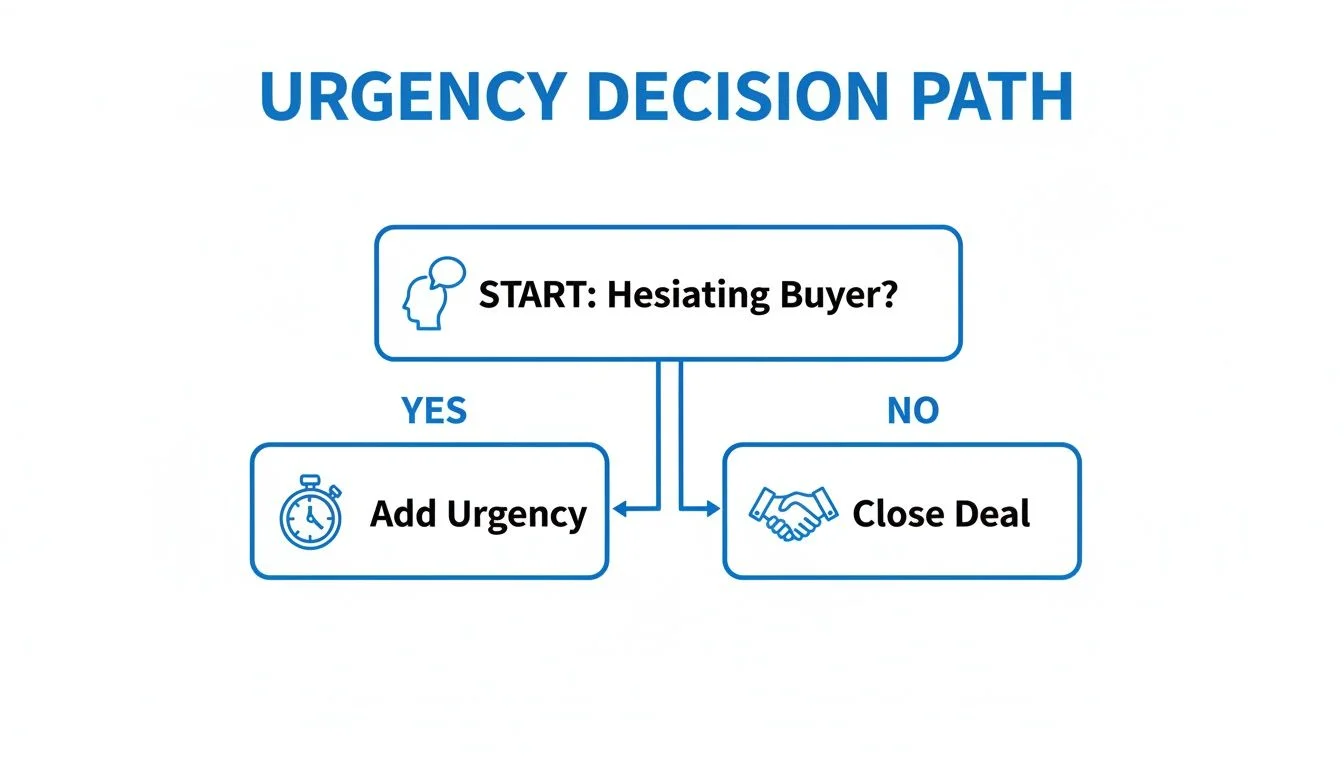
If the path to closing is clear, great. But if not, you need to pull the right lever to overcome that inertia. Let's break down the three you have at your disposal.
Scarcity: The Power of Limited Quantity
We’re all wired to place a higher value on things that are in short supply. It’s a simple human truth. Scarcity signals exclusivity and quality—if something is hard to get, our brains automatically assume it must be good.
The absolute golden rule here is to use genuine scarcity. If you claim only "5 seats left" for a webinar but then let 500 people in, your credibility is shot. Ground your scarcity in real-world, believable constraints.
Here’s how that looks in practice:
- SaaS Beta Access: When launching a new feature, try offering "limited beta access for the first 200 users." This creates a natural race to get in and gives you a focused group for valuable early feedback.
- Course Creator Bonuses: Don't just limit course enrollment. Offer a bonus that is legitimately scarce. For example: "The first 50 students get a free 1-on-1 strategy call with me." Your personal time is a finite, high-value resource.
- Physical or D2C Products: This is where scarcity is most obvious. Simply showing real-time inventory like "Only 7 left in stock" on a product page is one of the most effective conversion boosters there is.
Deadlines: The Motivation of Limited Time
While scarcity is about how many are available, deadlines are about how long they're available. A clear deadline forces a decision by creating a definitive end point. Without one, a prospect’s default action is to wait. With one, the default becomes making a choice.
The data backs this up. Emails with urgent subject lines can see up to a 22% higher open rate. People are programmed to pay attention when time is a factor.
Time-based urgency turns procrastination into a real cost. It answers the question "Why should I buy this now?" by showing them exactly what they'll lose by waiting—whether it's a discount, a bonus, or access itself.
Get specific. "Offer ends soon" is weak. "Early-bird pricing for the Growth Marketing Summit ends this Friday at 11:59 PM EST" is strong. That level of detail makes the deadline feel real and unavoidable.
A countdown timer is the ultimate visual for a deadline. Watching those numbers tick down on a checkout page or webinar sign-up form adds a tangible pressure that plain text just can’t replicate.
Social Proof: The Fear of Being Left Behind
You could argue that social proof is the most authentic form of urgency because it comes from the actions of other people. It plugs directly into the Fear of Missing Out (FOMO). When we see others buying, signing up, or getting results, it validates our own interest and creates a powerful pull to join the crowd.
This works especially well for more analytical buyers who look for external validation before they commit. Seeing that 47 other people have already enrolled in your course immediately lowers their sense of risk.
A few effective ways to use social proof:
- Real-Time Notifications: Tools that show pop-ups like "Someone from Dallas, TX just signed up for the Pro Plan" make your website feel busy and alive. Fomo and Proof are popular tools for this.
- Webinar Attendee Counts: Displaying "850+ people are registered" on a webinar signup page is an instant signal of popularity and value.
- Highlighting Popularity: On a pricing page, a simple tag like "Most Popular" on one of your plans uses the wisdom of the crowd to guide new users toward a specific choice.
To help you decide which trigger to use and when, here’s a quick breakdown.
Choosing the Right Urgency Trigger for Your Offer
| Urgency Trigger | Best For | Example Message | Primary Channel |
|---|---|---|---|
| Scarcity | Limited-run products, 1-on-1 services, exclusive beta programs, or high-value bonuses. | "Only 15 spots left for our hands-on workshop." | Product Pages, Email |
| Deadlines | Sales promotions, product launches, early-bird pricing, or seasonal offers. | "Our 30% off launch discount ends Friday at midnight." | Landing Pages, Email, Banners |
| Social Proof | SaaS signups, course enrollments, webinar registrations, or any high-volume offer. | "2,147 marketers have already joined. Don't miss out!" | Website Pop-ups, Social Media |
Each of these triggers works a little differently. Scarcity speaks to value, deadlines demand action, and social proof builds confidence. By understanding all three, you can craft compelling and ethical campaigns that give your prospects the nudge they need to act now.
How to Write Sales Copy That Creates Real Urgency
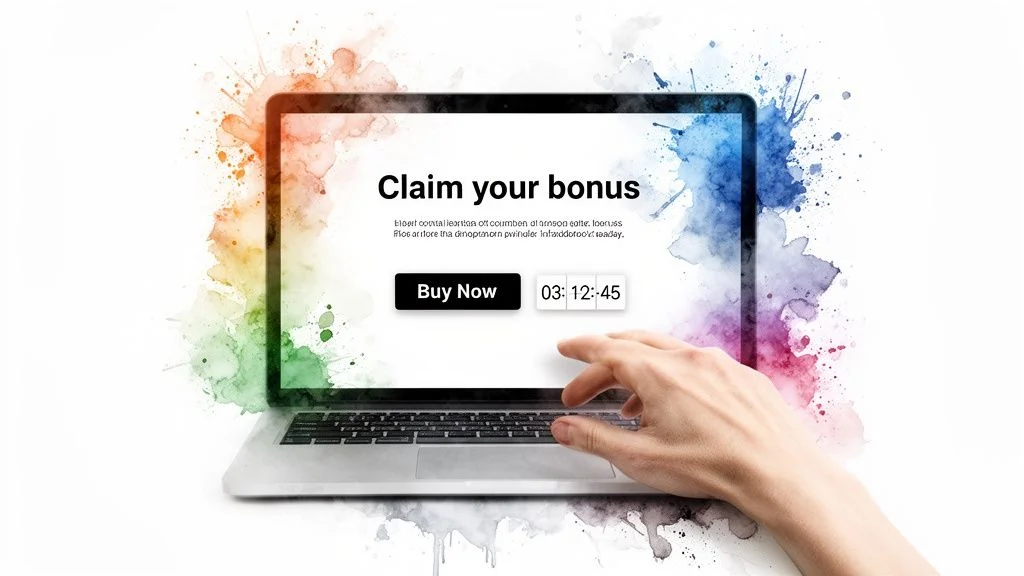
Think of psychological triggers like scarcity and deadlines as the engine for your sales strategy. But it's your copy—the actual words you use—that acts as the fuel. The right phrasing can turn a hesitant "maybe" into an enthusiastic "yes, now!" The wrong words? They can make you sound pushy, desperate, or just plain untrustworthy.
Good urgency copy isn’t about shouting with exclamation points or using all caps. It’s about being clear, specific, and laser-focused on value. It’s the difference between a generic “Buy Now” button and a compelling reason to act right now.
Use Words That Demand a Decision
When you're trying to nudge someone to make a move, weak and vague language is your enemy. Phrases like "ending soon" just don't have any teeth because there's no concrete endpoint. You need to use words that feel final and active.
Instead of soft suggestions, make firm statements.
- Swap "Ending Soon" for "Last Chance" or "Final Hours."
- Change "Sale" to "Offer Expires Tonight."
- Replace "Available for a short time" with "Gone for good after Friday."
These phrases cut through the noise. They don't just hint at a deadline; they declare it, leaving no room for interpretation. This clarity forces the customer to make a conscious choice instead of just putting it off for later.
Frame the Stakes: What They Gain vs. What They Lose
The way you frame your offer can completely change how people react. You have two primary angles: focusing on what they gain by acting now (positive framing) or what they stand to lose by waiting (negative framing).
Positive Framing (Gain-Oriented): This is all about the reward. You're encouraging people to grab a great deal before it’s gone. It's motivating and works great for audiences driven by achievement.
- "Claim your bonus before it expires."
- "Get your early-bird discount now."
- "Secure your spot to join the workshop."
Negative Framing (Loss Aversion): This taps into a powerful psychological quirk—we often fear losing something more than we value gaining something. Research shows that highlighting a potential loss can be a much stronger motivator.
- "Don't miss out on the 50% discount."
- "You'll lose access to the bonus modules after midnight."
- "Avoid the price increase—lock in your rate today."
So, which one is better? The only real answer comes from testing. I generally find that negative framing creates a stronger jolt of urgency, but positive framing can feel more encouraging and on-brand for some businesses. Try both and see what your audience responds to.
Key Takeaway: The goal is to make waiting feel like an active choice to miss out. Whether you frame it as a missed opportunity or an outright loss, the copy has to make the consequences of inaction crystal clear.
Back It Up with Visuals
Words are great, but they're even better when you back them up with visual proof. Visual elements make abstract ideas like deadlines or limited stock feel real, tangible, and immediate.
1. Countdown Timers: Nothing says "time is running out" like a ticking clock. A countdown timer on a product page, checkout, or in an email adds a tangible pressure that plain text just can't match. It makes the deadline impossible to ignore and can give your click-through rates a serious boost.
2. Dynamic Stock Levels: If you're selling physical products or have a limited number of seats for an event, show it. A simple text update like "Only 3 left in stock!" or "Just 2 spots remaining!" transforms scarcity from a vague idea into a hard fact. Just make sure it’s honest and reflects real-time numbers.
3. Smart UI Choices: Small design details can have a big impact. Using a high-contrast color like red or orange for a call-to-action button draws the eye, while adding a "Most Popular" banner to a pricing plan uses social proof to guide choices. You can dive deeper into these kinds of tweaks by exploring options for customizing widget appearance to fit your brand.
When you combine sharp, direct copy with these visual helpers, you create a powerful narrative that doesn't just tell people to act now—it shows them exactly why they should.
Weaving Urgency Through Your Sales Funnel
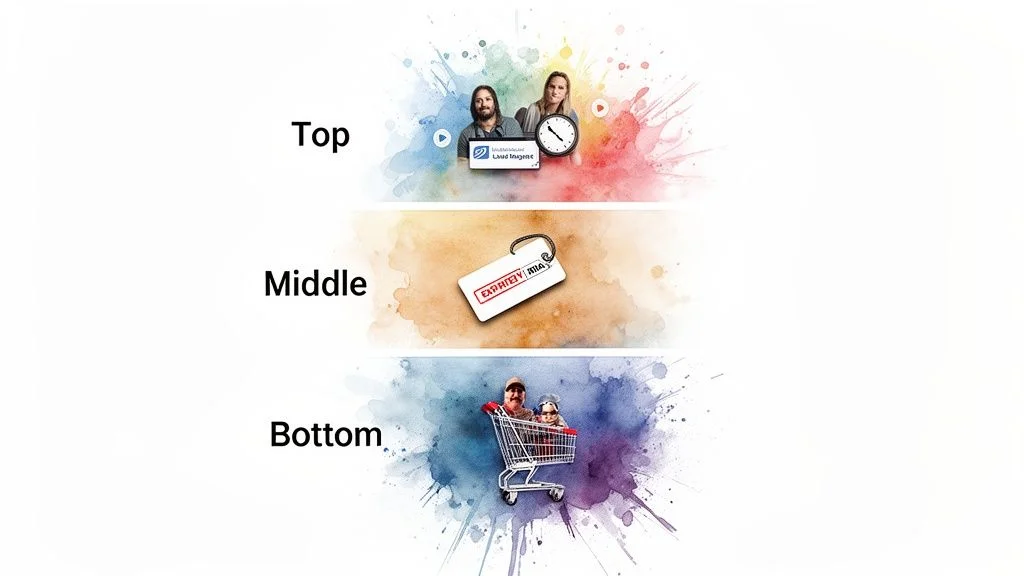
True sales urgency isn't a last-ditch effort you throw at the checkout page. It’s a subtle thread you weave through the entire customer journey. When done right, a well-timed nudge can turn a casual browser into a committed buyer.
Think about it like dating. You wouldn't propose on the first date, right? In the same way, hitting a first-time visitor with a "last chance" discount feels pushy and out of place. The real art is in matching the right kind of urgency to where your prospect is in their buying journey.
Top of the Funnel: Sparking Awareness and Interest
At the top of the funnel (TOFU), your main job is to get noticed and turn visitors into leads. You aren't trying to close a sale yet. The urgency here should be light and inviting, centered around a valuable trade.
- Limited-Time Lead Magnets: Don’t just offer a standard ebook. Frame it as something special, like a "free marketing plan template, available for download this week only." This simple twist encourages people to sign up now.
- Webinar Registration Deadlines: Create a sense of occasion for your live events. "Register by Friday to secure your spot and get the pre-webinar workbook" gives people a clear reason to act instead of putting it off.
At this early stage, you're not selling a product; you're selling the next step. You’re giving them a small, time-sensitive piece of value in exchange for their email address and attention.
Middle of the Funnel: Driving Consideration and Evaluation
Once someone is in your funnel, they're actively weighing their options. This is where you can gently introduce the cost of not acting. You want to shift them from just thinking about it to making a decision.
A SaaS company, for example, can make a trial feel more valuable. Instead of a generic "Start your 14-day free trial," try something like, "Activate your 14-day trial now to lock in our current pricing." Suddenly, starting the trial is tied to a real financial benefit, making it a more pressing choice.
A fantastic tactic for the middle of the funnel is showing momentum with social proof. Displaying real-time notifications like "25 people just enrolled in this course" or "Someone from New York just started a trial" creates a natural sense of FOMO. It tells prospects, "Hey, other people like me are moving forward," which validates their interest.
Tools like FOMOchat are built specifically for this. They can showcase recent sign-ups or highlight popular questions from a live demo, making the urgency feel helpful, not forced. If you're looking to implement this, you can learn how to create your first FOMOchat and see how it might fit into your own strategy.
Bottom of the Funnel: Closing the Deal
At the bottom of the funnel (BOFU), your prospect is on the brink of buying. They’ve shown clear intent, and now they just need a final, compelling reason to click "purchase." This is where you can be your most direct.
Proven tactics for this final push include:
- Cart Abandonment Offers: If someone leaves items in their cart, send a follow-up email with a tight deadline. "Complete your purchase in the next 3 hours and get 15% off" can be incredibly effective.
- Checkout Bonuses: Add a little something extra right on the checkout page. A message like, "Bonus: Complete your order now to get our advanced strategy guide for free," adds instant value and tips the scales.
- Exit-Intent Popups: To catch those last-minute hesitations, you can use tools like well-timed exit-intent popups to present a final, irresistible offer just as a user is about to leave.
By thoughtfully placing these triggers, you create a natural and logical path that guides people from initial curiosity to a confident purchase. Every step feels like the right one, making the decision to act now seem like the smartest choice they can make.
How to Keep Your Urgency Tactics Ethical and Effective
Urgency is a fantastic tool for moving customers to action, but it's a double-edged sword. There’s a razor-thin line between a helpful nudge and a manipulative shove. Get it wrong, and you don’t just lose a sale—you can torpedo customer trust for good. For a primer on the credibility that makes urgency land well, see our guide on how to build trust with customers.
The whole game is about authenticity. Deceptive tricks like fake scarcity or countdown timers that magically reset on a page refresh? Buyers are savvier than ever and can smell a gimmick a mile away. Once they sense you're being dishonest, their trust in your entire offer evaporates.
Keep It Real: Uphold Transparency and Honesty
The most powerful urgency is real urgency. Your job is to give customers a genuine, logical reason to act now. When you're straight with them, urgency feels like helpful guidance, not a sleazy sales pitch.
To build and maintain that credibility, stick to these non-negotiables:
- Use Real Limits: If you say, “Only 10 spots left,” there had better be just ten spots. Actual inventory levels and capacity constraints are your most potent—and honest—tools.
- Honor Your Deadlines: When a sale ends, it ends. Period. If you keep extending a “limited-time” offer, you’re just training your customers to ignore your deadlines completely.
- Explain the ‘Why’: Don't just announce a deadline; give it context. For example, "This introductory price ends Friday because we're rolling out a new feature set next week." This makes the deadline feel fair and logical, not just a random pressure tactic.
An ethical approach isn't just about what you don't do (like lie). It's about proactively building confidence. When customers understand the real reason for the urgency, they feel respected and can make a decision they feel good about.
Use Data to Build Confidence, Not Just Pressure
Instead of manufacturing pressure out of thin air, you can use authentic data to create a natural pull. This approach does more than just encourage action; it builds a powerful layer of social proof that boosts buyer confidence.
Think about it. Seeing a real-time notification like, "Someone from Austin, TX just enrolled" makes your offer feel alive and credible. It taps into FOMO by showing prospects that other people are jumping on board, which validates their own interest and makes them want to join in.
You can also show how many people are looking at a product right now or how many have bought it recently. This kind of data provides real-time social proof that can be far more convincing than a generic "limited-time offer" banner. Plus, it gives you valuable insights. For more on this, check out our guide on collecting visitor information the right way.
Test, Refine, and Test Again
Finally, never guess what works. The only way to know for sure if your urgency tactics are hitting the mark—without alienating people—is to test them. This is where A/B testing becomes your best friend.
Start with a clear question you want to answer. For instance, you could test:
- Does a countdown timer on our pricing page convert better than a simple text banner announcing the deadline?
- Does scarcity messaging like "Only 15 spots left" outperform a time-based message like "Offer ends in 48 hours"?
Run these tests by showing different versions of your page to different segments of your audience. Let the data tell you what actually resonates. This process moves you from guesswork to a strategy driven by real customer behavior, helping you find that sweet spot between creating urgency and maintaining trust.
Common Questions About Creating Urgency in Sales
Even the best-laid plans run into questions, especially when you start creating urgency in your sales process. Let's tackle some of the most common ones I hear so you can move forward confidently and ethically.
Can I Create Urgency for a Digital Product?
I see this question all the time. After all, how can you have scarcity when your inventory is infinite? When you're selling software or an online course, you can't just say "Only 5 left!" So, you have to get creative with controlled access or time-based incentives.
For example, a lot of course creators have found success by ditching the "always open" model. Instead, they open enrollment in cohorts for just a few weeks at a time. This creates a genuine deadline. If someone misses the window, they really do have to wait for the next launch.
You can also attach a bonus that is genuinely limited.
- Offer a one-on-one coaching call for the first 50 buyers.
- Toss in an exclusive resource or bonus module for anyone who signs up in the first 48 hours.
And of course, there’s always time-sensitive pricing. An "early-bird discount" that expires on a specific date gives people a logical, non-sleazy reason to buy now. These aren't fake constraints; they are real business decisions that motivate people to act.
What Is the Difference Between Urgency and Pushiness?
The line between helpful urgency and aggressive pushiness comes down to one thing: authenticity.
Pushiness feels manipulative. It’s self-serving, like a salesperson shouting, "You need to buy this today so I can hit my quota!" It’s all about creating pressure, which just makes people want to run in the other direction.
Ethical urgency, on the other hand, is all about the customer. It’s transparent and focuses on communicating a real-world benefit or a real constraint to the buyer.
The goal of ethical urgency is to help customers make a timely decision they feel good about. Pushiness is about pressuring them into a decision they might regret. Think of it as helpful guidance, not strong-arming.
Here’s the difference in practice:
- Pushy: "You need to buy this today."
- Urgent: "Just a heads-up, the 20% discount ends Friday, and I wanted to make sure you got the best price."
One is a demand. The other is a helpful reminder. Good urgency builds trust and gives your customer the clarity they need to make a confident decision.
What Is the Best Way to Test Urgency Tactics?
Stop guessing and start A/B testing. Seriously. The only way to know what really moves the needle with your audience is to let the data tell you.
Start by forming a clear hypothesis you want to test. For example, you might believe that a countdown timer on your checkout page will lead to more completed sales.
Your hypothesis could be: "Adding a countdown timer to our checkout page will increase completed purchases more than our current static text banner."
From there, you’d use testing software to show 50% of your visitors the countdown timer (Version A) and the other 50% the static banner (Version B). Once you have enough data, you can see which version led to a statistically significant lift in conversions. For more proven tactics beyond urgency, see our full guide on how to increase landing page conversions.
You can A/B test just about anything:
- Messaging: "Only 10 left!" vs. "Offer ends in 24 hours"
- Discounts: A 20% discount vs. a "Buy One, Get One" deal
- CTAs: "Claim Your Spot" vs. "Register Now"
Letting the data decide is the smartest way to refine your approach and find out exactly what makes your audience tick.
What Are the Biggest Mistakes to Avoid?
There are a few classic mistakes I see people make that can completely backfire and hurt their brand's credibility.
The absolute worst thing you can do is fake it. We’ve all seen it: the "limited time" offer that’s been running for six months or the countdown timer that mysteriously resets every time you refresh the page. Customers are smart. They will notice, and you will instantly lose all their trust.
Another common blunder is overdoing it. If every single email and social post is screaming "LAST CHANCE!," people will tune you out. This is called urgency fatigue, and it makes your real deadlines meaningless. Save urgency for the campaigns where it actually counts.
Finally, don’t be vague. A CTA like "Sale ending soon" is weak. It’s forgettable and doesn’t create any real pull. Be specific. "Save 30% until midnight EST" is believable, actionable, and gives someone a concrete reason to make a decision now.
Ready to turn on-page curiosity into real-time proof? FOMOchat combines AI-driven support with live social proof to help you create authentic urgency and boost conversions. See how it works.