
In a crowded digital marketplace, trust is the ultimate currency. Standard, static testimonials are quickly losing their impact because modern buyers expect dynamic, contextual proof that speaks directly to their specific needs and hesitations. Simply displaying a star rating is no longer enough to build the deep credibility required to drive conversions.
This is where strategic social proof comes in. (For a broader overview, see our guide on social proof in marketing.) It’s about moving beyond basic praise and transforming customer feedback into powerful conversion assets. To truly use social proof, understanding how to showcase authentic testimonials and build trust through positive experiences is key, often starting with strong customer reviews. This article provides a blueprint for doing just that.
We will deconstruct eight powerful 5 star review examples, complete with templates and deep-dive analysis tailored for different business goals. You won't find generic success stories here. Instead, you'll get actionable frameworks for various contexts, including:
- SaaS product pages
- Online course enrollments
- Product launch campaigns
- Webinar registrations
Each example is broken down into its core components, revealing the specific tactics that make it effective. We’ll explore how to handle objections, choose the right tone, and maintain authenticity. We will also touch on how to integrate these high-impact reviews into tools like chat widgets, turning passive testimonials into active, trust-building conversations that guide potential customers toward a confident purchase decision. This guide gives you replicable strategies to generate and deploy social proof that genuinely works. For broader context, see our guide on how to increase website conversion rate.
1. SaaS Product Page Conversion Review Template
A common challenge for SaaS companies is conveying trust and answering complex questions directly on a product page. This 5-star review example isn't a static quote; it's a dynamic, conversational template deployed through an AI chat widget like FOMOchat. It works by showcasing simulated, yet realistic, conversations where prospects ask tough questions and receive satisfying answers, building confidence for new visitors.
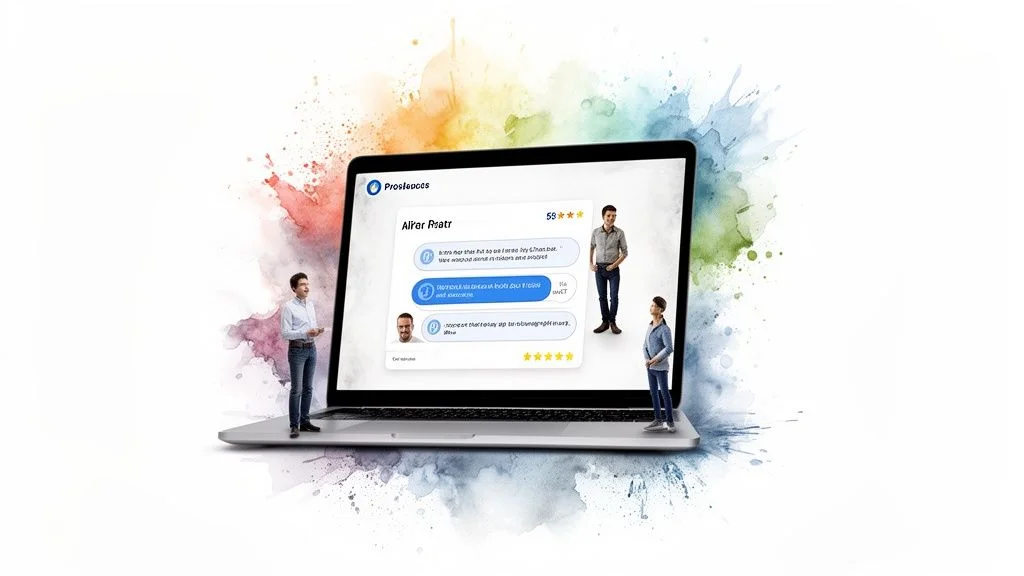
This method turns passive social proof into an active conversion tool. Instead of just reading that someone likes a product, a potential customer sees a peer ask the exact same question they were thinking. This approach is highly effective for B2B tools where technical validation and security are major buying considerations.
Strategic Breakdown
This template directly addresses the "consideration" phase of the buyer's journey. It moves beyond generic praise to tackle specific objections and feature questions head-on.
Key Insight: Prospects trust other prospects. By showing a conversation where a user persona (like a "startup founder" or "enterprise developer") gets their specific question answered, you build targeted trust and reduce friction.
- Objection Handling: The review anticipates and neutralizes common sales blockers, such as pricing confusion, security concerns, or integration complexities.
- Demonstrates Value: It shows the product's benefits in a real-world context, rather than just listing features. For example, seeing a chat about integration capabilities is more powerful than a simple bullet point.
- Builds Confidence: Visible engagement from others signals that the product is active and popular, encouraging new visitors to sign up for a trial or demo.
Actionable Tips for Implementation
To make these 5-star review examples work, the content must be authentic and genuinely helpful.
- Train Your AI: Feed your chat AI with content from FAQs, pricing pages, and common support ticket themes to ensure its answers are accurate and useful.
- Use User Personas: Feature conversations from different user types (e.g., SMB, Enterprise). An enterprise lead has different security questions than a small business owner.
- Focus on ROI: Include questions about return on investment, setup time, and efficiency gains.
- Analyze and Update: Use your chat data to see which conversations perform best. Dive into the FOMOchat reports to see what questions are being asked, and update your templates quarterly. You can explore how to track these results by checking out the guide to the analytics dashboard.
2. Online Course Enrollment Review Template
For online course creators, hesitation is the biggest conversion killer. Prospective students worry about time commitment, prerequisite skills, and whether the course will deliver its promised outcome. This 5-star review example tackles these fears directly by using a chat widget like FOMOchat to showcase simulated dialogues between interested students and successful alumni. It turns passive testimonials into active, reassuring conversations.
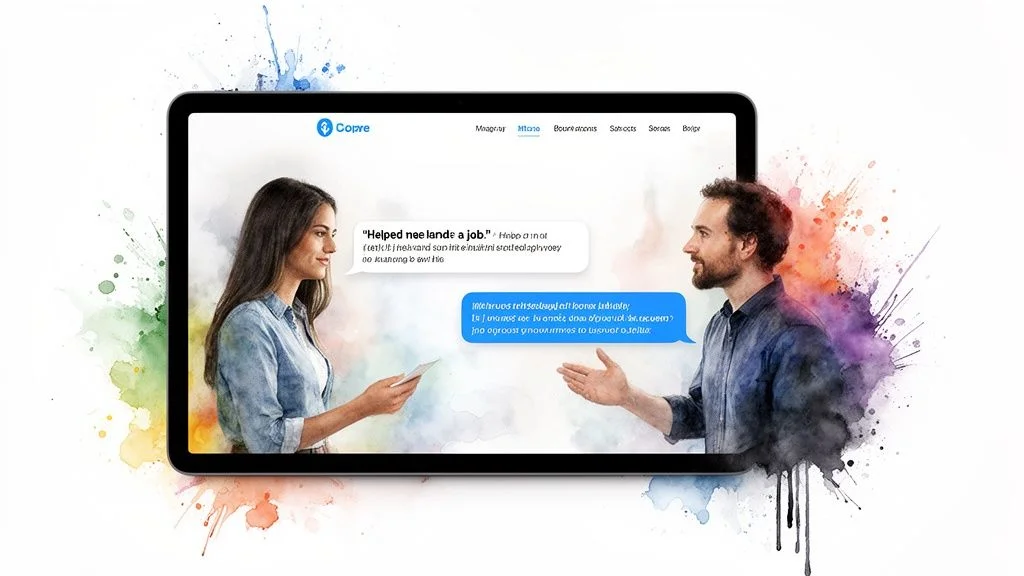
This strategy moves beyond a static "wall of love" on a sales page. Instead of just reading a generic review, a potential student sees a peer ask, "I work full-time, can I realistically finish this coding bootcamp in 3 months?" and receives a detailed answer from a graduate who was in the same situation. This dynamic approach is used by platforms like Coursera and cohort-based course creators to clarify value and reduce enrollment friction.
Strategic Breakdown
This review template targets prospective students in the final decision-making stage. It addresses specific, personal anxieties that a standard FAQ page often fails to resolve, making it a powerful tool for generating authentic 5 star review examples.
Key Insight: Student success stories are most convincing when they answer a direct question. By showing a conversation where a past student confirms the course's value or clarifies the time investment, you build a powerful sense of "this is for me" in new prospects.
- Outcome Validation: The review directly connects course features to real-world results. A dialogue showing a graduate landing a job is far more persuasive than a simple "job placement support" bullet point.
- Reduces Uncertainty: It answers critical questions about prerequisites, workload, and refund policies in a conversational, low-pressure format.
- Builds Instructor Authority: Conversations can include snippets about the instructor's expertise or background, building trust in the person behind the content.
Actionable Tips for Implementation
To create believable and effective conversational reviews, the content must reflect genuine student concerns and successes.
- Mine Your Student Data: Analyze pre-enrollment surveys, support emails, and community comments to identify the most common questions and fears.
- Showcase Transformation: Craft dialogues that tell a "before and after" story. Feature a student who was struggling with a specific problem and show how the course helped them achieve their goal.
- Include Practical Details: Your chat scripts should address specifics like the refund policy, time commitment per week, and any necessary software or tools.
- Incorporate Instructor Persona: Train the AI with the instructor’s bio, credentials, and unique teaching philosophy to add an authentic, authoritative voice to the conversations.
3. Product Launch Campaign Review Template
A product launch is a critical moment where initial perception can make or break success. This specialized 5-star review template uses an AI chat widget, like FOMOchat, to build pre-launch momentum and convert initial interest into a solid waitlist. It works by simulating authentic user curiosity and excitement in the weeks leading up to the launch, transforming a static "coming soon" page into an interactive experience.
Instead of a simple email signup form, visitors see conversations where other interested users ask about features, early-access perks, and the product's mission. This approach has proven highly effective, with some SaaS companies reporting up to 40% higher waitlist signups and others doubling engagement during their announcement window. It's a method frequently seen with Product Hunt-featured companies and Y Combinator startups looking to build an audience before day one.
Strategic Breakdown
This template targets the pre-launch and launch phases, turning passive website visitors into an engaged early-adopter community. It manufactures social proof before any official reviews exist, creating a powerful sense of FOMO (Fear Of Missing Out).
Key Insight: Early adopters are motivated by being part of something new and exciting. By showcasing conversations about the "why" behind the product and the benefits of getting in early, you tap directly into this motivation and build a foundational user base.
- Builds Pre-Launch Hype: The conversations create a buzz, making visitors feel like they've stumbled upon an insider community. Questions about the founding story or beta tester experiences make the launch feel personal and significant.
- Clarifies Value Proposition: Simulated dialogues can effectively explain what the new product does, who it's for, and why it's different, answering questions before a user has to search for them.
- Drives Waitlist Signups: By highlighting "early bird" pricing or exclusive beta access within the conversations, the template provides a compelling reason for visitors to sign up immediately.
Actionable Tips for Implementation
To generate authentic excitement, the simulated conversations must feel genuine and strategically timed.
- Create Tier-Specific Conversations: Develop separate dialogues for different audience segments. A free user might ask about upgrade paths, while a prospective enterprise client will have questions about scalability and support.
- Incorporate the Founding Story: Program the AI with your company's mission and the origin story of the product. Questions like "What inspired you to build this?" add a human element that resonates with early adopters.
- Schedule a Content Cadence: Rotate the simulated conversations as the launch date approaches. Start with broad, mission-focused chats and shift to feature-specific and early-access dialogues closer to launch day.
- Feature Beta Tester Feedback: In the final week before launch, introduce conversations that quote or paraphrase positive feedback from your beta testers. This is one of the most powerful forms of early social proof.
4. Webinar and Live Event Engagement Review Template
Webinar and live event marketers often struggle to convey the value and energy of a live session to potential attendees who only see a registration page. This 5-star review example uses a FOMOchat template to synchronize a simulated chat conversation with a webinar or event recording, creating a dynamic replay experience. It shows new visitors authentic audience reactions, questions, and "aha" moments exactly as they happened, boosting perceived value and driving more registrations.
This technique transforms a static video replay into a lively, interactive event. Instead of just watching a presenter, a prospective attendee sees peers asking insightful questions and sharing positive feedback at specific timestamps. This is especially powerful for B2B tech demos and educational workshops, where audience validation is a key signal of quality content.
Strategic Breakdown
This template targets the "interest" and "consideration" stages of the marketing funnel, turning passive viewers into active registrants. It proves the event is worth a person's time by showing, not just telling, them about the engagement it generated.
Key Insight: The fear of a boring, one-sided webinar is a major reason for low registration rates. By showcasing a lively chat log synchronized to the video, you prove the event is interactive and valuable before someone even commits to attending.
- Builds Anticipation: Seeing real-time reactions and questions makes new visitors feel like they are missing out on a valuable conversation, encouraging them to sign up for the next live session.
- Answers Questions Proactively: The displayed chat can feature attendees asking and receiving answers to common questions about the product or topic, educating viewers passively.
- Demonstrates Engagement: A lively chat sidebar proves that the content is compelling enough to hold an audience's attention, a powerful form of social proof that a simple "attendee count" cannot match.
Actionable Tips for Implementation
Authenticity is critical for this strategy. The chat must feel natural and align perfectly with the on-screen content to be effective.
- Script Key Moments: Identify the most impactful points in your webinar-the big reveal, a key insight, or a product demo feature-and script chat questions and reactions to appear at those exact times.
- Use Timestamp Triggers: Align specific chat messages to video timestamps. For example, trigger a question like, "How does that integration work?" at 18:45, right when the host mentions integrations.
- Feature Diverse Personas: Include chat messages from different attendee types (e.g., "Marketing Manager," "Startup Founder," "Enterprise IT") to show broad appeal.
- Import Real Chat Logs: For maximum authenticity, you can use existing chat logs from past events. You can get details on importing webinar chat logs to simplify this process and create highly realistic simulations.
5. Pricing Page and Tier Comparison Review Template
A pricing page is often the final hurdle before a conversion, yet it's where many prospects hesitate. This 5-star review template uses an AI chat widget like FOMOchat to tackle pricing objections directly. It displays simulated, multi-person dialogues where different customer personas discuss their needs and justify their choice of a specific pricing tier, providing powerful social proof for each option.
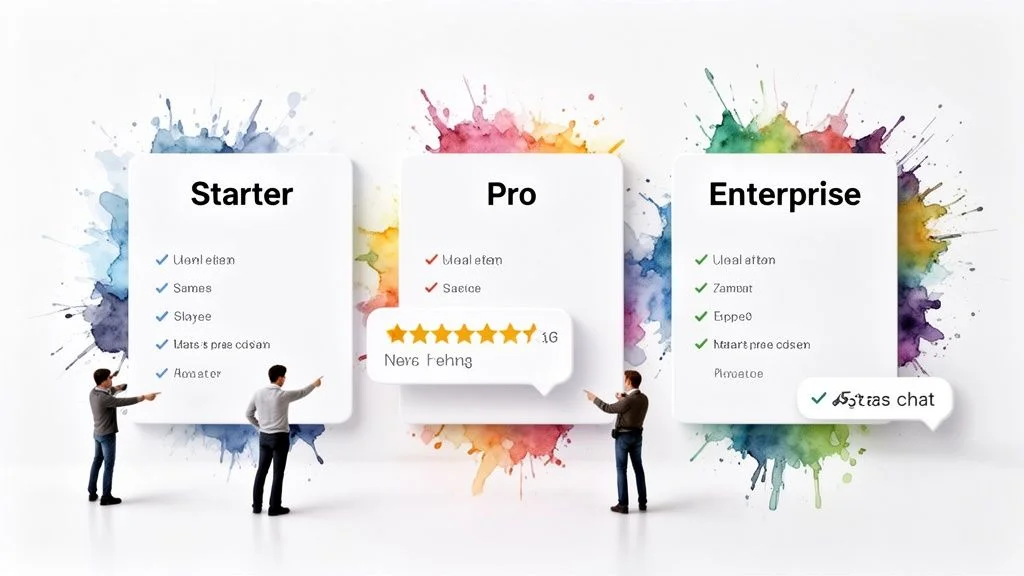
This method transforms a static pricing table into a dynamic decision-making tool. Instead of just comparing features, a potential customer sees a peer persona (like an "SMB owner" or "enterprise lead") voice their exact concerns about cost, ROI, and value, then confidently select a plan. It is especially effective for SaaS companies looking to increase average contract value or convert free users to paid plans.
Strategic Breakdown
This template targets prospects in the final decision-making stage, helping them overcome price sensitivity and choose the right plan with confidence. It reframes the conversation from "cost" to "investment."
Key Insight: Prospects are more likely to accept a price point when they see others like them justifying the value. Showing a conversation where an enterprise user justifies a higher-tier plan by discussing ROI makes that plan feel more attainable and valuable to similar leads.
- Tier justification matters across all price levels, not just the cheapest one. A visitor can see why someone would choose Pro over Starter, or Enterprise over Pro.
- Objection preemption: chat conversations address hidden fees, user limits, overage costs, and cancellation policies before the prospect has to ask.
- Value framing connects features to outcomes. A chat about API access becomes a conversation about scaling operations, making the higher-tier benefit clear.
Actionable Tips for Implementation
To make these 5-star review examples succeed, the conversations must reflect real customer logic and provide genuine clarity on value.
- Develop Buyer Personas: Create distinct chat conversations for each target segment (e.g., a startup founder worried about budget, a mid-market manager focused on team features, an enterprise director concerned with security).
- Focus on Tier-Specific ROI: Craft discussions that highlight the specific return on investment for each plan. For a premium plan, this might be a conversation about saving developer time or increasing sales capacity.
- Address Upgrade Paths: Show a success story where a user persona discusses their journey of starting on a lower plan and upgrading as their needs grew. This reduces the risk of choosing a smaller plan initially.
- Incorporate Risk Reversals: Weave mentions of money-back guarantees, free trials, or easy cancellation policies into the chat dialogue to build trust. You can review different options by exploring the details of our pricing and plans.
6. Lead Magnet and Gated Content Review Template
Gated content often struggles with a low commitment barrier. Visitors see a form and immediately weigh if the unknown resource is worth their email address. This 5-star review example, deployed via a FOMOchat widget, overcomes this hesitation by showing simulated conversations where past users confirm the value of the download. It answers the prospect's silent question: "What will I actually get, and is it worth it?"
This approach turns a static landing page into a dynamic proof-of-value engine. Instead of just a headline promising a "free guide," prospects see a chat where a peer confirms the resource saved them "10 hours of research" or provided a "template that doubled our open rates." It builds credibility and tangibly demonstrates the ROI of the content before the form is ever filled out.
Strategic Breakdown
This template focuses on the top of the funnel, specifically targeting the moment of conversion for email capture. It preemptively validates the quality and impact of the lead magnet, reducing form abandonment and increasing opt-in rates.
Key Insight: Prospects are skeptical of marketing promises but trust user outcomes. By showcasing a conversation that highlights a specific, desirable result from downloading the content, you directly address their primary concern about value exchange.
- The review focuses on what users actually achieve: saving time, increasing revenue, or solving a specific problem. Not just describing the content.
- Conversations can reference the creator's credentials or case studies. Something like, "This is from the same team that grew X company by 40%," builds trust fast.
- Answering questions about format, length, and immediate applicability removes uncertainty and makes the form submission feel like an easy yes.
Actionable Tips for Implementation
To make these 5-star review examples effective, the conversations must feel authentic and directly tie to the user's goals.
- Focus on Specific Outcomes: Craft conversations that mention clear results, like "This checklist helped us achieve 35% higher opt-in rates."
- Use Testimonials: Incorporate snippets from real user feedback into your chat templates to add a layer of authenticity.
- Show What's Next: Include chat bubbles that hint at the value subscribers get after the initial download, like access to an exclusive community or a bonus resource.
- Create Scarcity: Test conversations that mention "limited time access" to a bonus or a special version of the lead magnet to encourage immediate action. To further optimize these lead magnets for conversion, explore these 7 Top-Tier Gated Content Examples.
- Analyze Abandonment: Use conversation analytics to see which questions are asked most frequently on your lead magnet pages. This can provide valuable insights into why users might be abandoning the form.
7. Free Trial Signup Objection Handling Review Template
Getting a prospect to a free trial page is a major win, but converting them to sign up requires overcoming last-minute hesitations. This 5-star review template uses an AI chat tool like FOMOchat to tackle common trial objections head-on. It presents simulated conversations where prospects voice concerns about data security, complexity, or commitment, and then see those concerns resolved in a public-facing dialogue.
This proactive approach turns a standard signup page into a dynamic trust-building environment. For example, a developer tool might see a 50% higher trial activation rate, or a security-sensitive platform could reduce signup friction by 45% by transparently addressing compliance fears. It's a powerful way to show, not just tell, that your trial is safe, easy, and valuable.
Strategic Breakdown
This review template targets the critical moment just before a user commits to a free trial. It interrupts their internal monologue of doubt by providing immediate, relatable reassurance.
Key Insight: The biggest friction points for a free trial are often unspoken. By surfacing common objections in a conversational format, you validate the user's concerns and provide instant social proof that others have successfully overcome them.
- Proactive objection handling neutralizes fears about time commitment, credit card requirements, data privacy, and setup complexity before users bail.
- Seeing a peer ask about GDPR or SOC 2 compliance and get a clear answer makes the trial feel less risky.
- Users who sign up after having their concerns addressed are better informed and more likely to convert from trial to paid.
Actionable Tips for Implementation
To make these 5-star review examples effective, the conversations must directly address the most significant barriers to entry for your specific audience.
- Lead with Security: Start conversations by addressing data privacy and security, as these are often top-of-mind concerns, especially in B2B.
- Show the Onboarding Path: Include dialogue about the actual setup time, resources needed, and what the first 30 minutes in the app look like. This manages expectations and reduces fear of a complex onboarding process.
- Use Diverse Personas: Feature conversations from different user types, such as first-time users, people switching from a competitor, or developers concerned with integration.
- Address Industry Compliance: If you serve regulated industries, create specific chats that mention compliance standards like HIPAA or SOC 2 to build targeted trust.
8. Social Proof and Community Building Review Template
This template uses a "show, don't tell" approach by positioning the review tool itself as a case study. For a solution like FOMOchat, this means creating conversational reviews that showcase how other businesses successfully use the widget to boost social proof and build community. It’s a meta-strategy where the proof is in the product's own application.
Instead of a generic testimonial, visitors see simulated chats where a user persona-like a "B2B Marketing Director"-shares their success. These conversations feature tangible results, such as a "28% lift in demo requests" or "reduced cart abandonment," making the value proposition direct and believable. This technique turns the widget into a live-action case study.
Strategic Breakdown
This method builds powerful social proof by demonstrating the product's ROI in real-time. It targets prospects who are already evaluating social proof tools by showing them a best-in-class example of the tool in action, answering the question, "What could this do for my business?"
Key Insight: Prospects looking for a social proof solution are the most critical audience. By showcasing how other companies achieve specific growth metrics with your tool, you move the conversation from features to tangible business outcomes.
- Proof of Concept: It provides immediate evidence that the tool works, as visitors are experiencing its effects firsthand.
- Metric-Driven Trust: Featuring specific numbers (e.g., "15-minute setup," "28% higher signups") is far more compelling than vague praise. These metrics serve as mini-case studies.
- Role-Based Resonance: Displaying testimonials from different roles like a CMO, Product Manager, or Growth Lead helps prospects see themselves and their specific goals reflected in the review.
Actionable Tips for Implementation
To make these 5-star review examples effective, the success stories must be authentic, specific, and relatable.
- Feature Diverse Customers: Showcase conversations from startups, mid-market companies, and enterprise clients to broaden appeal. Each segment has unique pain points and success metrics.
- Highlight Before-and-After Data: Frame conversations around a problem and a solution. For example, "We struggled with low trial signups..." followed by a chat showing the analytics improvement after implementation.
- Emphasize Ease of Use: Many teams fear complex setups. Include chats that mention a fast, code-light implementation process to remove that friction point.
- Rotate Customer Stories: Keep the content fresh by updating the featured success stories quarterly. You can learn more about how to create these stories by reviewing our guide on generating conversations.
8-Point 5-Star Review Comparison
| Template | Implementation Complexity 🔄 | Resource requirements 💡 | Expected outcomes ⭐📊 | Ideal use cases | Key advantages ⚡ |
|---|---|---|---|---|---|
| SaaS Product Page Conversion Review Template | Low–Moderate: code-light integration, dialogue setup | Moderate: product FAQs, demo scripts, periodic updates | High: measurable conversion lift (examples: +23–35% signups) | B2B product pages, trial signups, feature pages | Reduces evaluation friction; builds credibility; quick deployment |
| Online Course Enrollment Review Template | Moderate: needs curriculum-aligned scripting and persona voice | Moderate: syllabus, instructor input, student testimonials | Moderate–High: higher enrollments and lower abandonment | Course landing pages, bootcamps, cohort courses | Answers pre-enrollment questions; builds community; boosts email capture |
| Product Launch Campaign Review Template | High: timing, countdown sync, and rotation scheduling | High: launch assets, timed scripts, coordination with GTM | High: strong waitlist and hype generation (examples: +40% waitlists) | Pre-launch pages, early-access signups, Product Hunt launches | Creates urgency/FOMO; captures emails; fast message testing |
| Webinar and Live Event Engagement Review Template | High: tight timeline coordination and video sync | High: timestamped scripts, testing, video integration | High: increased registrations and live engagement (examples: +45%) | Webinars, live demos, conference sessions with video content | Simulates real-time Q&A; boosts perceived attendee value |
| Pricing Page and Tier Comparison Review Template | Moderate: multiple tier paths and confidentiality handling | Moderate: pricing docs, ROI case studies, persona scenarios | High: reduces price objections; increases deal size and upgrades | Pricing pages, freemium conversions, enterprise deals | Justifies premium tiers; lowers support queries; improves AOV |
| Lead Magnet and Gated Content Review Template | Low–Moderate: content-focused setup with clear value messaging | Low–Moderate: lead material, testimonials, download metrics | High: higher opt-in rates and qualified leads (examples: +35% opt-ins) | Ebook/template downloads, gated reports, webinar signups | Increases email capture; pre-qualifies leads; builds authority |
| Free Trial Signup Objection Handling Review Template | Moderate: must align with trial terms and compliance | Moderate: trial docs, security/privacy info, onboarding content | High: higher trial activations and trial-to-paid conversions | Free trial landing pages, developer tools, security-sensitive apps | Removes signup friction; boosts activation and conversion rates |
| Social Proof and Community Building Review Template | Moderate: requires curated case studies and permissions | Moderate: updated case studies, testimonials, metric access | High: stronger trust and shorter sales cycles (examples: +28% signups) | Vendor/product pages, agency sites, marketing pages | Demonstrates effectiveness via customers; meta social proof |
| Pricing Page and Tier Comparison Review Template | Moderate: multiple tier paths and confidentiality handling | Moderate: pricing docs, ROI case studies, persona scenarios | High: reduces price objections; increases deal size and upgrades | Pricing pages, freemium conversions, enterprise deals | Justifies premium tiers; lowers support queries; improves AOV |
From Templates to Conversions: Your Action Plan
We’ve moved far beyond simply collecting positive feedback. The journey through these detailed 5 star review examples reveals a clear truth: strategic, context-aware reviews are powerful conversion tools. They are not passive decorations on a webpage; they are active participants in your customer's journey, addressing specific hesitations at the exact moment they arise.
Your key takeaway should be this: the most effective reviews are engineered with a purpose. They are built to overcome specific objections, clarify value, and guide a user toward a desired action. A review that shines on a product page might be entirely wrong for a pricing page, and a testimonial that builds community trust is different from one that drives webinar sign-ups.
Your Strategic Review Checklist
To turn these concepts into tangible results, you need a simple, repeatable process. The goal is to stop thinking about reviews as a happy accident and start treating them as a core part of your conversion strategy.
Here is your action plan for implementing what we've covered:
- Identify Your Conversion Goal: What is the single most important action you want a user to take on a specific page? Is it signing up for a free trial, enrolling in a course, or choosing a pricing tier? Be specific.
- Choose the Right Template: Match your goal to the corresponding review strategy we've discussed. Are you handling pricing objections? Use the Pricing Page Comparison template. Need to boost lead magnet downloads? The Gated Content template is your starting point.
- Gather Your Raw Materials: Collect the data needed to build your review. This includes real customer testimonials, frequently asked questions from your support tickets, common sales objections, and key feature benefits. This data is the foundation of an authentic, persuasive review.
- Define Your Personas & Guardrails: Before generating or writing, establish the voice. Who is this review from? A busy project manager? A skeptical first-time buyer? Set clear guardrails to ensure the tone, language, and core message stay true to that persona and your brand.
- Embed, Test, and Refresh: Place your new, strategic review in the right context. Test its impact on conversions. Most importantly, keep your reviews fresh. Stale social proof loses its power over time. Regularly update your examples to reflect new customer stories and evolving product features.
The Power of Authentic, Dynamic Social Proof
Mastering the art of the contextual review gives you a significant advantage. While competitors might still be using generic, out-of-place testimonials, you will be deploying precision-guided social proof that speaks directly to your audience's needs and fears. This approach builds deeper trust and creates a smoother path from interest to action.
You are no longer just showing people that others like your product. You are showing them why people just like them, facing the exact same problems, chose your solution and succeeded. This shift from generic praise to specific, problem-solving validation is what separates high-converting pages from the rest. The 5 star review examples in this guide are your blueprint for making that happen.
Ready to put these strategies into motion without the manual effort? The review templates and strategic breakdowns we’ve covered are exactly what FOMOchat is built to do. It’s the engine designed to bring these dynamic, objection-handling review conversations to life directly on your site. See how it works and start turning your best customer stories into your hardest-working conversion assets at FOMOchat.