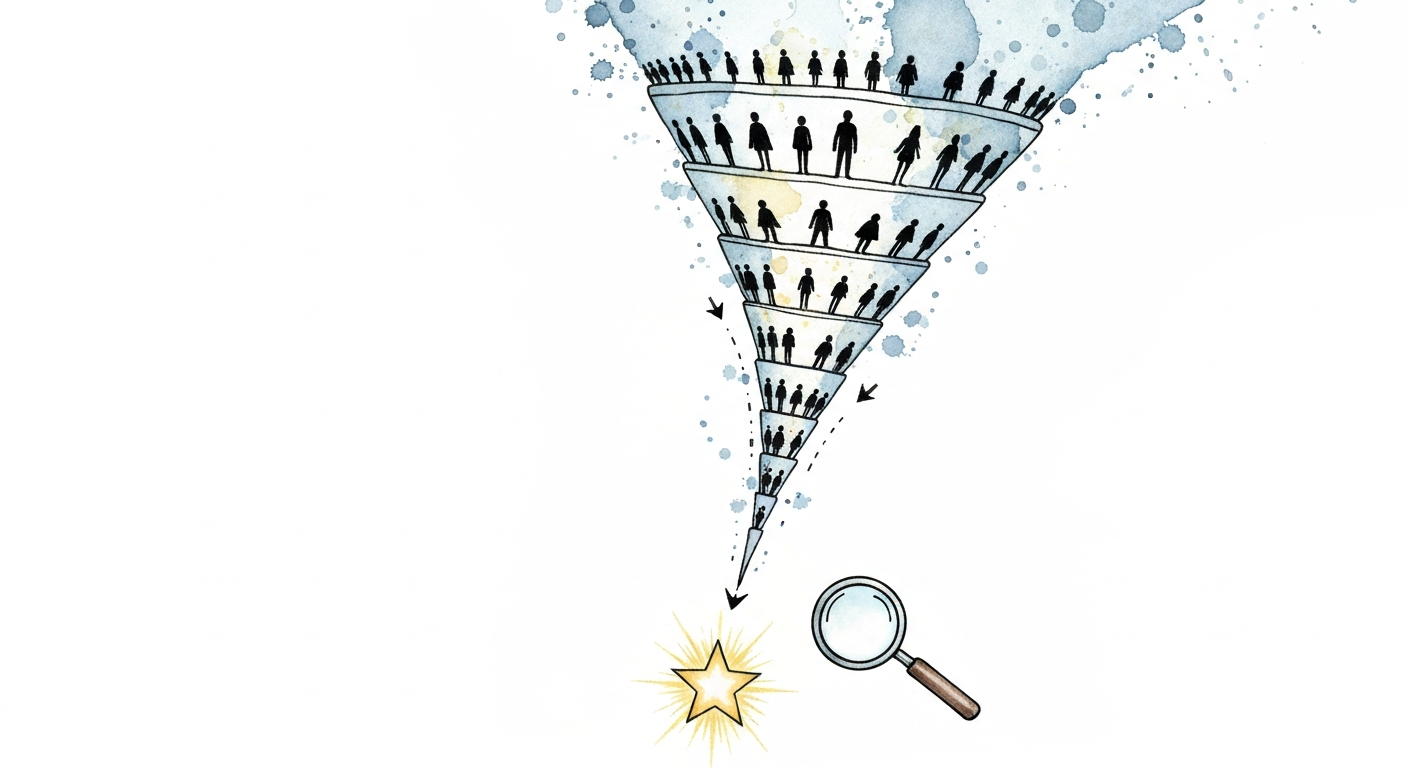
So, what exactly is a conversion funnel? Simply put, it’s a map of the journey a person takes from being a total stranger to your brand to becoming a happy, paying customer. It’s the path they follow from that first "hello" all the way to the final "yes."
It turns casual browsers into paying customers, one step at a time.
Your Guide to Understanding the Conversion Funnel
Let’s use a real-world analogy. Imagine you own a brick-and-mortar bookstore. Tons of people walk past your shop every day; that’s the top of your funnel. A smaller group will see your window display and decide to step inside. An even smaller group will pick up a book and read the back cover. And finally, a fraction of those people will actually walk up to the counter and buy it.
That gradual narrowing-down process is a conversion funnel in action. It’s wide at the top, catching as many eyes as possible, and gets tighter at each step. The name "funnel" is literal: not everyone who enters at the top will make it all the way to the bottom. Your job isn’t to shove them through, but to make the journey from one stage to the next as smooth and compelling as possible for the right people.
Why This Model Is So Powerful
Once you can see the customer's journey laid out like this, you can start making it better. A conversion funnel lets you pinpoint exactly where you’re losing people. Are they getting stuck on your pricing page? Is your checkout process a headache? The funnel gives you the clarity to find those weak spots.
The real value of a conversion funnel isn't in defining stages. It's in revealing the friction between them. That's where the money is. Each drop-off is an opportunity for improvement.
This framework gives your entire marketing strategy a clear purpose. Instead of throwing content into the world and hoping for the best, you can create targeted campaigns. Right message. Right person. Right stage. The result is better communication, higher engagement, and, of course, more conversions.
Before we get into the nitty-gritty, here's a quick look at the core stages.
| Funnel Stage | Primary Goal | Customer Mindset |
|---|---|---|
| Top of Funnel (ToFu) | Generate Awareness | "I have a problem, but I'm just starting to research it." |
| Middle of Funnel (MoFu) | Nurture Interest & Trust | "I'm evaluating different solutions and brands." |
| Bottom of Funnel (BoFu) | Drive a Conversion | "I'm ready to make a choice and buy." |
This table is just the starting point. Each of these stages has its own unique challenges and opportunities. In the next sections, we’ll break down every single one, showing you how to build, measure, and tweak your own funnel for serious growth.
Unpacking the 4 Stages of the Customer Journey
To really get what a conversion funnel is, you have to see it from the customer’s perspective. Their journey isn't a single leap from stranger to buyer; it's a gradual process of building trust and understanding. Marketers often map this path using the classic AIDA model, a simple but incredibly powerful framework that breaks the journey into four distinct stages.
Don't treat it as a rigid formula. Use it to read your customer's mindset at each step. Know where they are mentally, and you can deliver exactly the right message at exactly the right moment.
This visual shows that classic customer flow, from their first encounter with your brand all the way to making a purchase.
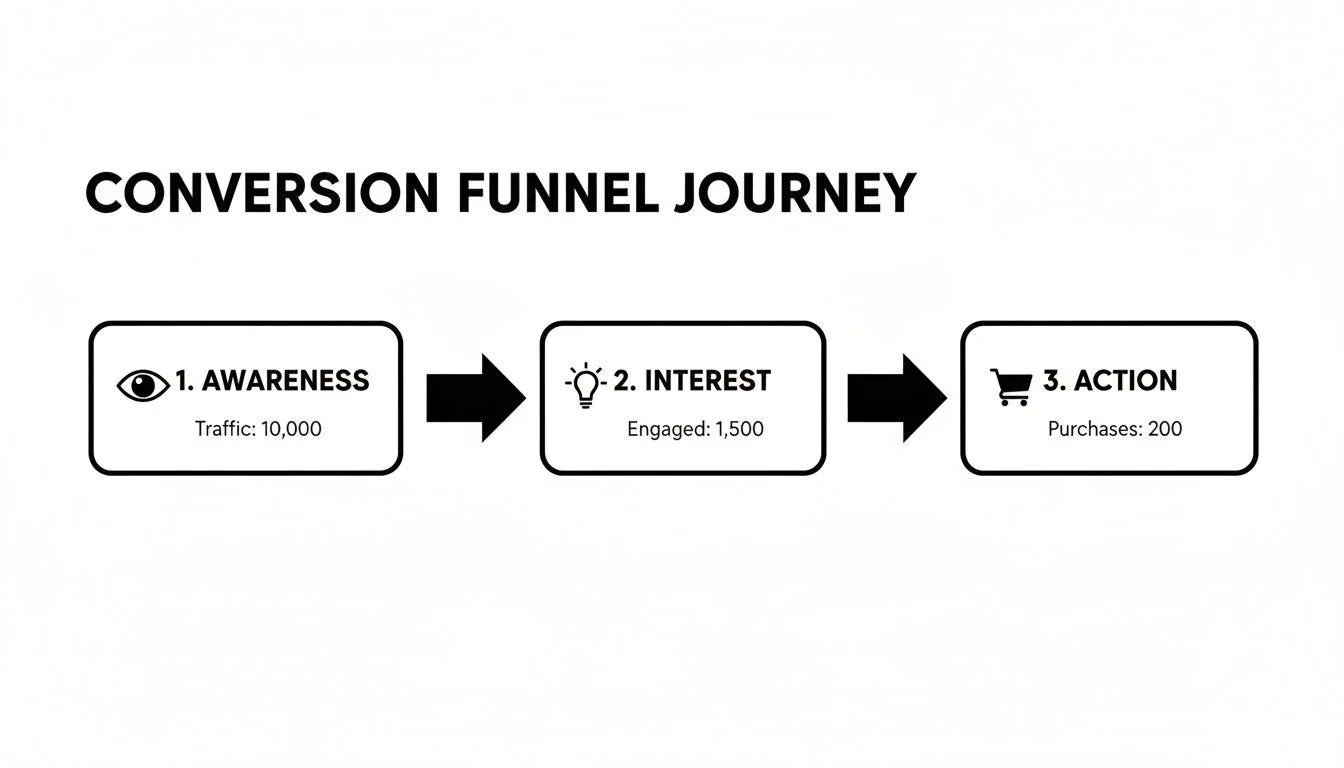
As you can see, a big crowd enters at the top, but only a small fraction actually converts. Every step needs to be as smooth as possible. That's the whole game.
Stage 1: Awareness
Everything starts with Awareness. Your potential customer just realised they have a problem. They don't know your brand yet. Your goal is simple: get on their radar.
You're casting a wide net here, reaching as many potential buyers as possible. Common tactics include:
- Search Engine Optimization (SEO): Creating helpful blog posts and guides that directly answer the questions your ideal customers are typing into Google.
- Social Media Marketing: Sharing engaging content, running targeted ads, and joining relevant online conversations to build your brand's presence.
- Content Marketing: Producing valuable, educational pieces like articles, videos, or infographics that attract and inform your audience.
The key: offer real value without immediately asking for a sale. No pitch. Just build familiarity and goodwill.
Stage 2: Interest
Once someone knows who you are, they slide into the Interest stage. Now, they're actively researching solutions and comparing their options. They’ve gone from "I have a problem" to "Okay, how can I solve this thing?" Your job is to grab their curiosity and establish your brand as a credible, knowledgeable resource.
You do this by serving up more in-depth content that helps them better understand both their problem and your unique solution. It’s like a second date: building a genuine connection before asking for anything.
At the Interest stage, your content needs to do more than just attract eyeballs. It has to actively nurture that attention. Use it to demonstrate expertise. Start building trust.
Webinars, detailed guides, email newsletters with real insights. They work. You're not selling yet. You're proving you know your stuff.
Stage 3: Decision
Now we’re getting serious. At the Decision stage, your prospect is ready to buy and is weighing their final options, yours included. They're asking themselves, "Is this really the right choice for me?" Your mission is to build undeniable trust and make a knockout case for your offer.
Your job here: show them exactly why you're the best choice. Tactics that really shine here are:
- Case Studies and Testimonials: Nothing beats social proof. Showing off success stories from happy customers is incredibly persuasive.
- Free Trials or Demos: Letting people experience your product or service firsthand is one of the best ways to prove its value.
- Detailed Product Pages: Be transparent. Clearly highlighting features, benefits, and pricing helps squash any last-minute doubts.
Tackle objections head-on. Give them confidence. Make choosing you feel inevitable.
Stage 4: Action
The Action stage. All that awareness-building, trust-earning, objection-crushing leads here. The customer is ready. Your only job now: get out of their way. Make it frictionless to click "buy" or fill out that form.
Don't let a clunky checkout ruin everything. Too many carts are abandoned at the finish line. You can learn more about how to fix a leaky checkout process in our detailed guide on the topic.
Success here comes down to having crystal-clear calls-to-action (CTAs), a super-simple checkout or sign-up process, and a secure payment system. Even tiny tweaks can lead to huge wins. The average sales funnel conversion rate is around 2-3% for e-commerce, but highly optimized funnels can crush that number. For example, some top-tier fitness brands see rates as high as 14.29% from Facebook ads, proving that fine-tuning each stage is absolutely critical.
By truly understanding this four-stage journey, you stop guessing. You start guiding with purpose.
Measuring What Matters in Your Funnel
A conversion funnel without data is just a guess. Full stop. To really understand what’s working and what’s not, you have to get your hands dirty with the numbers. Tracking the right metrics turns your funnel into a diagnostic tool. It shows exactly where customers slip away.
This isn’t about chasing vanity metrics. It’s about focusing on the numbers that tell a story about how people actually behave. By pinpointing the right key performance indicators (KPIs) for each stage, you can make smart decisions, plug the leaks, and guide more people all the way to the finish line.
Let's break down the essential metrics you should be watching at every step of the customer journey.
Top of Funnel Metrics: Awareness
At the very top (ToFu): the game is attention. Cast wide. Success isn't measured in sales yet. It's measured in eyeballs. One question matters: "Are people finding us?"
The most important metrics to watch here are:
- Website Traffic: This is your starting point: the total number of visitors to your site. It’s the broadest measure of your reach.
- Traffic Sources: Where is everyone coming from? Are they finding you through Google, social media, paid ads, or referrals from other sites? This tells you which channels are actually pulling their weight.
- New vs. Returning Visitors: This helps you see if you're bringing in a fresh audience while also keeping previous visitors interested enough to come back.
- Impressions: How many times was your content or ad shown to someone? It’s a core metric for understanding your brand's overall visibility.
Lots of organic traffic? Good sign your SEO is connecting at the right moment.
Middle of Funnel Metrics: Interest and Decision
You've grabbed attention. Now what? The middle of the funnel (MoFu) is about nurturing that spark into real trust. Metrics get specific here. Are people sticking around? Showing genuine interest? That's what you need to know.
The middle of the funnel is where casual browsers become serious prospects. The data you collect here shows you how well you're building a relationship and proving your value.
Key engagement metrics for this stage include:
- Bounce Rate: What percentage of visitors land on a page and leave without clicking anything else? (See our guide on how to reduce bounce rate.) High bounce rate? Red flag. Your page probably isn't matching what they expected.
- Average Session Duration: How long are people actually spending on your site? Longer sessions usually mean they're more engaged and find your content valuable.
- Lead Magnet Downloads: Are people downloading your ebooks, checklists, or whitepapers? A strong download rate means people are willing to trade their contact info for your expertise.
- Email Open & Click-Through Rates (CTR): If you're using email to nurture leads, these numbers tell you if anyone is actually paying attention to what you're sending.
For example, a high download rate on a guide but a terrible email open rate could mean your initial offer is great, but your follow-up emails are falling flat.
Bottom of Funnel Metrics: Action
Finally, we get to the bottom of the funnel (BoFu), where everything gets laser-focused on the ultimate goal: conversion. These are the metrics that directly impact your bottom line. The critical question here is, "Are people taking that final step?"
The most crucial numbers to monitor here are:
- Conversion Rate: The percentage of visitors who actually complete the action you want, like buying a product or signing up. The ultimate scorecard for your funnel's health.
- Cost Per Acquisition (CPA): How much are you spending in marketing to get one new customer? This number is essential for figuring out if your campaigns are profitable.
- Customer Lifetime Value (CLV): What's the total revenue you can expect from a single customer over time? A high CLV means you're not just making one-off sales. You're building loyalty.
- Shopping Cart Abandonment Rate: For e-commerce, this shows you how many people add items to their cart but bail before paying. Our guide on reducing cart abandonment covers the fixes in detail. It often points to a clunky or confusing checkout process.
By keeping a close eye on these stage-specific metrics, you get a full, 360-degree view of how your funnel is performing. For a deeper dive, check out our guide on how to increase your overall website conversion rate with more targeted strategies.
Proven Strategies for Funnel Optimization
So, you’ve mapped out your funnel’s stages and you know your key metrics. That’s like having a detailed blueprint of your customer's journey. Now it's time to put on a hard hat and start fixing the cracks and leaks. Funnel optimization is all about actively plugging the holes where you’re losing potential customers, paving a smoother, more convincing road from "hello" to "heck yes!"
Roll up your sleeves. Tackle the common bottlenecks head-on. Maybe it's a confusing landing page that sends people running, or a clunky checkout process that’s a graveyard for abandoned carts. Every single point of friction is a golden opportunity for improvement. By making smart, targeted changes, you can dramatically increase the number of people who actually make it to the finish line.
Fine-Tuning the Top and Middle Stages
Optimisation doesn't start at checkout. It starts at the very top. Make a strong first impression. Build trust early. Lose people at the start and they'll never see your offer, no matter how good it is.
Here are a few powerful tactics to tighten up the top and middle of your funnel:
- A/B Test Your Messaging: Stop guessing what headline or call-to-action resonates. Test it! Create two versions of a landing page (an 'A' and a 'B') with one key difference, like the main headline. Run them both, see which one performs better, and then make the winner your new champion.
- Improve Page Speed: We live in an age of "I want it now," and a slow-loading website is a conversion death sentence. Even a single second of delay can send your bounce rates through the roof. Use tools to shrink your images and clean up your code to make sure your pages load in a flash.
- Simplify Your Forms: Long, complicated forms are a huge turn-off. Be ruthless and ask only for the information you absolutely need right now. For a newsletter signup, an email address is perfect. For a lead magnet, a name and email will do. You’ll be amazed at how many more submissions you get just by cutting down the number of fields.
To really get this right, prioritizing your highest-intent leads and focusing your energy where it counts most is essential to keeping your funnel tight.
Strengthening the Bottom of the Funnel
The Decision and Action stages are where the sale is won or lost. Buyer hesitation peaks here, and your prospect needs a final dose of confidence and a clear, easy path to purchase. Tiny improvements at this stage can lead to massive returns.
The numbers don't lie. Globally, e-commerce sits at a 2.35% average conversion rate. Mobile? Even worse: 1.8%. That's not a crisis. It's an opportunity. Businesses that nail this stage see 18x revenue growth. Some report 102% higher deal sizes. The upside is enormous.
FOMOchat is built for exactly this moment. It’s designed to tackle the doubt and uncertainty that kill conversions at the one-yard line.
By injecting real-time social proof and instant support directly at the point of purchase, you can resolve last-minute objections and build the final burst of confidence a customer needs to click "buy."
FOMOchat uses AI-driven social proof to show visitors that other people are engaging with your brand in real-time. Its AI representative can instantly answer common questions about shipping, returns, or product details, stopping users from bouncing to Google for answers. If you're a course creator or webinar host, it can create genuine urgency by showing real-time signups, giving others that little nudge they need to join before it’s too late.
By attacking friction at these critical final moments, you directly address the main reasons for cart abandonment and give your overall conversion rate a serious boost. For a deeper dive into more techniques, check out our complete guide on conversion rate optimization strategies.
Conversion Funnels in the Real World
Theory is one thing. Seeing it work in a real business is where it clicks. When you see the stages connect, you grasp its practical power. To bring these ideas down to earth, let’s walk through three mini-case studies for completely different business models.
Each scenario will trace the customer's path from their very first encounter all the way to a successful conversion. You'll see how specific, strategic actions guide people from one phase to the next. These aren't just textbook examples; they're common, effective funnels driving real results every single day.
Example 1: The SaaS Free Trial Funnel
Imagine a SaaS company selling project management software. Their number one goal is to convince qualified leads to sign up for a 14-day free trial. To do that, they've built a funnel designed to attract, educate, and ultimately convert the right people.
Awareness: The journey begins with a blog post optimized for a search term like "best tools for remote team collaboration." A project manager, feeling the pressure of managing a distributed team, stumbles upon the article through a Google search. First touchpoint with the brand.
Interest: The article is genuinely useful, packed with practical, concrete advice. At the end, a clear call-to-action (CTA) invites them to download a free "Ultimate Remote Work Checklist." The project manager happily trades their email for the guide, officially becoming a lead.
Decision: Over the next week, the company sends a short sequence of value-packed emails. They don't just bombard the new lead with sales pitches. Instead, they share more tips on remote management, subtly showing how their software solves the very problems being discussed. The final email guides them to a detailed pricing page.
Action: Now on the pricing page, the prospect has a couple of specific questions about feature integrations. Make-or-break moment. Instead of letting them navigate away, a FOMOchat widget pops up. Its AI representative instantly answers their questions using info from the website. That instant, helpful response builds a ton of confidence, and they sign up for the free trial.
Example 2: The Online Course Webinar Funnel
Next up, let's look at an online course creator who teaches digital photography. Her main goal is getting people to enroll in her signature course, and she uses a high-value webinar to make it happen.
This approach is all about building authority and establishing trust before ever asking for a sale. The funnel is engineered to attract a highly engaged audience and give them a compelling, time-sensitive reason to buy.
For content-driven funnels, the transition from Interest to Decision is everything. The goal is to build such a strong case for your expertise that the final purchase feels like the next logical step.
Here’s how her customer's journey unfolds:
Awareness: She runs highly targeted Facebook ads promoting a free, live masterclass called "5 Secrets to Stunning Landscape Photos." The ads are aimed at users who have shown interest in photography gear and famous photographers.
Interest: Someone clicks the ad and lands on a simple registration page. After signing up for the webinar, they’ve entered the middle of the funnel. Before the live event, she sends reminder emails with bonus tips to keep them excited and make sure they attend.
Decision: During the live webinar, she over-delivers, teaching the "5 secrets" with passion and real expertise. At the very end, she introduces her premium course as the perfect next step for anyone serious about mastering the craft. This is the moment she turns interest into a real desire to buy.
Action: Just as she starts her course pitch, the FOMOchat widget syncs with her presentation. It starts showing real-time questions and comments from other attendees, creating the feeling of a vibrant, interactive community. Seeing others get excited and ask buying questions provides powerful social proof, nudging hesitant viewers to click that "Enroll Now" button.
Example 3: The E-commerce Product Launch Funnel
Finally, picture an e-commerce brand launching a new smart-home device. For a product launch, it's all about creating buzz and building anticipation. This funnel is built to generate a massive surge of pre-orders right on launch day.
This same idea of guiding people from discovery to commitment is used across different platforms. This launch funnel uses that same principle of turning casual attention into committed action.
Awareness: A month before launch, the brand starts teasing the new product on social media and in its email newsletter. They work with influencers to amplify their reach and drive traffic to a "coming soon" landing page.
Interest: On that landing page, visitors can sign up to become a "VIP Insider." This gets them on an exclusive list for early-bird access and a special launch-day discount. Thousands of eager fans join, creating a red-hot audience segment.
Decision & Action: On launch day, the VIPs receive an email with a private link to the product page an hour before it's available to the public. The page features a countdown timer and FOMOchat notifications displaying real-time purchases from other VIPs. This blend of exclusivity, urgency, and social proof ignites a buying frenzy, driving a huge number of pre-orders in the first hour alone.
Your Funnel Building Checklist
Alright, let's turn all this theory into action. This checklist is your practical, step-by-step guide to either building a new conversion funnel from scratch or giving your current one a much-needed audit. Your roadmap for turning casual visitors into committed customers.
Foundational Steps
Get the foundation right first. A successful funnel needs a deep understanding of who you're talking to. Skip this part and you're just guessing.
Define Your Ideal Customer: Don't just settle for basic demographics. You need to build a detailed buyer persona. What are their biggest headaches? What are their goals? Where do they hang out online looking for answers? Get specific about the questions they’re asking at every single stage.
Map the Customer Journey: Grab a whiteboard or a spreadsheet and outline every single touchpoint a potential customer has with your brand. Start from their very first Google search and follow them all the way to the final "thank you" page. This visual map is invaluable: it will immediately highlight the friction points you need to smooth out.
Execution and Optimization
Strategy mapped. Now build. This is where your plan meets the real world.
Select Your KPIs and Tracking Tools: Get your analytics tools set up to measure the key metrics for each funnel stage. It’s a simple rule: you can't optimize what you can't measure.
Create Stage-Specific Content: Your content needs to match where your customer is in their journey. Think blog posts for the Awareness stage, webinars for Interest, and compelling case studies for the Decision phase.
Integrate Conversion Boosters: This is where you bring in tools that build trust right when it matters most. For example, you can use FOMOchat on your checkout or sign-up pages. It provides instant social proof and answers those last-minute questions, directly tackling the hesitation that so often kills a sale.
Got Questions? Let's Talk Funnels
Once you start digging into conversion funnels, a few questions always seem to surface. Here are answers to the most common ones. some of the most common points of confusion that pop up when you're moving from theory to actually building something that works.
These come up constantly when you move from theory to actually building something.
Marketing Funnel vs. Sales Funnel: What's the Real Difference?
People use these interchangeably. They're not the same thing.
A marketing funnel covers the whole journey, from the moment someone first hears your name to becoming a qualified lead. Its job: reel in the right people.
The sales funnel, on the other hand, is a smaller, more focused part of that journey. It kicks in right when marketing passes over a qualified lead. From that point on, it’s all about the specific actions that lead to a closed deal: demos, proposals, and contract negotiations. Marketing gets them in the door; sales shows them to their seat.
A marketing funnel casts a wide net to find potential customers. A sales funnel is all about guiding those hand-picked, high-intent leads to say "yes."
Are Funnels Actually Different for B2B and B2C?
Yes. Night-and-day difference. The basic arc is the same (Awareness, Consideration, Conversion), but how you get people through it is completely different.
B2C (Business-to-Consumer) Funnels: These are usually fast and fueled by emotion. Someone sees an Instagram ad for a pair of shoes and buys them ten minutes later. The whole process is short, punchy, and built around making the purchase as easy as possible.
B2B (Business-to-Business) Funnels: This is a marathon, not a sprint. B2B funnels are long, complex, and driven by logic. You're dealing with multiple decision-makers, big budgets, and a whole lot of "we need to think about this." The focus here is on building trust over time with things like case studies, detailed whitepapers, and direct interaction with a sales team.
What Exactly Is a "Leaky Funnel"?
You’ll hear this term a lot. A "leaky funnel" is simply a funnel where you're losing way too many people between one step and the next. You might be great at getting traffic to your site, but something is scaring them away before they ever sign up or buy.
The classic signs are all over your analytics: a crazy high bounce rate on your pricing page, tons of abandoned shopping carts, or a fantastic guide that almost no one actually downloads. Finding where those leaks are and patching them up is what funnel optimization is all about.
Ready to plug the leaks in your funnel? FOMOchat uses the power of AI-driven social proof to answer questions, build trust, and create urgency right at the point of conversion. Discover how FOMOchat can boost your signups and sales.