
So, you’ve worked hard to get people to your website. But what happens once they arrive? Website conversion rate optimization (CRO) is all about answering that question and, more importantly, improving the answer.
It's the art and science of turning the visitors you already have into customers, leads, or subscribers. driving traffic is like getting people to your store, but CRO is about making sure your aisles are clear, your products are appealing, and the checkout line is fast. It’s how you convince more window shoppers to actually buy something.
Unlocking Your Website's Hidden Potential
Many businesses get trapped in the cycle of pouring money into ads to get more traffic, but that’s only one piece of the puzzle. Getting new visitors is expensive; getting more from your current visitors is where the real growth happens. CRO shifts your focus from just getting more clicks to getting more value from every single click.
This isn't about throwing spaghetti at the wall to see what sticks. It's a methodical process that helps you understand what your users are thinking and feeling. By digging into their behavior, where they get stuck, what grabs their attention, and what makes them leave. You can make smart, targeted changes that lead them right where you want them to go.
So, What Actually Counts as a "Conversion"?
A conversion isn't just about making a sale. It’s any specific, valuable action you want a visitor to take. What that action is depends entirely on your business.
To help you pinpoint what matters most for you, here’s a quick breakdown of common conversion goals.
Common Conversion Goals by Business Type
| Business Type | Primary Conversion Goal | Secondary Conversion Goal |
|---|---|---|
| E-commerce | Completed Purchase | Add to Cart, Wishlist Creation |
| SaaS | Free Trial Signup, Demo Request | Newsletter Signup, Case Study Download |
| B2B Services | Lead Form Submission, Consultation Call | Gated Content Download, Webinar Registration |
| Content/Media | Newsletter Subscription | Account Creation, Sharing an Article |
| Course Creator | Course Enrollment | Downloading a Freebie, Watching an Intro Video |
As you can see, conversions come in all shapes and sizes. Even smaller steps, like signing up for an email list or watching a video, are crucial. We call these micro-conversions, and they're powerful indicators of how engaged your audience is on their journey.
If you want to explore more high-level strategies, check out this excellent resource on how to increase website conversion rate and get more from your traffic.
How to Calculate Your Conversion Rate
The math here is surprisingly simple, but the insight it provides is huge. This single number gives you a clear benchmark to measure all your optimization efforts against.
Conversion Rate = (Number of Conversions / Total Number of Visitors) x 100%
Let’s say your webinar landing page had 5,000 visitors last month, and 100 of them signed up. Your conversion rate is 2% (100 / 5,000 x 100). Easy.
So, what’s a “good” rate? It’s useful to know that the average website conversion rate across industries hovers around 2.9%. But this can swing wildly depending on the source. For example, e-commerce sites often see rates closer to 3.6% from desktop users, and direct traffic (people who type your URL right in) tends to convert at around 3.3% because they already know you.
These numbers show that every single percentage point is a hard-won victory. In the end, CRO is what turns your website from a static online brochure into your most effective salesperson. One that works 24/7.
Finding the Conversion Leaks in Your Funnel
Before you can start optimizing anything, you have to put on your detective hat. Your mission is to find the "leaks" in your conversion funnel. Those specific spots where potential customers get stuck, confused, or just give up and leave. Guessing is expensive. A proper diagnosis backed by data is the only way to kick off effective website conversion rate optimization.
This whole process begins with numbers. This is the quantitative part, the part that tells you what is happening on your site. Think of it as getting the high-level report from the crime scene. Tools like Google Analytics are your magnifying glass, helping you pinpoint the exact problem areas with cold, hard data. You're searching for red flags that scream "leak here!"
Start with the "What" Using Analytics
Your analytics platform is sitting on a goldmine of clues about where your funnel is breaking down. It's easy to get lost in all the reports, so instead, laser-focus on a few critical ones that show you where people are dropping off.
Start by looking for these tell-tale signs:
- High Exit Rate Pages: Which pages are the last ones people see before they bail? A high exit rate on a "thank you" page is fine, but if it’s happening on your checkout or pricing page, you've found a major leak.
- Funnel Drop-Off Points: If you’ve set up a conversion funnel (e.g., Homepage -> Product Page -> Cart -> Checkout), where are you seeing the biggest drop in numbers? If 70% of people who add an item to their cart never even start the checkout process, you've got a clear, urgent problem to fix.
- Underperforming Segments: How do different groups of users behave? Do mobile users convert at a dramatically lower rate than desktop users? That’s a huge clue that your mobile experience is broken and costing you sales.
Analytics gives you the "what" and the "where." For example, you might discover that your main product page has an 85% exit rate for visitors coming from your social media ads. Now you have a specific, tangible problem to investigate. But you still don’t know why it's happening.
Uncover the "Why" with Qualitative Insights
Once you know where the leaks are, it's time to figure out why they're happening. This is where you get inside your users' heads with qualitative tools that show you their perspective. These methods add the human story that numbers alone can never tell you.
Combining the 'what' from your data with the 'why' from user insights is everything. You stop guessing and start building hypotheses based on real evidence. This is the secret to every successful optimization campaign.
There are three fantastic ways to gather these crucial insights.
1. Watch Real User Journeys with Session Replays
Session replay tools are like having a recording of what people actually do on your website. You can watch anonymous recordings of real visitor sessions, seeing their mouse movements, where they click, how they scroll, and where they get stuck. Honestly, nothing is more eye-opening than watching someone rage-click a broken button or scroll up and down a page desperately trying to find shipping info. A data table just can't show you that frustration.
2. Analyze Form Abandonment
Forms are notorious conversion killers. Form analytics tools will show you, field by field, where the friction is. You might find that asking for a phone number is a dealbreaker for most people, or that a confusing field label causes a long, frustrating pause. If 50% of users abandon your form at the "Create Password" field, you can bet your password requirements are way too complicated.
3. Gather Direct User Feedback
Sometimes, the easiest way to find out what's wrong is to just ask. You can use simple tools to get feedback straight from the source:
- On-page surveys: Pop up a simple question on a high-exit page, like, "What's preventing you from signing up today?"
- User testing: Recruit a few people from your target audience and give them a task to complete on your site. As they do it, ask them to think out loud. Their running commentary is pure gold.
When you put the "what" from your analytics together with the "why" from these methods, you can finally form a strong, evidence-based hypothesis. You’re no longer guessing; you’re solving a clearly defined problem. To dig even deeper into this, you can learn more about what a conversion funnel is and how to map out every stage of the user journey.
Building Your CRO Experimentation System
You’ve played detective and found the weak spots in your conversion funnel. Now it’s time to put on your lab coat. This is where we move from identifying problems to systematically solving them, turning your data-backed hunches into real, measurable improvements.
Great website conversion rate optimization isn’t about throwing ideas at the wall to see what sticks. It's about disciplined testing and learning. To avoid guesswork and random changes, you need a repeatable system that turns insights into action.
The Five-Step Experimentation Workflow
This simple five-step framework is your roadmap. It keeps your team focused and ensures every test you run is a deliberate step toward boosting your conversion rate.
- Hypothesize: Start with a clear, educated guess based on your research. A solid hypothesis follows a simple format: "If we do X, then Y will happen, because of Z." For example: "If we change the CTA button from blue to orange, then more people will click it because it will create a stronger visual contrast with the background."
- Prioritize: You’ll likely have a dozen great ideas, but you can't test them all at once. Use a scoring system like ICE (Impact, Confidence, Ease) to rank your hypotheses. This helps you focus on the tests most likely to deliver big wins with the least amount of effort.
- Test: This is the fun part. The most common method is an A/B test, where you pit your current page (the control) against a new version (the variation) to see which one performs better.
- Analyze: Once the test has run its course, it's time to look at the numbers. Did your new version win? Lose? Or was it a tie? Dig into the results to understand not just what happened, but why it happened.
- Implement: If your new version won by a statistically significant margin, roll it out to all your users. If it lost or the results were inconclusive, that’s okay! Use what you learned to form a new, smarter hypothesis and start the cycle over again.
This workflow is the engine that drives your CRO efforts, fueled by the insights you gather from your diagnostic tools.
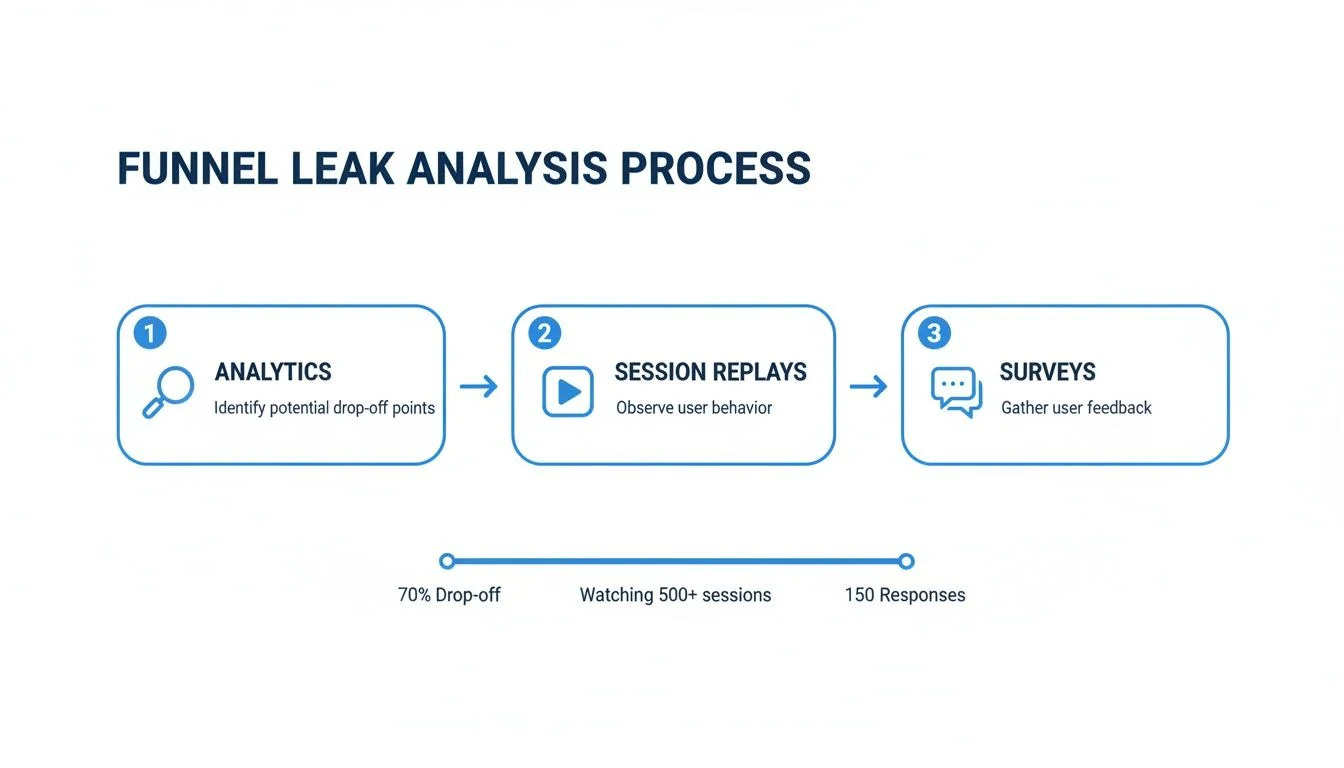
As you can see, quantitative data from analytics tells you where the leaks are, while qualitative insights from session replays and surveys help you understand why they're happening.
A/B Testing: Your Path to Smarter Decisions
A/B testing (or split testing) is the bread and butter of CRO. It’s a beautifully simple concept: you show half your visitors the original page (Version A, the "control") and the other half a modified version (Version B, the "variation"). Then you just measure which one gets more conversions.
But A/B testing is more than just picking winners. It's about systematically learning what your audience truly responds to. Every test, win or lose, gives you another piece of the puzzle, making all of your future marketing efforts smarter.
The golden rule of A/B testing is to change only one thing at a time. If you test a new headline, a new image, and a new button color all at once, you’ll have no idea which change actually made the difference.
You also need to run your test long enough to reach statistical significance. This is a fancy term for being confident that your results are real and not just a random fluke. Most testing tools will tell you when you've hit it, which is usually a 95% confidence level or higher.
Looking Beyond the Basics
Once you've mastered A/B testing, you can explore more advanced techniques to get even deeper insights.
- Multivariate Testing: Think of this as A/B testing on steroids. Instead of testing one new version, you test multiple combinations of changes at the same time (e.g., three different headlines paired with two different hero images). It requires a lot of traffic, but it’s a powerful way to find the absolute best combination of elements on a page.
- Personalization: This is where you start tailoring your website experience to different groups of users. For instance, you could show a "Welcome back!" offer to a returning customer or display different content based on where a visitor is located. Done right, the strategic personalization of content can make your visitors feel like the site was built just for them.
By building a robust experimentation system, you stop making one-off fixes and start creating a true engine for growth. Your website will constantly evolve, always getting better at meeting your customers' needs and driving your business forward.
How to Use Social Proof to Boost Your Conversions
We’re all social animals. We instinctively look to others for clues on what to do, especially when we feel uncertain about a decision. This little psychological quirk is called social proof, and it's a massive lever in website conversion rate optimization. The logic is simple: if a bunch of other people are doing something, it feels safer and more correct.
Think about the last time you were looking for a place to eat in a new city. Did you pick the empty restaurant or the one buzzing with happy customers? It's a no-brainer. The same thing happens on your website every single day. When you show visitors that other people already trust you, their hesitation starts to melt away, making it much easier for them to say "yes."
But here's where most businesses miss a huge opportunity. They slap a few testimonials on a page and call it a day. That's better than nothing, but it's like hanging a single photo of that busy restaurant on the wall. It just doesn't have the same energy. The real magic happens when you make your social proof dynamic, authentic, and feel alive.
Why Static Testimonials Aren't Enough
Static testimonials are passive. They sit there, waiting to be read. Dynamic social proof, on the other hand, creates an environment that feels busy and exciting. It pulls visitors into a community of people who are actively interested in what you're offering, which builds confidence in the blink of an eye.
This is where showing real-time activity changes the entire game. Imagine someone is on your webinar sign-up page, on the fence about registering. Suddenly, they see a live feed of questions that other potential attendees are asking, along with real answers. Their own objections and questions get answered without them even having to ask. It turns a lonely, solitary decision into a shared, reassuring experience.
That shift from passive viewing to active participation is where you'll find some of the biggest jumps in conversion. One study of 1,200 websites found that while just showing user-generated content gave a nice boost, the conversion rate actually doubled when people could interact with it. That’s a 102% increase, proving that getting people involved is what builds the trust needed to drive a decision. You can explore more findings like this in these conversion rate optimization statistics on Wordstream.
Comparing Social Proof Tactics and Their Impact
Not all social proof is created equal. Some tactics are easy to implement but have a subtle effect, while others require more effort but can deliver a serious conversion lift. Here’s a quick breakdown of common methods.
| Social Proof Tactic | Example | Best For | Impact Level |
|---|---|---|---|
| Customer Testimonials | "This product changed my business!" - Jane D., CEO | Landing Pages, Product Pages | Medium |
| Case Studies | A detailed story of how a client achieved specific results. | B2B, High-Ticket Sales Pages | High |
| Real-Time Notifications | "John from New York just purchased!" | E-commerce, SaaS, Course Pages | High |
| User/Purchase Counts | "Over 10,000 sold" or "2,500 people signed up this week." | High-Traffic Product & Landing Pages | Medium-High |
| Influencer Endorsements | A trusted industry figure recommending your product. | E-commerce, Direct-to-Consumer | High |
| Trust Seals & Badges | "As seen in Forbes" or security badges (McAfee, Norton). | Checkout Pages, Homepages | Medium |
Choosing the right mix of these tactics depends on your specific goals and audience. The key is to create a believable and compelling story that shows your offer is valuable and trusted.
The Power of Urgency and Scarcity
Once you're showing visitors that others are buying, you can light a fire under them by adding limits on time and quantity. Urgency and scarcity are two psychological triggers that work beautifully with social proof.
- Urgency: This is all about time. Think of countdown timers for a sale or a "your cart expires in 10 minutes" message. It creates a "now or never" feeling that pushes people to make a choice instead of procrastinating.
- Scarcity: This is about quantity. Phrases like "Only 3 spots left!" or "Limited edition" signal high demand. When something seems scarce, our brains tell us it must be valuable, and we feel a stronger pull to get it before it's gone.
Key Takeaway: Urgency makes people decide sooner, while scarcity makes them want the item more. Combine them with social proof, like showing how many people just bought that limited-stock item. And the effect is incredibly powerful.
For example, a course creator could show a small notification that says, "31 people have enrolled in the last 24 hours," right next to a countdown clock for an early-bird discount. That blend of social proof and urgency is tough to ignore. For more great ideas, check out these powerful social proof examples to boost sales.
Tools like FOMOchat are designed to make this happen automatically. Instead of a static quote, it can generate authentic-looking conversations that show a visitor they aren't the only one with questions. It answers their concerns while proving that other people are interested, creating a layer of trust that testimonials alone just can't build. And to really get the most out of your happy customers, learning how to build a customer testimonial landing page that converts is a great next step. When you weave all these elements together, you create a natural and ethical path that guides visitors toward a confident "yes."
Turning Theory into Traffic: How to Optimize Your Most Important Pages
All the analytics and user research in the world won’t matter if you don’t apply what you’ve learned to the pages that actually make you money. While it's tempting to want to fix everything at once, the reality is that some pages on your site do most of the heavy lifting. Focusing your efforts there is how website conversion rate optimization starts paying the bills.
Let's get practical and talk about the three types of pages where small tweaks can create a huge impact: your product pages, webinar sign-up forms, and time-sensitive launch pages.
Fine-Tuning Your Product and Service Pages
Think of your product page as the final conversation before a handshake. It's the moment where a curious visitor decides to become a paying customer. Your job is to make that decision feel easy, obvious, and exciting.
Here are the key areas to nail down:
- Talk about benefits, not just features. Don't just tell them it has "1TB of cloud storage." Instead, tell them what that means for them: "Never worry about running out of space for your precious memories again." People buy outcomes, not specs.
- Show your product in its best light. High-quality visuals are non-negotiable. Use crystal-clear images, 360-degree views, or short videos to let people see, feel, and imagine your product in their own hands.
- Make your Call-to-Action (CTA) impossible to ignore. Your "Add to Cart" button shouldn't blend in. Use a strong, contrasting color and simple, direct text. Make sure it's visible the moment the page loads and consider repeating it further down on longer pages.
The best product pages work like a great salesperson. They anticipate questions before they're even asked. Think about what might make someone hesitate. Shipping costs? Return policy? Security? Address these head-on with clear icons, a mini FAQ, and trust badges right next to your CTA.
This clears the path and removes any last-minute doubts. For a deeper dive, check out these essential landing page optimization best practices.
Boosting Webinar and Course Registrations
When you're promoting a webinar or a course, your registration page is everything. You're not selling a thing; you're selling a promise. A promise of new skills, a solved problem, or a personal transformation. You have to build both trust and excitement, and you have to do it fast.
Here’s a quick checklist for a registration page that works:
- Write a headline that sells the transformation. Instead of a dry "Sign Up for Our Marketing Course," try something that speaks to the result, like "Go From Beginner to Pro in 30 Days."
- Show them they're in good company. Nothing builds confidence like social proof. Displaying the number of people already signed up ("Join 1,500+ others!") and adding a countdown timer for a special offer creates a powerful sense of urgency.
- Use bullet points to list the takeaways. People scan. Make it easy for them to see exactly what they'll learn. Clear, concise bullet points help them quickly confirm the content is right for them.
- Put a face to the name. A friendly photo of the host or instructor instantly makes the page more human and trustworthy. Add a short bio highlighting their expertise to seal the deal.
These elements work together to convince visitors that your event is a valuable use of their time, making the decision to register feel both smart and time-sensitive.
Maximizing Momentum for Launch Pages
A product launch is a special kind of marketing event. It’s all about energy and momentum. Your launch page needs to be the vibrant hub of that excitement. It can't just be a static page. It needs to feel like a live event.
To really capture that launch-day magic, build an interactive experience:
- Create anticipation with timed content reveals. Don't show all your cards at once. Build suspense by unlocking new videos, feature deep-dives, or bonuses on a set schedule. This gives people a reason to come back again and again.
- Handle questions as they come up. Launches bring a wave of questions. Instead of relying on a static FAQ, imagine a visitor seeing their exact question being asked and answered in real-time. This builds incredible trust. A tool like FOMOchat can even create this dynamic experience, answering objections while showing off social proof.
- Make it feel like a party. When visitors see that others are signing up, commenting, and getting excited right now, it creates an irresistible buzz. It turns a solitary decision into a shared experience, making it far easier for someone on the fence to jump in and join the crowd.
Common Questions About Website Conversion Optimization
Whenever a team decides to get serious about conversion optimization, the same few questions always pop up. It's completely normal. The whole process can feel a little intimidating from the outside, but once you clear these initial hurdles, you'll be ready to dive in.
Let's walk through the most common sticking points and give you some straight answers so you can start making real progress.
How Much Traffic Do I Need for A/B Testing?
This is probably the biggest myth in the CRO world. So many people think you need Amazon-level traffic to get any value out of A/B testing, but that’s just not true. While more traffic definitely gets you results faster, it's not a deal-breaker.
You can absolutely run meaningful tests with as few as 1,000 unique visitors per month going to each version you're testing. The secret isn't just about the raw number of visitors; it's about the size of the change you're testing and having the patience to see it through.
Think about it this way: if your baseline conversion rate is 2% and you test a tiny change you hope will give you a 5% lift, you'll need a ton of traffic to prove it works. But if you test a bold change, like a completely new headline or a different page layout. That you think could double your conversions, you’ll see a clear winner much faster, even with less traffic.
The trick for lower-traffic sites is to go for big swings. Don't get bogged down testing tiny button color changes. Focus on high-impact ideas that have a real shot at making a difference.
You’ll also need to let your tests run long enough to smooth out any weird spikes or dips in user behavior, usually around 2-4 weeks. This makes sure your results are solid and not just a fluke from one unusually good (or bad) day.
How Do I Prioritize Which Tests to Run?
Once you start looking for things to improve, you'll suddenly have a to-do list a mile long. The real challenge is figuring out what to do first. You can't test everything at once, so you need a system to sort the high-impact changes from the minor tweaks. This is where prioritization frameworks are your best friend.
These are just simple scoring systems that help you look at each idea objectively, so you can pour your energy into what will actually move the needle.
One of the most popular frameworks is called ICE:
- Impact: On a scale of 1-10, how much do you think this will improve conversions?
- Confidence: How sure are you? Is your idea backed by data, or is it more of a gut feeling? (Score 1-10)
- Ease: How hard is this to build and launch? Is it a quick fix or a month of a developer's time? (Score 1-10)
Just score each idea on all three, multiply the numbers, and voilà. The ideas with the highest scores are your top priorities. Another common one is PIE (Potential, Importance, Ease), which works pretty much the same way.
No matter which framework you choose, always start by looking for the biggest "leaks" in your funnel. Things like a broken checkout button, a confusing menu, or a form that’s impossible to use on a phone are killing your conversions right now. Fix those glaring problems first before you start fine-tuning anything else.
Should I Hire a CRO Agency or Do It In-House?
Ah, the classic "build vs. buy" question. There’s no single right answer here; it really comes down to your team’s skills, budget, and time. Think of it as a spectrum of options.
On one end, you have the fully in-house approach. This is a great place to start, especially if you have someone on your team who’s analytical, curious, and willing to learn. With the right tools and a structured process, an in-house person or team can get some big wins, particularly by plugging those obvious funnel leaks.
On the complete opposite end, you can hire a specialized CRO agency. These folks live and breathe this stuff. They bring experience from hundreds of tests across different industries and can offer a valuable outside perspective that challenges your own assumptions. If you have a complex website or just need to get results fast, an agency is often the best move.
But there's also a fantastic middle ground:
A hybrid approach. You keep it in-house but empower your team with powerful, easy-to-use CRO tools that do a lot of the heavy lifting.
Modern platforms can handle the complicated parts like splitting traffic, collecting data, and calculating statistical significance, so you don't need a math genius on staff. This lets your team own the strategy and learn as they go while the technology makes execution simple. It’s a great balance of cost and capability that helps you build an optimization culture from the ground up.
Ready to see how dynamic social proof can answer visitor questions and boost your conversions? FOMOchat turns passive visitors into engaged prospects by showcasing authentic, AI-generated conversations that build trust and urgency. See it in action and start your free preview at https://fomochat.com.