
Think of your go-to-market (GTM) strategy framework as the master plan for getting your product into the hands of paying customers. It’s much more than just a marketing plan. It's the complete roadmap that gets everyone, from product and sales to marketing and support, pulling in the same direction for a successful launch.
Why a GTM Framework Is Your Launch Blueprint
Trying to launch a product without a solid GTM framework is like building a house without any blueprints. You might have a great team and the best materials, but chaos is almost guaranteed. You'll have the marketing team trying to paint the walls while the sales team is still arguing about where to dig the foundation.
A GTM framework puts an end to that kind of expensive confusion. It’s a structured approach that forces you to answer the tough questions before you sink a ton of time and money into a launch. It helps turn a high-stakes gamble into a well-oiled machine for finding and winning over the right customers.
From Disjointed Efforts to Aligned Execution
The real magic of a go-to-market strategy framework is alignment. When every department is reading from the same script, your customer gets a smooth, consistent experience from start to finish.
This alignment makes sure that:
- Product teams are building features that people actually want and need.
- Marketing teams are creating messages that hit home with that specific audience.
- Sales teams have a clear and powerful value proposition to close deals.
- Support teams are ready to help new customers get value from day one.
Getting everyone on the same page isn't just a nice idea anymore; it's how the best companies operate. In fact, recent studies show that by 2026, 85% of U.S. enterprises expect their GTM strategies to be a primary driver of revenue, a huge jump from just 62% back in 2023. This isn't a passing trend.
A GTM strategy isn't about making sure everyone is busy. It's about making sure everyone is working together to build the same thing. It's the ultimate tool for coordinating every action toward one goal: lasting success in the market.
This framework is particularly crucial in B2B, where sales cycles can be long and involve many different decision-makers. For a deeper dive into how to adapt your strategy for a business audience, this Go To Market Strategy Framework B2B guide is an excellent resource.
Ultimately, a GTM framework provides the clarity and structure you need to cut through the noise of a product launch. It's what turns a brilliant idea into a real, thriving business.
The Core Components of a Winning GTM Framework
A great go to market strategy framework isn't just a document you write and forget. It's the engine of your launch, a living blueprint with specific, connected parts that get your entire company pulling in the same direction. It’s where theory stops and you start defining the real-world levers that will drive your success.
You probably remember the classic "4 Ps" of marketing: Product, Price, Place, and Promotion. That model isn't obsolete; it's still the foundation for an estimated 75% of successful product launches. It's what helped Slack rocket to 150,000 daily active users within months of its 2014 launch, simply by nailing its inbound promotion. Asana has a great guide on how this model has been updated for today's market.
But to truly de-risk a launch, we need to go deeper. A modern GTM framework builds on that foundation, breaking the process down into eight essential components. Each one answers a crucial question that turns your launch from a hopeful guess into a calculated move.
This diagram shows how a GTM framework aligns the entire company, from the top-level blueprint down to the day-to-day work of your product, sales, and marketing teams.
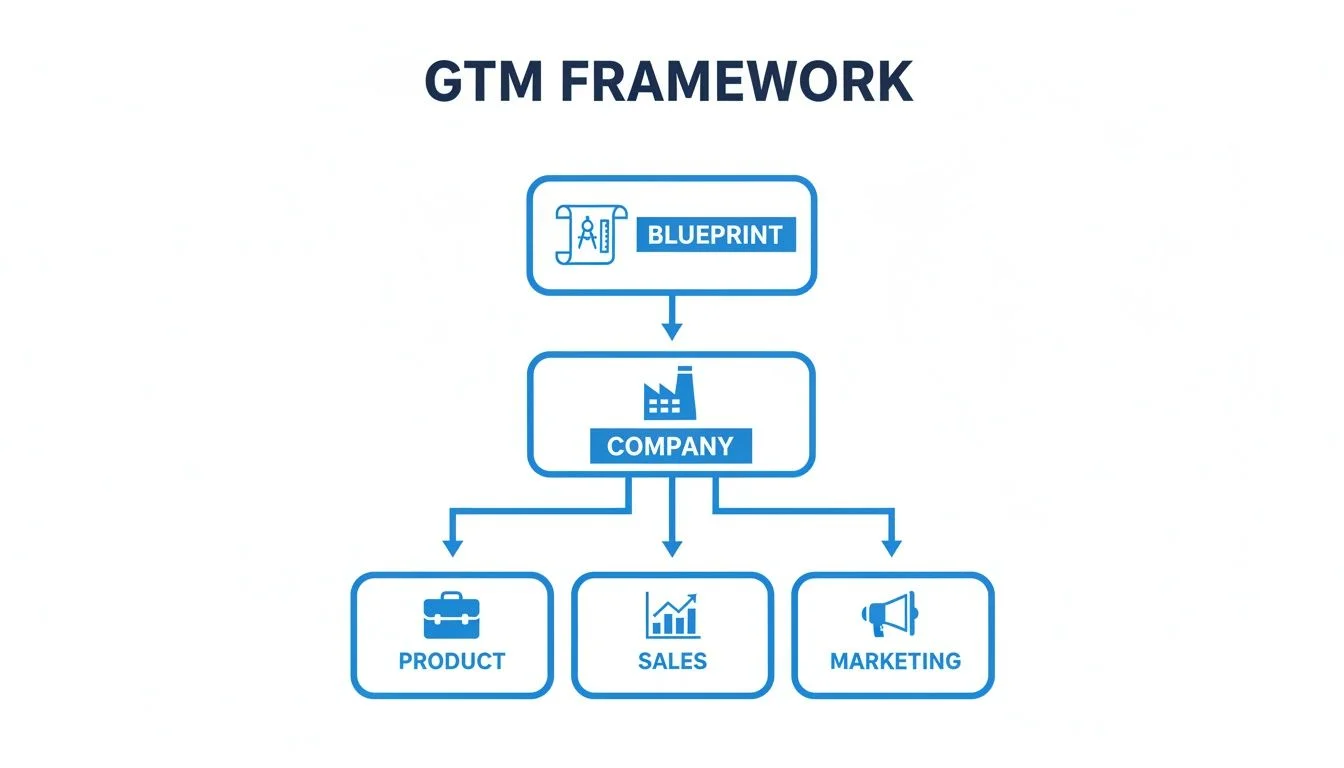
As you can see, a successful launch isn't about one team doing a great job. It's about total alignment, from high-level strategy to on-the-ground execution.
The Eight Pillars of a Modern GTM Strategy
Let's unpack the eight pillars that make a GTM framework repeatable and robust. Don't think of these as a simple checklist. They're a series of critical conversations you need to have across your organization.
- 1. Ideal Customer Profile (ICP): This is way more than just demographics. It’s about getting inside the head of your perfect customer. What keeps them up at night? What "job" are they really hiring your product to do? A crystal-clear ICP makes every other decision ten times easier.
- 2. Product-Market Fit Validation: This is the moment of truth. Does your product actually solve your ICP's problem in a way they’ll happily pay for? This stage is all about testing, listening to feedback, and tweaking your offer until the answer is a definite "yes."
- 3. Pricing and Positioning: This is where you claim your spot in the market. It's not just about picking a number; it’s about signaling your product's value. Your price has to match the value you provide and the brand image you want to project.
So many companies make the mistake of pricing based on their costs or what a competitor is doing. Smart pricing is a reflection of the value you deliver to a specific customer. It’s a powerful positioning tool all on its own.
Figuring out the right pricing model can be tricky. For a deeper dive into structuring tiers and communicating value, exploring different pricing strategies and plans can give you some much-needed clarity.
- 4. Distribution Channels: How will customers actually find and buy your product? This means figuring out the most direct paths to your audience, whether that’s through direct sales, strategic partnerships, online marketplaces, or a product-led growth model. The goal is simple: be where your customers already are.
- 5. Core Messaging and Content: Now that you know who you're talking to and how you're positioned, what exactly are you going to say? Here, you’ll craft your core value proposition and a messaging framework that connects with your audience. This work becomes the source code for everything you create, from website copy to sales pitches.
- 6. Tactical Launch Plan: This is the detailed "who, what, when" of your launch. It’s a project plan that maps out every activity before, during, and after your launch day, from the first PR outreach to the final post-launch customer check-in.
- 7. Sales and Support Enablement: Your customer-facing teams can't win without the right tools and training. This pillar is all about equipping your sales team to sell effectively and preparing your support team to handle any question that comes their way. Think battle cards, training guides, and clear help docs.
- 8. Success Metrics and KPIs: How do you know if you've actually won? This final piece is where you define the key performance indicators (KPIs) you'll live by. These metrics must cover the entire customer journey, from initial awareness all the way to revenue and long-term retention.
By working through each of these eight components, you build a complete and aligned go to market strategy framework. This structured approach makes sure no stone is unturned, turning your launch into a coordinated effort designed for maximum impact and real, sustainable growth. It gives every team the clarity they need to work together toward a single definition of success.
Nailing Your Ideal Customer Profile and Market

It’s an old saying, but it holds true: if you try to sell to everyone, you end up selling to no one. This is probably the single biggest reason promising products never quite get off the ground. That’s why the very first, most crucial piece of your go-to-market strategy framework is getting crystal clear on who your customer is, and just as importantly, who they aren’t. This is where you build your Ideal Customer Profile (ICP).
An ICP isn’t some vague demographic like "men aged 25-40." Think of it more like a detailed portrait of the one person or company that needs your product most. They’re the ones feeling the exact pain you solve, getting the most value from your solution, and ultimately being the most profitable to bring on board. Without a sharp ICP, everything else, your messaging, your pricing, your entire launch, is built on shaky ground.
From Vague Demographics to Real-World Pains
To build an ICP that actually works, you have to go deeper than surface-level details. You need to genuinely understand your customer's world. This means digging past the basic demographics and getting into the psychographics, the stuff that really drives them.
Start by asking these kinds of questions:
- Job to Be Done: Forget your product for a minute. What’s the real goal they're trying to achieve in their work or life?
- Pains: What are the specific headaches, roadblocks, and anxieties they run into while trying to get that job done? What’s keeping them up at night?
- Gains: What does a "win" look like for them? What are the concrete results and emotional relief they're searching for?
- Watering Holes: Where do they hang out, both online and off? What blogs do they follow, which podcasts are in their library, and what communities are they active in?
Getting this level of detail turns your ICP from a boring spreadsheet into a real character you can actually talk to.
The Power of a Disciplined ICP
Defining your ICP isn't just a thought exercise; it's a strategic move that has a massive impact on your growth. Recent 2025 go-to-market research shows a huge gap: companies with disciplined ICPs scaled 4x faster in 2024-2025, hitting $4M in annual recurring revenue with a 50% lower customer acquisition cost. The data highlights a major market shift, where being smart with your capital is no longer optional. In fact, 70% of VC-funded startups are now focused on building these kinds of defensible, efficient growth strategies.
The goal is to define a customer profile so precise that when they encounter your marketing, they feel like you’ve been reading their diary. That’s when you know you’ve nailed your ICP.
Once you have a first draft of your ICP, it's time to test it. Get on the phone with people who fit the profile. Ask them about their daily frustrations and goals. Do their real-world problems line up with your assumptions? This firsthand feedback is pure gold.
As you gather these insights, you can start collecting visitor information on your site to see if the people showing up match your ideal profile. Using tools like FOMOchat's pop-ups and chat widgets is a great way to segment your audience and validate your ICP in real time. When you combine hard data with real human stories, you build an ICP that is not only accurate but truly actionable.
Putting Your GTM Strategy Into Action
Knowing the theory behind a go-to-market strategy framework is great, but the real test is applying it in the wild. Think of the framework not as a rigid set of instructions, but as a flexible map. It helps you pick the right roads (tactics) to get to your destination, based on your unique product and the people you're trying to reach.
When it comes to the tools that power your launch, see our guide to the best AI tools for marketers in 2026.
Let's see how this works by running our eight core components through three totally different business models: a SaaS product, an online course, and a high-ticket webinar. You'll quickly see how the same strategic questions can lead to vastly different game plans.
For high-ticket webinar launches in particular, tools like FOMOchat can add real-time social proof to registration pages, showing live visitor activity and pre-answering common objections through an AI-powered chat widget.
Example 1: The SaaS Product
Let’s say you’re launching a new project management tool built specifically for small, remote-first marketing agencies. Your entire go-to-market strategy framework needs to be laser-focused on this niche.
- Audience: You're not trying to sell to everyone. You’re selling to "Maria," the owner of a marketing agency with 5-15 employees. Her biggest headache is the chaos of managing projects through spreadsheets and email, which is costing her team time and money.
- Positioning: This isn't just another project tool. You're "The Asana for lean marketing agencies." Your angle is simplicity and intuition, a direct contrast to the clunky, overly complex enterprise software she’s seen before.
- Pricing: A product-led growth model makes the most sense here, so you offer a 14-day free trial. Pricing is tiered by users and projects, with a "Pro" plan that unlocks a client collaboration portal, a killer feature for your target customer.
- Channels: Where does Maria find new tools? She listens to marketing podcasts, hangs out in LinkedIn groups for agency owners, and checks out review sites like Capterra. So, your channel mix will lean heavily into content marketing, hyper-targeted LinkedIn ads, and getting positive reviews on those key platforms.
A huge part of this is building out campaigns for effective lead generation to get your tool in front of people like Maria.
I’ve seen so many SaaS launches fall flat because they nail top-of-funnel awareness but completely drop the ball on converting that interest. For a SaaS business, your pricing page is where the money is made or lost. Every tactic should be obsessed with getting people over that final hurdle.
For example, a visitor on your pricing page is on the fence. A small FOMOchat notification that says, "Over 50 agency owners started a trial this week" can be just the nudge they need. It’s powerful social proof that builds immediate confidence.
Example 2: The Online Course
Now, what if you're not selling software? Let's look at an online course that teaches freelance writers how to find high-paying clients. The core framework holds up, but the tactics look completely different.
- Audience: Your ideal student is "David," a freelance writer with a year or two of experience. He's a talented writer but a total novice at business, stuck taking low-paying jobs from content mills.
- Messaging: The message isn't "learn to write better." It's "escape the content mill trap and build a six-figure freelance business." It’s all about the transformation and the tangible financial outcome.
- Launch Cadence: Instead of being always available, you’ll use an "open/close cart" launch model to create genuine urgency. The lead-up will include a free 5-day email challenge that gives away real value, building trust and positioning you as an expert long before you ask for the sale.
During that short enrollment window, you could embed an AI-powered chatbot on your sales page. If you're new to this, you can learn about creating your first FOMOchat and see how quickly you can get one running. Train it on your course content and testimonials, and it can instantly answer questions like, "Do you cover contract negotiation?" or "Is there a money-back guarantee?", clearing up doubts that might otherwise cost you a sale.
Example 3: The High-Ticket Webinar
Finally, picture a high-ticket webinar teaching financial advisors how to use social media for client acquisition. This is a game of exclusivity and personal touch.
- Audience: The target is an established financial advisor who is a master of their craft but a beginner in digital marketing.
- Pricing: This isn't a cheap, mass-market webinar. It’s a $1,500 live training session capped at 20 attendees to guarantee personal attention. The high price itself acts as a filter, attracting only serious professionals.
- Channels: These folks aren't scrolling for online courses. You find them through professional networks, high-level industry masterminds, and direct, personal outreach on platforms like LinkedIn.
GTM Strategy Application Comparison
This table contrasts the specific tactics used for different product types within the same GTM framework, showcasing its flexibility.
| GTM Component | SaaS Product Tactic | Online Course Tactic | Webinar Tactic |
|---|---|---|---|
| Pricing | Monthly subscription with a free trial | One-time payment with a payment plan | High-ticket, one-time fee |
| Channel | Product review sites, targeted ads | Email marketing, social media groups | LinkedIn outreach, industry partnerships |
| Launch | Evergreen, always available for sign-up | Open/close cart model twice a year | Application-only, offered quarterly |
As you can see, your go-to-market strategy framework gives you the blueprint. It’s your business model and your audience that tell you which materials to build with. By consistently working through these core questions, you can craft a smart, effective plan for anything you want to bring to market.
How to Measure Success and Iterate Your Strategy
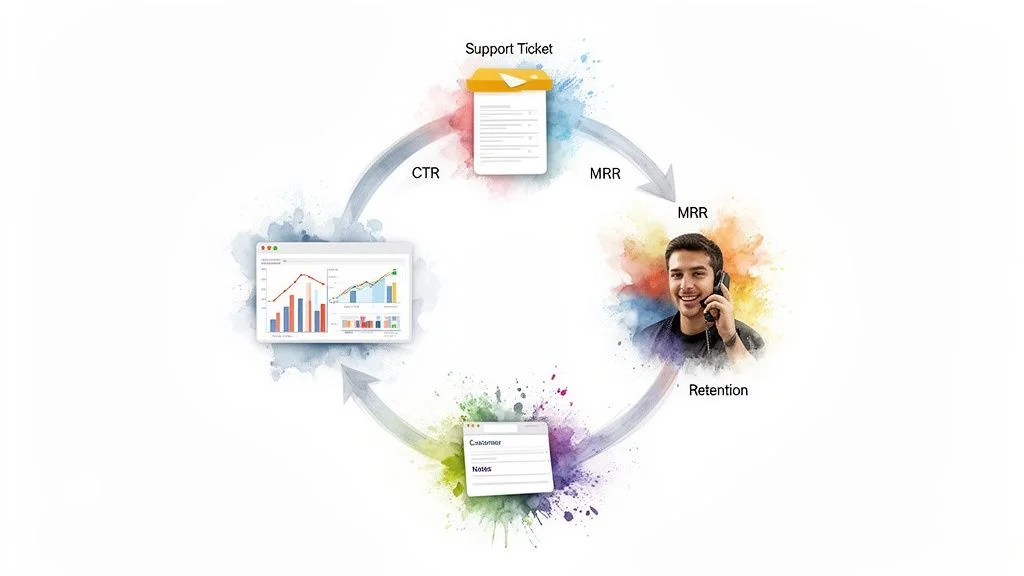
Your go-to-market strategy isn't something you create, frame, and hang on the wall. Launch day is just the starting line. The real work starts the moment you get your first click, sign-up, or sale.
Think of your initial strategy as a well-researched hypothesis. You've made your best guess about your audience, message, and channels. Now, it’s time to see how that hypothesis holds up in the real world. This cycle of measuring, learning, and tweaking is what turns a single good launch into a repeatable engine for growth.
Identifying Your Key Performance Indicators
You can't tell if you're winning if you don't define the score. Before you launch, you need to decide exactly what success looks like by defining your key performance indicators (KPIs). These numbers should give you a clear view of the entire customer journey, not just one part of it.
For context on what conversion metrics actually mean in practice, see our breakdown of what is a good conversion rate.
Your most important metrics will fall into a few key stages:
- Awareness Metrics: Are people even seeing your stuff? Keep an eye on top-of-funnel numbers like website traffic, social media engagement, and brand mentions.
- Acquisition Metrics: This is all about turning lookers into leads. The big ones here are lead generation volume, trial sign-ups, and, crucially, your Customer Acquisition Cost (CAC).
- Revenue Metrics: Is this thing actually making money? You have to watch your conversion rates, Average Revenue Per User (ARPU), and the all-important Monthly Recurring Revenue (MRR).
- Retention Metrics: It costs a lot less to keep a customer than to find a new one. Pay close attention to your customer churn rate, Customer Lifetime Value (LTV), and Net Promoter Score (NPS).
Setting clear targets for these KPIs before you launch gives you an immediate benchmark. This data-first approach takes the emotion out of it and helps you see what's really working. For a closer look at tracking these numbers, see how to use the FOMOchat analytics dashboard to monitor engagement and conversions in real-time.
Creating a Feedback Loop for Iteration
Your KPIs will tell you what is happening. For instance, you might see that your trial sign-ups are low. But they won't tell you why. To get the full story, you need to pair that quantitative data with qualitative feedback from real people.
Your first customers are your most important source of market intelligence. The insights they share, whether in a support ticket, a sales call, or a product review, are pure gold. Your job is to systematically collect, analyze, and act on that gold.
This feedback is everywhere if you know where to look:
- Sales Call Recordings: Listen to how prospects actually talk. Do they use the same words you do? Are their pain points what you thought they were? Their reactions to your pitch are priceless.
- Support Tickets: This is a goldmine for finding confusing parts of your product or places where your marketing promises didn't quite match reality.
- Customer Interviews: Just ask! Reach out to new customers and talk to them. What almost stopped them from buying? What was the "aha!" moment that sealed the deal?
When you combine the hard data from your dashboards with these real-world stories, you get the complete picture. This is how you make smart, targeted adjustments, refining your messaging, tweaking your pricing, or prioritizing a new feature, and turn a good GTM strategy into a great one.
A Few Common Questions About GTM Strategy
Putting together a go to market strategy framework is a huge undertaking. It forces you to ask tough questions and connect dots across your entire company. Even with a solid plan, a few questions always seem to pop up.
Let's clear up some of the most common ones we hear from teams as they're getting their GTM plans off the ground.
How Is a GTM Strategy Different From a Marketing Plan?
This is, without a doubt, the question I get most often. And it’s a good one, because understanding the difference is crucial.
Think of it like you're building a house.
Your marketing plan is the real estate agent and the staging crew. They’re focused on making the house look amazing, creating stunning brochures, running open houses, and ultimately, getting people excited to make an offer. Their job is to create demand and bring qualified buyers to the door.
Your go-to-market strategy framework is the architect’s full set of blueprints. It starts way earlier. It decides who the house is for (your target audience), where to build it (your market), how much to sell it for (pricing), and what kind of sales team you need to sell it. It even covers the warranty and support you'll offer after the new owners move in (customer success).
A marketing plan is a vital chapter in the story of your launch. A GTM strategy is the whole book. It pulls product, sales, marketing, and support together, all working from the same script.
So, your marketing plan is a key piece of your GTM strategy. But the GTM strategy is the master plan that makes sure the right product finds its way to the right people, in a way that actually works.
How Often Should I Update My Go To Market Strategy?
The biggest mistake you can make is treating your GTM strategy like a stone tablet you file away after launch day. The market doesn’t stand still, and neither should your plan. It needs to be a living, breathing document.
A good rhythm for most companies looks something like this:
- Quarterly Tactical Check-ins: At the end of every quarter, get the team together to review the nuts and bolts. Are your channels hitting their numbers? Is your messaging still landing? Are you seeing the conversion rates you expected? This is where you make smaller adjustments, like shifting ad spend or tweaking email copy.
- Annual Strategic Overhaul: Once a year, it's time to zoom out and look at the big picture. Re-examine the very foundation of your strategy. Has your ideal customer changed? Is your pricing still competitive and aligned with the value you deliver? Has a new competitor completely changed the game?
Of course, don't wait for a scheduled review if something big happens. A new funding round, a pivot in your product, or a major move by a competitor are all clear signals that you need to pull out the strategy and see if it still holds up. If the ground shifts, you need to shift with it.
What Are the Biggest Mistakes to Avoid When Creating a GTM Framework?
I've seen go-to-market strategy frameworks fail for all sorts of reasons, but most breakdowns can be traced back to just a handful of common, and completely avoidable, mistakes. If you know what they are, you can steer clear of them.
Here are the three landmines to watch out for:
- A Fuzzy Ideal Customer Profile (ICP): If you’re even a little bit vague about who you're selling to, every other part of your strategy will suffer. A fuzzy ICP means you'll have weak messaging, you'll waste money on the wrong channels, and you'll end up with a product that doesn't really excite anyone. You have to be ruthless about defining exactly who your customer is.
- Working in Silos: A GTM plan cooked up by the marketing team alone is dead on arrival. If sales and product aren't in the room helping to build it, you'll end up with a customer experience that feels broken. The ads will promise one thing, the sales rep will say another, and the product will do something else entirely. True alignment isn't a nice-to-have; it's everything.
- A "Set It and Forget It" Mindset: Your launch day is just the beginning. A GTM strategy that doesn't include a plan for tracking metrics and listening to customer feedback is like launching a ship without a rudder. You have no idea if you're on course or sailing straight toward the rocks.
Dodging these traps isn't complicated, but it does take discipline. Focus on a crystal-clear ICP, demand real collaboration between your teams, and build a culture of constantly measuring and improving. That’s how you turn a GTM plan from a document into a real engine for growth.
Ready to turn more website visitors into customers? FOMOchat uses AI and social proof to answer questions and build trust, helping you convert traffic from your GTM efforts. Learn how FOMOchat can boost your launch today.
Earning that trust starts well before the first sale. Our guide on how to build trust with customers covers the specific signals buyers look for.