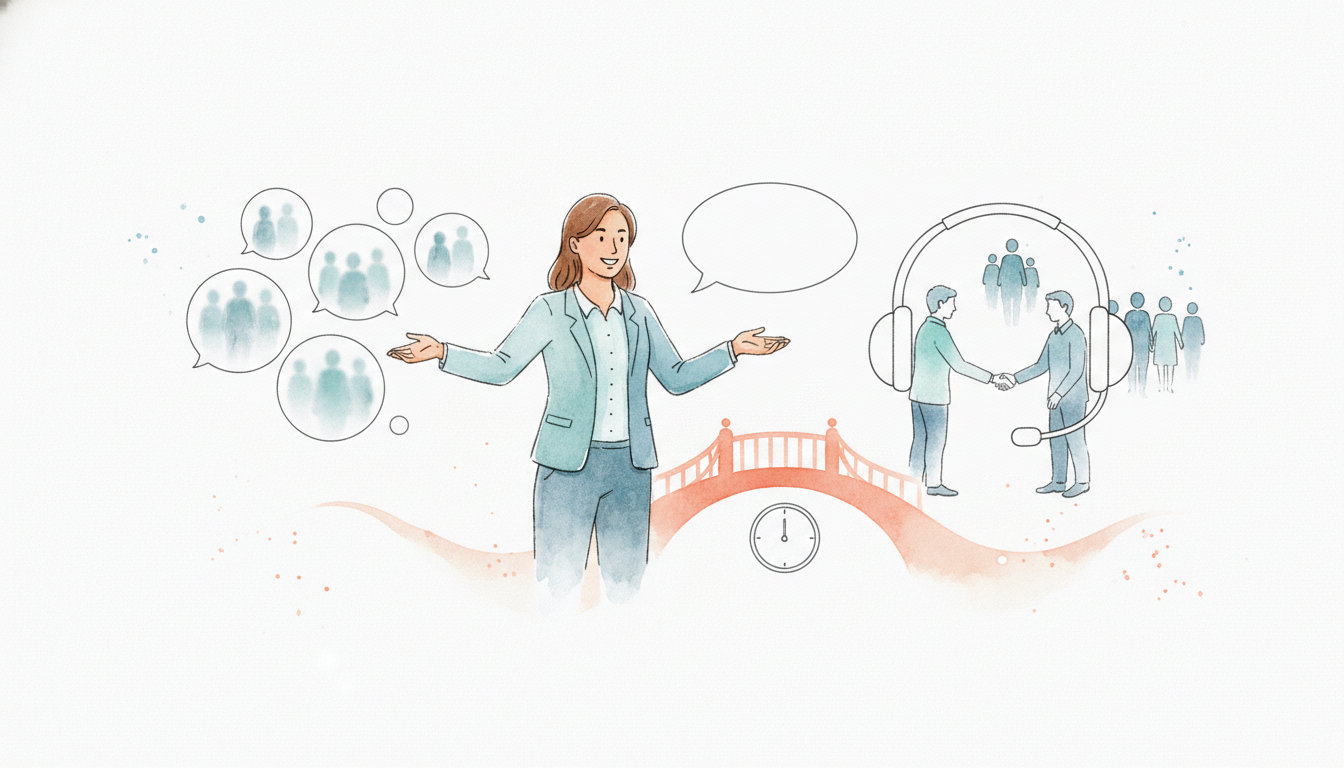
Chatbots win when you need instant, consistent handling for routine questions. Live chat wins when human trust and nuanced guidance protect a high-value conversion, so neither channel is always better.
The counterintuitive evidence is that automation can scale without sacrificing the handoff experience. A 2025 benchmark covering 220 million live chat interactions found that chatbot-to-agent handoffs still reached 92.6% CSAT, even while AI chatbot handling reached 75.3% and wait times for large teams fell by 37.5% (Elfsight's 2025 chatbot versus live chat benchmark). The winning question isn't “Which tool should we install?” It's which conversation should start with automation, and which moment deserves a person.
Why This Comparison Matters for Conversions
Chat support sits directly on the path between interest and action. A visitor on a pricing page may need a quick answer about billing, while a prospect evaluating implementation risk may need reassurance from someone who understands the product. Treating both visitors alike creates friction in opposite directions: a human team wastes time on repetitive questions, while a bot can make a serious buyer feel abandoned.
The choice affects more than customer service. On a SaaS product page, chat can clarify integrations before a trial starts. During a product launch, it can handle repeated availability questions while a specialist addresses objections. In a webinar, a prompt answer can keep attention focused on the offer instead of sending attendees to search through a help center.

The conversion cost of the wrong channel
A chatbot removes waiting and creates consistency. Live chat adds judgment, empathy, and credibility. Neither benefit matters if it appears at the wrong stage. When you're weighing tools, our roundups of the best AI chatbot for websites and best live chat software for small business can help you match channel to stage instead of buying features you won't use.
Use a bot to collect context before a conversation reaches an agent, much like the workflow described in FOMOchat's guide to collecting visitor information. Ask what the visitor wants, identify the relevant product or plan, and pass that context forward. A human can then spend the conversation resolving uncertainty instead of repeating intake questions.
Practical rule: Put automation where delay is costly and the question is predictable. Put a person where trust, risk, or personal judgment can change the decision.
Success also needs a sharper definition than “more chats answered.” For a support team, it may mean fewer unresolved routine requests. For a course creator, it may mean more enrollments from visitors who need reassurance about fit. For a growth marketer, it may mean preserving momentum on a launch page. The right channel is the one that improves the next business action, not the one with the longest feature list.
What Is a Chatbot and What Is Live Chat
A chatbot is software that conducts a conversation through predefined rules, an AI model, or both. It can answer recurring questions, qualify a visitor, retrieve approved information, and guide someone through a simple path without an agent participating in every exchange.
A live chat tool connects the visitor with a human agent in real time. The agent can interpret unusual wording, ask follow-up questions, adjust tone, and make a judgment when the answer isn't contained in a script. That flexibility is the main reason live chat remains valuable on high-consideration pages.

Classify the conversation before choosing the tool
Start with the visitor's intent, not the vendor's feature list.
- Routine intent: Delivery status, account access, basic eligibility, and known product questions usually fit automation.
- Exploratory intent: A visitor comparing plans or asking how a workflow works may benefit from a bot that gathers context, followed by an agent when uncertainty remains.
- High-stakes intent: Pricing exceptions, migration concerns, complaints, sensitive situations, and purchase objections usually need a person.
The distinction isn't absolute. A well-designed chatbot should offer an obvious route to a human, while a live agent can use automated prompts, knowledge retrieval, and pre-chat questions to work faster. That combined approach is covered well in resources on live chat benefits for sales teams, particularly when sales conversations need both speed and personal judgment.
Operational boundaries matter
Chatbots scale conversations horizontally. They can respond to many visitors at once and maintain the same approved wording. Their weakness appears when the visitor's intent falls outside the information and guardrails they were given.
Live chat scales through staffing, training, and queue control. An agent can handle ambiguity more effectively, but availability is limited by schedules and concurrent conversations. Your decision should reflect the shape of demand: repetitive volume favors automation, while nuanced intent justifies human capacity.
Head-to-Head Comparison Criteria
A chatbot versus live chat decision should follow the conversion job of each page, not a feature checklist. Response speed earns attention, trust reduces hesitation, and social proof matters most when visitors are close to committing. Compare both channels against those conditions.
Response time
Chatbots respond immediately for supported questions, which protects conversions on high-traffic pages and during short evaluation windows. Live chat can create the same sense of access, but only when staffing and queues keep response times short. A delayed agent is not a human advantage. It is a new source of friction.
Scalability
Automation handles many routine conversations at once without expanding the service team. Live chat provides richer guidance, yet capacity depends on schedules, concurrent conversations, and queue control. Use the chatbot to absorb predictable demand, then reserve human capacity for conversations where uncertainty threatens the sale.
Personalization
A bot can use visitor details, page context, and approved product information to guide the next step. An agent can interpret hesitation, change the explanation, and respond to emotional cues. That difference matters on comparison and checkout pages, where a generic answer can leave an objection unresolved.
Support quality
Chatbots perform best when the question has a stable answer and clear classification. Agents perform better when the visitor needs diagnosis, negotiation, reassurance, or an exception. A confident but incomplete bot response can reduce trust more than a slower, accurate human reply.
Implementation complexity
Chatbot programs require content, intent design, escalation rules, testing, and regular updates. Live chat requires staffing, training, routing, quality review, and queue coverage. Choose the operational burden your team can sustain, not the channel that looks simpler in a demo.
| Criterion | Chatbot | Live chat |
|---|---|---|
| Speed | Immediate for supported intents | Depends on queue and agent availability |
| Volume | Strong for simultaneous routine requests | Constrained by team capacity |
| Nuance | Limited by context and guardrails | Stronger for ambiguity and objections |
| Trust | Consistent, but can feel impersonal | More reassuring in sensitive moments |
| Conversion role | Qualifies, answers, and routes | Reassures, explains, and closes |
| Main risk | Incorrect or repetitive responses | Delays, inconsistency, and staffing strain |
The comparison points to a clear operating model: automate fast answers where repetition dominates, and hand off when trust, judgment, or purchase risk becomes the conversion barrier. Elfsight's benchmark analysis supports evaluating automation by its effect on capacity and escalation quality, rather than treating chatbot volume as the sole success measure. Teams should assign the first response and handoff rules page by page, then measure completed actions, qualified conversations, and assisted conversions.
Use Cases Where Each Channel Wins
The right channel changes with the page, the visitor's intent, and the cost of hesitation. A support center, a pricing page, and a live webinar shouldn't all use the same conversation design.

Customer support
Use a chatbot for repetitive questions such as account navigation, policy information, and basic status checks. It can give customers a fast first response and keep agents available for cases involving multiple systems, unusual circumstances, or frustration.
Live chat earns its place when the customer needs diagnosis rather than retrieval. A billing problem, a failed integration, or a complaint needs someone who can understand the full context and own the next step.
Sales inquiries
On a product page, a chatbot can ask qualifying questions and direct visitors to the right plan or resource. It can also identify buying intent and collect details before routing the conversation. For lead-focused setups, see our guide to the best chatbot for lead generation.
A live agent should handle pricing ambiguity, procurement concerns, implementation risk, and competitive comparisons. These questions often contain an unstated objection. A human can address the concern instead of returning another generic product description.
Webinar engagement
A chatbot can send reminders, answer predictable logistical questions, and guide attendees to relevant resources. Live chat is more valuable during the presentation when attendees ask questions tied to the speaker's argument or need reassurance before registering.
A synchronized conversation can make the difference between passive viewing and active participation. Tools like FOMOchat lean into that moment with conversational widgets and real-time social proof so attendees see questions answered in context, not just another notification popup. The following video offers a visual reference for how chat can support engagement across a customer journey.
Product launches and guidance
Launch pages often receive bursts of similar questions. Let the bot cover availability, core capabilities, and basic setup, then route visitors who ask about migration, internal approval, or fit.
The same rule applies to courses and high-consideration purchases. Automation can explain the offer, but a person should step in when the visitor needs a personalized recommendation or doubts whether the solution will work for their situation.
Live-agent speed still matters. Independent benchmark reporting found overall response times around 44.8 seconds, with top-quartile teams achieving first responses in under 10 seconds while bottom-quartile teams exceeded 2 minutes (Comm100's 2025 live chat benchmark report). A human channel only protects conversion when the team can keep the queue under control.
Performance and ROI Benchmarks
ROI follows the job assigned to each channel. A chatbot earns its place by handling repeatable questions without consuming agent hours. Live chat earns its cost on pages where a timely human response can protect a high-value decision. Judge both channels by assisted revenue and customer outcomes, not activity volume alone.
The strongest benchmark here is resolution quality within a defined scope. Across 220 million interactions, AI chatbots resolved 44.8% of the chats they handled. Smaller teams with 1 to 5 agents routed 54.3% of chats to automation and resolved 89.0% of those routed chats, according to Lorikeet's analysis of AI support resolution rates. Use automation for stable, low-complexity intents, then hand off questions involving fit, risk, or purchase approval.

Resolution is only one outcome
A bot can resolve a policy question. An agent can resolve a complex issue while preventing churn or helping a prospect choose the right plan. Those outcomes carry different commercial value, so automation rate alone can reward the wrong behavior.
Set metrics by page intent:
- Support pages: Resolution quality, accurate escalation, and customer satisfaction.
- Pricing pages: Qualified conversations, assisted trials, and completed purchases.
- Launch pages: Objection handling, lead capture, and post-chat conversion.
- Webinars: Questions answered, engagement during the pitch, and registrations.
Live chat performs well when response speed supports trust. A separate benchmark reported an average wait time of 23.6 seconds and live chat CSAT of 79.9%. The cost of a weak queue is lost momentum, especially when a ready buyer receives a shallow answer or repeats information.
Measure the handoff, not only the bot
The channel transition directly affects conversion. Pass the conversation history, visitor intent, viewed page, product or plan under consideration, and supplied details to the agent. The agent can then respond to the decision already in progress instead of restarting discovery.
Use your FOMOchat analytics dashboard or equivalent reporting to compare assisted conversions, escalation rates, response times, satisfaction, and abandonment by page. If the bot resolves routine support requests but escalates pricing objections, that may indicate effective qualification. The right channel is the one that creates the next conversion step at that funnel stage.
Implementation Complexity and Setup Reality
Chatbot setup fails when teams treat it as a copywriting exercise. The system needs a defined scope, reliable source content, explicit escalation rules, and tests based on real visitor questions. Start with a small set of intents, write approved answers, and identify what the bot must never claim.
Build the bot around boundaries
Give the chatbot:
- A narrow first assignment: Begin with recurring questions that have stable answers.
- Trusted context: Use current product, pricing, policy, and event information.
- A safe fallback: Admit uncertainty and route the visitor to a person or resource.
- A clear handoff: Pass the conversation and collected details to the agent.
- A review loop: Examine failed or abandoned conversations and update the content.
Teams often focus on whether the bot sounds natural. Accuracy and routing matter more. A friendly answer that misstates eligibility can create more sales friction than a plain answer that escalates responsibly. Use FOMOchat's guidance on improving AI responses as a practical reference for refining context, guardrails, and response quality.
Live chat has a different setup burden. You need coverage hours, ownership, routing rules, response standards, and coaching. Agents also need access to the information they use during conversations, otherwise a human channel becomes a slower version of a help center.
Keep the first rollout focused. Place the channel on one high-intent page, define the conversion event, and review transcripts with both marketing and support. Expand only after the team knows which questions the bot handles well and which moments consistently need a person.
When to Choose Chatbot vs Live Chat
Choose based on volume, complexity, and consequence.
If the page receives many routine questions and visitors mainly need facts, start with a chatbot. Give it a limited scope, collect useful context, and provide a direct human option when the answer doesn't fit.
If the page attracts fewer but more valuable conversations, start with live chat. This is the right default for enterprise pricing, complex onboarding, migration planning, regulated decisions, or purchases where confidence matters more than instant availability.
A hybrid model is the practical choice for most growth teams. That same bot-plus-human pattern shows up across conversational AI for customer support rollouts, where automation clears the queue and people handle the moments that change the outcome:
- Bot first for orientation: Answer predictable questions and identify intent.
- Human second for uncertainty: Escalate objections, unusual needs, and emotional conversations.
- Context always: Transfer the transcript and visitor details so the agent doesn't restart the exchange.
- Measurement after conversion: Compare assisted actions, not just chat volume.
The handoff deserves its own success metric. Independent benchmark data found that AI chatbots fully resolved 44.8% of conversations, while bot-to-agent handoff satisfaction reached 92.6% in 2025 (Comm100's chatbot resolution analysis). That result points to the design challenge: escalation should feel like progress, not a transfer penalty.
Install the widget only after deciding where it belongs in the journey. Comparing options for the best website chat widget is useful, but placement still beats a long feature list. FOMOchat's widget installation guide can support the technical step, while routing should come from your conversion strategy. A bot on every page may create noise. A carefully timed conversation on a pricing, launch, course, or webinar page can remove a specific barrier to action.
Final Recommendations and Next Steps
A small team with limited agent capacity should begin with a chatbot for repetitive questions and reserve human time for qualified conversations. A larger SaaS team can use automation across support and qualification while staffing live chat around pricing, implementation, and expansion opportunities. A course creator or webinar host should prioritize reassurance and social proof where prospects are deciding whether the offer fits them.
Skip vanity chat counts. Judge the rollout by whether the visitor takes the next valuable action.
A practical test plan
- Choose one page: Start with a pricing page, launch page, course page, or webinar registration page.
- Define one conversion goal: Use a trial start, registration, enrollment, booked conversation, or completed purchase.
- Write escalation rules: List the questions the bot can answer and the signals that require a person.
- Review transcripts weekly: Look for repeated objections, missing context, incorrect answers, and abandoned conversations.
- Balance coverage and quality: Expand automation only when answers remain accurate and the human queue stays useful.
Recent benchmark reporting found that chatbots handled 73.8% of chats in 2024, while live chat satisfaction remained near 79.9%, supporting a focused rather than universal live-chat strategy (Stealth Agents' analysis of human handoffs). Live chat is easier to defend for emotionally charged, high-stakes, or high-intent conversations. It isn't automatically the right answer for every visitor.
FOMOchat fits the hybrid pattern on conversion-focused pages by combining an AI representative trained on website content with interactive group conversations that let visitors see questions and answers in context. Prefer real conversations over static notification popups when you want proof and reassurance in the same thread. Use that experience when instant information, visible engagement, and human-style reassurance need to work together, then measure whether it increases the action that matters for your funnel.
If you're deciding how to balance instant answers with trust on your product pages, launches, courses, or webinars, explore FOMOchat to add an AI representative and interactive social-proof chat to the visitor journey. Start with one high-intent page, define the handoff rules, and use the resulting conversations to improve conversion instead of just adding another support channel.