

At its core, software customer retention is all about one thing: keeping the customers you already have. It’s the art and science of ensuring your users stick around, month after month, because they’re getting real value from your product and simply don't want to leave. This isn't just about preventing them from canceling; it's about turning them into genuine fans of your brand.
Why Software Customer Retention Is Your New Growth Engine
For too long, we’ve been told that growth is all about acquisition. But that’s only half the story. Think of your business as a bucket. Every new customer you win is a splash of water you pour in. But if that bucket is riddled with holes (what we call customer churn) and you'll be working around the clock just to keep the water level from dropping. You're stuck on a treadmill, pouring more resources into marketing and sales without ever actually growing.
This is where retention flips the script. It’s far more profitable to plug the holes in your bucket than it is to keep pouring more water in. In fact, acquiring a brand new customer can be anywhere from five to twenty-five times more expensive than keeping an existing one. That single economic reality changes everything.
The Shift from Acquisition to Retention
A decade ago, the SaaS playbook was simple: acquire customers at all costs. The main game was getting as many sign-ups as you could, as fast as you could. But the market has grown up, and so have the strategies. A loyal customer base is no longer just a "nice-to-have." It's your single most valuable asset.
Happy, long-term customers give you a predictable revenue stream you can build upon. They're also the first to upgrade, try new features, and provide the honest feedback you need to improve. Their success stories become your best marketing tool, which is why top founders now define customer retention with clear metrics, formulas, and strategies as their number one priority.
A mere 5% increase in customer retention can boost profitability by anywhere from 25% to 95%. Think about that. Small, focused efforts to keep your customers happy can have an outsized impact on your bottom line.
Building a Defensible Moat
In today's crowded software market, a competitor can copy your features or undercut your pricing in a heartbeat. What they can't replicate is a thriving community of loyal customers who are deeply invested in your product. That is your ultimate competitive advantage. That's your moat.
When you focus on software customer retention, you build a business that’s not only more profitable but also far more resilient. You can finally step off the hamster wheel of chasing new leads and start building a stable foundation based on real customer success. This journey from a leaky acquisition bucket to a strong, self-sustaining reservoir of loyal users is what separates good companies from great ones. The process starts by understanding the path users take to become customers in the first place, often visualized as a conversion funnel.
The Essential Metrics for Measuring Retention
You can't improve what you don't measure. If you want to get a handle on your software customer retention, you need to know your numbers. Without them, you're just guessing, making changes without knowing if they’re actually working.
Think of these metrics as your company’s vital signs. They give you a clear, honest look at the health of your customer base and tell you exactly where to focus your energy. It might sound complicated, but it really boils down to a few key numbers that tell a powerful story.
This chart drives home the point perfectly. While chasing new customers is always part of the game, holding onto the ones you already have is where real, sustainable growth comes from.
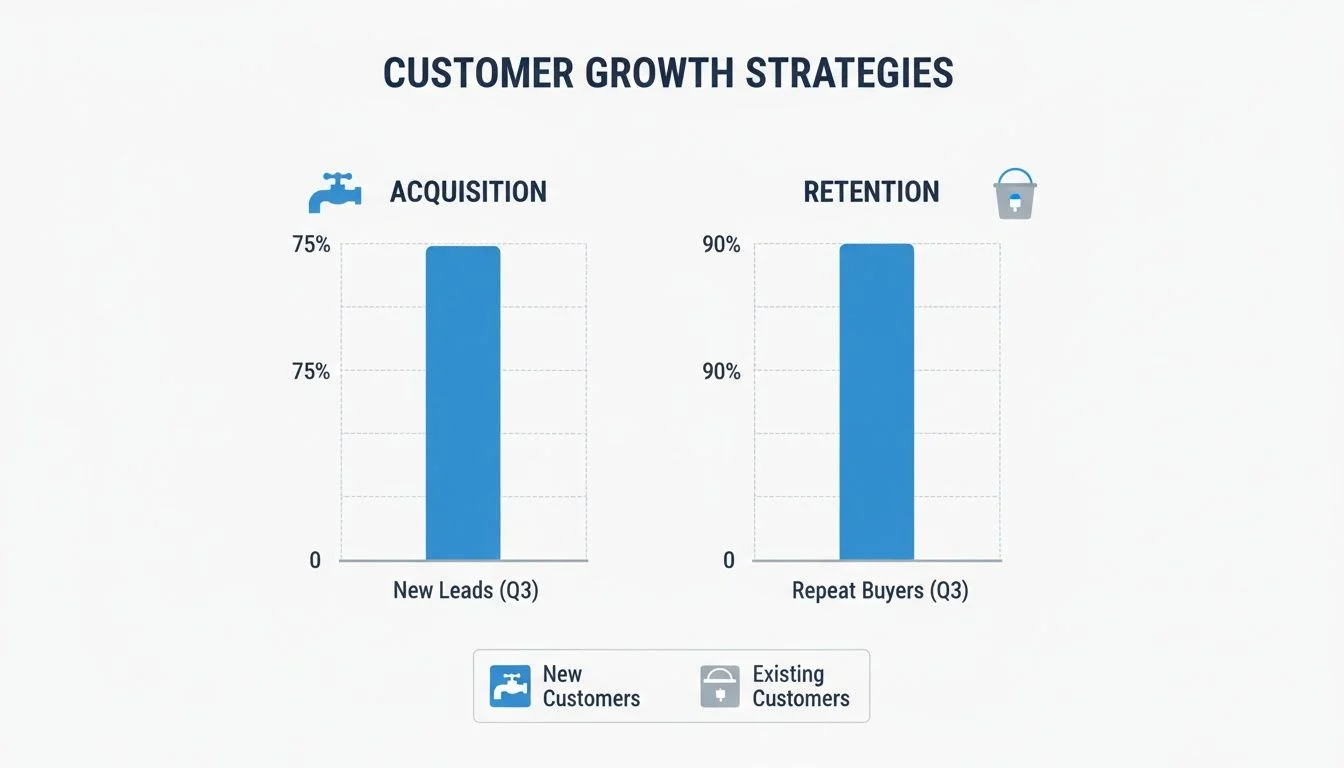
As you can see, the growth potential from keeping your existing customers happy is massive compared to just filling the top of the funnel.
Customer Churn and Retention Rates
Let's start with the basics. The first metric to watch is your Customer Churn Rate. It’s the percentage of customers who leave (by canceling or not renewing) within a set timeframe, like a month or a quarter. If you started the month with 100 customers and 5 of them left, your monthly churn rate is 5%. Simple as that.
The other side of that coin is your Customer Retention Rate. It’s the exact opposite: the percentage of customers who stick around. In our example, if you kept 95 of your 100 customers, your retention rate is 95%. They're two sides of the same story, but tracking both helps paint a complete picture.
But there’s a catch. Losing five customers who pay you $10 a month is a very different problem than losing five enterprise clients who pay you $1,000 a month. That's why you also need to track Revenue Churn. This metric shows you the percentage of monthly recurring revenue (MRR) you’ve lost, giving you a real sense of the financial damage churn is causing.
Customer Lifetime Value: The North Star Metric
While churn and retention tell you what's already happened, Customer Lifetime Value (LTV) helps you look into the future. It’s an estimate of the total revenue you can expect from a customer for as long as they stay with you.
LTV is the ultimate north star for a subscription business. It answers the most important question: How much is a customer truly worth to us over the long run?
A healthy LTV means your customers are happy, staying longer, and buying more. It shifts your focus from short-term wins to building valuable, long-term relationships. The impact is significant. A study by Bain & Company found that even a 5% increase in retention can boost profits by as much as 95%. To see how this journey unfolds, you can explore our guide on the participant lifecycle.
Cohort Analysis: Uncovering Hidden Trends
If you really want to understand what drives retention, you need to dig deeper with Cohort Analysis. This isn't as scary as it sounds. It just means grouping customers by a shared trait, usually when they signed up. You might have a "January cohort," a "February cohort," and so on.
By tracking how each of these groups behaves over time, you can spot trends you’d otherwise miss.
- Maybe your January cohort had an 80% retention rate after six months, but the March cohort only had a 60% retention rate.
- That’s a huge red flag. It tells you that something you did in March (maybe a change to your onboarding, a new feature, or even a competitor's new offer) had a negative impact.
Cohort analysis takes you beyond a single, blended retention number. It lets you see the individual stories of your customer groups, helping you connect your actions to real-world results.
Understanding Why Your Customers Really Leave
If you want to stop customers from leaving, you have to figure out why they're leaving in the first place. A high churn rate is just a symptom; the real work is diagnosing the underlying disease.
Churn rarely happens overnight. It’s almost never one big, dramatic event that sends a customer packing. Instead, it’s usually death by a thousand paper cuts: a series of small frustrations that build up over time until leaving feels like the only logical choice. Your job is to find those friction points before they become fatal.
The Onboarding Experience Goes Wrong
It all starts with that first impression. A clunky, confusing, or just plain boring onboarding process is probably the quickest way to lose someone. People sign up for your software to solve a problem, and if they can't see how to do that right away, they'll just assume your tool is the problem.
This is where you lose them before you ever really have them. They never get to that magical "aha!" moment, the instant they see the value you offer. They get stuck in a maze of settings or an overwhelming interface and churn within days. A Gartner survey backs this up, showing that 24% of software buyers end up canceling their contracts because of things like a slow or painful setup.
Think of onboarding as a guided tour of a new city. If the guide gets you lost on the first day, you're not going to stick around for the rest of the trip. You'll just find another guide.
Failure to Demonstrate Ongoing Value
Okay, so you nailed the onboarding. Great! But the work doesn't stop there. You have to keep showing your customers that your product is worth their time and money, month after month.
This often becomes a problem when users are only scratching the surface of what your software can do. They might be using just one or two features and start wondering if the price tag is really justified. It also happens when you ship new features without telling anyone, or when the product simply doesn't keep up with their evolving needs. You have to make sure your software remains an indispensable part of their workflow, not just another line item on an expense report.
Poor or Unresponsive Customer Support
When a user hits a snag, your support team is their lifeline. And a bad support experience can poison the entire relationship, sometimes instantly. It's often the final straw for a customer who was already on the fence.
These are the classic support failures that drive people away:
- Slow Response Times: Making someone wait hours, or even days, for help sends a clear message: "You're not important to us."
- Impersonal Interactions: Nothing is more frustrating than having to explain your problem over and over again to different support agents.
- Ineffective Resolutions: When the support team can't even solve the problem, it completely shatters a user's trust in your company's competence.
Don't underestimate the damage here. Research shows that after just one negative support experience, more than 50% of customers will take their business to a competitor.
A Mismatch Between Price and Perceived Value
At the end of the day, people leave when they feel the price they're paying no longer matches the value they're getting. It's a simple cost-benefit analysis.
This isn't just about being "too expensive." It's about a gap in perception. If a competitor offers a similar product for less, or if your tool's benefits just don't feel substantial enough to warrant the cost, you're at risk. This is especially true if your pricing is confusing or if customers get hit with surprise fees. Your pricing needs to be transparent and directly tied to the value you deliver. Customers should always feel like they're getting a fair deal.
Proven Playbooks to Keep Your Customers

Knowing why customers churn is half the battle. The other half, the more important half, is doing something about it. This is where you move from analysis to action with structured, repeatable strategies, or 'playbooks,' designed for key moments in the customer journey.
These aren't just vague goals. They are concrete game plans your team can follow to systematically fix the leaks in your customer bucket. By focusing on critical stages like onboarding, engagement, and support, you can build an experience that makes customers want to stick around for the long haul.
The First 30 Days: The Onboarding Playbook
The first month a customer spends with your software is make-or-break. A great start builds a foundation for loyalty, but a confusing or frustrating one is a fast track to churn. The mission is simple: get users to their first "aha!" moment as fast as humanly possible.
A winning onboarding playbook is less about showing off features and more about guiding users to their first small victory.
- Week 1: Guided Activation. Your welcome email should do more than just say hello. It should celebrate their decision and immediately point them to the single most important setup task. Use in-app checklists and guided walkthroughs to make this feel less like a chore and more like a clear path to success.
- Week 2: Reinforce the Value. Now that they're up and running, share case studies or quick tips that open their eyes to what’s possible. You can use targeted in-app messages to nudge them toward a powerful secondary feature they haven't touched yet, tying it directly to a benefit they’ll appreciate.
- Week 3: The Proactive Check-In. Your usage data will tell you who's thriving and who's struggling. Send a personal email to users who seem stuck, offering a hand. This simple gesture proves you're paying attention and are genuinely invested in their success.
Building out a library of educational content, like great corporate training video production, can make a huge difference here, helping users get skilled and satisfied on their own time.
Proactive Engagement and Personalization
Once onboarding is over, the real work begins. You have to shift from just reacting to problems to proactively keeping users engaged and invested. Don't wait for them to get frustrated or slowly drift away; give them the right nudge at just the right time.
Proactive engagement is about knowing what your users need before they do. It’s the difference between being a tool they use and a partner they can’t live without.
This is where personalization truly shines. Nobody pays attention to generic, one-size-fits-all messages anymore. But when you tailor your outreach based on actual user behavior, your communication becomes relevant and impossible to ignore. We dive deeper into this in our guide on the personalization of content.
Here are a few tactics to build into your engagement playbook:
- Lifecycle Email Campaigns: Set up automated emails triggered by what users do (or don't do). If someone hasn't logged in for 14 days, send a friendly email highlighting a new feature or a cool success story to reel them back in.
- Usage-Based In-App Messaging: Celebrate their wins! Did a user just finish their 10th project or invite their 5th teammate? Acknowledge it with a quick, celebratory pop-up. It makes them feel good and reinforces the right behaviors.
- Targeted Feature Announcements: Instead of a mass email blast, segment your audience for new updates. Only tell the users who will actually benefit from a new feature, and be sure to explain exactly how it solves a problem they face.
The AI-Powered Support and Community Playbook
Today, keeping customers happy means delivering instant, smart support and creating a real sense of community. When someone has a question, they want an answer now, not tomorrow. AI is the key to delivering that instant gratification while freeing up your support team for trickier issues.
An AI chat agent, for example, can be trained on your help docs to answer common questions 24/7. This not only gets customers unstuck faster but also helps you scale support without piling on headcount.
These smarter strategies are clearly working. Across the industry, SaaS companies are seeing average customer retention rates climb to an impressive 77%, largely thanks to better, automated onboarding. With B2B companies holding onto about 82% of their customers over 12 months, every single percentage point counts, especially when a new enterprise customer can cost $1,847 to acquire. Check out more of these customer retention rate benchmarks to see where you stand.
Beyond just answering questions, modern tools help build a living, breathing community. For instance, an interactive group chat widget like FOMOchat shows new visitors that real people are getting help and finding value right now. This social proof transforms a lonely user journey into a shared experience, making your product feel less like a tool and more like an active community they belong to.
How Community and Social Proof Create Stickiness

Great features and solid support are must-haves for software customer retention, but they aren't the whole story. The real secret to making your product "sticky" isn't about the code. It's about people. When customers feel like they're part of something bigger, your tool stops being just a utility and becomes a vital part of their professional life.
Think about it this way: leaving your platform should feel like leaving a club you love, not just canceling another subscription. This powerful sense of loyalty comes from two key ingredients: community and social proof. When you nail these, you create a bond with users that your competitors simply can't copy.
Turn Users Into a Community
A thriving user community gives your customers a place to connect, trade secrets, and help each other out. This creates a powerful sense of belonging that directly ties into retention. Customers who are active in a community feel more invested and are way less likely to bail the first time they get stuck.
You can foster this environment in a few different ways:
- Dedicated Forums: The classic go-to. A space where users can post questions, share their wins, and get to know their peers.
- User Groups: Whether it's a virtual meetup or a local get-together, these events help customers network and learn in a more personal way.
- In-App Social Features: Building community elements right into your software makes interaction feel natural and immediate.
When customers feel connected to each other, their loyalty expands beyond just your product. They become loyal to the entire world you've built around it.
The Power of Social Proof and FOMO
Have you ever joined a busy restaurant over an empty one? That’s social proof in action. We’re wired to follow the crowd, assuming that if others are doing something, it must be the right thing to do. For software, this means showing new and potential users that real people are already using and loving your product. It builds instant trust.
When a new user logs in and sees a lively, active community, it immediately validates their decision to sign up. It’s a powerful signal that says, "You're in the right place. Smart people are getting real value here."
This is also a great way to create a little positive "fear of missing out" (FOMO). When someone sees notifications that others are signing up, hitting milestones, or getting quick answers, it creates a natural urge to jump in and participate. Nobody wants to be left on the sidelines while others are succeeding.
Making Stickiness Actionable with the Right Features
So, how do you translate these psychological principles into actual features? The table below connects common retention-focused features to the real benefits they provide for both your customers and your business.
Connecting Retention Features to Business Impact
| Retention Feature | Customer Benefit (Why they care) | Business Impact (Why you care) |
|---|---|---|
| In-App Community Forum | "I can get help from peers and share my expertise." | Higher engagement, lower support costs, user-generated content. |
| Live Social Proof Notifications | "I see that other people like me are signing up and succeeding." | Increased conversions, reduced buyer's remorse, builds trust. |
| User-Generated Content (e.g., templates) | "I can use proven resources from the community to get started faster." | Faster time-to-value for new users, deeper product adoption. |
| AI-Powered Group Chat | "I can get instant answers and see what others are asking." | Instant support reduces friction, creates a sense of a busy and helpful community. |
| Gamification (Badges, Leaderboards) | "My contributions are recognized, and I feel a sense of accomplishment." | Encourages valuable user behaviors, creates "super-users," and boosts engagement. |
These features aren't just bells and whistles; they are strategic tools that reinforce the value of your platform every time a user logs in. They prove that your software isn't just a product. It's a destination.
Turning Lookers Into Lifelong Customers
You don't need a massive team to create this sense of community. Modern tools like FOMOchat can build this atmosphere right into your website. An AI-driven group chat widget, for example, can create the look and feel of authentic engagement, showing new visitors that others are getting their questions answered and finding value in real time.
This approach is brilliant because it blends support and social proof into a single, seamless experience.
- It Answers Questions Instantly: The AI handles common queries on the spot, so users don't have to open a support ticket and wait.
- It Demonstrates Activity: The visible chat stream proves your product is alive with active, happy customers.
- It Reduces Friction: Seeing others ask questions makes new users feel more comfortable asking their own, which helps them find value faster.
By building a visible hub of activity, you make your product feel like an exclusive and dynamic environment. Customers aren't just buying software; they're getting access to a community. You can discover more about the best social proof tools for 2026 in our detailed guide.
All the theory in the world is great, but nothing beats seeing retention strategies play out in the wild. Let's move from the abstract to the concrete and look at a couple of companies that have absolutely nailed it.
These brands haven't just reduced churn; they've built loyalty by making their products and experiences feel essential. It’s less about locking people in and more about creating something they never want to leave.
How Asana Becomes Essential
If you’ve ever used Asana, you know how quickly it can become part of your team's DNA. This isn't an accident. Their entire approach is a masterclass in making a product indispensable, starting from the very first click.
Asana’s onboarding is brilliantly simple. It guides you to create a task and a project right away, giving you that immediate "Aha!" moment where you see the value. But that’s just the hook.
The real magic happens over time. Asana consistently rolls out features that solve real-world workflow problems: new project views, more powerful integrations, and smart automations. The product grows right alongside your team's needs. Before you know it, Asana isn't just a to-do list; it’s the operational hub for your entire company. The thought of switching and losing all that embedded workflow and history becomes a massive headache, making churn highly unlikely.
The Key Lesson: A product that evolves with its customers becomes a partner, not just a piece of software. Continuously solving their next problem makes you irreplaceable.
How Sephora Builds an Invested Community
Okay, Sephora isn't a typical software company, but their Beauty Insider program is a phenomenal example of building a retention-driving community. It’s a strategy any software business can learn from.
The program cleverly gamifies the shopping experience. Customers earn points with every purchase, which unlocks status tiers like VIB and Rouge. These tiers come with real perks: exclusive access to products, special events, and better deals.
This creates a powerful sense of investment and belonging. Why shop anywhere else when you’d lose your status and miss out on all the benefits you’ve earned? Their mobile app doubles down on this by offering personalized suggestions and a community forum where members connect and share advice. It transforms a simple transactional relationship into a genuine emotional connection with the brand.
The Key Lesson: Give your customers something to invest in beyond just the product itself. Status, community, and a feeling of belonging create powerful emotional ties that make leaving feel like a personal loss.
A Few Common Questions About Software Retention
Even after laying out the whole playbook, a few common questions always seem to pop up. Let's tackle some of the big ones we hear all the time so you can clear up any confusion and get to work.
What Is a Good Retention Rate for Software?
Everyone wants 100% retention, but that's just not realistic. So, what’s a "good" number to aim for? In the software world, a solid annual retention rate hovers around 77%.
But don't get too fixated on that one number. The industry you're in matters a lot. For instance,, media and professional services often hit closer to 84%. The real goal is to beat your own baseline. If you move the needle from 70% to 75%, that's a huge victory. It proves what you're doing is actually working.
How Long Does It Take to See Retention Improve?
You won't fix churn overnight, but you also won't have to wait a year to see progress. Generally speaking, if you put a focused retention strategy in place, you should start seeing a real impact within 3 to 6 months.
The first signs of life usually show up in your leading metrics, things like better engagement or higher customer satisfaction scores. The big lift in your main retention rate comes later, as all those small, positive experiences start to add up.
How Does Customer Education Impact Retention?
Customer education is a secret weapon for keeping users around. When people genuinely understand how to get the most out of your product, its value skyrockets for them. It stops being just another tool and becomes essential to how they work.
- Quicker "Aha!" Moments: Great tutorials and walkthroughs help new users find that moment of magic right away, which is critical for preventing them from churning in the first 30 days.
- Deeper Product Adoption: Educated users don't just stick to the basics. They explore more advanced features, embedding your software deeper into their routines and making it much harder to leave.
- Lighter Support Load: When people can find answers themselves in a knowledge base or training video, they feel more capable and have a much smoother experience.
It’s simple, really. An educated customer is a successful customer, and successful customers are the ones who stick around for the long haul.
Ready to turn passive visitors into an active, engaged community? FOMOchat uses AI-powered social proof to show prospects that others are finding value in real-time, building trust and urgency that drives conversions. See how it works.