

When a prospect hits you with an objection, your first instinct might be to jump in with a counter-argument. Resist it. The best way to handle any sales objection boils down to a simple, three-part process: Listen to what they're really saying, diagnose the root cause of their hesitation, and only then respond with a targeted solution. It’s less of a fight and more of a conversation.
A Modern Framework for Handling Sales Objections
Let’s be honest. The old-school, high-pressure tactics are dead. Today’s buyers are smart, well-researched, and can spot a canned rebuttal from a mile away. Objections aren't roadblocks you need to steamroll; they're signals. They’re an invitation to dig deeper.
Think of an objection not as a hard "no," but as a "not yet, because..."
Your entire job in that moment is to figure out what comes after the "because." This means shifting your mindset from a defensive debater to a trusted advisor. It all starts with the understanding that a prospect's first objection is almost never the real one.
A classic like, "It's too expensive," can mean a dozen different things.
- Value Gap: "I don't see how this is worth the price tag."
- Budget Constraint: "I literally don't have the money approved for this right now."
- Trust Issue: "I'm not convinced you can actually deliver the results you're promising."
- Authority Hurdle: "My boss will never sign off on an expense this big."
This simple flow shows you exactly how to approach it.
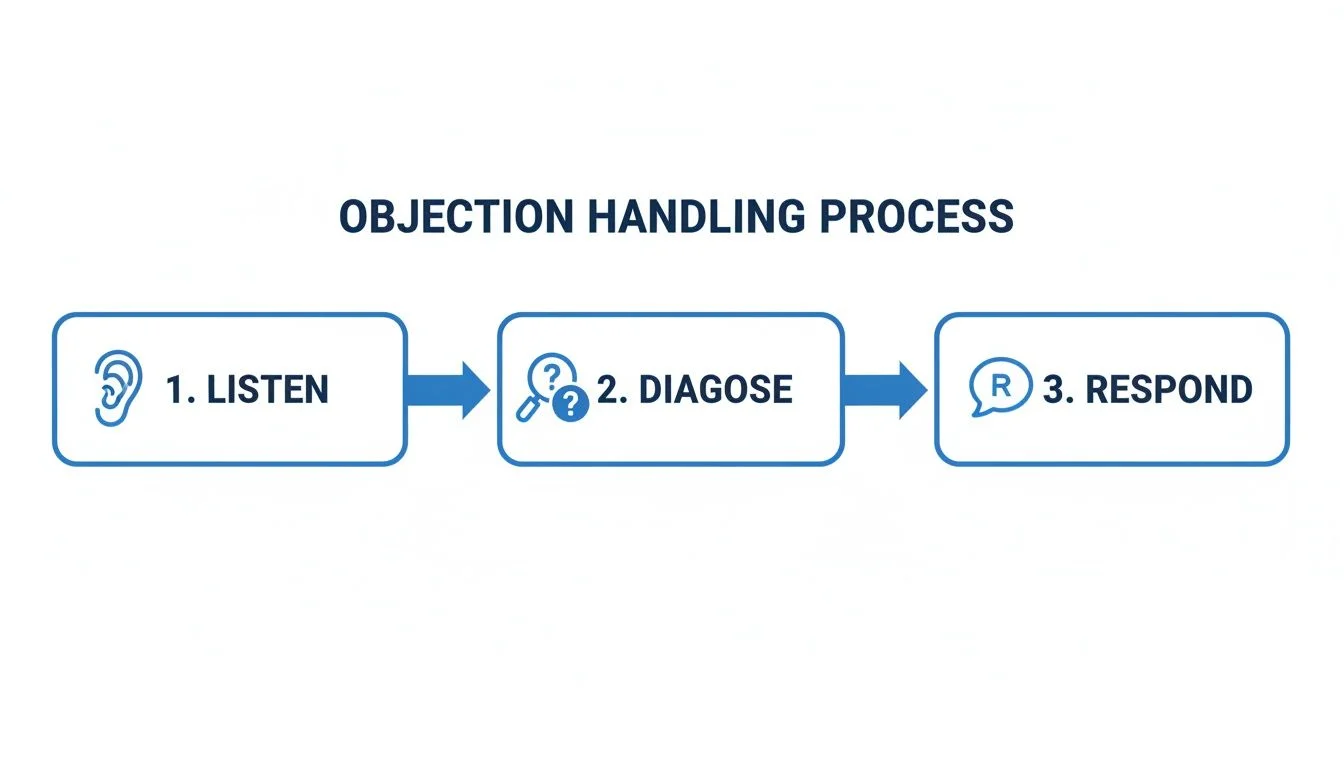
The big takeaway here is that responding is the last thing you should do, not the first. By spending more time listening and diagnosing, you make sure your response actually hits the mark, which dramatically increases your odds of moving the deal forward and building genuine trust.
The most common mistake I see reps make is responding too fast. You end up solving the wrong problem, which just adds friction and makes you look like you weren't listening.
Nailing this down is the first step to building a system that doesn't just put out fires but actually strengthens your entire sales process. When you turn objections into productive conversations, you can even see a big lift in your website's performance. We cover how this works in our guide on how to increase website conversion rates.
If you’re looking to go even deeper on this topic, there are some great additional resources on Mastering Objection Handling. This is the new playbook for turning doubt into done deals.
Diagnosing and Navigating Price Objections
Ah, the classic: “It’s too expensive.” Every sales professional has heard it a thousand times. But here’s the secret: it’s almost never just about the number on the page. When a prospect brings up price, they’re actually handing you an invitation to either prove your worth or dig for a much deeper issue.
This isn't about winning a negotiation. It's about figuring out what’s really going on. Budget is always a top concern, but "too expensive" is often just a smokescreen for one of two things: they genuinely can't afford it, or you haven't made them feel the value yet.

Decoding Common Price Objections
To get past the surface-level objection, you need to understand what's really being said. I've found that most price objections fall into a few common categories. This table is a simple framework to help you read between the lines.
| What You Hear | What It Could Mean | How to Diagnose It |
|---|---|---|
| "It's too expensive." | "I don't see the value yet." | Ask: "If price wasn't an issue, would our solution be the right fit for you?" |
| "That's not in our budget." | "The budget is allocated elsewhere, or I don't have the authority to spend this." | Ask: "Can you walk me through how you've budgeted for initiatives like this?" |
| "I can get a similar tool for less." | "I don't understand your unique differentiators." | Ask: "That's fair. What features are most important to you in the other solutions you're looking at?" |
Think of these questions as your diagnostic toolkit. They shift the conversation away from a standoff and toward a collaborative discussion, turning you into a partner instead of just a vendor.
Uncovering the Real Issue
The absolute worst thing you can do when you hear a price objection is to get defensive and start rattling off features. You'll lose them instantly. Your first move should always be to get curious.
Try using a few clarifying questions to gently probe what's behind their hesitation.
- "That's a fair point. To help me understand better, when you say it's expensive, are you comparing it to another solution, or is it more of a budget timing issue?"
- "I appreciate you sharing that. If price were no object, would this be the right solution for your team?"
- "Could you walk me through how you've allocated the budget for this kind of project?"
These questions do more than just get you information; they change the entire dynamic of the conversation. Suddenly, you're not arguing. You're problem-solving together. This same diagnostic mindset is crucial in other areas, too, like when you need to learn more about reducing cart abandonment.
The moment you hear a price objection, your only job is to get curious. Don’t defend your price, explore their perspective. The real objection is usually hiding just one question deep.
Shifting from Cost to Investment
Once you have a handle on the real concern, you can pivot the conversation from cost to investment. This is your moment to connect the dots between their specific problem and the return they'll see from your solution. Don't be vague; use concrete numbers.
For instance, instead of saying your software "saves time," give them the math.
"I hear you. But let's look at the numbers for a second. Teams just like yours save an average of 10 hours per employee each week with our platform. For your team of five, that’s over 200 hours a month you get back. What could you all accomplish with that extra time?"
By framing the price against tangible gains, whether it's more revenue, better efficiency, or lower risk. You reframe the entire discussion. The price is no longer an expense; it's a smart investment that pays for itself. Keep building your value case with specific examples and clear metrics until the cost seems small compared to the massive upside.
Overcoming Authority and Credibility Objections
Let’s talk about two of the most common stalls you’ll hear: "I need to check with my boss" and "I've never heard of your company." It's easy to take these at face value, but they’re rarely about your prospect's org chart or your brand's fame.
Nine times out of ten, these are just polite ways of saying, "I'm not sure I trust you yet." The real objection isn't about their boss or your logo. It's about their own fear of making the wrong call. Your job is to make them feel confident and smart for choosing you.

Building Instant Trust When You're the Underdog
When you’re a newer or smaller player, you can’t lean on a household name. You have to build trust on the spot. This is where social proof isn't just a nice-to-have; it's your most critical tool.
Don’t just tell them you’re great. Show them who else thinks so.
- Pivot to a Success Story: The moment they express doubt, share a case study from a company just like theirs. "That makes total sense. We’re newer to the game, but that's what Company X thought, too. They’re in your industry and were dealing with the exact same challenge. We ended up helping them achieve a 25% increase in efficiency."
- Show Off Third-Party Proof: Have you won any industry awards? Do you have stellar reviews on sites like G2 or Capterra? Mention them. Outside validation is like getting a great reference from a trusted source.
- Embrace Your Size: Instead of hiding that you're small, turn it into your superpower. "You're right, we're not the biggest name out there. That’s by design. It means you get direct access to our leadership and a level of partnership you simply can’t get from a huge vendor."
Being radically transparent is one of the most powerful symbols of trustworthiness you can deploy. You turn a perceived weakness into your unique strength.
Navigating the "I Need to Ask My Boss" Objection
Ah, the classic "boss" objection. It’s tricky. Sometimes it's a real roadblock, but more often, it's your prospect's way of saying they're afraid to champion a solution that isn't a "safe" bet.
Recent sales data shows 46% of reps feel they lack the complete information needed to stand out, and that uncertainty trickles right down to the prospect. You can learn more about how sales pros are tackling modern objections to stay ahead of the curve.
Your mission is to arm your contact to sell for you internally. Don’t push back; partner up.
Prospect: "This all sounds great, but I really need to run it by my manager."
You: "That's a great idea. To make that conversation as productive as possible, what are the key metrics your manager will care about most? Let's put together a one-pager with the specific ROI projections for those areas."
This approach is brilliant for three reasons:
- You validate their process: It shows respect and that you're on their side.
- You make them look good: You're literally helping them build their business case for their boss.
- You uncover the real priorities: You find out exactly what the actual decision-maker cares about.
By framing it as a collaborative next step, you turn your contact from a gatekeeper into an internal champion. You’re not just knocking down an objection. You’re building a partnership.
How to Proactively Address Objections with Social Proof
What if you could answer a prospect’s biggest questions before they even think to ask them? That’s the real secret to proactive objection handling. Instead of getting stuck in a defensive loop, reacting to concerns about price, trust, or fit, you can weave the answers right into your sales experience.
Think about someone on your pricing page or watching your webinar. Just as the thought "Is this really worth it?" pops into their head, a small notification appears. It shows a recent, genuine conversation where another customer asked the same thing and got a great answer that sealed the deal for them. This isn't some futuristic fantasy; it’s a smart way to use social proof.
Turn Static Pages into Living Proof
Your product pages, landing pages, and even your demo request forms are where prospects' doubts are loudest. These are the perfect spots to put this strategy to work. By adding a smart chat tool like FOMOchat, you can transform these pages from static brochures into active, convincing assets.
The idea is to show real conversations that hit on your prospects’ most common worries. When they see others asking their exact questions, it builds an immediate connection. To get a better handle on the psychology at play, check out our guide on what is social proof in marketing.
When you show prospects that other people have the same concerns. And that you’re happy to address them openly. You’re not just answering a question. You're building a sense of community and showing you have nothing to hide. That kind of transparency melts away distrust almost instantly.
This works wonders with video, too. You can time specific testimonials or Q&A snippets to appear at the exact moment you're discussing a certain feature, like your onboarding process. It’s like having a happy customer jump in to vouch for you at the perfect time.
Putting It All Together
Getting a system like this up and running is more straightforward than you might think. It all starts with the objections your sales team hears every single day. Once you know what they are, you can craft the perfect, most helpful responses.
These answers then become the foundation for a library of authentic-looking dialogues that you can deploy right where they’re needed most.
Here’s a quick look at how this new proactive method stacks up against the old reactive one.
Proactive vs Reactive Objection Handling
This table compares the traditional way of waiting for objections with a modern strategy that uses social proof to address them ahead of time.
| Objection Type | Traditional Reactive Approach | Modern Proactive Approach |
|---|---|---|
| Price | Wait for "It's too expensive," then try to justify the value. | Show a conversation where a user talks about their ROI, answering the value question before it's even asked. |
| Trust | Hear "I've never heard of you," then send over a case study later. | Display a real-time feed of new sign-ups or positive user comments directly on the page. |
| Fit | Answer "Will this work for my industry?" during a one-on-one demo. | Surface a dialogue where a peer from a similar industry gets their specific use-case question answered. |
Ultimately, this strategy does more than just help you handle objections. It stops many of them from ever coming up. It builds a prospect's confidence and frees up your team to focus on building relationships and closing deals.
To start gathering powerful customer stories, you might want to use a video testimonial script generator to help your clients share feedback that truly resonates. Capturing the right stories is the first step; using them proactively is how you win.
Lessons in Objection Handling from Global Markets

Handling objections isn't just about what one sales rep says in a single call. When you zoom out, you see it’s a make-or-break skill for entire companies, especially when the economy gets rocky. How different regions respond to widespread customer hesitation tells us a lot about what actually works.
When customers start pinching pennies, budget and value objections pop up everywhere. The markets that weather these storms are almost always the ones where sales teams have mastered the art of justifying their value.
A Tale of Two Markets
The global direct selling industry is a perfect example. This is a massive $167.6 billion market, but its performance in 2023 was a mixed bag. While Europe saw a healthy 3.4% increase in sales, the Americas actually saw a 3.8% decline. You can dig into more of the 2023 billion-dollar market trends to see the full picture.
What does this tell us? It suggests European sales teams were far more effective at navigating those tough budget conversations and proving their worth. Their success in a tricky global economy drives home a critical point: getting great at handling objections is essential for growth.
The lesson here is powerful. Companies that get good at explaining their value don't just survive downturns. They can actually thrive. They learn to turn skepticism into a chance to prove their worth.
Universal Truths for Justifying Value
So, what are these successful markets doing right? The good news is that their strategies are universal. You can apply them whether you’re selling to a small local shop or a huge enterprise.
Looking at what works on a macro level, three core strategies really stand out:
Acknowledge the Pressure: Don't pretend your prospect isn't worried about the economy. Start by showing you get it. A simple, "I know budgets are tight for everyone right now" builds instant rapport and makes it easier to have a real conversation.
Stop Defending the Price: Instead of getting defensive about cost, change the subject to ROI. This is where you bring out your proof. Use solid case studies and real numbers to demonstrate how your solution delivers value that makes the price seem small.
Lean on Social Proof: When people are uncertain, they look to see what others are doing. This is your chance to use testimonials and customer stories strategically. Showing a hesitant buyer that companies just like them are succeeding with your product provides the confidence they need to say yes.
A Few Common Questions I Hear in the Trenches
Even with a solid game plan, you're going to run into specific hurdles. Mastering objection handling is a career-long process of practice and small adjustments. Let's tackle some of the questions that always come up when sales pros are trying to get this right.
Here’s some quick, practical advice you can put to work on your very next call.
What’s the Most Effective First Move When a Prospect Hits You with an Objection?
Your gut reaction will be to defend your product. Fight that urge. The single best thing you can do first is to simply listen and validate what they said.
When you jump straight into a counter-argument, the prospect immediately feels like you're not listening. A wall goes up, and the conversation is over before it begins.
Instead, just take a beat. Use a simple phrase that shows you heard them.
- "That's a fair point."
- "I completely understand why you'd feel that way."
- "Thanks for bringing that up."
This small gesture completely changes the dynamic. It defuses tension and shows you respect their perspective. Once you've done that, your next move is to ask a gentle, open-ended question like, "Could you tell me a bit more about that concern?" This turns a confrontation into a problem-solving session and helps you uncover what's really going on.
How Do I Get Around the "We Don't Have Budget" Objection Without Slashing My Price?
It’s so tempting to just offer a discount. Don't do it. You instantly devalue your solution and teach your customers that your pricing is just a suggestion. The smarter play is to reframe the entire conversation from a "cost" to an "investment."
Try a response that pivots the discussion:
"I hear you on the budget. Honestly, some of our best clients felt the same way before they came on board. To make sure this is even worth discussing further, what if we spent five minutes mapping out the kind of return this could generate for your team?"
This shifts their focus from an expense on a spreadsheet to a real business outcome. If the budget constraint is genuine and more about timing, you can get creative without hurting your price point.
- Flexible Payments: Can you break an annual fee into quarterly payments?
- Phased Rollout: Is there a smaller, entry-level package they can start with? This lets them prove the value internally before committing to the full-boat solution.
You’re not being cheaper; you’re being a strategic partner who understands their cash flow.
How Can Social Proof Tools Help with Objections on a Live Webinar?
During a live event, questions and objections can come flying in from every direction. It's impossible to personally address every single one while you're trying to present. This is where a tool that provides social proof, especially one powered by AI, can be a real shift for handling objections before they even fully form.
For one, you can preload an AI with smart, well-written answers to your most common questions about price, features, or setup. When someone asks in the chat, the AI delivers a perfect response instantly.
But here’s the really powerful part: these tools can also show realistic-looking dialogues where other attendees are asking the very same questions. Imagine a prospect who's on the fence. They see someone who looks like a peer ask, "Is this hard to set up?" and then immediately see a clear, reassuring answer. That’s powerful social proof in action.
This handles objections at scale, creates a sense of group consensus, and builds trust. All while you stay focused on your presentation. It helps turn a group of passive viewers into a crowd of convinced buyers.
Ready to get ahead of objections instead of just reacting to them? FOMOchat embeds AI-powered social proof directly on your website, webinars, and product pages to answer questions and build trust before prospects even have to ask. See how it works at fomochat.com.