
Did your last campaign cause growth, or did it just collect buyers who would have signed up anyway? That question separates a busy marketing calendar from marketing growth hacking. You'll learn a simple system below. Pick one number, test one idea against a control group, keep only what creates new conversions, and protect trust while you do it.
What Marketing Growth Hacking Means for Your Team
A good mechanic tunes one part of an engine at a time and measures what changes. She doesn't repaint the whole car and hope it runs faster. A growth hacker works the same way with a customer journey, adjusting one lever, checking the result, then deciding what to tune next.

Marketing growth hacking is a repeatable process of testing ideas quickly across the customer journey to produce measurable growth. That one sentence matters because it rules out vague activity. If you can't name the customer step you're changing and the number you expect to move, you don't have a test yet.
Where the Idea Came From
The term started with a hiring problem. According to the Wikipedia history of growth hacking, Sean Ellis coined the term "growth hacker" in 2010 in his essay "Find a Growth Hacker for Your Startup," arguing startups should prioritize a specialist whose primary objective was scalable growth rather than hiring a conventional vice president of marketing. By 2012, Andrew Chen had helped popularize the role as one operating at the intersection of marketing, product, engineering, and analytics.
That mix explains why the work doesn't sit inside one department. A signup problem might live in an ad, but it might also live in onboarding copy, a slow product step, or an unanswered pricing question. The growth owner follows the problem across those boundaries.
How It Differs From a Traditional Campaign
A traditional awareness campaign often reports reach and impressions. Those numbers tell you people saw something, but they rarely tell you whether spend produced signups, paid enrollments, or revenue. Growth hacking shifts attention to outcomes a team can count, such as acquisition, activation, retention, referrals, and revenue.
Here's a plain example. Say a course team runs ads to a sales page. A campaign view asks how many people clicked. A growth view asks where qualified visitors stalled, tests a clearer answer beside the enrollment button, and compares paid enrollments against visitors who saw the original page. That stall often shows up in conversation analytics as the same pricing or onboarding question repeating before the click.
This approach suits SaaS companies, course businesses, and launch teams because their journeys have clear steps and measurable actions. Use this quick check before you start work.
Practical rule: If an idea can't be measured within a week or two, it's a campaign, not yet growth hacking.
That rule doesn't make longer projects useless. It asks you to split them into a smaller first test that can produce a decision.
Core Principles That Make Growth Repeatable
Think of your funnel as a leaky bucket. Pouring in more water helps for a moment, but the holes decide how much you keep. Fix the largest hole first, then spend on more traffic.
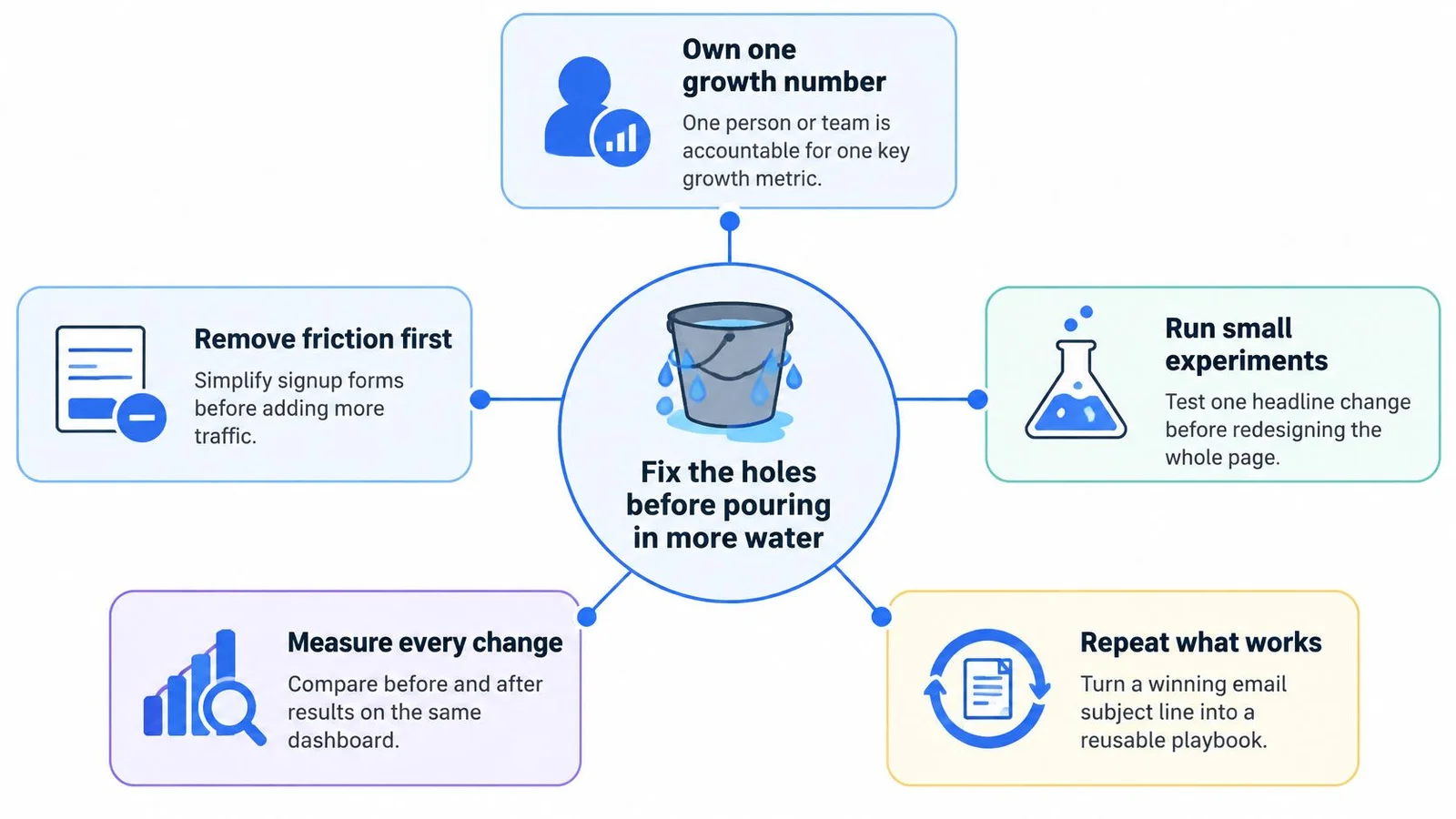
Say visitors reach your pricing page but don't start a trial. More ads send more people to the same confusion. A clearer pricing answer, a shorter form, or a guided first step can lift every future visit without raising ad spend. Teams that track conversion rates in marketing by funnel step spot this leak faster than teams that only watch top-of-funnel traffic.
Five Principles to Use Every Week
- Own one growth number: Give one person or team clear accountability for one metric, such as activated users per week. Shared ownership sounds friendly, but it often means nobody decides which test runs first.
- Treat the funnel as connected levers: Acquisition, activation, retention, referral, and revenue affect each other. Weak onboarding wastes paid traffic because new users leave before they receive value.
- Test small and fast: Write a hypothesis, run a small test, measure the result, and scale only what shows traction.
- Remove friction first: Look for unanswered questions, unclear pricing, or doubt at the moment of action. A practical way to spot these blockers is to collect customer feedback at each funnel step and group complaints by where people stopped.
- Build loops, not one-off campaigns: Design product actions so one user's progress can bring in the next user. An invite after a first success is a loop, while a single launch post fades when posting stops.
Don't treat these as posters for a wall. Use them as sorting questions in your planning meeting. Which number are we moving, where's the leak, what's the smallest test, and can the result repeat without fresh effort every time?
That shared language prevents a common argument. Instead of debating whose idea sounds cleverest, the team compares ideas against the same leak and the same metric. The winner earns the next test slot because it fits the constraint, not because its owner argued loudest.
Real Examples From Hotmail, Dropbox and Airbnb
Famous examples help when you study the mechanism, not the costume. Each company below built acquisition into normal use or borrowed an audience that already existed. According to the Startups.com growth hacking lexicon, these cases became influential because users themselves helped acquire additional users.
Hotmail Put Acquisition Inside the Product
Hotmail reportedly appended a short promotional message to outgoing emails in 1996 and grew from zero to 12 million users in 18 months. Every sent email did two jobs. It delivered the sender's message and showed the recipient an easy next step.
The lesson isn't to add a tagline everywhere. The lesson is to find an action users already repeat and attach a visible, low effort invitation to it. Say students share a course certificate after finishing a lesson. That share can carry a link to a free sample lesson.
Dropbox Rewarded Both Sides
Dropbox used a two-sided referral incentive of 500 megabytes of free storage for both the referrer and the invited user, and signups increased from 100,000 to 4 million in 15 months. The referrer didn't feel like a salesperson because the friend received value too. Both sides had a clear reason to act.
Apply that logic carefully. A SaaS team might give extra seats or credits to both accounts after an invited colleague activates. Pay the reward after a meaningful action, not after a bare signup, so you don't buy empty accounts.
Airbnb Borrowed an Existing Marketplace
Airbnb's 2009 Craigslist integration allowed hosts to cross-post listings, giving the service access to an established marketplace rather than relying only on paid acquisition. Hosts gained wider exposure with little extra work. Airbnb gained distribution where demand already gathered.
Your version might be an integration directory, a partner webinar, or a template gallery on a platform your buyers already use. The partner needs a real benefit, and your tracking needs to show which signups came from that source.
Copy the mechanism, then test it in your own context. Copying the surface tactic rarely copies the conditions that made it work.
Those results also had many contributing factors, including timing, product quality, and market demand. Treat each story as a hypothesis source. Build the smallest version, compare it with a control, and keep it only if your users respond.
Metrics and Tests That Prove Growth Is Real
Conversions can rise for reasons that have nothing to do with your tactic. A partner mention, a seasonal spike, or a price email can lift the same week you launch a test. You need metrics that separate activity from incremental growth, which means conversions your tactic caused.
The table below defines five metrics, how to calculate each one, and the warning sign that should trigger action.
| Metric | What It Shows | How to Calculate | Warning Sign |
|---|---|---|---|
| Activation rate | Share of signups who complete the key first action | Activated users divided by signups | Falling month over month |
| Week 4 retention | Share of a cohort still active four weeks later | Cohort users active in week 4 divided by cohort size | Curve flattening at a low level |
| Viral coefficient (k) | How many new users each user brings in | Invites sent multiplied by invite conversion rate | Below 1 means referrals will not compound alone |
| Customer acquisition cost | Cost to win one paying customer | Total acquisition spend divided by new customers | Rising faster than customer lifetime value |
| Incremental conversions | Conversions caused by the tactic | Treatment conversions minus holdout conversions | Near zero despite high raw conversion counts |
Why a Holdout Group Matters
A holdout group sees the standard experience while the treatment group sees your change. If both groups receive the same traffic mix during the same period, the difference gives you a cleaner estimate of cause. Without that comparison, you're often crediting a tactic for demand that would have converted anyway.
This concern is now mainstream. In eMarketer's July 2025 report on incrementality testing, 52.0% of U.S. brand and agency marketers reported using incrementality testing, while 44% cited concerns about result accuracy or reliability. Those two facts belong together. Teams want proof, but proof needs careful design.
Write the hypothesis before launch and estimate the minimum detectable effect, which is the smallest lift your sample can reasonably reveal. If your traffic can only detect a large change, don't pretend a tiny difference settles the question. Wait for more data, choose a higher traffic step, or test a bolder treatment.
A Worked Example With Illustrative Numbers
Say a landing page receives 20,000 monthly visitors. You randomly show a widget to half and keep the standard page for the other half. The treatment converts 1,200 visitors, or 12.0%, while the holdout converts 1,000, or 10.0%.
Raw conversions rose 20% in relative terms, but leadership needs the plainer version. The absolute lift is 2.0 points, and the incremental gain is 200 conversions, or 10 per 1,000 visitors. Report those numbers, not clicks on the widget.
Use supporting dashboards to track marketing results that drive growth, and connect the final result to revenue with a consistent marketing ROI calculation method. Keep quality in view too. Paid enrollments, activated accounts, and retained users prove more than a click-through rate that may never become revenue. When the treatment is a chat or proof widget, also watch live chat conversion rate so volume doesn't hide weak enrollments.
How to Run a Growth Experiment Step by Step
A good experiment feels almost boring while it runs. You've decided the question, the groups, and the finish line in advance, so the team isn't reinventing the rules each morning. That discipline protects you from exciting noise.
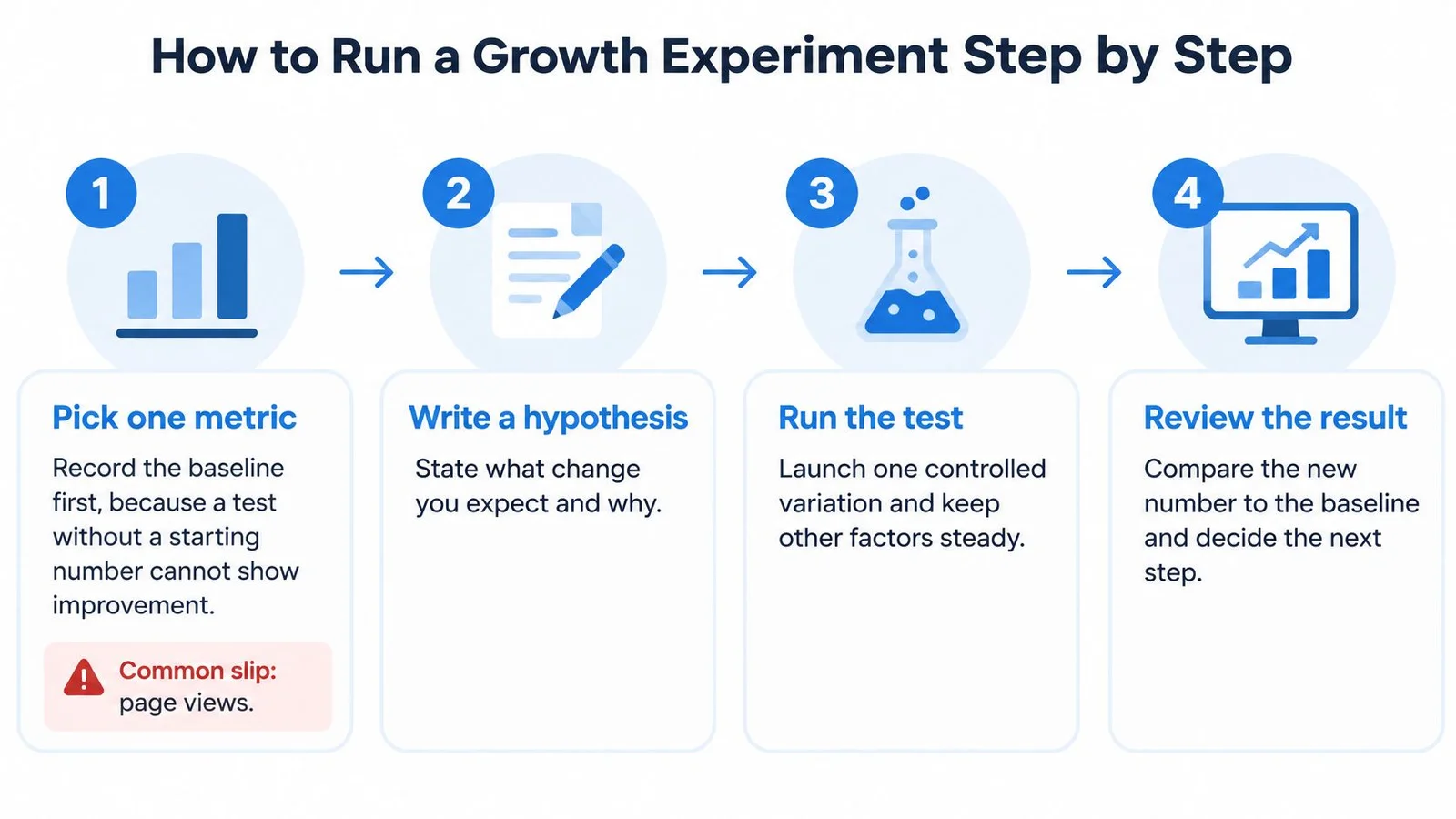
Use these eight steps as a repeatable operating rhythm. Keep each test narrow enough that you can explain the result in one short paragraph.
Set Up the Test Before You Launch
- Pick one metric and record its baseline: A test without a starting number can't show improvement. Choose activated users, paid signups, or another outcome close to revenue. Don't pick page views as the main target, because more views can hide weaker intent.
- Write a hypothesis: Use this form. If we change X for group Y, metric Z will rise by about N percent because of a stated reason. Say you add a deployment answer beside a trial button for pricing page visitors because implementation doubt is the top unanswered question.
- Score ideas with ICE: Rate impact, confidence, and ease from 1 to 10, add the scores, and test the highest total first. Confidence should come from evidence such as support tickets, session recordings, or user interviews, not seniority.
- Define the smallest useful test: Name the primary metric, sample size, audience, and stop date before launch. A short guide to A/B and multivariate testing choices can help you decide whether one variation is enough or several combinations need separate groups, and what split testing is covers the single-change case when traffic is tight.
Don't change the audience, offer, or success metric halfway through. If you discover a broken link or tracking error, pause, fix it, and restart cleanly if the error affected one group more than the other.
Run It Without Chasing Daily Noise
- Create a control group or holdout: Randomly assign eligible visitors so the groups stay comparable. Check that device mix, traffic source, and new versus returning visitors look balanced before you read results.
- Launch and monitor, but don't stop early: Watch for technical faults, complaints, and guardrail problems. Don't declare a winner because Tuesday looked strong, since weekday traffic often differs from weekend traffic.
- Compare treatment against control: Report absolute lift, relative lift, and incremental conversions per 1,000 visitors. Break results down by device and traffic source only after the main comparison, so you don't hunt for a flattering subgroup.
A clear no is a useful result. It frees budget and attention for a better hypothesis.
- Decide and log the outcome: Scale a clear winner, revise a weak but promising result, or drop the idea. Record the hypothesis, dates, audience, result, and decision in a shared experiment log so a new teammate doesn't rerun a failed test six months later.
The finish line isn't a positive chart. It's a clear answer to the hypothesis, supported by a fair comparison. Even when the answer is no, you've bought knowledge at a small cost instead of rolling out a weak idea to everyone.
Repeatable Tactics and Where Each One Works
A tactic is useful only when it matches the biggest leak in your funnel. A referral program won't fix confusing onboarding, and more content won't fix a pricing page that leaves key questions unanswered. Start from the leak, then choose from the table.
| Tactic | Funnel Stage | Main Metric | Typical Channel | Effort |
|---|---|---|---|---|
| Referral program | Acquisition and retention | Invites sent and invites converted | In-product | Medium |
| Content and SEO | Acquisition | Organic signups per topic | Blog and search | High |
| In-product prompts | Activation | Share of new users completing first success | Product | Low |
| Onboarding email sequence | Activation and retention | Week 1 return rate | Low | |
| Partnerships and integrations | Acquisition | Signups from partner traffic | Partner sites and marketplaces | Medium |
| Social proof on landing pages | Conversion | Signup rate per visitor | Website | Low |
| Webinar or launch countdown | Conversion | Registrations and attendance | Live events and email | Medium |
Match the Tactic to the Leak
- Referral program: Choose this when users naturally invite colleagues or friends after receiving value. Reward activation, not empty signups.
- Content and SEO: Choose this when buyers search for a clear problem and your team can publish patiently around one topic cluster. Judge pages by organic signups, not traffic alone.
- In-product prompts: Choose this when new users miss an obvious first success. A checklist, sample project, or guided import can move them to value faster.
- Onboarding email sequence: Choose this for trial products where users need reminders tied to actions they haven't taken. Send the next useful step, not a generic feature tour.
- Partnerships and integrations: Choose this when another trusted product already serves your buyer. Give the partner's users a concrete benefit and track partner signups separately.
- Social proof on landing pages: Choose this when traffic is healthy but signup rate is weak. Use verifiable proof near the decision point, then compare against a holdout. Our social proof for ecommerce guide covers proof formats that hold up under a holdout test.
- Webinar or launch countdown: Choose this when a live event creates a real deadline. Measure attendance and paid conversion, not registrations alone. On the registration or replay page, FOMOchat can answer agenda and pricing questions in conversation instead of stacking another popup.
Friction often hides in forms. If qualified leads stall while sharing project details, structured client intake forms for small businesses can give you a cleaner pattern for asking only the questions needed at that step. Test a shorter form against the current one and watch completed qualified submissions, not form starts.
Pick one tactic for your largest leak. Run it against a control before adding a second, because overlapping changes make the result hard to read and can cancel each other out. One proven lever beats five unproven decorations.
Trust, Disclosure and Consent Guardrails
Automation can cost the conversions it's meant to raise when visitors suspect they're being misled. An industry review citing a 2025 Raptive study found suspected AI content reduced reader trust by nearly 50% and lowered purchase consideration by 14%. The same review described an October 2025 survey of 1,539 U.S. consumers in which 50% preferred brands that did not use generative AI in consumer-facing content.
Five Guardrails for AI Driven Tactics
- Label AI clearly: Tell visitors when they're reading generated content or speaking with an AI assistant.
- Limit answers to accurate sources: Route unknown questions to a human instead of inventing a reply.
- Use verifiable proof only: Don't present generated dialogue as real customer testimony.
- Collect data with clear consent: Explain storage and use in plain language before people share details.
- Track trust beside conversion: Watch opt-outs, complaints, refund requests, and consideration scores.
These rules fit a broader ethical AI in marketing approach that treats disclosure as a trust signal. AI is already common, since The CMO Survey report for 2025 states artificial intelligence powered 17.2% of marketing activities among surveyed U.S. companies. Clear labels therefore don't make you unusual. They make your claims easier to believe.
Start a 90-Day Growth Roadmap This Quarter
You don't need a growth department to start. You need one owner, one funnel map, reliable tracking, and a weekly decision meeting. This 90 day plan keeps the work narrow enough for a small team.
Days 1 to 30 Find the Largest Leak
Audit the journey from first visit to paid customer. Record how many people enter each step, how many continue, and where the largest qualified drop occurs. Set up event tracking for visits, key questions, CTA clicks, signups, activation, and payment so later tests share the same definitions.
Read support tickets, sales notes, webinar questions, and on-page conversations during this audit. Group repeated objections by funnel step. The biggest leak with a repeated, fixable cause becomes your first testing area. A website chat widget that logs those objections gives you evidence for the ICE score instead of guessing which blocker matters most.
Days 31 to 60 Run Three Controlled Experiments
Run one experiment at acquisition, one at activation, and one at conversion if traffic allows. Give each test a written hypothesis, a control group, guardrails, and a stop date. Don't run competing changes on the same step at the same time.
One optional test fits pages where visitors repeat the same objections. Every FOMOchat includes an AI company rep trained on your website content, which answers questions using product details, pricing, and features on your site. Keep that site information accurate and up to date, label the assistant clearly, and compare completed conversions against a holdout rather than judging chat volume. Conversations beat notification popups when someone still needs a real answer before they convert; see conversational marketing examples for patterns you can test next to a control.
Days 61 to 90 Scale Winners and Retire Losers
Roll out clear winners gradually and keep a small holdout when risk remains. Retire losing ideas without turning the review into blame. Write a short playbook for each winner that states the audience, exact change, primary metric, result, and any trust guardrails.
Review proof metrics with leadership each month. Show baseline, control result, treatment result, absolute lift, and incremental conversions. That format makes budget requests easier because leaders can see what the tactic caused.
Start this week with one concrete action. Pick one metric and write down its baseline. Once that number is visible, your first hypothesis will be much easier to choose.
Put this testing playbook to work on a page where visitors hesitate with questions. FOMOchat gives them an AI company representative trained on your website content, so you can test clearer objection handling against a holdout and measure real signups, enrollments, or registrations. Pair that with website conversion tools that keep proof and help near the decision, then scale only what the holdout confirms.