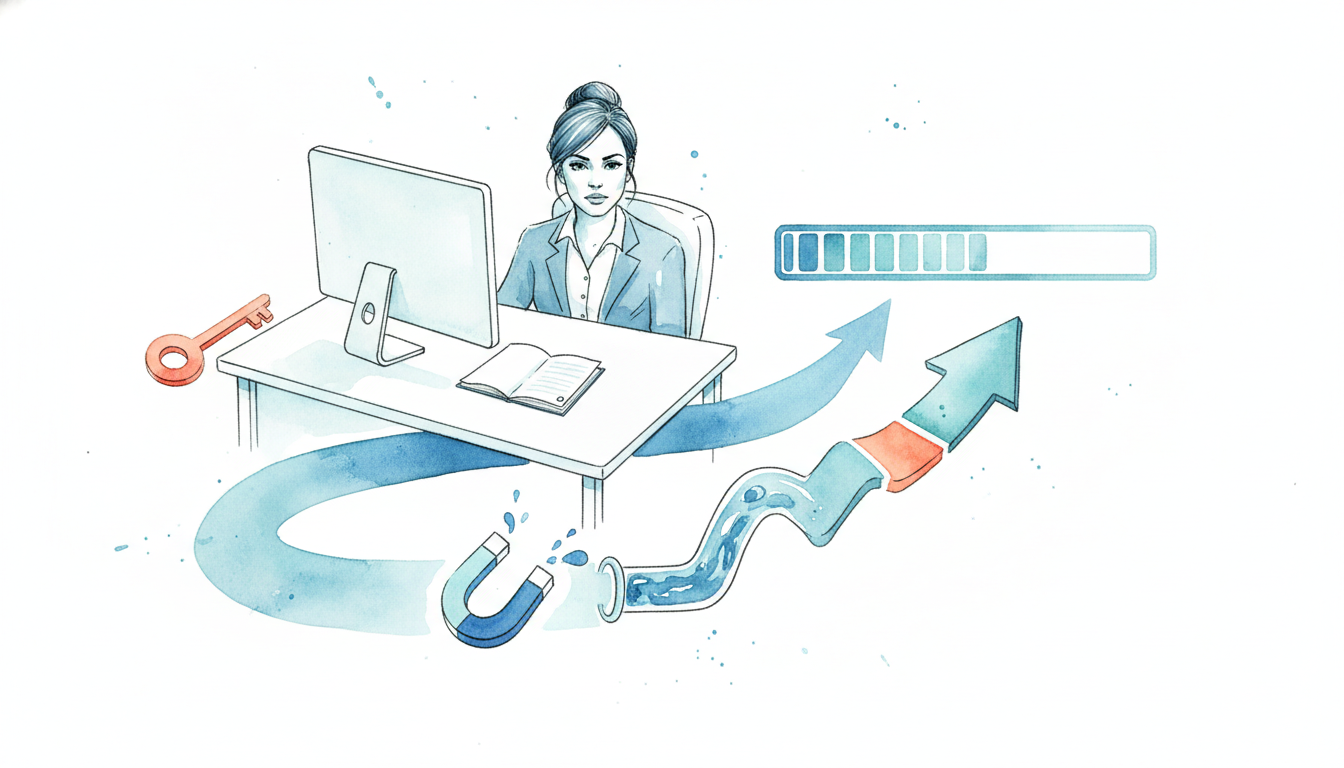
Most advice on lead generation for SaaS still treats the job like a math problem. Add more traffic. Launch more campaigns. Collect more emails. Hand a larger list to sales and call it growth.
That's backwards.
A bloated pipeline hides weak positioning, fuzzy qualification, and bad handoffs between marketing and sales. Teams celebrate lead counts while account executives complain that “none of these people are ready.” That pattern is common because the actual bottleneck usually isn't top-of-funnel volume. It's whether the people entering the funnel are a fit, have the right problem, and are moving with enough intent to justify human follow-up.
The SaaS teams that outperform don't chase raw lead volume. They build a system that attracts the right accounts, captures intent early, qualifies fast, and routes people into the right next step. That's the difference between a noisy pipeline and a reliable one.
Why More Leads Is the Wrong Goal
The popular playbook says you need more leads. In practice, most B2B SaaS teams need better filtering and stronger conversion readiness.
That's the uncomfortable part. A lot of companies don't have a lead generation problem. They have a qualification problem. As noted in this LinkedIn discussion on B2B SaaS conversion gaps, B2B SaaS companies rarely struggle with lead volume but consistently fail at conversion rates, often because marketing and sales don't share the same definition of a qualified lead.
When those definitions drift, the whole machine breaks. Marketing optimizes for form fills. Sales optimizes for meetings that can close. Customer success later inherits accounts that were a poor fit from day one.
Practical rule: If sales says lead quality is low, don't respond by buying more traffic first. Audit your qualification logic.
A familiar scenario looks like this:
- Marketing launches content and paid campaigns: Demo requests rise, newsletter signups look healthy, and dashboards turn green.
- Sales works the queue: Reps find students, consultants, tiny teams without budget, or curious competitors.
- Leadership sees conflicting stories: Marketing says acquisition is working. Sales says pipeline quality is poor.
- Revenue stalls anyway: Volume grows, but close readiness doesn't.
This is why the better goal is a predictable flow of sales-ready leads, not just names in a CRM.
A strong system for building a high-performing marketing pipeline starts with that shift in mindset. You're not trying to maximize form submissions. You're trying to create clean progression from attention to qualified conversation.
That changes how you judge every tactic. A webinar registration from the wrong segment isn't a win. A lower-volume content program that consistently attracts buyers with active pain often is.
Build Your Foundation with a Bulletproof ICP
Most SaaS lead gen problems start before the first campaign goes live. The issue isn't ad copy or landing page color. The issue is that the team never got precise about who should convert in the first place.

A disciplined process for B2B SaaS lead generation starts with a precise ICP and shared lead definitions between marketing and sales. That matters because campaigns can see 40-50% open rates yet still fall below 5% response rates when the ICP is too broad, as explained in this B2B SaaS lead generation breakdown from Pipedrive.
What a real ICP includes
A weak ICP says, “mid-market SaaS companies in North America.”
A useful ICP says something closer to this: B2B SaaS companies selling into operations leaders, with a sales-assisted motion, a pricing page that already gets traffic, and a team that feels friction between inbound demand and rep follow-up.
That level of detail sharpens every downstream decision.
Use these layers:
- Firmographics: Company size, business model, team structure, geography.
- Technographics: What tools they already use. HubSpot, Salesforce, Segment, Intercom, Stripe, product analytics tools.
- Buying context: Are they replacing a tool, adding a missing workflow, or solving a new problem?
- Operational pain: Where does the current process fail? Slow handoff? Poor trial activation? Messy qualification?
- Negative fit signals: Who should never get routed to sales?
For lead generation for SaaS, the negative-fit list is as important as the target list. If your product requires implementation support, solo founders and very small teams may love the idea and still be a bad sales use of time.
The MQL and SQL line has to be explicit
It's often believed there's agreement on lead stages. Then you look inside the CRM and realize everyone is using the same labels differently.
Marketing calls someone an MQL because they downloaded a guide and visited pricing. Sales expects an SQL to mean budget, need, and urgency are visible. Both teams think they're being reasonable. Both teams are using different thresholds.
A clean setup usually answers four questions:
| Question | What you need to define |
|---|---|
| Fit | Which company types are worth pursuing |
| Intent | Which actions suggest real buying interest |
| Readiness | What qualifies a handoff to sales |
| Disqualification | What sends a lead into nurture instead |
If a rep has to guess why a lead was handed over, your qualification model isn't finished.
One practical way to tighten this is to review closed-won, closed-lost, and no-show opportunities together. Look for patterns in title, team size, product use case, urgency, and objection type. Then update definitions from evidence, not opinion.
Broad targeting creates fake momentum
A broad campaign often feels productive because the top of funnel fills quickly. That's false comfort. You end up paying to acquire people who were never likely to buy.
That's why teams increasingly use AI to find high-intent leads only after they've nailed the ICP logic. AI can help prioritize, but it can't rescue a vague targeting strategy.
A realistic example: a workflow automation SaaS might think it sells to “operations teams.” After a few deal reviews, it may learn that RevOps managers inside sales-led SaaS companies move faster, ask better questions, and convert with less friction than general ops buyers. That insight changes outreach, content topics, demo flows, and scoring.
A bulletproof ICP doesn't limit growth. It removes waste.
Design Your Multi-Channel Lead Engine
Single-channel dependence creates fragile pipelines. The strongest lead generation for SaaS programs behave like systems. One channel captures demand. Another creates it. Another qualifies it. Another keeps the brand present in buying conversations that never show up cleanly in attribution.

The anchor is content. In SaaS, content marketing accounts for over 50% of lead acquisition methods used by B2B companies, which is why it remains the foundation for durable inbound growth according to this 2025 lead generation statistics roundup from Databox.
Content is the base layer
Content works when it pulls in buyers with a specific problem, not when it publishes generic awareness posts no one uses.
A strong content motion usually includes topic clusters tied to commercial intent. If you sell analytics software for product teams, don't stop at broad thought leadership. Build content around competitor comparisons, implementation questions, reporting workflows, stakeholder use cases, and pricing-related concerns.
One high-impact tactic is to structure content around buying jobs:
- Problem-aware content: “Why trial users never reach activation”
- Solution-aware content: “Product analytics vs session replay for onboarding analysis”
- Decision-stage content: “Best tools for SaaS onboarding measurement”
- Objection-handling content: “How to roll out analytics without engineering bottlenecks”
The common mistake is publishing educational content with no path toward qualification. Traffic arrives, reads, and leaves because the page never helps the visitor take the next logical step.
Paid acquisition should narrow, not widen
Paid channels help when you already know which ICP slices convert well. They hurt when used as a shortcut around strategy.
For most SaaS companies, the best paid tactic isn't blasting broad interest targeting. It's matching ad sets and landing pages to one use case at a time. One page for RevOps. One page for customer education teams. One page for agencies. Different pain, different proof, different CTA.
If your paid acquisition is underperforming, a focused SaaS ad performance review can expose wasted spend, mismatched landing pages, and weak intent handling before you throw more budget at the problem.
A common mistake is routing every ad click to the homepage. Buyers don't need a tour. They need relevance.
Partnerships reach buyers before forms do
Partnerships are underrated because they don't always scale neatly in a dashboard. But they often produce stronger intent than cold paid traffic.
Good SaaS partnerships usually take one of three forms:
- Integration partners who share a technical or workflow overlap
- Agencies and consultants who already advise your target accounts
- Communities and niche media where your buyers ask practical questions
This matters even more because some of the strongest buying conversations happen in private channels and dark social, where buyers research tools through peer recommendations, Slack groups, DMs, and forums before they ever identify themselves, as discussed in this Mouseflow article on SaaS lead generation strategies.
A useful tactic here is co-created assets with a partner who already has trust with your audience. Not fluffy webinars. Specific pieces with a clear operational angle, such as onboarding templates, evaluation checklists, or migration guides.
The mistake is treating partnerships like logo swaps. If the audience overlap is weak, the leads will be weak too.
Product-led motion needs qualification guardrails
Trials and freemium plans can generate a lot of signups. They can also flood the pipeline with curiosity-driven users who never had business intent.
That doesn't mean PLG is overrated. It means product signups need segmentation. A lead engine gets stronger when product activity feeds qualification. A user who invites teammates, revisits setup docs, or explores core workflows should enter a different path than someone who logs in once and disappears.
If you're using product signals inside your website experience, it helps when communication layers can also follow richer interactions like syncing chat with video moments, especially for launches, demos, and webinar-style sales motions where intent changes during the session.
Buyers rarely move in a straight line. Your channels shouldn't operate like they do.
Build channel interplay, not channel silos
The best lead engines connect channels on purpose.
A realistic pattern looks like this:
| Channel | What it does best | What usually breaks |
|---|---|---|
| Content | Captures search intent and educates | Too broad, weak CTAs |
| Paid | Tests offers and reaches specific segments quickly | Generic pages, loose targeting |
| Partnerships | Borrows trust from established voices | Poor audience fit |
| Product-led | Reveals real behavior and use case depth | No qualification filter |
| Nurtures and routes interest over time | Same sequence for everyone |
When teams think this way, lead generation for SaaS stops being “run more campaigns” and starts becoming architecture. Every channel earns a job. Every handoff has a reason.
Optimize Your Website for Conversions
Most SaaS websites still behave like brochures. They explain features, add a few buttons, and hope buyers will connect the dots.
That's a mistake. A landing page should act like a guided conversation.

Visitors arrive with partial context. They have objections, uncertainty, internal constraints, and comparison questions. If the page only talks at them, many leave with the same uncertainty they arrived with.
Reduce friction first
A lot of conversion work is less glamorous than teams want. It starts with removing friction.
Initial capture forms should be short. Ask for what you need to begin the relationship, not everything the sales team might eventually want. If you need deeper qualification, gather it later through progressive profiling or follow-up steps.
The principle is simple:
- First interaction: Capture minimal information
- Second interaction: Learn role, company, or use case
- Third interaction: Route based on behavior and fit
This is also where page structure matters. Clear CTA hierarchy, visible proof, direct copy, and fast access to answers consistently beat clever design language.
Real-time answers change the conversion curve
The strongest websites don't force a visitor to wait for sales just to resolve a simple objection.
That's one reason conversational layers are becoming more important. According to this lead generation data on AI chatbots and conversational marketing, AI-powered chatbots have delivered a 64% increase in qualified leads, with real-time interaction boosting B2B conversion rates by up to 20%. The same source notes that AI technologies can improve overall lead generation results by approximately 50% when companies use them for automation and better identification of high-intent prospects.
Those numbers make intuitive sense. A visitor comparing vendors often needs one answer, right now. Pricing model. Implementation scope. Security concern. Use case fit. If the site can answer that in-session, the lead is more likely to keep moving.
A conversion page shouldn't just present information. It should remove hesitation while intent is still warm.
Treat design as trust infrastructure
Good conversion design isn't decoration. It's credibility management.
The page should tell the visitor:
- What the product does
- Who it helps
- Why this approach is different
- What happens next if they engage
That includes the interface around any on-page communication tool. If you use conversational elements, they should match the brand, feel native to the page, and avoid looking bolted on. Teams that care about consistency usually spend time customizing widget appearance for brand alignment because design mismatch lowers trust fast.
Later in the journey, richer media can answer more layered objections. This kind of walkthrough is useful when a visitor needs to see the product in context rather than just read claims about it.
What works better than stuffing more copy on the page
A realistic SaaS page usually improves when the team does less, not more.
Try this checklist:
- Rewrite the hero for one buyer: If three personas land there, one of them should still feel directly addressed.
- Move proof near the CTA: Don't bury reassurance below the fold.
- Answer common objections in-page: Don't make every question a support ticket.
- Separate education from conversion: Blog readers and demo-ready evaluators need different paths.
The common mistake is trying to make one page satisfy every stage of awareness. That usually creates a long page that says many things and resolves very little.
Nurture and Qualify Leads on Autopilot
The hand raise isn't the finish line. It's the start of sorting intent.
A lead fills out a form for a webinar replay. Another starts a trial. Another downloads a migration checklist. If all three get the same generic email sequence, you've already lowered the odds of conversion.
A better post-conversion journey
Take a realistic example. A prospect named Elena downloads a buyer's guide from a B2B analytics SaaS. The form asks only for name and email. That matters because initial forms with fewer than three fields can achieve 2-3x higher conversion rates than forms with five or more fields, according to this B2B SaaS lead capture guide from Gravitate Design.
Elena gets a confirmation email immediately. Not a newsletter dump. A useful next step tied to the guide she wanted.
The next day, she visits the pricing page. That action should trigger a different path than a lead who only skimmed a blog post. If no behavior-based automation exists, SaaS businesses can lose up to 60% of potential leads who don't convert immediately, based on the same Gravitate Design source.
Use behavior to change the sequence
The simplest nurture systems often work best because the logic is obvious.
A practical model might look like this:
- Content download: Send educational follow-up tied to the same problem
- Pricing page visit: Send comparison or implementation-focused material
- Trial signup: Trigger onboarding help and use-case-specific setup guidance
- Repeat visits from the same account: Notify sales if fit signals are strong
Teams often overcomplicate scoring but underbuild routing. You don't need an elaborate model on day one. You need enough logic to separate casual curiosity from active evaluation.
Lead scoring should help reps make decisions
A useful scoring model combines two buckets.
| Bucket | What it captures |
|---|---|
| Fit score | Company type, role, segment, use case |
| Intent score | Pricing visits, repeat sessions, trial behavior, demo requests |
If someone has high fit and low intent, keep nurturing.
If someone has low fit and high intent, qualify carefully before handing off.
If someone has high fit and high intent, route fast.
Sales doesn't need more names. Sales needs a smaller queue with clearer reasons to act.
Automation also gets stronger when your messaging layer is trained on actual product context and common objections. Teams using AI in nurture flows usually get better outcomes when they spend time improving AI responses with stronger source material and guardrails, rather than letting generic copy do the work.
The common failure here is using automation as a substitute for relevance. It should do the opposite. It should make follow-up feel more timely, more specific, and more connected to what the lead already showed you.
Measure What Matters and Select Your Tools
Most SaaS dashboards are crowded with numbers that don't change decisions. Traffic. Clicks. Impressions. Form fills. Those aren't useless, but they're not enough to judge whether your lead engine is healthy.
The numbers that matter are the ones that tell you where readiness breaks.
Metrics that expose pipeline quality
Start with a short operating set:
- Cost per lead: Useful, but only when reviewed alongside lead quality.
- MQL to SQL conversion: Shows whether marketing qualification lines up with sales reality.
- Trial-to-paid conversion: Critical for product-led motions because signup volume can hide weak commercial intent.
- Meeting booked to opportunity quality: Tells you whether calendar activity is translating into real pipeline.
These metrics work as a group. Low cost per lead can still be a bad outcome if the MQL to SQL step is weak. Strong traffic can still be a bad outcome if trial users never reach a meaningful product milestone.
A practical dashboard should let you trace drop-off by segment. Not just by channel. If paid search converts well for one ICP slice and poorly for another, the problem may be targeting, landing page alignment, or an offer mismatch.
Attribution should stay simple enough to trust
Attribution gets messy fast. Teams chase perfect models and end up trusting none of them.
For most SaaS companies, a workable approach is to compare three views:
| View | What it tells you |
|---|---|
| First touch | Which channels create awareness |
| Last touch | Which channels capture existing intent |
| Pipeline review by account | What actually influenced serious deals |
That last one matters most. Revenue decisions often depend on a mix of content, direct visits, product usage, peer recommendations, and rep follow-up. No single dashboard view captures all of that cleanly.
Build a lean stack
You don't need a bloated tool stack. You need systems that pass context properly.
A lean setup often includes:
- CRM: HubSpot or Salesforce
- Marketing automation: HubSpot, Customer.io, Marketo, or similar
- Product analytics: Mixpanel, Amplitude, or PostHog
- Session and web behavior tools: Hotjar, Microsoft Clarity, or equivalent
- Conversation and conversion layer: A tool that captures questions and on-page intent
- Reporting layer: Native dashboards or BI, depending on team maturity
The key selection question is simple. Does the tool help you identify fit, capture intent, or improve handoff quality?
If not, it's probably dashboard furniture.
For teams using conversational conversion layers, a dedicated analytics dashboard for on-page engagement can be useful when you want to see which questions, prompts, and interactions correlate with stronger next-step behavior.
Your Quick-Start Implementation Checklists
Strategy gets stuck when no one turns it into operating tasks. Good teams don't need more theory here. They need a short list of actions they can assign this week.

30-day content launch checklist
Use this when your inbound motion exists in theory but not in practice.
- Choose one ICP slice: Don't build content for the entire market.
- List recurring buyer questions: Pull them from sales calls, onboarding friction, and support conversations.
- Create one commercial topic cluster: Include problem-aware, comparison, and decision-stage assets.
- Write one bottom-funnel page first: Start with the page closest to a buying decision.
- Add one clear CTA path: Demo, trial, checklist, or buyer guide. Pick one primary next step.
- Distribute deliberately: Share through email, founder social, partner channels, and community placements that match the ICP.
Paid campaign sanity check
This is the audit before you increase budget.
| Check | What to confirm |
|---|---|
| Audience match | The campaign targets a defined ICP segment |
| Offer match | The ad promise matches the landing page |
| Intent path | The CTA fits the visitor's awareness stage |
| Sales feedback loop | Reps can report lead quality quickly |
| Exclusion logic | Poor-fit segments are removed where possible |
If one of these is weak, don't scale yet. Tighten first.
Conversion optimization to-do list
These are the fixes that usually improve lead quality before you redesign the whole site.
- Shorten the first form: Capture only the information needed to start the conversation.
- Review pricing and demo pages: Make sure both answer common objections directly.
- Separate CTAs by intent: Don't push every visitor into the same path.
- Add qualification cues on the page: Help low-fit visitors self-select out.
- Test support visibility: Visitors with active evaluation questions should have a fast path to answers.
- Check mobile experience: Many teams forget that serious evaluators still browse on phones between meetings.
Sales enablement handoff checklist
Marketing and sales alignment should show up in process, not just in meetings.
- Define MQL and SQL in writing: Put the criteria inside the CRM, not just a slide deck.
- Create a lead notes standard: Reps should see why a lead was routed.
- Track no-show and no-fit reasons: Those reasons often reveal broken qualification.
- Review lost leads weekly: Not just lost deals. Lost leads.
- Refresh ICP exclusions monthly: Markets shift, and your waste patterns do too.
The fastest path to better lead generation for SaaS is usually subtraction. Fewer broad campaigns, fewer weak handoffs, fewer mixed signals.
Use these checklists as operating discipline, not one-time setup work. Lead quality improves when the team revisits definitions, routes, pages, and channel performance often enough to catch drift before it becomes pipeline noise.
If you want to turn more on-page interest into qualified conversations, FOMOchat is worth a look. It helps SaaS teams answer objections in real time, add visible social proof to key pages, and capture intent while visitors are still evaluating, which makes it a practical fit for launches, demos, webinars, and high-stakes conversion pages.