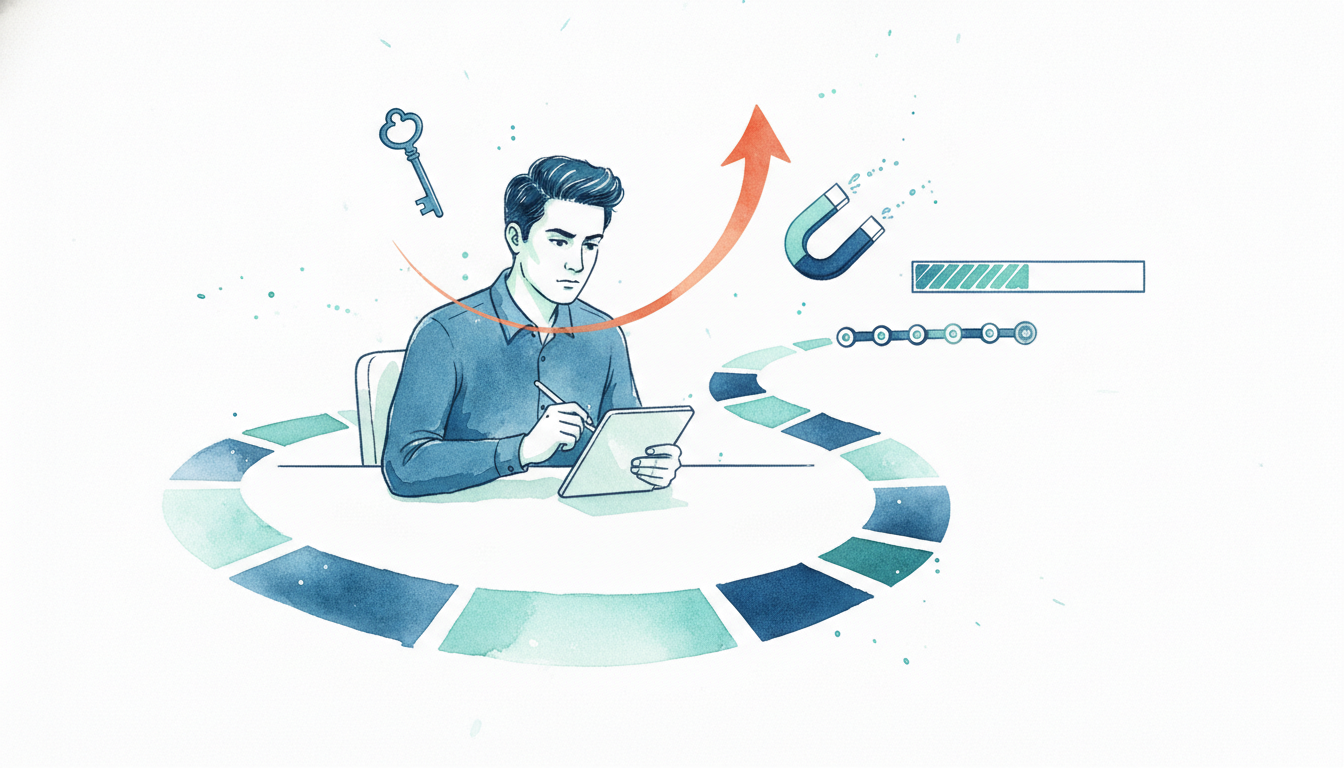
Most instagram lead gen advice fails because it treats content as the outcome instead of the input. Post more Reels. Stay consistent. Use trending audio. That advice fills a calendar, but it doesn't build a pipeline.
The core problem isn't reach. It's conversion design. Many guides still focus on profile polish and content tactics, while skipping the hard part: tying Instagram activity to qualified leads, sales conversations, webinar registrations, and revenue. That gap shows up clearly in Sked Social's discussion of attribution and lead quality on Instagram. Native lead ads can create noise, and link-in-bio paths often break attribution, so “more content” often just means “more untracked effort.”
That's why I don't look at instagram lead gen as a posting strategy. I look at it as a system. A system has clear traffic entry points, a defined handoff into DMs or landing pages, a way to qualify interest, and a measurement layer that tells you which pieces create pipeline.
If you're trying to scale SaaS demos, course enrollments, or webinar signups, the account needs to work like a compact funnel. Content earns attention. The profile filters and directs it. DMs capture intent. Ads amplify warm segments. The landing page closes the click. If you need help producing more top-of-funnel creative without turning your team into a manual editing shop, BlitzReels' AI video editing is a useful reference for batching Reel production more efficiently.
Stop the Content Treadmill Start Building a System
Teams get stuck because they mistake activity for meaningful advantage. They publish every day, answer a few DMs, maybe run a boost, then wonder why lead flow is inconsistent. The issue usually isn't effort. It's that the pieces don't connect.
A working instagram lead gen system is simpler than it is often made to be. It has five parts:
- Positioning that qualifies people fast so the right visitor knows they're in the right place.
- Content formats with distinct jobs instead of random posting.
- A conversion mechanism like a landing page, DM keyword flow, webinar signup, or demo request.
- Follow-up and automation so interest doesn't die in the inbox.
- Measurement tied to lead quality instead of likes, shares, and follower spikes.
Practical rule: If a post gets attention but gives the viewer no obvious next step, it's content, not lead gen.
High-ticket offers require a stricter standard. A SaaS buyer rarely converts because of one clever Reel. A course buyer usually needs proof, clarity, and reassurance. A webinar registration often depends on timing, topic fit, and urgency. That means your funnel has to support consideration, not just discovery.
What works is coordinated motion. A Reel surfaces the problem. A carousel explains the framework. A Story prompts the response. A DM delivers the asset or booking link. The landing page handles objections and captures the lead. Then retargeting brings back the people who didn't convert the first time.
What doesn't work is treating each of those as separate campaigns run by different instincts.
Position Your Profile as a High-Intent Funnel
Instagram users aren't just browsing for entertainment. Many are actively researching what to buy and who to trust. Oberlo reports that 62.2% of Instagram users follow and research brands and products on the platform in its Instagram statistics roundup. That changes how you should think about your profile. It isn't a business card. It's the first serious evaluation point.

Tighten the promise in the first screen
When someone lands on your profile from a Reel, Story mention, ad, or DM, they make a decision fast. Stay, click, or bounce. Your top screen needs to answer three questions without fluff:
- Who is this for
- What result do they help create
- What should I do next
A weak SaaS bio says:
“Helping companies grow with automation.”
A stronger one says:
“CRM workflows for B2B teams. Book a demo to reduce manual follow-up.”
A weak course bio says:
“Teaching creators how to scale.”
A stronger one says:
“Turn your expertise into a cohort course. Join the next free training.”
If you want extra ideas on structure and layout, this guide to Instagram profile optimization for brands is a solid companion piece.
Use Highlights like a sales deck
Most brands waste Highlights on vague labels and old event clips. For lead gen, Highlights should answer objections in the order a buyer has them.
A simple setup looks like this:
- Start here with a quick overview of what you offer
- Results with proof, wins, or customer context
- How it works with the process, product flow, or course structure
- FAQ covering pricing logic, who it's for, and common fit questions
- Enroll or Demo with direct action paths
Don't make people hunt for confidence. Put reassurance where they already tap.
For webinars, keep one Highlight dedicated to event snippets, topic breakdowns, and “who should attend.” For SaaS, keep one Highlight that shows the product in action. For courses, use one Highlight for curriculum and one for student objections.
Pick one primary conversion path
A lot of instagram lead gen underperforms because the profile sends traffic in five directions. Podcast. Newsletter. YouTube. Free guide. Demo. Community. That's too many asks for a visitor with low context.
Choose one main action based on your current campaign. If you're promoting a webinar, send the bio link there. If you're closing demos, send people to the demo page. If you're nurturing colder traffic, send them to a lead magnet built for the same offer.
For cleaner capture after the click, I prefer a focused landing page over a crowded link hub. It's easier to track, easier to message-match, and easier to improve over time. If you want a simple way to pair your page with lead capture after the visit, FOMOchat's guide to collecting visitor information is useful for thinking through what data you need and when to ask for it.
The Content Funnel From Reach to Relationship
Most brands use Instagram formats interchangeably. They post a Reel because reach is good, a carousel because it looks educational, and Stories whenever there's a launch. That creates motion, but not progression.
The better model is to assign each format one job in the funnel.

Reels pull in problem-aware traffic
Reels are the discovery layer. They're not where you explain everything. They're where you make the right person feel seen.
For SaaS, a strong Reel usually starts with friction:
- sales reps forgetting follow-up
- a pipeline full of stale leads
- customer success teams updating records by hand
For courses, the friction is different:
- knowledge trapped in scattered Google Docs
- an audience that engages but doesn't buy
- a launch plan built on guesswork
Good Reel hooks are blunt and specific:
- “Your CRM isn't the problem. Your follow-up logic is.”
- “Most course creators don't need more content. They need a clearer offer.”
- “If your webinar registration page feels flat, this is probably why.”
The goal here isn't to close. It's to create enough tension that the viewer checks the profile, watches more content, or replies to a Story later.
Carousels do the qualification work
If Reels get attention, carousels earn trust. That's why they matter so much in instagram lead gen for higher-consideration offers. Sprout Social reports that carousel posts produce the highest influencer engagement rate at 1.36%, ahead of reels at 1.24% and single photo posts at 1.04% in its Instagram stats analysis. That fits what many performance teams already see in practice. Carousels are easier to use for structured education.
A carousel can handle sequential persuasion in a way a Reel usually can't. You can move from problem, to mistake, to framework, to example, to CTA without losing the thread.
Examples that work:
| Offer type | Carousel concept | CTA |
|---|---|---|
| SaaS demo | “5 signs your inbound leads are dying in the handoff” | “DM DEMO for the workflow” |
| Course launch | “Why your mini-course isn't converting to full enrollments” | “Comment YES for the training” |
| Webinar | “The 7 questions buyers ask before they register” | “Grab your seat from the link in bio” |
The best carousels don't just teach. They sort readers into “not for me” and “I need this.”
If a carousel doesn't increase buying intent, it's just a prettier blog post.
For teams trying to build more conversations from these posts, FOMOchat's guide to generating conversations has useful prompts for turning passive page visits into active questions after the click.
Stories convert warm attention
Stories sit lower in the funnel. They work well when the viewer already knows who you are and just needs a prompt, a reminder, or a nudge toward action.
Use Stories for:
- deadline reminders
- poll-based qualification
- quick objection handling
- behind-the-scenes proof
- direct link pushes to sign up or book
A SaaS Story sequence might look like this:
- Story 1: “Still routing demo requests by hand?”
- Story 2: Poll. “Do reps respond in under an hour?” Yes / No
- Story 3: Short screen recording of the automation
- Story 4: “Want the setup? Reply DEMO.”
A course Story sequence might look like this:
- Story 1: “Building a course but stuck on pricing?”
- Story 2: Question sticker about biggest launch obstacle
- Story 3: Face-to-camera answer to one objection
- Story 4: Registration link to the next training
The formats support each other. Reels broaden the top. Carousels deepen interest. Stories create action. When brands skip one of those jobs, the funnel gets weaker.
Design Irresistible Lead Magnets and Landing Pages
The Instagram click is not the win. The page visit isn't the win either. The win is the conversion after curiosity.
That is why the landing page matters more than many realize. Instagram can generate intent, but a weak page wastes it fast. Many instagram lead gen campaigns break at this point. The content is good. The ad is decent. The CTA is clear. Then the visitor lands on a page with vague copy, too many fields, and no reason to trust the offer.

Match the lead magnet to the sales motion
High-ticket buyers usually don't want another generic PDF. They want something that reduces uncertainty or helps them make a decision.
Better lead magnets include:
- Webinar registration for teaching a framework and handling live objections
- Product walkthrough or free trial invite for SaaS offers that need interaction
- Case study download when buyers need proof and specificity
- Resource library or implementation guide for course buyers comparing options
- Template bundle if the audience wants quick execution, not theory
The key is alignment. If the next paid offer is a live cohort course, the lead magnet should preview the method or the outcome. If the next step is a demo, the asset should help the buyer understand the problem clearly enough to want a solution call.
Keep the page focused and mobile-first
Instagram traffic is mobile traffic first. So don't send people to a page designed like a desktop brochure.
A page that converts from Instagram usually has:
- one promise above the fold
- one primary CTA
- a short form
- tight message match with the post or ad they clicked
- immediate proof that the offer is credible
Here's a simple comparison:
| Weak page | Strong page |
|---|---|
| Multiple CTAs | One clear next step |
| Long brand intro | Immediate value proposition |
| Generic stock copy | Copy tied to the exact Instagram hook |
| Heavy navigation | Minimal distraction |
| No objection handling | FAQ, proof, and reassurance near the form |
Add social proof on the page, not just in the feed
This is the conversion-lift step most guides miss. Social proof in your content helps create interest. Social proof on the landing page helps close hesitation.
When someone clicks from Instagram, they often arrive with partial trust. They're interested, but not settled. On-page proof shortens that gap. That can be testimonials, recent signups, common questions answered in context, or visible engagement that shows other people are taking the offer seriously.
One option is installing the widget from FOMOchat, which adds an AI support and social proof layer on the page so visitors can see questions, get answers based on site content, and interact without leaving. Used carefully, this can help when the traffic is warm but still uncertain, especially for webinar pages, launches, and course enrollments.
The closer the visitor is to the form, the more useful proof becomes.
If the click came from a Story CTA, make the page feel like a continuation of that Story. Same promise. Same offer. Same tone. Don't force the visitor to re-interpret what they already understood on Instagram.
Automate Conversations and Scale With Ad Funnels
The mistake I see all the time is treating Instagram lead gen like a content problem. It becomes a handoff problem as soon as people start replying, commenting, and clicking at the same time. For SaaS demos, webinars, and high-ticket course launches, the account that responds first and routes cleanly usually gets the lead.

Build keyword-triggered DM flows
Start with content that asks for a specific action, then automate the first reply. Folk recommends direct CTAs in posts in its Instagram lead generation guide, and that advice holds up in practice because it gives you a clean trigger for follow-up.
Use prompts like:
- “Comment WEBINAR and I'll DM you the registration page.”
- “DM DEMO and I'll send the setup checklist.”
- “Reply COURSE and I'll send the lesson breakdown.”
Then make the automation do only the first part of the job:
- Send the thing you promised.
- Ask one qualifying question.
- route the lead to the right page, rep, or next message based on the answer.
For SaaS, a useful first message is:
- “Here's the workflow guide: [link]. Are you solving this for your own team or for clients?”
If they answer “own team,” send the demo booking page. If they answer “clients,” send the agency use-case page or partner offer.
For a course launch:
- “Here's the training link: [link]. Are you building your first offer or improving an existing one?”
That one question matters. It turns a generic inquiry into a segmented conversation without making the DM feel robotic.
Use outbound DMs for warm intent, not cold pitching
Automation handles volume. Outbound DMs still have a place, but only when the context is real.
The message should reference something specific they posted, connect to a problem you solve, and end with an easy question. No intro paragraph. No fake compliment. No pitch deck in the first message.
Examples:
- “Saw your Story about webinar no-shows. Are you filling seats from Instagram or mostly from email?”
- “You mentioned rebuilding onboarding. Are your demo requests already qualified before sales gets them?”
- “Noticed the new cohort launch. Are you using Instagram for reach, or are you trying to drive direct enrollments too?”
Those messages work because they start from the prospect's situation, not your offer.
If you add AI support after the click, keep the answers tied to your actual sales process. The setup advice in improving AI responses for site visitors is useful here because weak automated replies create friction fast, especially on webinar and course pages where buyers have detailed questions.
Scale proven offers with retargeting and lookalikes
Ads should extend what already works in organic. They should not cover up weak messaging.
Once a Reel, Story angle, or comment CTA starts producing qualified conversations, build a paid path around that exact hook. Send traffic to the same offer. Keep the same promise in the ad copy, the DM handoff, and the landing page. That consistency matters more than fancy creative.
The warm audiences that usually perform best for high-ticket offers are:
- recent content engagers
- profile visitors
- Instagram-driven site visitors
- customer-based lookalikes built from strong first-party data
There is a trade-off here. Broad targeting can get cheaper leads. Custom audiences and quality lookalikes often get better sales conversations. For SaaS and premium education, I would take fewer qualified leads over a pile of cheap form fills every time.
For creative testing, this piece on scaling Meta ad creative performance is useful if you want to turn organic winners into paid ads without losing the original hook.
A practical funnel looks like this:
- Reel or Story offers a specific resource
- comment or DM triggers the asset delivery
- automation asks one qualifier
- retarget non-converters with the same core offer
- send them to a page that matches the ad and includes proof close to the form
That last step is where paid and conversion rate work meet. If the ad gets the click and the DM gets the lead warm, the page still has to close hesitation with clear proof, not just copy.
A quick walkthrough helps here:
Measure What Matters to Prove ROI
Instagram ROI gets distorted fast when teams stop at reach, saves, or low-cost leads. For high-ticket offers, the essential question is simpler. Which posts, DMs, ads, and pages produce qualified pipeline and closed revenue?
The KPI set should stay tight. Track cost per lead, landing page conversion rate, DM-to-lead rate, lead-to-qualified rate, booked calls or registrations, and purchase rate. Engagement can help diagnose creative strength, but it should never sit at the top of the dashboard for SaaS demos, paid courses, or webinar funnels.
Track the handoffs, not just the clicks
Use UTM-tagged links anywhere Instagram traffic can branch:
- bio link
- Story link sticker
- ad destination URL
- webinar or demo links shared in DMs
Then map every source to the stages that matter in your CRM or even a clean spreadsheet:
- lead captured
- qualified
- booked
- attended
- purchased
That setup shows which traffic source brings buyers, not just opt-ins.
I have seen Instagram Reels produce the cheapest leads in a funnel while Story replies produced the best sales calls. If both get lumped into one Instagram bucket, the team keeps feeding the wrong asset. The fix is basic attribution. Separate organic post clicks, DM-delivered links, paid retargeting clicks, and profile traffic so you can see where intent actually increases.
A cheap lead source that never turns into qualified conversations is expensive.
Review the full path every week
Do not score content in isolation. Review the chain from hook to proof on page.
A practical weekly review looks like this:
- which Reel hooks drove profile visits from the right audience
- which carousels pulled comments or DMs with buying intent
- which Story frames got link taps or replies
- which DM scripts turned interest into registrations or demo requests
- which landing pages converted that traffic
- which audience segments produced qualified leads and sales
One more metric deserves a place here because it often decides whether Instagram traffic converts. Track how visitors interact with proof near the form. For high-ticket offers, a page usually needs more than sharp copy and a clean CTA. Buyers want confirmation that people like them got a result. Testimonials, client logos, short case-study snippets, or real-time social proof placed close to the conversion point can raise conversion rate after the click and after the DM handoff. That is the final lift step a lot of Instagram lead gen guides skip.
If your Instagram traffic is clicking through but hesitating on the page, FOMOchat can add a lightweight social proof and support layer that answers common questions in context and helps visitors move from interest to signup, demo request, or registration.