

When a happy customer leaves a glowing review, it’s more than just a nice compliment. It's a golden marketing opportunity. Thanking them isn't just about being polite; it’s a smart move that strengthens loyalty, builds undeniable social proof for new buyers, and turns that passive praise into an active asset for your brand.
Why Responding to Positive Reviews Is a Growth Superpower

It’s completely natural to focus on putting out fires and dealing with negative feedback. But what about all those happy customers? Ignoring them is one of the biggest missed opportunities I see. Every positive review is a potential marketing headline written by your most authentic spokesperson. A real, satisfied customer.
When you take a moment to respond, you're doing so much more than just saying "thanks." You’re showing both that reviewer and every single future prospect that you’re an engaged, appreciative brand that actually cares about its community. That public display of gratitude builds an incredible amount of trust.
Turn Praise into Powerful Social Proof
Think of your reviews section as a live conversation. When a potential customer, whether they're looking at your SaaS tool, online course, or webinar, sees a great review, that's a win. But when they see you've taken the time to write a personal, thoughtful response? That’s an even bigger win.
That simple interaction validates the original praise and creates a powerful feedback loop. Your response signals that the positive experience wasn't a fluke; it's the standard you aim for every single day. And this has a direct impact on your bottom line.
Responding to positive reviews isn't just a nice-to-have. We've seen that answered reviews can generate 12% more revenue, while those positive interactions boost customer advocacy by a whopping 16%.
Boost Your Visibility and Build Lasting Loyalty
Search engines and review platforms are smart; they notice this kind of engagement. Responding consistently can actually improve your visibility in search results, as these platforms often reward active and responsive businesses.
But beyond the algorithms, you’re forging a real human connection. A simple, personalized reply can turn a one-time buyer into a lifelong fan who tells their entire network about you. For SaaS founders and course creators, this is pure gold. That happy customer might just become your next case study, an enthusiastic affiliate partner, or your biggest champion on social media.
This isn’t just about customer service. It’s a core part of a growth marketing plan that builds real relationships and a brand people genuinely want to be a part of. You can find more practical strategies like this in our other guides on the FOMOchat blog.
The Anatomy of a Perfect Review Response
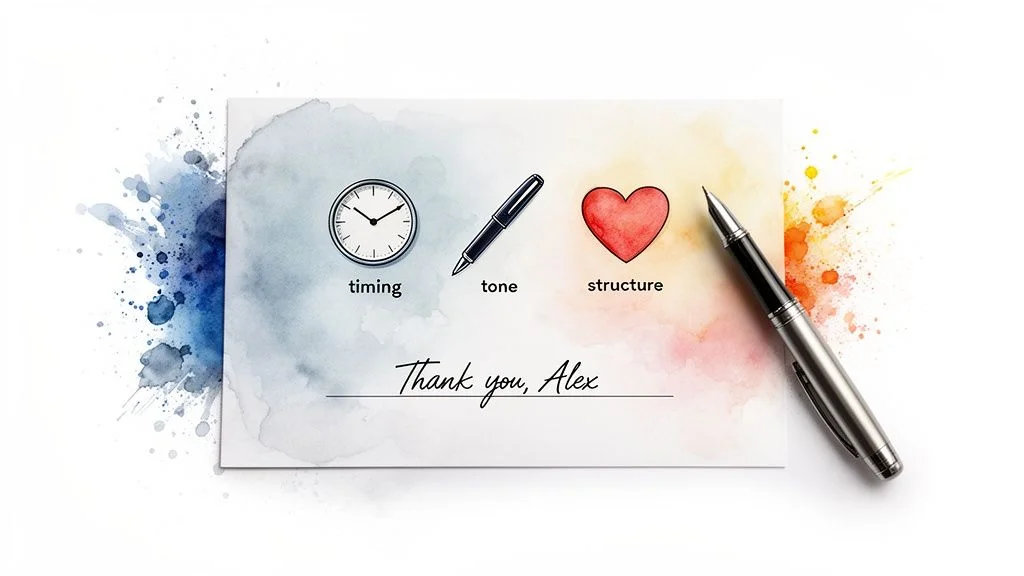
It’s tempting to see a 5-star review, fire off a quick "Thanks!", and call it a day. While that's better than silence, you're leaving a huge opportunity on the table. A truly great response doesn't just thank the customer; it makes them feel seen, reinforces what they loved, and even does a little marketing for you to anyone else reading along.
every positive review is a chance to have a public conversation that shows off your brand's personality. Getting this right comes down to three things I've learned are non-negotiable: responding quickly, getting the tone just right, and following a simple, repeatable structure.
Nail the Timing and Tone
First up, timing. You want to reply while the customer's positive feelings are still fresh. I’ve found that responding within 24-48 hours is the sweet spot. It shows you’re on the ball and genuinely appreciate them taking the time. Plus, it looks fantastic to potential customers who see that you're an engaged and attentive brand.
Next, let's talk about tone. Your reply needs to sound like it came from a real person, not a corporate script. The key is to match your brand's natural voice. Are you a fun, quirky course creator? Let that energy shine through. Are you a more buttoned-up B2B service? Keep it professional, but warm and approachable.
A simple trick I use is to read my response out loud before hitting send. Does it sound stuffy and robotic, or does it sound like something I'd actually say to someone in person? If it's the latter, you're on the right track.
Structure Your Response for Impact
Once your timing and tone are sorted, having a loose structure helps you say everything that matters without rambling. This isn't about creating a rigid, copy-paste template but more of a mental checklist to make sure every reply is effective.
Here’s a simple framework that I’ve seen work wonders:
- Thank them by name. This is the easiest way to make a response feel personal. A simple "Hi, Sarah!" is so much more impactful than a generic opening.
- Echo something specific. Did they love the Q&A in your last webinar or a particular feature in your app? Mention it! This proves you actually read their review and aren't just going through the motions.
- Add a little something extra. End with a gentle, forward-looking comment. It could be a hint about a new feature they might like or an invitation to your next event. Something like, “We’re so glad you found the session valuable and can’t wait to see you at the next one!” encourages them to stick around.
This approach turns a simple "thank you" into a conversation that builds loyalty. It also helps you identify your biggest fans. The kind of people you might want to reach out to for testimonials later. Learning how to properly start https://fomochat.com/help/collecting-visitor-information can be a great first step toward building those deeper relationships.
Crafting an Effective Positive Review Response
To help you stay on track, here's a quick cheat sheet covering the essential do's and don'ts for crafting a reply that truly connects with your customers.
| Do | Don't |
|---|---|
| Use the customer's name to make the response personal. | Use a generic, one-size-fits-all template for every review. |
| Mention a specific point from their review to show you listened. | Only say "Thank you" and nothing else. |
| Subtly reinforce a key feature or benefit they enjoyed. | Make a hard sales pitch for another product. |
| Keep the tone authentic and aligned with your brand voice. | Wait weeks to reply, letting the moment pass. |
By keeping these simple guidelines in mind, you can build a system for responding that not only makes your happy customers feel great but also strengthens your brand with every single reply. For more specific examples and platform-based advice, this guide on how to respond to a Google review is a fantastic resource.
Platform-Specific Strategies for Responding to Praise
Let's be clear: a "thank you" isn't just a "thank you." The way you respond to a happy customer has to change depending on where they're singing your praises. A response on a B2B review site is a completely different beast than a quick reply on social media.
the platform is the context. A quick nod on social media is about public engagement and brand personality. But a detailed reply on a serious review site? That’s for prospects who are deep in their research, weighing their options. You have to adapt your strategy for each channel to get the most out of every positive mention.
Responding on SaaS and B2B Review Sites
When you see a positive review pop up on a site like G2 or Capterra, you need to pay attention. These platforms are where your most serious potential buyers hang out. They aren't just browsing; they're actively comparing you to your competitors, and your responses are part of that evaluation.
So, when a customer leaves a glowing review, don't just say thanks. Your reply has a dual purpose: make that customer feel heard, and subtly sell your product to everyone else reading.
Imagine a user posts a review for your webinar software on G2, saying something like, "The real-time Q&A feature saved me so much time and made my event feel truly interactive."
A good response looks something like this:
"Hi Mark, thanks so much for the fantastic review! We're thrilled to hear the real-time Q&A made such a difference for your event. Our goal was to create that feeling of seamless interaction, so your feedback means the world to our product team."
See what that does? It acknowledges the user personally but also reinforces a key value proposition for anyone else who's on the fence. It's a strategic thank you.
Engaging on Social Media and App Stores
On the flip side, social media and app stores are all about fast, visible, and community-focused interactions. Speed and personality are your best friends here.
If someone tags your company in a glowing post on LinkedIn or X (formerly Twitter), your job is to amplify it. Thank them, tag them back, and consider sharing it with your own audience. Even if they don't tag you, it’s worth setting up alerts to search for your brand name so you can jump into those conversations. A quick tip for LinkedIn: tagging the reviewer in your reply can push their praise out to their entire professional network.
App stores are a bit different. Responding to reviews shows you’re an active, engaged developer, which builds trust.
- Acknowledge their rating: Always start by thanking them for that 5-star review.
- Keep it short and sweet: People reading app reviews are usually on their phones. Get to the point.
- Encourage them to stick around: Something simple like, "We're glad you're enjoying the app!" is perfect.
Capitalizing on On-Site Testimonials
When you get a great piece of feedback you can use as a testimonial on your own website, you're in the driver's seat. You control the entire presentation. This is your chance to pair powerful social proof with a direct call to action.
Let's say a course creator sends you a fantastic quote: "This course completely changed my approach to marketing." Don't just slap the quote on your landing page. Frame it.
You could add a small note right below it:
"We're so proud of students like Jennifer who are achieving incredible results! If you're ready to transform your marketing, [learn more about the course here]."
This little move seamlessly connects a real person's success story to your conversion goal. It’s incredibly effective.
Remember, with 94% of shoppers reading reviews before making a purchase, how you engage with praise is a massive opportunity. One hotel chain saw bookings skyrocket by 77% in just a few months simply by personally answering reviews. It’s proof that turning praise into a conversation isn’t just good manners. It’s good business. You can explore more of these fascinating review management statistics and their impact.
Using Templates and AI to Scale Your Responses
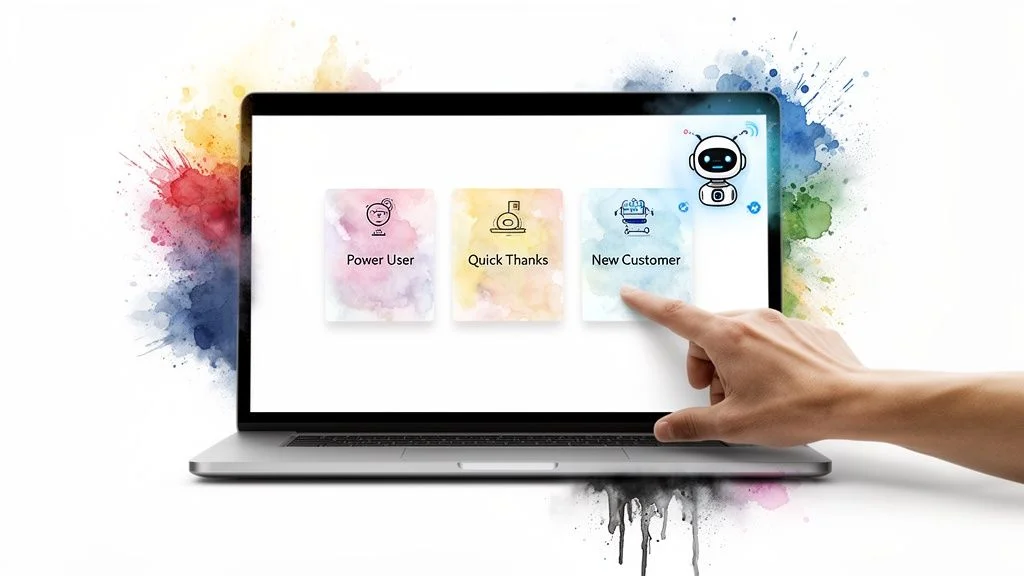 When you're just starting, replying to every positive review is a joy. It's exciting to connect with your first happy customers. But as your business grows, that trickle of praise can quickly become a firehose. So, how do you keep up without losing the personal touch that made your responses great in the first place?
This is where you need to get smart about scaling. By blending customizable templates with the right technology, you can stay on top of the volume and make sure no happy customer goes unnoticed. The goal isn’t to fake your gratitude. It’s to make showing it much more efficient.
Customizable Templates for Common Scenarios
Templates often get a bad rap, but they are a lifesaver when you treat them as a starting point, not a copy-paste final answer. Forget the one-size-fits-all "Thanks!" and create a few different templates for the types of reviews you see most often. This gives you a solid foundation you can quickly build on.
Here are a few common scenarios and some templates you can adapt:
For the Quick 5-Star Rating: This customer didn’t leave a comment, but their high rating is still a win.
- Template: "Hi [Name], thank you so much for the 5-star rating! We’re thrilled you had a great experience and really appreciate you taking a moment to share it."
For the Enthusiastic First-Timer: They're new to your brand and clearly excited. Your job is to welcome them and reinforce that they made a great choice.
- Template: "Welcome aboard, [Name]! We’re so happy to hear you’re already loving [Product/Course]. We can't wait to see what you achieve with it. Thanks for the fantastic review!"
For the Detailed Power User: This person mentioned specific features and gave you some amazing feedback. Their review is pure gold.
- Template: "Wow, [Name], thank you for such an amazing and detailed review! We’re beyond happy that you’re finding [Specific Feature Mentioned] so valuable. That’s exactly what our team was hoping for when we built it!"
The secret to making templates work is personalization. Always use the customer's name and mention at least one specific detail from their review. This small effort turns a generic reply into a genuine conversation.
Using AI to Streamline Your Workflow
While templates are great for predictable reviews, AI can bring a whole new level of efficiency to your process. Today's AI tools have gotten surprisingly good at understanding the context of a review and drafting a response that sounds human, saving your team countless hours.
To really speed things up, you can look into tools like AI agents for customer support. These systems can parse incoming reviews, figure out what the customer is excited about, and generate draft replies that are already 80% of the way there.
Instead of writing every response from scratch, your team's role changes. They become editors, focused on adding that final human touch. An AI can handle the heavy lifting of generating a solid base, and your team member can then inject your brand's personality, fix any subtle mistakes, and make sure the tone is just right. This hybrid approach lets you respond to way more reviews without sacrificing quality.
For anyone looking to dive deeper, it's worth learning more about improving AI responses to ensure they always reflect your brand’s voice. By combining smart templates with AI assistance, you can build a powerful system for managing all that great feedback.
Turning Positive Feedback Into Actionable Insights
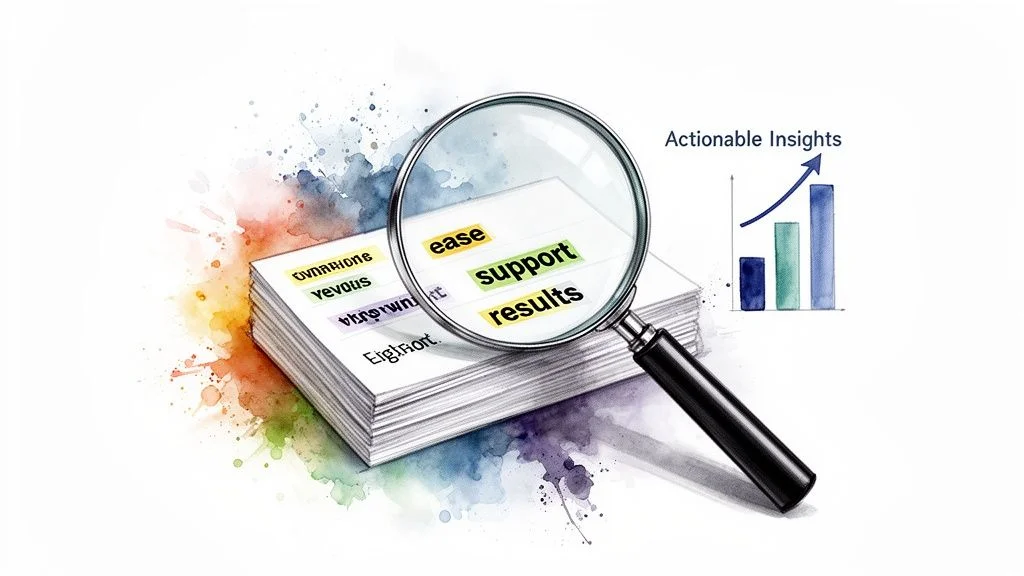
Knowing how to respond to positive reviews is a great start, but the real magic happens after you’ve hit "reply." The most successful brands I've seen treat these glowing testimonials not just as social proof, but as a goldmine of customer intelligence hiding in plain sight.
It’s time to move beyond simply acknowledging praise and start listening at scale. When you treat positive feedback as raw data, you uncover the exact words your happiest customers use to describe your value, identify your most-loved features, and pinpoint what truly makes you different.
Creating a Feedback Analysis System
Don't worry, this doesn't have to be complicated. A simple spreadsheet and a tagging system are all you really need to get going. The goal is to start sorting your feedback so you can spot the themes that keep popping up.
Think of it like doing a "year in review" for your business, but with customer comments instead of calendar appointments. Just go through your reviews and start assigning simple tags.
- Feature Mentions:
Q&A feature,dashboard,onboarding - Benefits & Outcomes:
saved time,increased signups,felt confident - Customer Experience:
fast support,easy to use,great community
This simple act of organizing feedback immediately starts to clarify your strengths from your customers' point of view. It’s a direct line into what they truly care about.
By systematically analyzing your reviews, you're essentially building a real-time voice of the customer program. This isn't just about feeling good; it's about making smarter business decisions backed by qualitative data.
Turning Praise Into Growth
Once you have this system in place, the insights can directly fuel your entire growth strategy. It’s incredibly powerful.
For instance, a course creator might notice dozens of reviews mentioning how "module 3 completely changed my perspective." That's not just a nice comment; that’s a brilliant marketing angle for your next ad campaign. Or a SaaS team might realize a "minor" feature they almost sunset is consistently praised, signaling it’s a key differentiator they should be shouting about.
This approach has a measurable impact. Consistently responding to reviews can improve click-throughs by 25% and boost customer advocacy by 16%. And with businesses that have over 200 reviews being seen as 21% more trusted, the ROI of both engaging with and analyzing feedback is undeniable. You can find more details in this great breakdown of how online review statistics impact business growth on HookAgency.com.
When you dig into the praise, you arm your marketing, sales, and product teams with the exact language that resonates with your best customers. You can see these trends and a whole lot more in our comprehensive analytics dashboard.
Frequently Asked Questions About Responding to Reviews
Once you start making review responses a regular part of your routine, you'll run into the same practical questions everyone does. Let's get straight to the point with some answers based on what actually works.
How Quickly Should I Respond to a Positive Review?
The sweet spot is within 24-48 hours. When you reply that quickly, you’re catching the customer while they’re still feeling good about their purchase and your brand.
A fast response shows you’re paying attention and genuinely appreciate the time they took. Plus, to any potential customers scrolling through, it makes your company look incredibly on the ball. If you wait too long, it just feels like you’re checking a box.
Should I Respond to Every Single Positive Review?
When you're starting out? Absolutely. Responding to every single review is a fantastic way to build momentum and show your early customers that they matter. It sets a powerful precedent.
But as your company grows, the sheer volume can become overwhelming. If you can't possibly get to every single one, you’ll have to prioritize. Here’s where I’d focus my energy:
- The super-detailed reviews: These are pure gold. They give you amazing marketing copy and real-world insights.
- Reviews on high-traffic sites: Think major players like G2 or Capterra, or your most active social media channels.
- Anyone who mentions a specific feature or team member: This is your chance to highlight what works and publicly recognize your team.
Even when you have to prioritize, the closer you can get to a 100% response rate, the stronger your brand's reputation will be.
A good rule of thumb I've seen work well is to answer at least half of your 4- and 5-star reviews within two days. This strikes a nice balance. It shows you care without making your replies look automated or robotic.
Is It Okay to Include a Call-to-Action in My Response?
Yes, but you have to be smart about it. The primary goal is always to say "thank you," not to make another sale. The trick is to use a soft call-to-action (CTA) that offers more value, not one that asks for more money.
For instance, instead of a blunt "Buy our other course!" try something more inviting. You could say: "We're so glad you love that feature! If you're interested, we have experts in our community forum who share advanced tips on using it."
See the difference? You’re inviting them deeper into your world without being pushy. You could also suggest they share their story for a case study or mention a referral program if it feels right. The key is to offer something, not just ask for something.
Turning feedback into a conversation is how you build a real community. FOMOchat helps you do this right on your website by using AI-powered social proof and chat to display real-time engagement, turning hesitant visitors into confident buyers. Discover how FOMOchat can boost your conversions today.