

Let’s cut straight to it. Your Cost Per Lead (CPL) is simply what you pay to get one new lead. It's the price tag for a potential customer's email address or contact info. Think of it less as a marketing metric and more as a fundamental business number that shows if your growth efforts are actually working.
What Is Cost Per Lead And Why It Matters

It’s easy to get distracted by flashy numbers like clicks and impressions. But cost per lead is where the rubber meets the road. It answers the most important question for anyone spending money on marketing: "What did we actually get for our ad budget?"
At its core, understanding What Is Cost Per Lead (CPL) is about measuring the efficiency of your marketing spend.
Imagine you own a small coffee shop. You wouldn't just count the people who glance in your window. You'd track the exact cost of beans, milk, and cups for every latte you sell. CPL applies that same practical logic to your marketing. The "ingredients" are your ad spend, software tools, and freelancer fees, and the "latte" is a brand new lead.
The True Value of Tracking CPL
Knowing your cost per lead gives you incredible clarity and control. For SaaS founders, course creators, and webinar marketers, this isn't just a "nice-to-have" metric. It's the key to scaling up without setting your cash on fire.
So, why does this one number matter so much?
- Smarter Budgeting: When you know your CPL across different channels, you know exactly where to double down and where to cut your losses. If LinkedIn ads bring in leads for $50 but Google Ads cost you $150, the decision of where to allocate more budget becomes obvious.
- Proving Marketing's Worth: CPL gives you a concrete number to show your team or investors. It elevates the conversation from "we got a lot of traffic" to "we generated 200 qualified leads at an average cost of $75 each." That’s a result you can build on.
- Connecting to Profit: The real magic happens when you compare your CPL to your customer lifetime value (LTV). If it costs you $100 to get a lead that becomes a $1,000 customer, you have a profitable machine. If that same lead costs you $500, you know you've got a leak in the bucket that needs fixing.
In short, Cost Per Lead is your financial North Star for generating interest. It guides every decision you make, from tweaking an ad campaign to building your entire marketing strategy, ensuring every dollar is an investment, not an expense.
Ultimately, tracking CPL helps turn your marketing from a mysterious cost center into a predictable engine for growth. Each lead is just the first step in a customer's journey, and knowing what that first step costs is essential. To see how that journey unfolds, explore our guide on what a conversion funnel is and how it works.
How to Calculate Your Cost Per Lead Accurately
Figuring out your cost per lead seems simple on the surface, but getting a number you can actually trust means digging deeper than just your ad spend. A truly accurate CPL accounts for all the hidden costs that go into winning that lead. It’s the difference between a rough guess and a reliable metric that can steer your entire marketing strategy.
The basic formula is a good place to start: Total Marketing Spend ÷ Total New Leads = CPL. The real magic, however, is in how you define both sides of that equation. Get either one wrong, and you'll be making decisions based on faulty data.
Defining Your Total Marketing Spend
This is where most people trip up. They look at their ad spend and call it a day. But your "Total Marketing Spend" should include every single dollar you invested to generate leads during a specific timeframe. Think of it as the total cost of running your lead generation machine, not just the gas you put in the tank.
Your real spend includes more than you might think:
- Ad Spend: This is the obvious one: the money you pay directly to platforms like Google, Meta, LinkedIn, or TikTok.
- Tool Subscriptions: Don't forget the monthly fees for the tools that make it all happen. This includes your landing page builders, email marketing software, analytics platforms, and SEO tools.
- Creative and Content Costs: Did you hire a designer for your ad creative or a writer for the copy? Those invoices are part of your campaign cost.
- Team and Freelancer Costs: If you have an in-house team or an agency working on a campaign, you need to factor in a portion of their salary or retainer.
Bundling all these expenses together gives you a true picture of your investment. It stops you from celebrating a "profitable" campaign when hidden costs are secretly draining your budget.
Defining What a Lead Is for You
Just as important is getting crystal clear on what a "lead" actually means for your business. It's not just a website visitor or a social media follower. A real lead is someone who has intentionally raised their hand and given you their contact information.
But even that can mean different things. Is a lead someone who:
- Downloads a free guide?
- Subscribes to your newsletter?
- Registers for a webinar?
- Books a product demo?
- Starts a free trial?
The right answer depends entirely on your business. A SaaS company might only count a demo request as a legitimate lead, while a course creator might consider a webinar signup to be the key conversion.
Key Takeaway: You have to define what a "lead" is based on your unique sales process. Once you decide, stick with it. Consistency is the only way to make sure you’re comparing apples to apples when you calculate your cost per leads over time.
A Practical CPL Calculation Example
Let's put this into practice. Imagine a SaaS company runs a LinkedIn campaign for one month with the goal of generating demo requests.
Here's a breakdown of their costs:
- LinkedIn Ad Spend: $4,000
- Landing Page Software (Unbounce): $150
- Freelance Copywriter Fee: $500
Total Marketing Spend = $4,000 + $150 + $500 = $4,650
At the end of the month, the campaign brought in 75 demo requests.
Now, we just plug those numbers into our formula: $4,650 (Total Spend) ÷ 75 (Total Leads) = $62 CPL
Just like that, the company knows it costs them exactly $62 to get one potential customer on a demo call. They can now weigh this against their customer lifetime value to see if the campaign is truly profitable and how it stacks up against other channels. This accurate CPL is the key to optimizing your campaigns and scaling with confidence. And for more on what to do with those leads, you can learn how to increase your website conversion rate.
What Is a Good Cost Per Lead by Industry?
So, you want to know what a "good" cost per lead is. That’s a bit like asking, "How much should I pay for a car?" There’s no single right answer.
Think about it: $50,000 is a crazy price for a basic family sedan, but it’s a steal for a high-end luxury sports car. Your CPL is the exact same. Its real value is all about context: your industry, how much a customer is worth over time, and how long it takes to close a sale.
A high CPL doesn't automatically mean you're failing. If you're a B2B SaaS company selling a $50,000 annual contract, paying $400 for a solid lead is a fantastic investment. But if you’re selling $25 t-shirts, a $15 CPL will sink your business fast.
The goal isn't just to chase the lowest number possible. It's to figure out what's profitable and sustainable for your business. That starts with understanding where you fit in the bigger picture.
Industry CPL Benchmarks: A Starting Point
To get your bearings, it helps to look at what others are paying. These industry averages give you a valuable reference point, but remember: they are just averages. Your own numbers will swing based on your marketing channels, who you're targeting, and what you're offering.
Before we get to the numbers, it's important to remember all the costs that go into your final CPL. It's not just what you pay for ads.
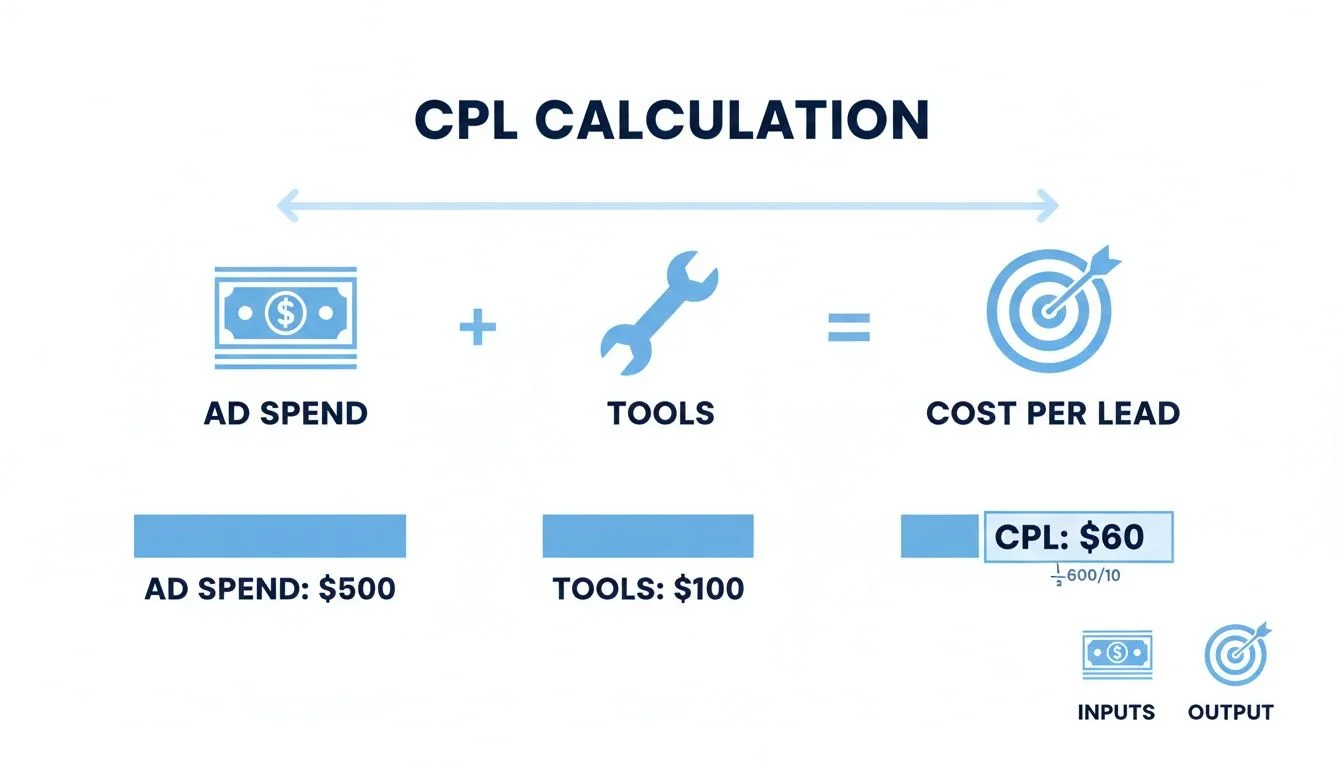
As you can see, you have to account for both your direct ad spend and the cost of any tools you use in your campaigns.
Recent data shows just how wide the range can be. While the global average CPL sits around $198, that number hides some pretty wild differences. For instance, B2B SaaS companies might see a CPL of $237, while e-commerce brands often get by with a much leaner $91 per lead. These gaps come from the unique economics of each market.
If you're curious, you can find more detailed cost per lead breakdowns to see how these numbers shake out.
Diving Deeper into Industry Averages
Let's look at some benchmarks to see this in action. The table below shows just how much an "acceptable" cost per lead can change from one field to the next.
| Industry | Average CPL | Why It Varies |
|---|---|---|
| Technology/SaaS | $237 | High LTV, longer sales cycles, competitive market. |
| Finance & Insurance | $160 | High-value customers, but strong competition. |
| Healthcare | $162 | Trust-based decisions and regulatory hurdles. |
| E-commerce | $91 | Lower transaction value, requires high volume. |
| Education | $105 | Long consideration phase, multiple touchpoints. |
It’s pretty clear from the table: industries with high-value customers and long, complex sales cycles (like tech and finance) can afford a much higher CPL. Landing one big enterprise client can easily pay for a whole lot of marketing.
On the flip side, e-commerce is a numbers game that depends on high volume and repeat business, so keeping the CPL low and efficient is everything.
It's not about hitting some universal "good" CPL. It's about finding the CPL that fuels a profitable growth engine for your business, where the cost to get a lead is way less than the value that lead brings in.
Company size also makes a huge difference. Large companies (over 1,000 employees) spend roughly $349 per lead, leaning on brand recognition and big budgets. At the same time, small businesses (under 50 employees) are much scrappier, averaging just $47 per lead by using hyper-targeted or grassroots tactics.
Knowing these benchmarks gives you a realistic place to start. Instead of aiming for a random number you read in a blog post, you can set goals that actually make sense for your industry, your company size, and your bottom line.
Comparing CPL Across Different Marketing Channels
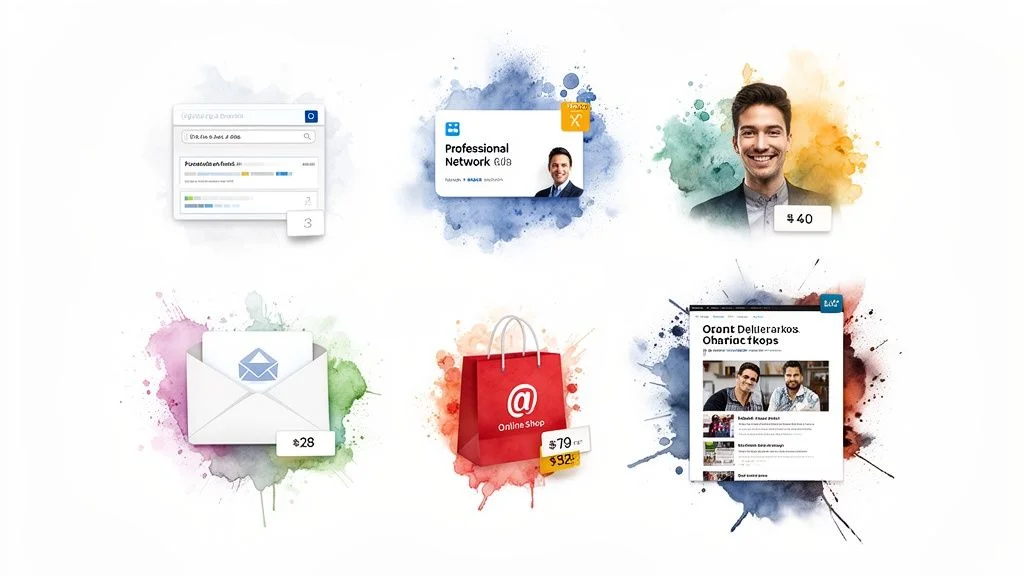
Think of your marketing channels like different places to shop. You wouldn't expect to pay the same price for a carton of milk at a 24/7 convenience store as you would at a bulk warehouse club. The same logic applies to generating leads. Your cost per lead will swing, sometimes wildly, depending on where you're looking for them.
A lead from a highly targeted LinkedIn campaign will almost always have a bigger price tag than one you get from your company's email list. Getting a handle on these differences is the first step toward building a smart marketing budget that actually works.
The Paid vs. Organic Divide
The most fundamental split in CPL is between paid and organic channels. It's really a question of renting an audience versus earning one.
- Paid Channels (like Google Ads, LinkedIn Ads): This is the fast lane. You pay platforms like Google or Meta for instant access to their users. You can launch a campaign and see leads roll in the same day, but the trade-off is a direct cost for every single interaction. Your CPL is front and center.
- Organic Channels (like SEO, Content Marketing, Email): This is the long game. It requires an upfront investment of time and effort to create great content and build a community. The direct CPL is often much lower, but the payoff isn't immediate. Over time, however, the ROI can be massive.
For almost every business out there, the smartest approach isn't an "either/or" choice. The real magic happens when you find a blend of paid and organic that delivers quick wins while building a foundation for sustainable, long-term growth.
A Closer Look at Channel-Specific Costs
Here's where things get interesting. Not all paid channels are created equal, and the same is true for organic ones. Some platforms are just naturally more expensive because they offer access to very specific, high-value audiences.
For example, reaching a C-suite executive on LinkedIn is going to cost more than running a general brand awareness ad on Facebook. Why? The audience's intent and professional context are completely different, and the platform prices that access accordingly. This is a big reason why B2B companies often see a much higher CPL on paid social than B2C brands.
A channel's cost is a direct reflection of the audience's value. A higher CPL isn't always a bad thing. It can be a fantastic investment if it gets you a lead who is actively searching for your solution and has the authority to buy.
The differences between industries can be just as stark. According to research from seoprofy.com, some industries face incredibly high lead costs due to longer sales cycles and higher lifetime customer value. For instance, legal services might pay $784 for a single lead from a paid channel but only $516 from their organic efforts.
Meanwhile, a SaaS business might see a paid CPL of $310, while their organic CPL is a far more efficient $164. The numbers make it pretty clear how much these businesses rely on paid ads to find qualified prospects.
Building a Cost-Effective Marketing Mix
If you rely only on paid channels, you'll burn through your budget in a hurry. That's why building a strong organic engine is so important for keeping your overall cost per lead under control. Channels like email marketing, for example, consistently deliver one of the highest ROIs because you're talking to people who already know and trust you.
Here’s a simple framework for building a more efficient marketing mix:
- Use Paid Ads for High-Intent Leads: Focus your ad spend on bottom-of-funnel keywords in search or hyper-specific job titles on LinkedIn. This helps you capture people who are actively looking to make a decision.
- Invest in SEO and Content for the Long Haul: Create genuinely helpful blog posts, guides, and tools. This attracts your ideal customers over time through search and social sharing, steadily lowering your blended CPL.
- Amplify Everything with Social Proof: By showcasing real customer activity, testimonials, and reviews, you increase conversion rates across all your channels. This makes every dollar you spend (whether on paid or organic) work harder. If you're new to the concept, our guide on what social proof is in marketing is the perfect place to start.
Actionable Strategies to Lower Your Cost Per Lead
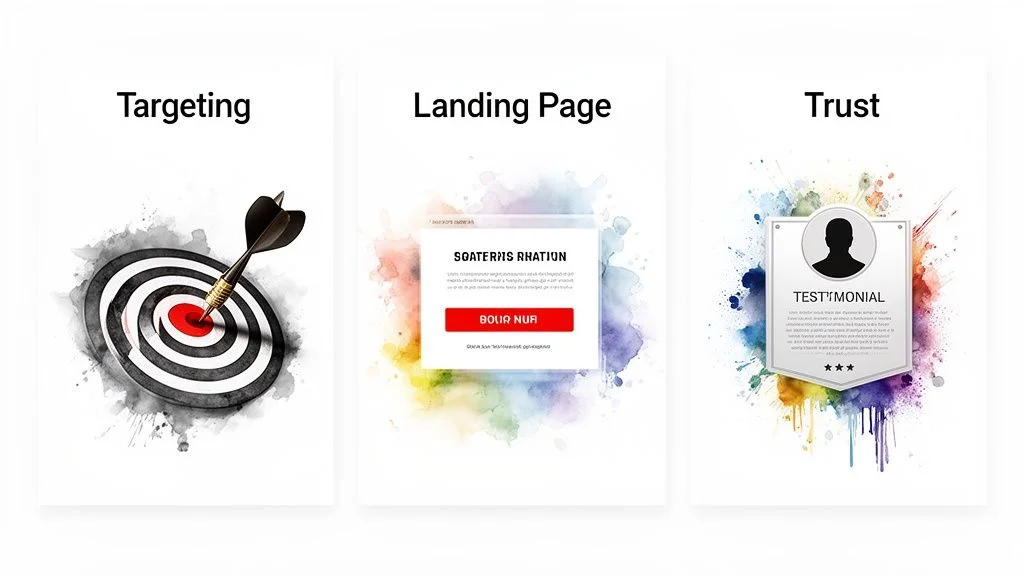
It’s always frustrating to watch your cost per lead start creeping up. Your first instinct might be to cut your budget, but that's rarely the answer. The real solution is to make every dollar you spend work harder for you.
To do that, we're going to focus on three core parts of your lead generation machine: your ad creative and targeting, your landing pages, and the trust you build with visitors. By making small, smart improvements in each area, you can bring your CPL down significantly.
Think of it like tuning an engine. A few precise adjustments can make a car run faster and more efficiently. We're going to apply that same mindset to your campaigns, turning wasted ad spend into high-quality leads.
Refine Your Ad Creative and Targeting
The most expensive lead you’ll ever get is one from someone who was never a good fit for your business. If your ads are catching the eye of the wrong crowd, you’re just paying for clicks that go nowhere. So, the first place to start is right at the top of your funnel: your ads and who you’re showing them to.
Dive into your ad platform's analytics. Who is actually clicking on your ads and converting into a lead? Now, hold that up against your ideal customer profile. If there's a disconnect, it's time to tighten up your targeting.
- Get Hyper-Specific with Audiences: Ditch the broad, interest-based targeting and start building smaller, more focused audiences. Layer demographics with job titles, company sizes, and specific behaviors to pinpoint the people who look just like your best customers.
- Use Negative Keywords and Exclusions: Be ruthless about telling ad platforms who not to show your ads to. If you sell B2B software, you should be excluding students, interns, and any industries you don't serve. This one move can slash your wasted spend overnight.
- Test Your Ad Copy Relentlessly: Your message matters just as much as your targeting. A/B test everything: your headlines, your hooks, your creative. Does an ad that highlights a pain point outperform one that focuses on a benefit? Don’t guess. Let the data tell you what works.
Remember, the goal isn't just to get cheaper clicks. It's to get clicks from people who are genuinely likely to become leads. A higher click-through rate (CTR) from a qualified audience is one of the fastest ways to lower your CPL, because ad platforms reward relevant ads with lower costs.
Optimize Your Landing Page Experience
Okay, so someone clicked your ad. Great. But now the clock is ticking. You have just a few seconds to prove they’ve landed in the right place. A slow, confusing, or untrustworthy landing page will absolutely demolish your conversion rate and cause your cost per lead to skyrocket.
Your landing page should have one job and one job only: to get the conversion. Every single element (every word, every image) needs to support that goal. This is where you can make some simple changes and see massive results.
For a deeper dive into this crucial step, our guide on landing page optimization best practices offers a complete playbook.
Here’s where to focus your efforts first:
- Craft a Powerful Headline: Your headline must instantly deliver on the promise from your ad. It needs to be crystal clear, concise, and speak directly to the visitor's goal or problem.
- Simplify Your Form: Every field you add to your form is another reason for someone to give up. Be honest with yourself: what information do you absolutely need right now? For a guide, an email is probably enough. For a demo, maybe you need a name and company. Question every single field.
- Strengthen Your Call-to-Action (CTA): Get rid of boring, generic CTAs like "Submit." Instead, use action-oriented text that reinforces the value. "Get Your Free Guide" or "Book My Demo" is far more compelling because it tells the user exactly what they're getting.
Build Trust Instantly with Social Proof
In today’s crowded market, trust is your most powerful conversion tool. People are simply more likely to do something if they see other people have already done it and had a good experience. By building social proof directly into your landing pages, you give visitors that instant dose of confidence they need to take the next step.
This is especially true for SaaS products, online courses, and webinars, where you're asking for a bigger commitment than just an email. You're asking for someone's time, attention, and trust.
Here are a few ways to show, not just tell, that your offer is the real deal:
- Showcase Testimonials and Reviews: Pull direct quotes from your happiest customers. If you can, add their photo and job title to make it even more credible.
- Display Recent Activity: Using a simple widget that shows recent signups or purchases (like "Sarah from New York just enrolled!") creates a powerful sense of momentum and popularity.
- Use Real-Time Engagement: Tools like FOMOchat take this even further by showing live, AI-powered group chats right on your page. When visitors see other people asking questions and getting answers in real-time, it builds incredible trust and handles their objections on the spot.
By putting these strategies into action, you're creating a much more efficient, compelling journey from ad click to conversion. The result? A lower cost per lead and a much healthier return on your marketing investment.
Key Lead Generation Market Trends
To really get a handle on your CPL, you have to zoom out and look at the bigger picture. Lead generation isn't some tiny marketing tactic; it's a massive, booming industry. Businesses are pouring serious money into finding their next customers, which is exactly why getting your CPL right is so critical.
The market itself is exploding. Valued at $31.2 billion back in 2026, the global lead generation market is expected to surge to $47.1 billion by 2036. This isn't just a number. It shows how central getting new leads has become for virtually every company. You can dig into the specifics in this lead generation market forecast.
As more and more businesses jump into the fray, the competition for your audience’s attention gets fiercer. That pressure to find leads efficiently isn't going away; it's only going to grow.
Where Is the Money Going?
So, where is all this cash flowing? Right now, 37% of marketing budgets are earmarked specifically for lead generation. What's more, a huge 69% of B2B companies say they plan to spend even more in this area. The takeaway is clear: the race for quality leads is heating up.
This spending spree is happening across all sorts of channels, but some are definitely proving to be smarter investments than others.
Key Insight: Lowering your cost per lead isn't just about saving a few bucks. It's a strategic move to stay ahead in a market where everyone is ready and willing to spend more to win new customers.
Paid channels like PPC ads are still a big piece of the puzzle, with some companies shelling out between $9,000 and $10,000 every month. But when you look at pure efficiency, one classic channel continues to dominate: email marketing.
- A Marketer's Favorite: 32% of marketers say email is their best-performing channel for generating leads.
- Incredible ROI: A whopping 35% of companies see a return of $10–$36 for every single dollar they put into email.
These numbers tell a pretty compelling story. While the market gets bigger and budgets climb, the most successful businesses are doubling down on the channels that offer proven, cost-effective results. Understanding these trends helps you build a smarter, more resilient lead generation strategy, one that not only brings down your CPL but also sets you up for success in an increasingly competitive world.
Frequently Asked Questions About Cost Per Lead
Once you get the hang of calculating your Cost Per Lead, a few practical questions always seem to pop up. Let's walk through the most common ones so you can put this metric to work with confidence.
We'll clear up the gray areas and give you a solid footing for your marketing strategy.
What Is a Good CPL for a New Business?
If you're just starting out, the single most common question is: "What's a good cost per lead?" The honest answer? There's no magic number. In the beginning, your real job isn't to hit some random industry benchmark. Establish your own baseline.
Don't be surprised if your CPL feels high at first. That's totally normal while you're testing different ad channels and finding your voice.
Instead of chasing an arbitrary number, focus on these three things:
- Profitability: Is your CPL low enough that you can still make a profit when a lead eventually buys?
- Learning: Are you gathering enough data to figure out which marketing efforts are actually working?
- Improvement: Is your CPL heading in the right direction (downward) as you optimize your campaigns?
A "good" CPL for a new business is simply one that's profitable and gets cheaper over time as you learn what resonates with your audience.
How Often Should I Calculate My Cost Per Lead?
This really depends on how fast your marketing is moving. For most businesses, checking your cost per lead once a month is a great rhythm. It gives your campaigns enough time to collect meaningful data, but it's not so long that you're burning cash on something that clearly isn't working.
The exception is when you're running short, intense campaigns. Think of a big product launch or a limited-time webinar series. In those cases, you'll want to check your CPL weekly or even daily. This lets you make quick, smart adjustments to your targeting, ads, and budget to get the best possible results while the campaign is live.
What Is the Difference Between CPL and CPA?
This is a big one, and it’s a distinction that trips up a lot of marketers. They sound similar, but CPL and Cost Per Acquisition (CPA) measure two completely different milestones in your funnel.
Cost Per Lead (CPL) is what it costs you to get a potential customer. This is someone who has shown interest by giving you their contact info, like an email address. They're a prospect, not yet a customer.
Cost Per Acquisition (CPA), which is also called Cost Per Customer, is what it costs you to get a paying customer. This metric tracks the total spend it took to make an actual sale.
Here's an easy way to think about it: CPL is the cost of getting someone interested enough to knock on your store's door. CPA is the cost of getting them to walk inside and actually buy something. You need to track both to see how healthy your entire marketing and sales process really is.
Ready to lower your cost per lead by building instant trust and answering visitor questions in real-time? FOMOchat is an AI-powered social proof widget that turns passive visitors into engaged leads. See how it can boost your conversion rates.