
Which proof will your visitors believe? A pop-up showing a recent purchase only helps when visitors trust the activity behind it. The best social proof tools differ less by the length of their feature lists than by where their proof comes from, how clearly it's verified, and how pricing changes as traffic grows.
That distinction matters. A real purchase signal, a verified review, a customer video, and an AI-led group conversation solve different trust problems. Nielsen found that 92% of surveyed internet respondents trusted recommendations from friends and family more than other advertising formats, while online reviews ranked second at 70% in its global research across 56 countries (Nielsen's consumer trust research). Buyers still want context, attribution, and honest disclosure, not just movement on a screen. That's the psychology of social proof in one line. People follow people they can see and believe.
This comparison covers FOMOchat, Fomo, Proof Pulse, ProveSource, Nudgify, Evidence, and Testimonial.to. Each is judged on proof source, pricing behavior, and setup effort, with practical trade-offs for SaaS teams, course creators, ecommerce operators, launch teams, and webinar hosts. Teams also refining influencer approval workflows should apply the same standard to every public trust signal.
1. FOMOchat
Sometimes the proof a visitor needs isn't a purchase popup or a review badge. It's a visible answer to the objection that's blocking the click.
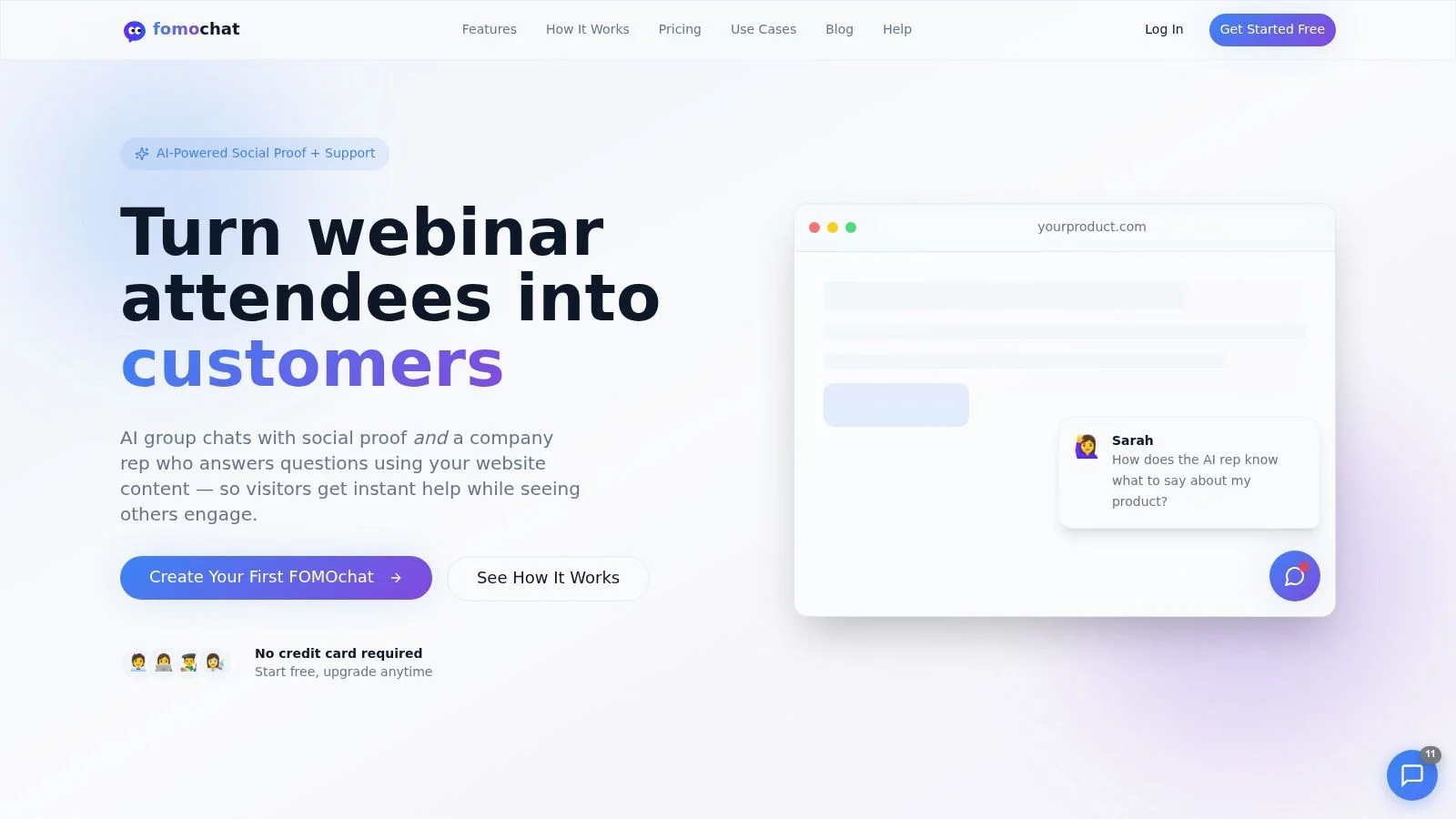
FOMOchat is built for that job. It combines an AI company representative with a shared on-page conversation, so visitors can read questions, reactions, and follow-up answers in one place. The proof source is different from tools that show real purchases or verified reviews. Here, the signal is AI-led group chat. It works when buyers need context and explanation, not just reassurance that other people acted.
That makes it a practical fit for SaaS product pages, online courses, launches, and webinars. Teams can set personas, context, facts, guardrails, and confidence qualifiers, then publish the widget with a small embed snippet. Styling controls cover colors, placement, and conversation tone. Paid plans add analytics, which helps teams see whether chat interactions support signups, enrollments, or registrations.
FOMOchat also supports video and webinar timeline synchronization. Reactions and answers can appear at a chosen moment in the presentation, which is more useful than repeating the same static notification across the whole page. On a webinar replay, FOMOchat's timeline sync keeps viewers engaged right when they'd normally drift. A static toast can't do that. Our roundup of webinar engagement tools shows where it fits next to polls and Q&A.
Where FOMOchat works best
Setup is quick, but output quality depends on the inputs. A well-approved knowledge base and clear disclosure make the experience credible. Weak context or loose guardrails create polished answers that still miss the actual objection.
Trust rule: Label AI-assisted conversations clearly. Simulated participants should not be presented as verified customers or real-time purchasers.
Cost is another real trade-off. FOMOchat offers a free preview, a $1 one-time production release, and monthly tiers including Silver at $29 per month, Gold at $49 per month, and Premier at $299 per month. The free preview includes 100 lifetime visitors, 400 AI messages, and one widget. That pricing model makes early testing easy, but teams with growing traffic should check how visibility affects monthly spend before placing the widget sitewide.
If you want a clearer explanation of this proof format, see what social proof in marketing means. Teams whose visitors need answers more than reassurance will get the most from this setup. Teams that only trust proof tied to a verified transaction stream should compare it with purchase-led tools instead. visit FOMOchat
2. Fomo
Fomo is a mature notification platform built around real-time purchases, signups, and on-site activity. Its proof source is closer to behavioral evidence than testimonial content. A visitor sees that another person took an action, usually through a popup or an inline message near a call to action.
The platform suits ecommerce and SaaS teams that already have activity data available through their commerce, CRM, or marketing stack. Fomo lists more than 100 integrations, supports geographic and language targeting, and offers an optional Verified data badge. That badge matters because a notification without visible provenance can look like a generic marketing claim.
Fomo Inline is useful when a floating popup would distract from the page. You can place social proof beside a pricing block, signup form, or product CTA instead of forcing every visitor to watch a toast appear in the corner.
What to watch before subscribing
Fomo provides ROI and conversion analytics by notification type, so teams can compare a purchase popup with an inline activity message. Its Shopify presence also makes installation straightforward for merchants using that ecosystem.
The trade-off is pricing behavior. Plans are primarily usage-based, which can make costs less predictable as visitor activity and notification volume grow. Some merchant feedback also points to confusion around cancellation or downgrade steps, so confirm those workflows before adding Fomo to a production funnel.
- Best proof source: Real purchases, signups, and activity.
- Best fit: Shopify merchants, ecommerce teams, and SaaS marketers with reliable event data.
- Main limitation: Usage-based plan management can require closer monitoring as traffic expands.
Fomo works when the event is real, recent, and relevant to the page. It works less well when a site has little activity or when repeated popups make the page feel automated rather than active. Visit Fomo to check its current integrations and plan details. If you're weighing Fomo against a conversation-led option, our Fomo alternative breakdown lays out where real-time conversations beat notification popups, and where they don't.
3. Proof Pulse by UseProof
Proof Pulse, from UseProof, keeps the implementation simple. It uses a single pixel, supports unlimited notifications and domains, and charges according to monthly unique visitor tiers. The proof source is typically recent activity, streaks, or visitor counts, so it belongs in the event-notification category rather than the review or testimonial category.
Its strongest practical feature is the testing layer. Built-in A/B testing and impact analytics let teams compare notification variants rather than treating every popup as automatically persuasive. That matters because social proof can support a decision, but it can also interrupt a visitor who already has enough information.
A sensible fit for multi-site teams
Unlimited domains make Pulse attractive to agencies, portfolios, and companies managing several properties. One team can apply the same notification system across multiple sites without paying a separate domain fee for each property. The visitor-based model is also easier to forecast than a per-notification charge when notification volume fluctuates.
The catch is scale. Visitor tiers can rise quickly for high-traffic sites, even when the number of notifications remains unlimited. A team should calculate the cost at both current and expected traffic rather than evaluating the entry tier alone.
A low-friction install doesn't remove the need for a proper holdout test. It only gets the message onto the page faster.
Pulse offers a 14-day free trial, with visitor tiers ranging from 1,000 to more than 300,000 monthly visitors, based on UseProof's published plan details at the time of writing. Those limits make the pricing model clear, but teams should confirm current terms before choosing a long-term plan. Pulse is a good fit for landing pages and SaaS funnels that want measurable activity notifications without per-message billing. See Proof Pulse by UseProof for the current product details and trial options.
For education teams comparing interactive proof with conventional activity popups, this Proof alternative for educational social proof offers a useful contrast.
4. ProveSource
Two questions decide whether ProveSource fits: what kind of proof you need to show, and what happens to the bill when traffic rises. ProveSource is easiest to justify when the answer is simple activity proof at a controlled visitor-based cost. It focuses on recent activity notifications and related widgets, with pricing tied to Monthly Unique Visitors rather than impressions, so a team can estimate spend from traffic instead of popup volume.
Setup is one of its strengths. ProveSource uses async loading and CDN delivery to keep the widget from blocking the main page, which helps, but it does not remove the need to check mobile layouts and page speed after launch. The product also includes ProveSource Boost, which adds countdowns, announcement bars, WhatsApp buttons, and other conversion elements. That gives small teams more than one way to show momentum, even if the core proof type still centers on on-site activity signals.
The free plan is useful for a real test, not just a demo. It supports 1,000 MUV, keeps the core feature set available, and leaves ProveSource branding in place. For a side project, validation page, or internal experiment, that can be fine. For a client-facing site, the branding is often the first reason to move up.
There is a practical catch. ProveSource does not auto-upgrade accounts that exceed the limit. It stops showing new notifications until the period resets. That protects teams that want hard cost control, but it also means proof can disappear during a campaign spike if nobody is watching usage.
Use ProveSource if you want basic activity proof, quick setup, and fewer pricing surprises at low traffic. It fits small businesses, early funnels, and teams testing whether recent-sales style proof helps before they invest in review collection or richer interaction. If you are comparing static popups with a more interactive format, this look at why conversations can beat popups shows the trade-off clearly.
5. Nudgify
Nudgify uses a broad library of “nudges” rather than one narrow proof format. You can show recent purchases, reviews, visitor counts, low-stock messages, popularity signals, and shipping information. The proof source depends on the nudge. Some messages come from real customer activity, while others reduce friction by clarifying delivery or availability.
That flexibility makes Nudgify a natural fit for ecommerce stores, especially when urgency and reassurance need to appear together. It also imports reviews from services such as Google Places, Trustpilot, and Capterra. A store can therefore combine transaction activity with external customer opinion instead of relying on one signal.
Pricing for lean teams
Nudgify offers a free plan, a seven-day free trial, multilingual support in 32 languages, and lifetime purchase options alongside recurring subscriptions. Impression-based limits are easy to understand, and all tiers support unlimited websites and nudges according to Nudgify's published plans. A lifetime option can appeal to a budget-sensitive team that prefers an upfront commitment over another monthly tool.
The limitations are practical. The free plan is restricted to 1,000 impressions and one review, and branding removal is either an add-on or connected to higher tiers. A store using several review sources may also need more time to maintain consistent wording, source labels, and disclosure across its nudges.
Placement matters: Use a low-stock or shipping nudge only where the visitor is making that specific decision. Generic urgency on every page quickly loses meaning.
Nudgify is best for a merchant that wants reviews, scarcity, and reassurance in one interface. It isn't the cleanest fit for a SaaS team seeking structured objection handling or for a brand that needs a dedicated video testimonial library. Review Nudgify before choosing between impression-based billing and its lifetime options, and compare it with this Nudgify alternative.
6. Evidence
Here, the audit trail matters more than the animation.
Evidence is built for teams that want social proof tied to a visible source. Its notifications cover Conversions, Streaks, Visitor Count, Offers, and Announcements, but the sharper differentiator is the Verified by Evidence badge. That shifts the product away from simple activity popups and toward proof with provenance. For SaaS companies, agencies, and higher-consideration offers, that distinction matters. A loose claim can create doubt faster than it creates urgency.
The pricing model reinforces that positioning. Evidence supports unlimited domains and notifications across plans, so cost pressure comes from traffic growth, not from how many campaigns or messages a team publishes. If your site visits rise quickly, the budget conversation changes quickly too.
I also like the clarity of the product stance. Evidence rejects fake notifications and makes verification part of the interface at a time when buyers are more skeptical of synthetic signals. Analysts at GatherUp found that 70% of respondents would trust a business less if they discovered its review responses were AI-generated, while 33% frequently encounter reviews that appear fake or AI-generated (GatherUp's 2025 trust research). If you use FOMOchat or any AI-led format, hold it to the same bar. Disclose AI-led conversations as AI-led. Never pass them off as verified customers.
There are practical frictions. Entry pricing is higher than some lighter notification tools, and annual billing is less straightforward because support is involved rather than a fully self-serve checkout. On the other hand, Evidence does explain how visits are counted and handles overages with options to pause or move to a prorated upgrade, which is more transparent than vague usage caps.
Use Evidence if your proof source is real conversions and real visitor activity, and you want that provenance visible on the page. Evidence earns its place when trust in the source is part of the sale. Teams that need objection handling through AI chat, or a workflow built around collecting customer video, will need another layer alongside it.
7. Testimonial.to
What if your strongest social proof is not a live purchase feed or a verified review badge, but a customer explaining the result in their own words?
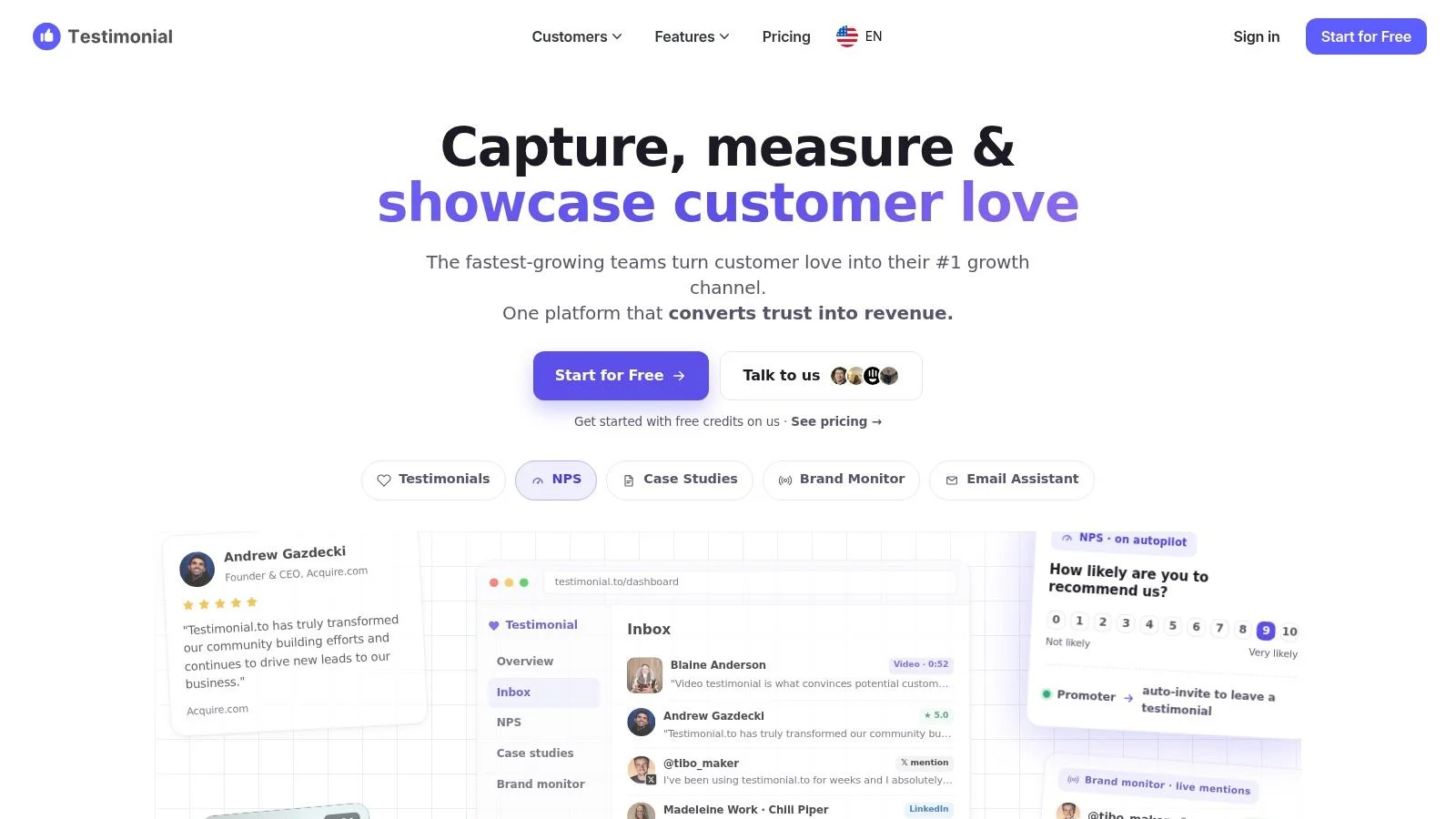
Testimonial.to is built for that proof source. It centers on customer-submitted video and text testimonials, then turns them into assets you can publish through Wall of Love widgets on landing pages, sales pages, and product pages. That makes it a better fit for SaaS teams, course creators, and service brands that need proof with context, not just activity.
It also goes further upstream than simpler popup tools. You can collect testimonials, import reviews and social posts, automate outreach, track brand mentions, and use AI support in the testimonial workflow. Higher plans add AI video editing, and Ultimate and above include unlimited video, based on Testimonial.to's published plans. In practice, that shifts the product from a lightweight social proof widget to a system for building and managing a testimonial library.
The trade-off is cost shape. Tools built around real-time notifications usually rise in price as traffic grows. Testimonial.to puts more pressure on content limits and workspace structure instead. Free and Starter plans are tight on video length and total content, and per-space pricing can become expensive for agencies or teams running several brands. If your site traffic climbs fast but your testimonial library stays small, that model may be easier to live with than visitor-based pricing. If you need many spaces, the math changes.
A strong customer video can do work that a purchase popup cannot. It can show situation, objections, and outcome in enough detail for a prospect to judge fit. It is also reusable across sales collateral and campaign pages. AI tools can speed up editing, but they do not replace consent, review, or clear labeling of edited material.
If you are building that workflow, how to make testimonial videos is a useful starting point. For the written side, our guide on how to create case studies shows how to turn one strong customer story into several assets.
Use Testimonial.to if you want reusable proof assets from customer stories. Skip it if your main goal is real-time purchase proof or visitor-triggered urgency.
Top 7 Social Proof Tools Comparison
| Product | Implementation (🔄) | Resource & Cost (⚡) | Expected Outcomes (⭐📊) | Ideal Use Cases (💡) | Key Advantages (⭐) |
|---|---|---|---|---|---|
| FOMOchat | 🔄 Low, code‑light setup; persona/config UI, embed snippet | ⚡ Free preview; paid tiers scale by visibility (can be costly at high traffic) | ⭐ High, case studies report +28–52% lifts (varies by use case) | 💡 Marketers, launch teams, course creators, webinar hosts | ⭐ Social‑proof group chats + AI rep; timeline sync; brandable; analytics |
| Fomo | 🔄 Low, quick install, Shopify app and 100+ integrations | ⚡ Free option; usage/visibility‑based pricing | ⭐ Moderate, mature platform with ROI/conversion analytics | 💡 Ecommerce (Shopify) and SaaS sites | ⭐ Wide integrations, inline proof, verification badge, analytics |
| Proof (UseProof) – Pulse | 🔄 Very Low, single‑pixel install, simple setup | ⚡ Visitor‑based tiers (pricing by monthly unique visitors); unlimited notifications | ⭐ Moderate, built‑in A/B testing and impact analytics for optimization | 💡 Multi‑site portfolios and teams wanting A/B testing | ⭐ Unlimited notifications/domains; transparent visitor pricing |
| ProveSource | 🔄 Low, async loading, CDN optimizations, simple tiering | ⚡ Generous free tier (1K MUV); MUV limits govern tiers; no auto‑upgrade on overage | ⭐ Moderate, accessible for SMBs to drive social proof | 💡 Small businesses and budget‑sensitive sites | ⭐ Affordable/free entry; CDN performance; optional Boost widget suite |
| Nudgify | 🔄 Low–Medium, template ("nudge") based setup and review imports | ⚡ Free plan limited; offers lifetime purchase options as alternative | ⭐ Moderate, effective via varied nudges (reviews, scarcity, counts) | 💡 Ecommerce, multilingual sites, review‑driven products | ⭐ Large nudge library; review integrations; lifetime licenses available |
| Evidence | 🔄 Low, standard notification setup with verification options | ⚡ Higher entry pricing vs SMB tools; unlimited domains/notifications | ⭐ Moderate–High, trust gains from verified data; ROI reporting | 💡 Brands prioritizing authenticity and conversion ethics | ⭐ Anti‑fake stance with “Verified” badge; ROI reporting; unlimited notifications |
| Testimonial.to | 🔄 Medium, testimonial collection workflows, video processing and embeds | ⚡ Free/Starter limits; per‑space and higher tier costs for video/SOC2 | ⭐ High for brand trust, strong impact from curated video testimonials | 💡 SaaS and course creators needing video/text social proof | ⭐ Robust video workflows, AI helpers, SOC2 Type II option on top tiers |
Match Your Proof Source to the Right Tool Today
The best social proof tools aren't interchangeable. Start with the proof you can show. If your system records dependable purchases or signups, Fomo, Pulse, ProveSource, Nudgify, or Evidence can turn those events into visible activity. If your strongest evidence lives in customer experiences, Testimonial.to is the better starting point. If prospects repeatedly ask questions before enrolling, subscribing, or registering, FOMOchat can combine answers with a visible group discussion. Notification popups tend to stall on complex products, as we cover in why social proof notifications don't work for complex products. That's where a conversation earns its spot.
Then inspect the pricing curve, not just the entry price. Fomo and Nudgify can make sense when the message volume or impression model matches your traffic. Pulse and Evidence are easier to assess through visitor or visit tiers. ProveSource reduces overage risk by stopping new notifications when the limit is reached. FOMOchat scales by visibility, while Testimonial.to can become more expensive when a team needs multiple spaces for brands or sites.
Authenticity should be a selection requirement, not a finishing touch. Nielsen's research found that 88% of global respondents trusted recommendations from people they knew more than measured advertising channels, across regions including Asia-Pacific, Europe, Latin America, the Middle East and Africa, and North America (Nielsen's trust benchmark). A simulated conversation isn't equivalent to a personal recommendation. It should be labeled, constrained by approved facts, and measured for whether it helps visitors make a better decision.
A practical evaluation sequence
- Choose the proof source: Decide whether the page needs purchases, verified reviews, testimonials, or interactive answers.
- Check provenance: Confirm that the tool can show source identity, timestamps, verification labels, or customer consent where appropriate.
- Model growth: Compare the cost at your current traffic and your expected campaign traffic. Include domains, spaces, impressions, visitors, messages, and branding fees.
- Run a controlled test: Use a holdout group or randomized page test rather than comparing this month's conversions with last month's results.
- Track downstream quality: Measure signups, qualified leads, enrollments, registrations, revenue, refunds, and retention where those outcomes matter.
Reviews also need context. Northwestern University's Spiegel Research Center reported that purchase likelihood for a product with five reviews was 270% greater than for a comparable product with no reviews, and that review displays increased conversion by 190% for lower-priced products and 380% for higher-priced products (Spiegel Research Center's review study). The same research found that likelihood generally peaked between 4.0 and 4.7 stars, rather than at a perfect rating. The lesson is simple. More proof isn't automatically better proof, and flawless sentiment can look less credible.
Test a free plan or trial before committing. Set one clear goal, such as SaaS signups, course enrollments, or webinar registrations, and review the analytics after two weeks. BrightLocal found that 74% of consumers check at least two review sites before purchasing, while 89% expect businesses to respond to both positive and negative reviews (BrightLocal's 2025 consumer review survey). Replying well is its own skill, and our guide to responding to positive reviews has templates. A tool that only displays a badge but doesn't help you understand objections, provenance, or response quality may be solving the visible problem rather than the trust problem.
FOMOchat combines an AI company representative with customizable group conversations, so visitors can get immediate answers while seeing relevant questions and objections discussed on the page. It also supports timeline-synchronized reactions for videos and webinars, with configurable facts and guardrails to keep the experience aligned with approved information. If interactive, disclosed AI-led proof fits your funnel, visit FOMOchat and test the free preview before scaling visibility.