

Picking the right virtual event platform isn't just about getting through a post-pandemic world anymore. It's a core piece of your entire strategy. The best platforms have become permanent fixtures in marketing and sales, helping you pull in leads, grow a community, and actually see a return on your investment. A good virtual event platform comparison is no longer a simple feature checklist; it's about finding a tech partner you can grow with.
What to Expect from Virtual Events in 2026

Let's be honest, the days of just streaming a one-way video and calling it an "event" are long gone. Your audience expects much more. They want an interactive experience that feels just as alive and engaging as being there in person. This change has turned virtual events from a simple marketing tactic into a powerful way to build real relationships and drive business.
The market numbers back this up in a big way. The global virtual event platform market hit $16.28 billion in 2025 and is on track to jump to $19.1 billion in 2026. Looking ahead, forecasts show it rocketing to $36.63 billion by 2030, thanks to a steady annual growth rate of 17.7%. If you want to dig into the numbers, The Business Research Company's global market report has all the details.
Why Your Event Tech Matters More Than Ever
This kind of explosive growth tells a clear story: businesses are no longer asking if they should run virtual events, but how they can get the most out of them. And the platform you choose is the key to unlocking that potential.
Modern event technology does so much more than just broadcast a video. A well-chosen platform should help you:
- Generate real, qualified leads by tracking who's engaging and what they're interested in.
- Build a lasting digital community with features like networking rooms and interactive breakout sessions.
- Show measurable ROI with analytics that connect event activities directly to sales results.
- Make your brand shine with deep customization and white-labeling options.
When comparing virtual event platforms, remember you're not just picking a tool for a single event. You're investing in a system that will support your marketing, sales, and community goals for years to come.
As we navigate 2026, the line between a basic webinar tool and a true virtual event platform has become crystal clear. The latter is an all-in-one environment built to create connections, deliver value, and drive real business outcomes. This guide will help you understand that difference and make a smart, forward-thinking choice.
How to Actually Choose the Right Virtual Event Platform
Picking the right virtual event platform isn't about finding the one with the longest feature list. It’s about finding the right fit for your event. Before you even start comparing options, you need to be crystal clear on what a "win" looks like for you.
Start with the absolute must-haves. Think about the basics, like streaming quality. If your keynote speaker's video freezes or the platform crashes mid-event, none of the other fancy features matter. Your entire event's credibility is on the line.
Nail Down Your Core Technical Needs
First things first, look under the hood at the platform's technical capabilities. A slick interface is great, but a solid foundation is what will prevent a disaster on event day.
- Scalability: Will the platform support 100 attendees as flawlessly as it supports 10,000? Test this. Some platforms buckle under pressure, so make sure it can handle your peak audience size without a hitch.
- Security and Compliance: Are they compliant with standards like GDPR or SOC 2? Protecting attendee data isn't just a good practice; it's a requirement for building trust.
- Branding and Customization: Can you make the event look and feel like your brand? The ability to add your logo, custom colors, and unique layouts is crucial for creating a professional and immersive experience.
A platform’s real strength shows when things get busy. How it scales and how it protects data are the true tests. Get these two things wrong, and nothing else you do will matter.
This focus on the fundamentals isn't just my opinion; it’s where the market has settled. The virtual event space saw an incredible 1,800% jump in usage back in 2020. More importantly, that usage has stuck around, driven by serious business needs for analytics, security, and scale. According to virtual event statistics on EntrepreneurSHQ, 78% of planners have increased their use of event tech since the pandemic, showing these platforms are now a core part of the business toolkit.
Evaluate the Tools for Engagement and Interaction
Once you're confident the technical side is solid, you can shift your focus to what makes an event memorable: the experience. Nobody wants to just sit and watch a screen anymore. Attendees expect to be part of the action.
Look for tools that get people talking and participating. Live chat, polls, and Q&A features are the bare minimum for real-time interaction. For creating more personal connections, breakout rooms are a standout features. They can turn a massive broadcast into a series of small, meaningful conversations.
Don't forget about lead generation, especially for business events. See if the platform supports advanced tools like event registration forms with qualification to help you gather better leads from the start. And of course, check out the analytics. You need a platform that gives you clear data on who attended, what they engaged with, and which sessions were most popular.
Finally, think about how the platform plays with your other tools. A platform that doesn’t connect to your CRM or email marketing software will just create headaches and manual work. Some platforms are better at this than others, so it's smart to map out your integration needs ahead of time. If you find a platform that’s almost perfect but has an engagement gap, you can often use specialized tools to fill it. You can see how add-ons work by checking out guides like our own on FOMOchat's pricing and plans.
A Detailed Virtual Event Platform Comparison
Picking the right virtual event platform feels a lot like choosing a venue. The space has to match the vibe and purpose of your event. To get beyond the glossy marketing brochures, you have to look at how these platforms actually work and who they’re truly built for.
Let's break down some of the heavy hitters: Hopin (now part of RingCentral), ON24, Zoom Events, and Cvent. We'll skip the generic pro/con lists and dig into real-world scenarios to see which one aligns with what you’re trying to achieve, whether that’s packing your sales pipeline, training your team, or hosting a massive industry conference.
To help you compare these platforms at a glance, we've put together a quick-reference table. It breaks down each tool's main strength, key features, and best-fit use cases.
Feature Comparison Of Leading Virtual Event Platforms
| Platform | Core Strength | Key Features | Ideal For... | Pricing Model |
|---|---|---|---|---|
| Hopin (RingCentral Events) | Immersive Community Building | Virtual venue, expo hall, speed networking, session stages | Multi-day conferences, trade shows, community-focused events | Per-attendee or subscription-based |
| ON24 | Data-Driven Lead Generation | Deep analytics, engagement scoring, CRM integration, on-demand content | Marketing webinars, product demos, lead nurturing campaigns | Subscription-based, often tiered by features and usage |
| Zoom Events | Simplicity and Scalability | Familiar interface, robust video, ticketing, event hubs | Internal meetings, corporate training, single-track webinars | Per-attendee or flat-rate license |
| Cvent | End-to-End Event Management | Registration, budget tools, mobile apps, hybrid event support | Large-scale enterprise events, complex global conferences | Custom enterprise pricing, often a significant investment |
This table gives you the high-level view. Now, let's get into the details of what it's like to actually use these platforms.
Hopin (RingCentral Events): The All-In-One Community Builder
Hopin, now under the RingCentral Events umbrella, was designed from day one to feel like a real, in-person event. Its biggest strength is its all-in-one environment where people can wander between different areas. A main stage, breakout sessions, a networking lounge, and sponsor booths.
This structure is a standout features for events where interaction is everything. Think of a multi-day user conference or a virtual trade show. Hopin gives attendees the freedom to guide their own experience, bouncing from a keynote to a sponsor chat and then into a roundtable discussion, all inside one cohesive digital venue.
Hopin’s magic lies in its venue-based approach. It’s fantastic at creating a sense of place and encouraging those serendipitous "hallway" conversations that other platforms miss.
Unlike tools that feel like a one-way broadcast, Hopin is built to spark connections. Its speed networking feature, which randomly pairs attendees for quick video chats, is a perfect example. This makes it a top pick for anyone trying to build a genuine community, not just talk at an audience.
ON24: The Data-Driven Lead Generation Machine
Where Hopin is about community, ON24 is all about data. This platform is less of a virtual "venue" and more of a powerful marketing engine cleverly disguised as an event tool. Its core mission is to capture incredibly detailed analytics on everything your audience does.
Every click, poll answer, question asked, and resource downloaded is tracked and scored. This gives marketing and sales teams a crystal-clear picture of each person, showing who the hot leads are and what they’re interested in. For a software company running a product demo, that kind of insight is pure gold.
ON24 is built for marketers who live and die by ROI. You can pinpoint your most engaged attendees and send that data straight into your CRM to arm your sales team.
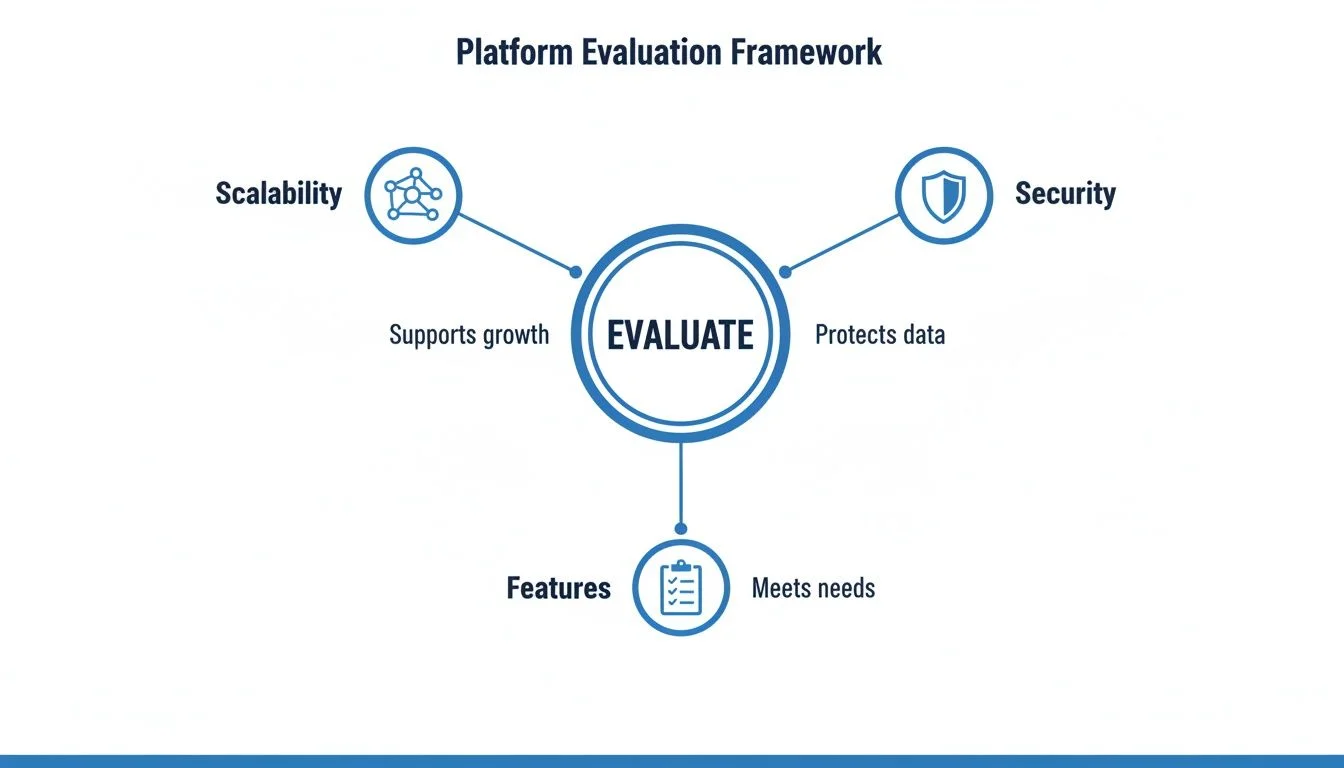
As this framework shows, any good evaluation balances a platform's features with its underlying technical strength and security. All areas where ON24 provides deep visibility.
The trade-off? The ON24 experience can feel a bit more passive and buttoned-up. It's brilliant for delivering polished, controlled presentations but doesn't offer the same spontaneous networking as Hopin. As you weigh your options, it's worth seeing what else is out there; this list of the 12 best virtual event platforms offers a good overview of the market.
Zoom Events: The Familiar And Scalable Workhorse
Zoom Events plays to its biggest advantage: everyone already knows how to use Zoom. It builds on the familiar foundation of Meetings and Webinars, which makes it incredibly easy to adopt for both organizers and attendees. There's almost no learning curve.
This makes it a no-brainer for corporate trainings, internal all-hands meetings, or simple, single-track conferences. The platform takes Zoom's reliable video and layers on essential event management tools like ticketing, registration, and a basic event hub.
Zoom Events is all about simplicity and scale. It’s a workhorse. It's built to handle huge audiences with rock-solid video streaming, which is exactly what you need for a company-wide town hall with thousands of employees.
But while it has added features like a virtual expo, the experience isn't as immersive as Hopin. The networking tools get the job done, but they feel more like an add-on than a core part of the experience. It's the practical, get-it-done choice when your top priority is delivering content reliably.
Cvent: The Enterprise-Grade Event Management Powerhouse
Cvent is in another category altogether. It’s not just a virtual event platform; it's a massive, end-to-end event management ecosystem. This is the tool for large enterprises and professional planners who are running complex, high-stakes events that span the virtual and physical worlds.
Cvent’s real power is its sheer breadth of functionality. It can manage everything from complicated registration and budgeting to custom mobile apps and deep post-event reporting. It’s designed for organizations with a huge portfolio of events that demand granular control, tight security, and seamless integrations with other enterprise software.
A global company planning its annual sales kick-off with both in-person and virtual components is Cvent's ideal customer. The platform has the muscle to manage that entire event lifecycle. That power, however, comes with a steep learning curve and a significant price tag. It's usually overkill for smaller teams or simpler online events.
No matter which platform you choose, a lively chat is key to keeping your audience tuned in. You can learn more about turning passive viewers into active participants by reading our guide on syncing chat with video presentations.
Matching The Right Platform To Your Event
Picking a virtual event platform by just looking at a feature list is a common mistake. It’s like buying a truck when all you need is a scooter. You might have the power, but it’s the wrong tool for the job. The best virtual event platform comparison doesn't just list what a platform can do, but what it does best.
To make a smart choice, you have to think strategically about your event's specific goal. Let’s walk through a few real-world scenarios to show you how different goals point to very different platforms. This way, you’re choosing a tool based on the results you need, not just its bells and whistles.
For SaaS Companies Launching A New Product
Let's say you're a B2B SaaS company about to launch a game-changing new feature. Your event isn't just a simple announcement. It’s a lead-generation machine designed to pinpoint prospects who are ready to buy and give your sales team the intel they need to close deals.
For this job, a data-focused platform like ON24 is your best bet. Its real power isn't in the live event itself, but in the deep analytics it provides.
- Pinpoint Hot Leads: The platform tracks everything, which polls an attendee answered, what resources they downloaded. And then rolls it all into a single engagement score.
- Arm Your Sales Team: You can automatically send this data to your CRM, flagging attendees who are highly engaged. Your team can then follow up with a conversation that’s already warm, because they know exactly what that person was interested in.
- Keep Generating Leads: ON24 also makes it easy to turn your live webinar into an on-demand asset that continues to capture leads for months.
When you're launching a product, the event is just the starting line. The real money is in the data you capture and how you use it to feed your sales pipeline. A platform built around analytics isn't just a nice-to-have; it's a must.
For Course Creators Hosting Interactive Workshops
Now, let's switch gears. Imagine you're a coach or course creator hosting a paid workshop. Here, your success isn't measured in leads, but in deep engagement. You need your attendees to connect, participate, and walk away feeling like they had a truly valuable, hands-on experience.
In this situation, an immersive platform like Hopin (now RingCentral Events) or Remo is a much stronger choice. They are built from the ground up to feel less like a webinar and more like an actual workshop.
These platforms excel because of features like:
- Breakout Rooms & Virtual Tables: They make it incredibly simple to split your main group into smaller teams for collaborative exercises, just like you would in person.
- Natural Networking: With features like speed networking or visual floor plans, attendees can mingle and have the kind of spontaneous conversations that build a real sense of community.
- A Dynamic Environment: People can move freely between the main stage, a networking lounge, and smaller session rooms, which keeps the energy high and the experience from feeling static.
This intense focus on interaction is exactly what you need to create a premium educational experience that people will be talking about long after it's over.
For Marketers Organizing A Multi-Day Virtual Summit
Finally, think about the complexity of a massive, multi-day industry summit. You’ve got thousands of attendees from around the globe, several content tracks running at once, and a virtual expo hall full of paying sponsors who expect a return on their investment.
This is where you need an enterprise-level, all-in-one platform like Cvent or BigMarker. These are the heavy-duty tools built to handle scale and complexity without breaking a sweat.
The global scale of these events is also a major factor. In 2025, North America was the dominant force in the virtual event platform market, accounting for over 38% of the global share, with the U.S. market alone valued at $4.56 billion. Yet, the Asia-Pacific region is growing the fastest, which means you need a platform that can handle different languages, time zones, and currencies. You can dive deeper into these trends by exploring the latest research from Precedence Research.
For a huge global summit, your platform must have:
- Sophisticated Registration: The ability to handle different ticket tiers, manage access to various content tracks, and segment your attendee list is crucial.
- Robust Sponsor Management: You need to offer sponsors virtual booths, reliable lead capture tools, and analytics that prove their investment was worthwhile.
- True Hybrid Functionality: Many large summits now include an in-person element. A platform like Cvent is designed to manage both the virtual and physical event from a single dashboard.
These platforms are a serious investment, but for a high-stakes, large-scale event, their powerful and comprehensive features are what ensure a smooth and successful outcome.
Boost Your Event ROI with FOMOchat
So, you've sifted through the virtual event platforms and found one that ticks almost all the boxes. But there's a nagging feeling that something is missing. The secret ingredient that turns passive listeners into motivated buyers. Standard chat and Q&A features are fine, but they rarely create that buzzing, "you-had-to-be-there" energy that actually drives sales.
It’s a surprisingly common oversight. Most platforms nail the content delivery but completely miss the mark on the human psychology that convinces people to take action. When attendees see others actively engaged, it validates their interest and builds a powerful sense of trust. Without that visible buzz, you’re leaving money on the table.
This is where a tool like FOMOchat shines. It’s not another event platform; it's a specialized add-on that works with the one you already use. Think of it as an AI-powered widget that injects authentic social proof into your event, waking up your audience and getting them involved.
Turning Passive Viewers into Active Participants
FOMOchat overlays an intelligent, interactive layer on your event. It surfaces real-time conversations from your audience, uses your own website to answer their questions, and can even time-stamp chat highlights to appear at the most relevant moments in your presentation.
Imagine you're doing a product demo. Right as you reveal a key feature, the widget pops up with a few related questions and positive comments from the chat. It reinforces your point at the exact moment it matters most.
The real power of a virtual event isn't just what you present; it's what your audience does with it. When you make engagement visible, you kickstart a feedback loop that builds momentum and pulls everyone else in.
This completely changes the dynamic from a one-way lecture to a lively conversation. It clears up doubts on the spot and builds the trust people need before they’ll click your call to action.
Connecting Genuine Conversations to Real Conversions
At the end of the day, marketers and creators need a return on their investment. Whether your goal is selling a course, getting webinar signups, or closing deals, the path to conversion is paved with trust and a little bit of urgency. FOMOchat helps you build both by making the room feel packed and engaged.
When attendees see others asking smart questions and showing interest, it triggers a natural "fear of missing out." That social proof gives them the confidence to take the next step. This system helps you:
- Drive More Signups and Sales: Visible interest and enthusiasm lower the barrier to purchase.
- Encourage More Participation: A buzzing chat invites even the quietest attendees to join the conversation.
- Improve Your Event ROI: Higher conversion rates mean you get more value from your event platform.
In short, FOMOchat is a conversation and conversion multiplier. It ensures the hard work you put into your virtual event pays off with real, measurable results. To see it in action, you can explore the features of FOMOchat and learn how it transforms passive watching into active buying. You're no longer just hosting an event; you're building a high-conversion experience.
Your Platform Implementation Checklist
You’ve done the hard work, compared the options, and finally picked your new virtual event platform. That’s a big win, but the real work starts now. Getting the implementation right is what separates a smooth, successful first event from a day full of technical fires.
Think of this as your game plan for moving from purchase to launch. Following these steps will help you sidestep the common traps, like jumbled attendee data or a team that feels unprepared when the pressure is on.
Prepare Your Data and Team
Before you get into any of the tech setup, you need to get your house in order. That means focusing on two things that can make or break your event: your attendee data and your own team. Clean data means your attendees won't have frustrating login problems, and a trained team means they can handle any question that comes their way.
Start with your attendee lists. Go through them and clean everything up, standardize the fields, get rid of duplicate entries, and make sure it’s all formatted correctly for the new system. While you're doing that, get training sessions on the calendar for your entire event staff.
Make sure your team can confidently:
- Find their way around both the backend and what attendees will see.
- Run the interactive tools you plan to use, like polls, Q&A sessions, and breakout rooms.
- Quickly solve the most common issues attendees might run into.
A messy data import or an untrained team can sink even the best platform. Getting this prep work done upfront is the single best thing you can do to ensure a stress-free event day for everyone.
Configure Integrations and Run a Full Test
With your data clean and your team ready, it's time to plug your new platform into the rest of your tools. This is how you build a seamless workflow, making sure information moves automatically between your event platform, your CRM, and your marketing software.
First, tackle the most important connections. Link your CRM to capture leads without manual entry and connect your email tool to keep communications flowing. Then, add in your engagement tools. If you’re using a third-party chat widget, for instance, you'll want to follow the simple steps for installing the FOMOchat widget so it’s ready to drive conversations.
Once everything is connected, there’s one last, critical step. Run a complete test event. I don't mean just clicking around to see if features work. This needs to be a full-blown dress rehearsal with your entire team, walking through the event from the moment doors open to the final session. This dry run will expose any hidden problems and give your team the confidence they need to nail it on the big day.
Frequently Asked Questions
Still have a few questions? You're not alone. When you're comparing so many virtual event platforms, a few key things tend to come up again and again. Here are the answers to the most common ones we hear.
How Much Should I Budget for a Virtual Event Platform?
This is the big question, isn't it? The honest answer is that costs are all over the map, swinging from $50 per month for a basic tool to thousands for a massive virtual conference. Your budget really hinges on how big and complex your event needs to be.
- For simple webinars or small workshops: If you're just running straightforward presentations, you can look at platforms like GoToWebinar or the lower-tier plans for Zoom Events. These usually land in the $50 - $200 per month range.
- For interactive, multi-session events: When you need more engagement features, something like Remo or RingCentral Events is a better fit. These typically start around $300 - $700 per month or even per event.
- For large enterprise conferences: For the full-blown conference experience, you'll be looking at comprehensive solutions like Cvent or vFairs. These are custom-priced and can easily run into the thousands because they're built to manage every last detail.
What Is the Difference Between a Webinar Tool and a Virtual Event Platform?
It all comes down to scope and interaction. A webinar tool (think GoToWebinar) is built for one-to-many presentations. Its main job is to broadcast your speaker's content reliably, usually with some basic Q&A and polls thrown in.
On the other hand, a virtual event platform (like Hopin or Cvent) is a complete, all-in-one environment. It's designed to mimic an entire in-person event with multiple stages, networking areas, sponsor booths, and in-depth analytics. It’s built for creating a community, not just delivering a lecture.
Here’s a simple way to think about it: a webinar tool is a lecture hall, while a virtual event platform is a full convention center. Your choice depends on whether you just need to give a speech or host an entire conference.
How Do I Measure the ROI of My Virtual Event?
Measuring your return on investment is impossible if you don't define your goals first. Before the event kicks off, decide what success looks like. Once you know your target, you can track the right metrics.
A few key indicators of ROI include:
- Lead Generation: How many qualified leads did you capture? Platforms like ON24 are great for this because they can score attendees based on their engagement.
- Conversion Rate: Track how many attendees took the action you wanted them to, like booking a demo, buying a product, or starting a trial.
- Cost Per Lead: This is a simple but powerful one. Just divide your total event cost by the number of leads you generated to see if it was a cost-effective strategy.
- Audience Engagement: Dig into the data. Look at session attendance, chat activity, and poll responses to see what resonated with your audience and where they dropped off.
A solid virtual event platform can get people through the virtual doors, but getting them to take action is a whole different ballgame. FOMOchat adds that critical layer of social proof and AI-powered support to any platform, creating the buzz that turns passive viewers into active customers. Learn more about how FOMOchat can maximize your event ROI.