
A form fill looks like progress. It usually isn't. A widely cited B2B benchmark finds that only 27% of marketing-generated leads are sales-ready when first created, while about 79% never convert into sales, and weak nurturing is a major reason those leads are lost, as summarized in CIENCE's lead generation statistics. Treat both figures as directional. Companies don't share one definition of "lead," "sales-ready," or "conversion."
Why Most Campaigns Stall After the Form Is Filled
Plenty of teams still treat the submit button as the finish line. The contact lands in a spreadsheet, someone celebrates the cost per lead, and the prospect waits. By the time a human replies, the person has compared two other options or gone back to the work that pulled them away.
A lead generation campaign is a planned chain that turns a stranger into a known prospect, then into a buyer, a trial user, or an enrolled student. It is closer to a relay than to a single ad. The form is one handoff. The race is lost at whichever handoff is slow, vague, or handed to nobody.
Say a SaaS team, a course creator, a launch group, or a webinar host collects 400 names in a week and books almost no calls. The list isn't the problem. The middle of the chain is. Nobody qualified the fit, answered the obvious objection, or explained what happens next. Volume without that middle work produces a crowded CRM and a thin pipeline.
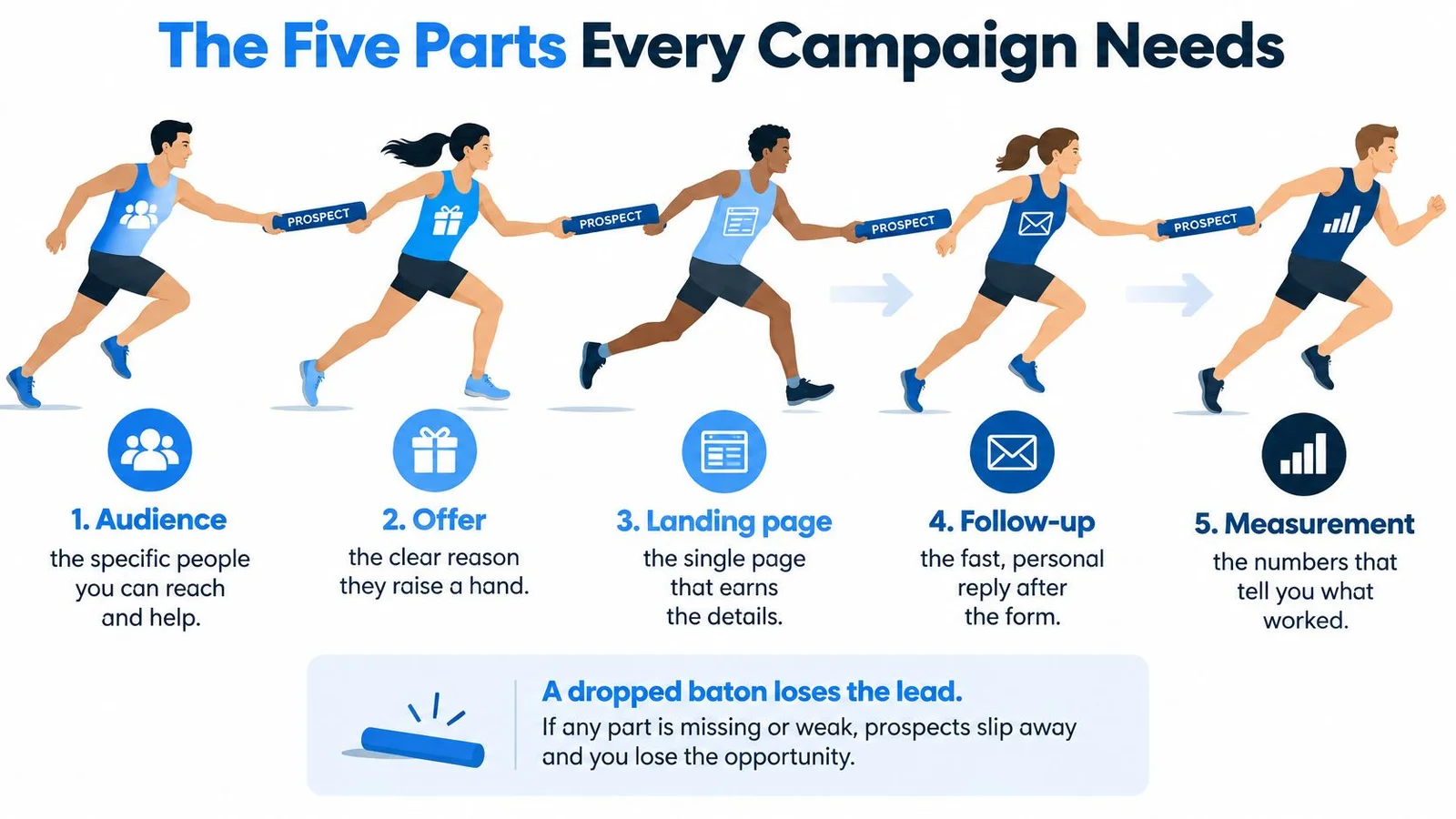
Five parts carry the baton:
- Audience: the specific people you can help.
- Offer: the reason they trade their details.
- Landing page: the single page that earns those details.
- Follow-up: the fast, personal reply after the form.
- Measurement: the numbers that show whether any of it became revenue.
Practical rule: If the contact list is long and the pipeline is short, stop buying more traffic and inspect the handoff after the form.
If your own chain has several weak links, it can help to find a lead generation partner who will look at qualification and follow-up, not only at form fills. Your job this week is simpler. Score the campaign you already run and mark the weakest link before you add another channel. Running this for a software product? Our guide to lead generation for SaaS covers the channel side.
The Five Parts Every Campaign Needs
Audience, offer, landing page, follow-up, and measurement have to pass the prospect along in that order. Picture five runners. The baton is the person, not the click. Drop it anywhere and the lead is gone, even if the ad looked sharp.
A strong page can't rescue a fuzzy offer. A good offer can't rescue a reply that arrives three days later. Measurement isn't a report you write after the campaign ends. It is a check that runs across all five parts while the campaign is live, so you can see which runner is slowing the rest.
| Component | Question It Answers | Example | Key Metric |
|---|---|---|---|
| Audience | Who is this for? | Growth leads at mid-size SaaS companies | Share of leads that fit the profile |
| Offer | What do they get for their details? | Webinar seat, product demo, or template | Offer acceptance rate |
| Landing page | Does the page make the next step clear and easy? | One-goal page with a short form | Visitor-to-lead conversion rate |
| Follow-up | What happens in the first hour and the first week? | Instant reply, then a short email sequence | Response time and meeting-booked rate |
| Measurement | Did the campaign produce pipeline and revenue? | Leads tagged by source in the CRM | Qualified leads and revenue per campaign |
How the handoffs fail
The audience row fails when ads reach people who will never buy, so later metrics look worse than the creative deserves. The offer row fails when the promise in the ad and the thing on the page don't match. The page row fails when the form asks for a phone number, a budget, and a team size before any value shows up.
Follow-up fails without anyone noticing. The lead is real, the owner is in meetings, and the first note goes out tomorrow morning. Measurement fails when every lead is tagged "website," so you can't tell a webinar from a trial signup.
Take the campaign you have now and score each part strong, okay, or weak. Work on the lowest score first. Fixing a second part before the broken handoff only hides the drop.
Picking the Audience and Offer That Fit
Start with where this person already spends time, then write the profile. If they read LinkedIn posts from operators, search for comparison terms, or open a partner newsletter, those are your entry points. An offer written for a search ad will feel wrong in a newsletter, and the reverse is just as clumsy.
A clear audience is a short description with specific traits. Name the job, the company size or student goal, the problem, and where they are in the decision. One workable profile: a product marketer at a software company of 50 to 300 people who is comparing onboarding tools this quarter and needs a decision before the next planning cycle. "Marketers" is not an audience. It is a crowd.
The offer ladder
Offers sit on a ladder from easy to serious. Lower commitment brings more leads. Those leads are usually less ready to buy, enroll, or start a trial. Match one rung to the profile above, not three rungs at once.
- Low commitment: A checklist, template, or short guide. Example: a one-page onboarding checklist they can use this week.
- Medium commitment: A webinar seat or a course preview lesson. Example: a 45-minute session that walks through one workflow.
- High commitment: A live demo or a free trial. Example: a 25-minute call on their actual setup, or a trial that starts only after they name a use case.
The trade-off is volume against readiness. A template can fill a list and still leave sales with almost nobody to call. A demo attracts fewer people, and more of them already have a problem and a timeline. For a wider set of rungs, compare lead magnet examples against the entry point you chose, then keep a single pair.
Pick one audience segment and one offer level. Every headline, email, and question should speak only to that pair. Clarity here makes the page, the reply, and the scorecard easier to design.
Building a Landing Page That Earns the Details
Treat the landing page as a room with one door. One goal, one offer, and no side exits. Navigation links, extra products, and a second form all give the visitor a way to leave without raising a hand.
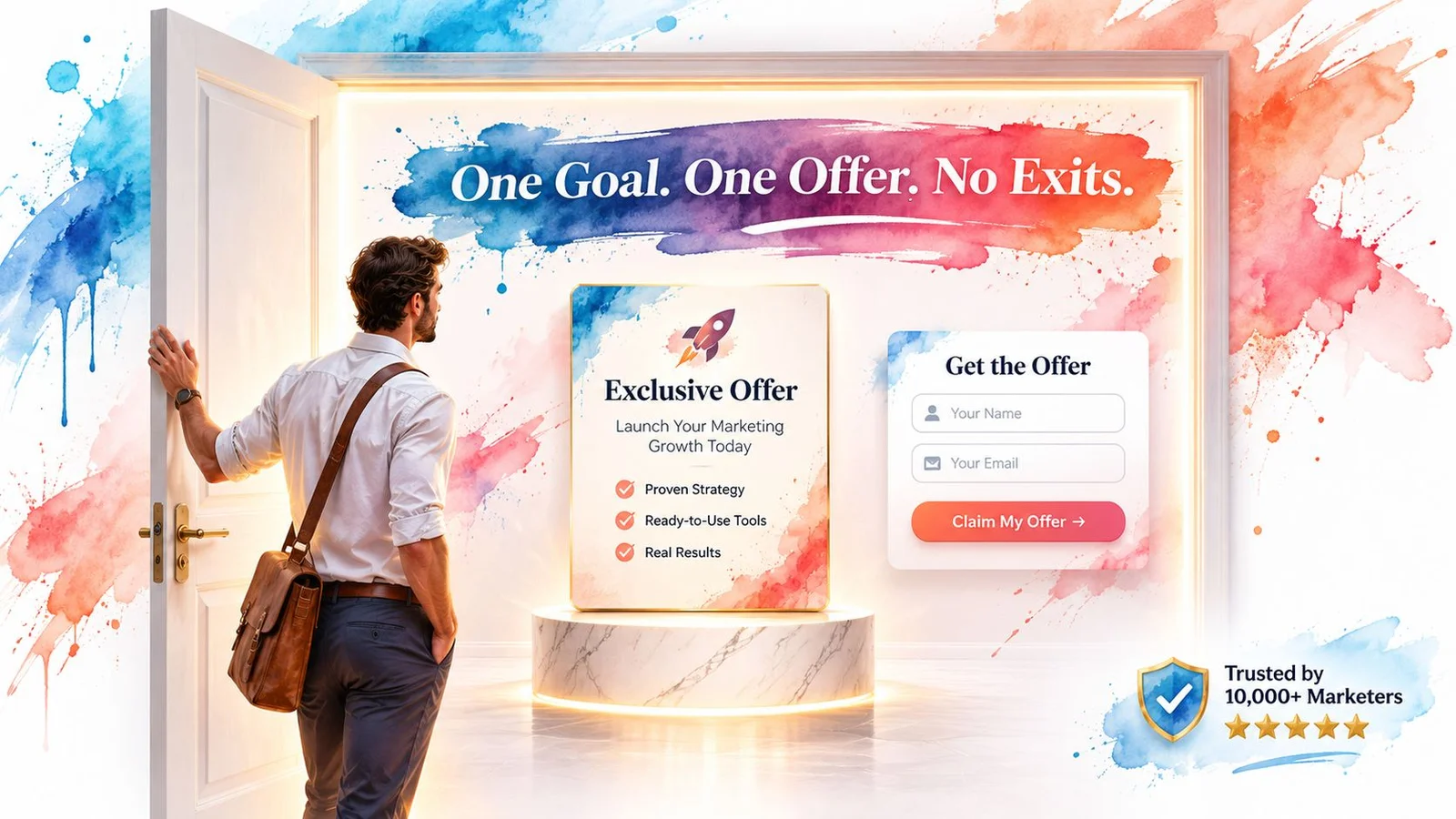
Four elements, in order
- Headline. Repeat the promise from the ad, post, or email that brought them. If the ad said "onboarding checklist," the page should not open with a brand slogan.
- Short answer. One paragraph should cover the first question a buyer asks, usually what happens after they sign up. Name the next email, the time of the session, or when the trial opens.
- One proof point. A short customer quote or one concrete result is enough. A wall of logos doesn't answer "will this work for someone like me?"
- One short form. Name and work email are the usual minimum. Role, goal, or timing can wait. Every extra required field lowers completion, especially on a phone.
Build the form so it stays usable on a small screen. A practical pass over mobile-friendly lead capture forms will catch tiny tap targets and fields that jump when the keyboard opens. The same habits show up in landing page optimization: one path, fast load, and a next step you can see without scrolling past a novel.
Consent is part of the form
State beside each field why you want it. "Work email, so we can send the checklist and the session link" is a purpose. A pre-checked box is not. Privacy-focused guidance says first-party data needs explicit consent, and the record should hold the purpose, legal basis, timestamp, collection channel, privacy-notice version, and a way to withdraw, not only a yes or no, as outlined by Realize. If you can't prove what the visitor agreed to, the highest-converting magnet becomes a long-term risk.
Ask later questions through progressive profiling. Goal, timing, and objection belong on the thank-you step or in the first follow-up, after the offer is delivered. Keep the thank-you page short and exact. We don't use AI Continuation there, or on checkout pages, webinar video, tightly controlled scripts, or time-limited promotions that need word-for-word messaging. Where the public site is thin, we add extra context so answers stay tied to facts that aren't on the page. The only path on the landing page itself stays the form, then the thank-you step.
Following Up Fast Enough to Win the Lead
A form submission is a raised hand. The person is still at the desk, still thinking about the problem your offer addresses. Ten minutes later they are in another tab, and the hand is down. Follow-up speed is the part of the chain where campaigns win or lose revenue they already paid to create.
The MIT and InsideSales lead-response study found that contacting a web-generated lead within 5 minutes produced about 100 times higher odds of contact and 21 times higher odds of qualification than waiting 30 minutes. Immediacy mattered more than the day of the week or the time of day. Those ratios are odds, not a promised lift for every team.
A second analysis covering 1.25 million leads, drawn from 29 B2C and 13 B2B companies, found that firms attempting contact within one hour were nearly 7 times as likely to qualify a lead as firms that waited even one hour longer, and more than 60 times as likely as firms that waited 24 hours or longer. There, qualification meant a meaningful conversation with a key decision-maker.
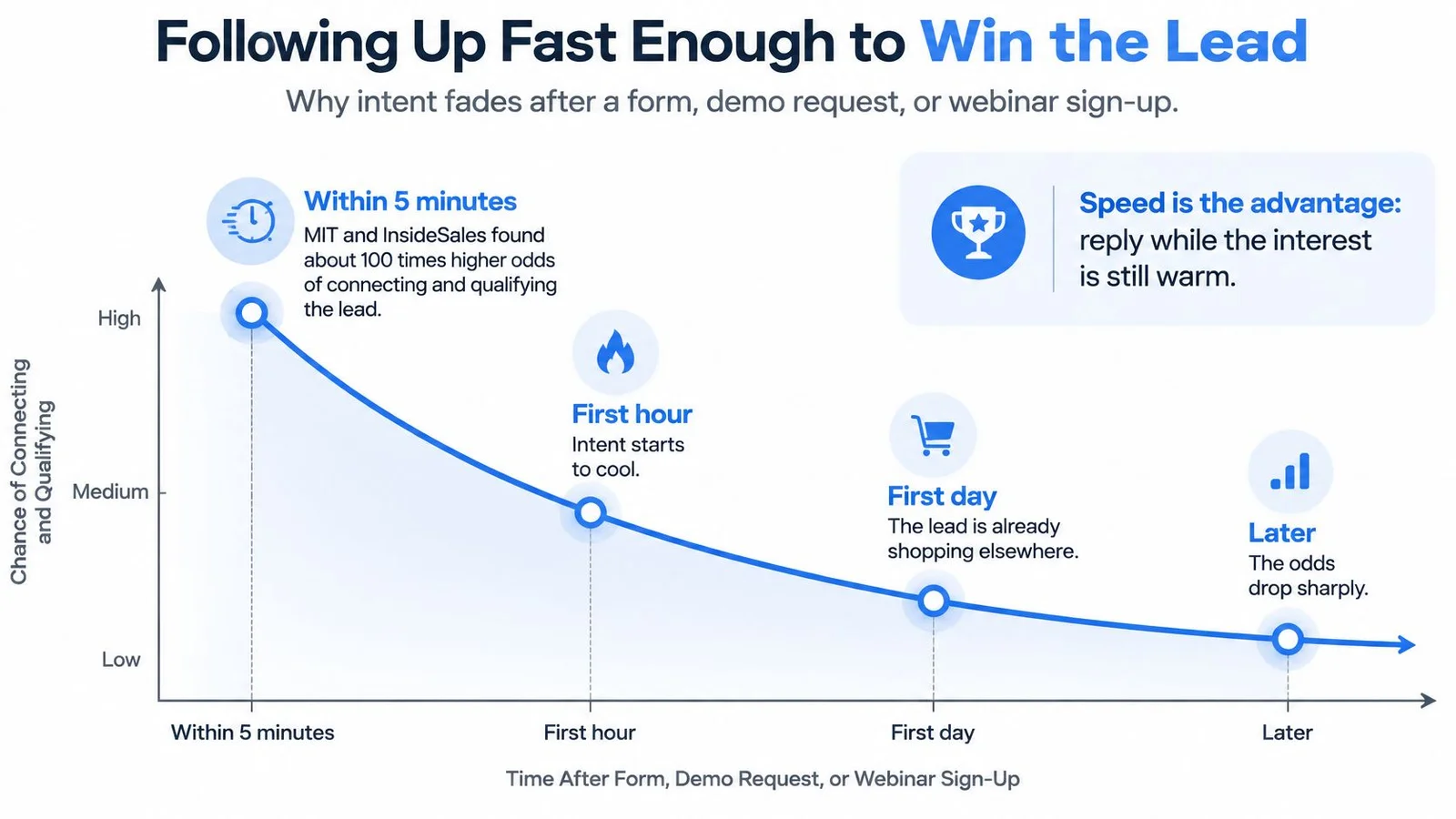
| Response Window | Reported Effect | Action to Take |
|---|---|---|
| Within 5 minutes | About 100 times higher odds of contact than at 30 minutes | Send an automatic acknowledgment and route to an owner |
| Within 1 hour | Nearly 7 times as likely to qualify as waiting one more hour | Assign an owner and send a first message with a qualifying question |
| After 24 hours | Far lower qualification odds; the one-hour responders were more than 60 times as likely to qualify | Start a timed nurture sequence and review the lead list weekly |
The four moves after submit
- Send an instant acknowledgment that names the offer and the next step, so the lead knows the request landed and what happens now.
- Route the lead to a named owner within seconds, not to a shared queue. In FOMOchat, the email address on the account is where lead notifications arrive, so point it at an inbox someone watches.
- The first human or assisted message asks about use case or goal. A question invites a reply; a pasted brochure ends the exchange. If an assistant handles that first message, our roundup of the best chatbots for lead generation shows what to look for.
- If nobody replies, run a short email sequence over several days, then stop. Silence after a handful of touches is itself an answer. Need wording for those emails? Borrow from our follow-up email subject lines.
Unanswered leads escalate after one hour. For the routing and the sequence itself, map the triggers in a marketing automation workflow before you launch, so the first hour depends on a system rather than on someone noticing a spreadsheet.
Run a holdout before you treat the odds as your own result. Withhold the fast path from a random slice of leads for a set period. Compare contact rate and qualification rate by geography, device, source, and offer. Keep the test short enough that you aren't stranding a whole month of demand.
Measuring What Actually Turns Into Revenue
Cost per lead can flatter a campaign that never reaches a sales conversation. A $12 form fill that nobody can qualify is more expensive than a $40 signup that becomes a meeting. Optimize the qualified-conversation rate, then revenue, and store the clues that explain both.
Separate the stages instead of jumping from "lead" to "won."
| Stage | Metric | What a Weak Result Means |
|---|---|---|
| Capture | Visitor-to-lead rate | The page or offer is not clear or compelling |
| Qualification | Qualified-lead rate | The form or questions attract the wrong audience |
| Sales handoff | Meeting-booked rate by source | Follow-up is slow or the owner is not contacting leads |
| Revenue | Pipeline and revenue per campaign | Leads are qualified but the offer or sales handoff does not match |
What to keep on the record
Score explicit signals and write them into the CRM: requested feature, budget or enrollment goal, implementation timing, attendance intent, and objection category. Then compare sources and offer types on those fields. An on-page conversation can look average on raw conversion and still raise qualification or clear an objection. Judge it on those middle outcomes, not only on the submit rate.
That's also why we built FOMOchat around conversations instead of notification popups. A ticker saying "Someone in Austin just signed up" might nudge a click, but it can't tell a visitor whether the trial covers their use case. A visible conversation can, and other visitors see the answer too. Our take on why notification popups fall flat for complex products goes deeper.
Individual tracking is less reliable than it used to be, so don't pretend last-touch tells the whole story. Pair first-party data with a campaign experiment, CRM opportunity source, and what the buyer says when asked how they heard about you. In the 2025 State of Marketing Attribution Report, 68% of legacy go-to-market teams and 92% of account-based teams said they use attribution models, yet only 37–39% measure performance at the tactic level. Many teams can name an influenced deal. Far fewer can say whether this webinar, this page, or this follow-up changed it. Our explainer on attribution modeling helps you pick a model you can defend.
Review the scorecard every two weeks. Change one part at a time, or you won't know which edit moved the number.
A simple holdout, one source versus another, beats a model you can't explain to the person who owns the pipeline. If you need a worksheet for the money side, walk the same stages through a marketing ROI calculation so pipeline and revenue stay next to the lead count.
Launch One Small Campaign and Measure It
Here is one illustrative run, not a benchmark to copy. A SaaS team hosts a webinar on onboarding. The audience is operations leads at companies of 50 to 300 people. The offer is a 45-minute live session plus a checklist. The page has one headline, fields for name and work email, and a single proof line from a customer who cut onboarding time.
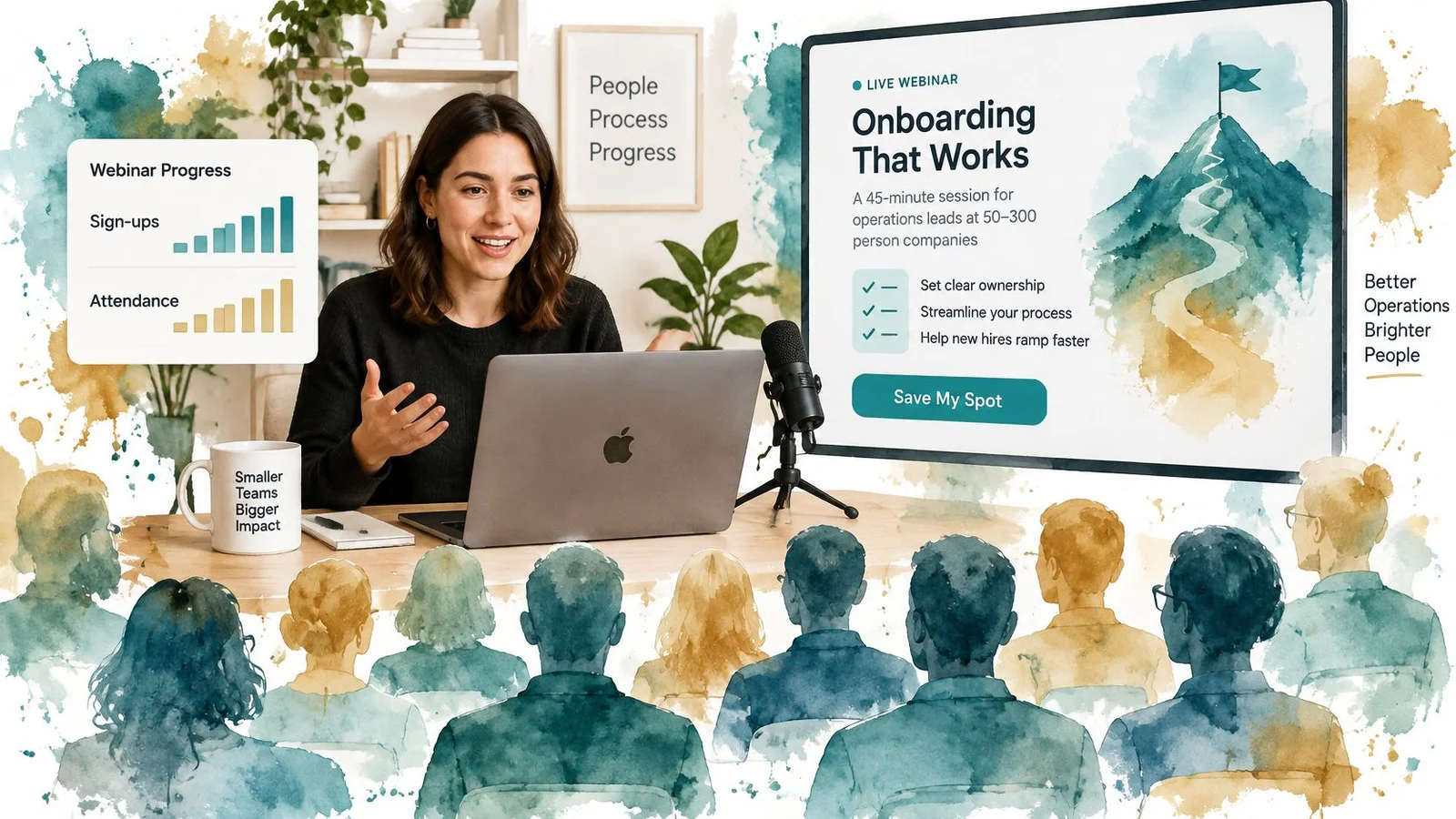
Follow-up is an instant confirmation, a named owner who messages within one hour, and three emails if there is no reply. For measurement they watch one cohort: 1,000 visitors, 120 signups, 40 people who attend or meet a qualifying condition, and 12 booked calls. Those counts are a teaching example. Your prices, traffic, and close rates will differ.
Read the drop, not the top number. Losing most visitors before the form points at the promise or the page. Losing signups before they attend points at the reminder and the confirmation. Losing attendees before a call points at the ask after the session, or at a slow owner. One weak stage is enough to fix.
Webinar campaigns have one more leak: the replay. Plenty of signups never make it live, so the recording does the selling. With FOMOchat webinar chat on the replay page, later viewers see the questions earlier attendees asked, which keeps the room feeling alive. Our tips on increasing event attendance help with the live side.
A short walkthrough of how a full campaign is assembled can make the handoffs easier to see before you build your own.
Thirty days, five steps
- Choose one segment. Write the role, company size or student goal, problem, and timing in a single sentence.
- Write one offer. Pick one rung on the ladder and say what they receive and when.
- Build one page. Headline, short answer, one proof point, short form, consent note, no extra navigation.
- Set a one-hour response rule. Instant acknowledgment, named owner, escalation if the hour passes with no contact.
- Track the scorecard for four weeks. Capture, qualification, meetings by source, and pipeline or revenue. Change one part, then look again.
If you want to see how a fast on-page reply fits a page like this, you can book a demo with us and bring the segment sentence with you. Start with step 1 this week. Write the chosen segment in one sentence and don't add a second audience until that sentence is easy to say out loud.
FOMOchat helps SaaS teams, course creators, launch groups, and webinar hosts answer high-intent questions on the page while interest is still warm, so a lead generation campaign doesn't stall at the form. Visitors see real questions get answered, and you can route the conversation toward a signup, a seat, or a demo. See how it fits your page at FOMOchat.