
The most popular product-launch advice is to build buzz, post everywhere, and make launch day impossible to miss. Cut that plan. A small marketing team needs evidence that buyers will change what they do, not a crowded calendar of announcements. A paid signup matters more than applause, and repeat use matters more than the launch-day spike.
A 30-Day Calendar for Your Product Launch
Retire the claim that 95% of new products fail as a universal planning benchmark. A peer-reviewed Marketing Letters study examined 83,719 new stock-keeping units across 31 U.S. consumer packaged-goods categories introduced between 2002 and 2009, finding that 25% were no longer purchased after one year, rising to approximately 40% after two years, with failure defined as permanent cessation of sales.
That isn't a forecast for your SaaS, course, or webinar. It is a useful correction to the idea that a single failure percentage describes every launch. Set your own milestones around buying behavior, successful use, and continued value.
Pin decisions to the calendar
Use this 30-day product launch calendar as a proposed operating schedule, not a guarantee that every product can be ready that quickly. Assign a named owner to each row and replace relative dates with actual dates before work starts.
| Phase | When | Main work | Pass evidence |
|---|---|---|---|
| Problem lock | T-30 | One buyer, one job, one metric | Written problem and metric the team agrees on |
| Behavior interviews | T-21 | Last incident, workaround, cost | At least 5 interviews with a real workaround named |
| Message freeze | T-14 | One line and 3 objections | Prospects repeat the benefit without prompting |
| Page and test setup | T-7 | Tracking, control, staffed channels | Events fire and sample rules are written |
| Public launch | Launch day | Ship the offer, watch support | Activation and support load reviewed same day |
| Channel cut | Day 7 | Drop the weakest source | Source-level conversion, not blended traffic |
| Scale or pause | Day 14 | Keep, fix, or stop spend | Conversion plus repeat use and complaints |
At T-30, choose the commercial action that matters: a trial start, course enrollment, webinar registration, or purchase. Define activation separately. Creating an account isn't the same as completing the task someone bought the product to do.
At T-21, recruit people from the intended buyer group, not whoever answers fastest. Use the interview requirement in the table as a minimum operating gate, not as a representative market sample. Keep recruiting if the answers conflict or come from different buying situations.
At T-14, stop rewriting the offer to accommodate every internal opinion. Freeze the central promise and the objections the page must resolve. If you need a visual announcement, ShipTeaser can help you turn landing pages into launch teasers, but finish the message before producing the asset.
Protect the launch from extra work
At T-7, test the entire customer path, including confirmation messages, payment, onboarding, and support routing. Give someone authority to remove unfinished extras. A second offer, an untested integration, or an additional audience segment can wait.
On launch day, review activation and support load hourly while the team is staffed. Don't introduce a discount or change the promise midway through the day just because the traffic graph looks disappointing. You'll lose the ability to interpret what happened. Keep your product launch tools shortlist tight: one primary CTA, one proof surface, and one place for unanswered questions.
Calendar rule: A missed evidence gate moves the launch date. It doesn't lower the standard.
Schedule the post-launch reviews before publishing. Keep a month-12 review on the calendar too, using renewal, continued use, repeat purchasing, or another measure appropriate to the offer. The public announcement starts the test; it doesn't settle the result.
How to Prove Demand Before You Spend
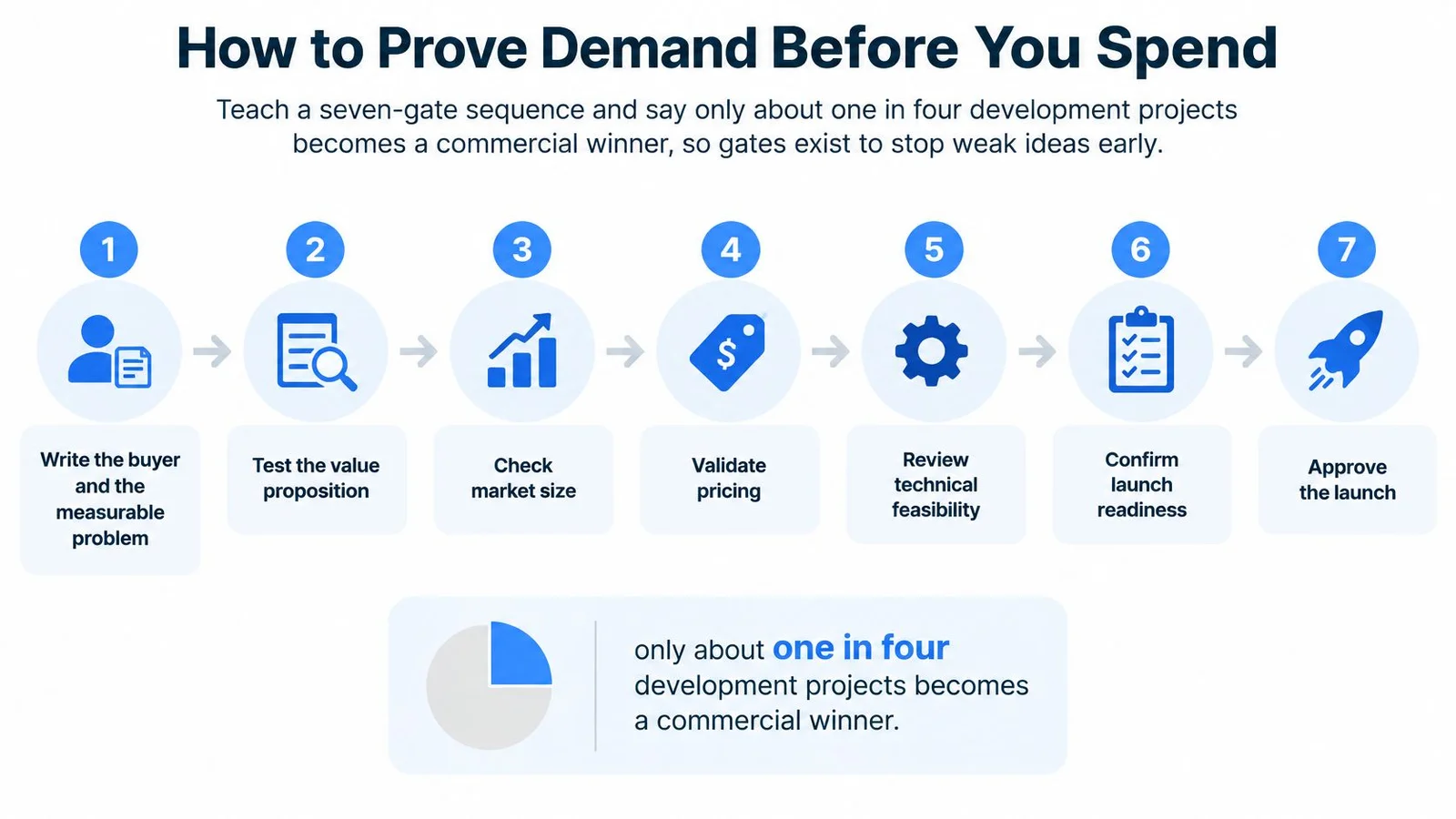
A launch budget shouldn't become a reward for finishing a product. Research on formal new-product processes reports that only about one in four development projects becomes a commercial winner, according to the Industrial Marketing Management paper on new-product processes. Use gates to stop weak ideas before promotion makes them expensive.
The process below gives the team a shared route from a defined problem to launch approval.
Require evidence at every gate
- Define the buyer and measurable problem. Write a sentence naming the person, the job, and the consequence of leaving it unfinished. Add an exclusion: who won't benefit enough to buy? Pass when the team can recruit that buyer without relying on broad labels such as entrepreneurs or busy professionals.
- Investigate an existing workaround. Ask prospects to walk through the last incident, show the tool or process they used, and explain its cost. Someone saying they'd probably buy isn't a pass. Require a concrete account of what they'd replace and what would trigger that change.
- Test the actual proposition. Put the proposed headline, offer, and price in front of representative prospects. Ask them to explain what they'd receive before you explain it yourself. Check whether you can reach enough relevant buyers through channels you can afford, rather than substituting a large market-size slide for a distribution plan.
- Validate pricing against delivery costs. Record willingness to pay alongside payment evidence where feasible, with clear terms for any pilot or preorder. Estimate servicing costs, refund exposure, and support effort. Pass only when the offer can make commercial sense without assuming customers never need help.
- Build the smallest complete solution. Deliver the core job from beginning to end. A waitlist or clickable presentation can test interest, but it can't prove that someone can use the product successfully. Check technical feasibility, error handling, and the dependencies needed to fulfill the promise.
- Run a controlled pilot. Write the completion requirement, observation window, and acceptable support burden before inviting participants. Watch users attempt the task without coaching them through every screen. Pass when the intended buyers can reach the promised outcome under conditions you can sustain.
- Approve or reject the launch. Bring acquisition, activation, conversion, retention, and support-load evidence to the same meeting. Give each unresolved issue an owner and consequence. Approval means the evidence clears the written requirements, not that everyone is tired of preparing.
Use a consistent interview log so enthusiasm doesn't crowd out difficult answers. Our guide to collecting customer feedback can help you organize questions and turn responses into actionable changes.
Don't confuse distribution with validation
For a physical product, targeted product seeding through Sup can put samples in relevant hands. Define what you need to learn before sending them: actual use, fit, recurring objections, or reasons someone won't switch. A complimentary post isn't evidence of willingness to pay.
The same discipline applies to digital offers. A lively chat or flattering poll can sit beside an empty checkout. Generated conversations may explain an offer, but they aren't customer testimony and mustn't be presented as such.
Use this video as an additional discussion resource for your launch team.
If the controlled pilot fails, slip the public launch. Fixing a product with a small group is a better use of money than buying a larger audience for the same failure.
Positioning and Messages Buyers Can Repeat
Your feature list isn't your positioning. Buyers need to recognize the job you help them complete and understand why your approach is worth changing for. If a competitor could paste your headline onto its homepage unchanged, cut it.
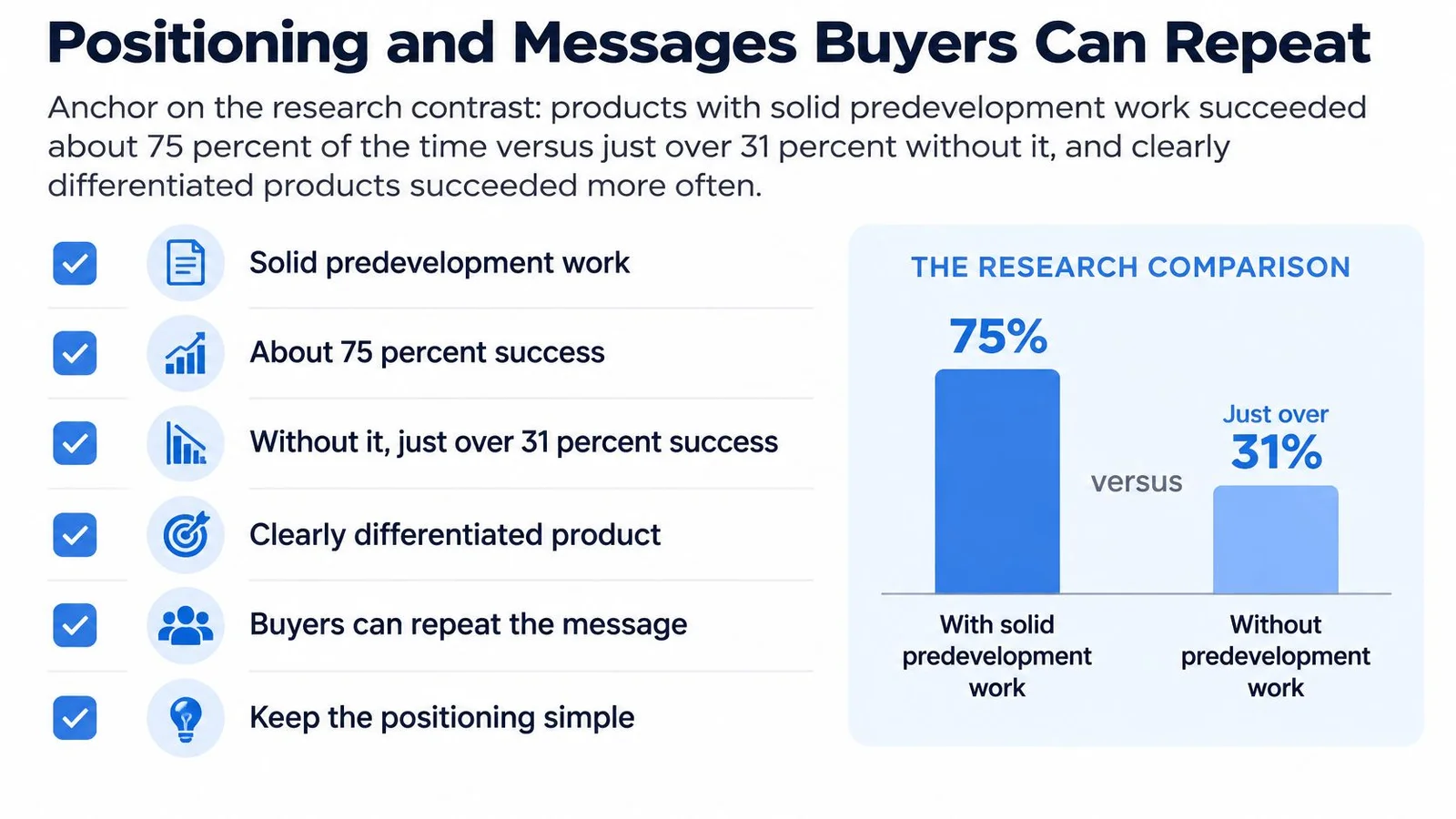
The OpenStax Principles of Marketing synthesis reports a 75% success rate for products with well-defined and well-executed predevelopment activities, compared with just over 31% when those activities were lacking. Those figures support disciplined preparation, not a promise that finishing a messaging worksheet guarantees success.
Use the comparison as a reason to resolve the offer before amplifying it.
Replace categories with recognizable work
Say a SaaS homepage describes an AI-powered operations platform. That tells an operations lead almost nothing about what changes on Monday morning. A more testable proposition is a tool that replaces the Friday export the operations lead rebuilds in a spreadsheet.
That second version names a task and an alternative. It also creates an obligation: the product must replace that export workflow. Don't make the claim if customers still need the spreadsheet to finish the job.
For a course, the alternative might not be another paid course. It might be stitching together free tutorials while still failing to complete a portfolio assignment. Position the course around the finished assignment, the feedback provided, and the prerequisites, rather than vague access to expert knowledge.
Use competitive positioning to compare against those real alternatives. Include doing nothing, hiring help, and keeping the current workaround. Buyers can reject your product without choosing a direct competitor.
Pair each claim with its objection
Draft a compact message sheet before writing the full page:
- Outcome claim. Name the work the buyer can complete, then address whether the outcome fits their situation.
- Effort claim. Explain what setup or participation requires, then address the time and switching burden honestly.
- Trust claim. Show relevant evidence, a demonstration, or explicit limits, then address why the buyer should believe you.
Use the buyer's nouns. If interviewees talk about assignments, exports, approvals, or client handoffs, don't replace those words with proprietary feature names. Save the feature vocabulary for the explanation.
Segment the message test by buyer role and urgency. An operations lead facing a reporting deadline may interpret the same promise differently from a founder casually exploring tools. Don't average those reactions into a bland headline intended to please both.
If a prospect can't repeat the benefit after one reading, the line is still an internal slogan.
After the message freeze, change a claim only when interview notes, product behavior, or pilot evidence contradicts it. A senior teammate preferring a different adjective isn't enough. Keep the page stable long enough to learn whether the proposition works.
Channels and On-Page Proof for Launch Week
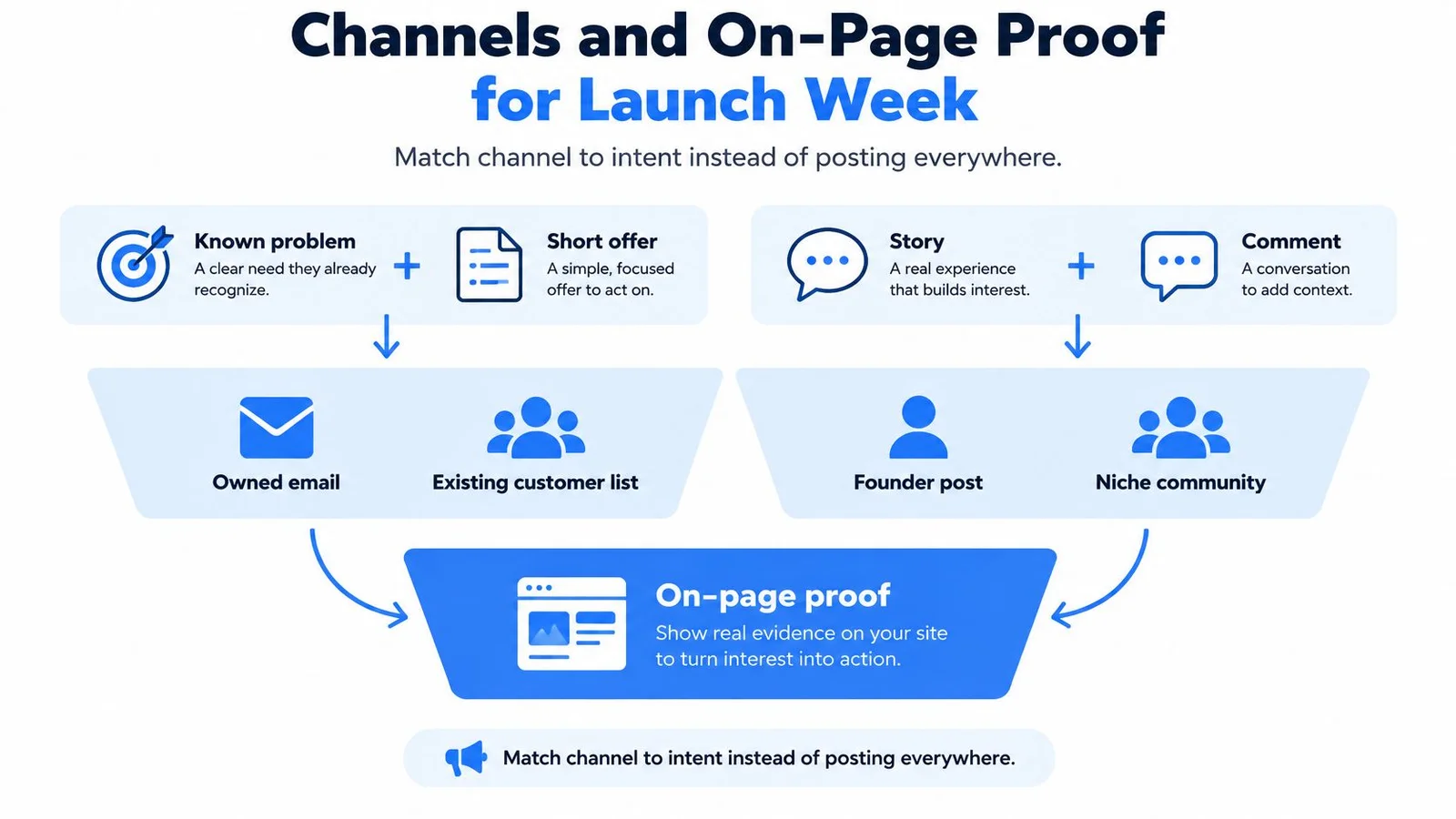
Choose two staffed channels, not every channel the team knows how to publish on. For a small team with an existing audience, start with owned email and a founder-led niche conversation. Give each a named responder and a clear route to the offer.
Match the channel to the buyer's intent rather than the format you happen to enjoy producing.
Give every channel a specific job
Use this launch channels and when to use them comparison to choose your starting pair. The stop signals are prompts to investigate or pause, not reasons to abandon a channel after an isolated visit.
| Channel | Best fit | Week-one job | Stop if |
|---|---|---|---|
| Email to existing list | Known problem, warm audience | Drive the primary signup | Openers do not reach the page |
| Founder or community post | Niche buyers who reply | Start conversations, send to the page | Comments are curiosity only |
| Webinar or live demo | Course, SaaS, high-ticket | Registrations and attended questions | Signups stall after the pitch |
| Partner mention | Audience already paying for a workaround | Borrow trust into one offer | Traffic bounces on the headline |
| Paid search or social | Page already converts warm traffic | Scale a winning message | Cost per signup exceeds the tested ceiling |
For community outreach, Bazzly can help you find subreddits for your product. Read each community's rules and existing discussions before posting. Finding an audience doesn't give you permission to drop an advertisement into it.
Reserve webinars and live demos for offers that need explanation or evaluation. Measure registrations as the acquisition action, then track attendance and subsequent buying behavior separately. Don't celebrate a full registration list if nobody progresses. An FOMOchat widget on the registration page can answer replay and agenda questions in a conversational thread while other attendees' questions stay visible, so you aren't stacking another notification popup on top of the form.
Approximately 44% of new-product projects miss profit objectives and 49% launch late, according to the Wiley overview of new-product development. Protect scope instead of adding another channel to compensate for an unfinished page.
Make the page answer the buying questions
Put the frozen positioning line above the fold, followed by a primary action and understandable price or plan logic. Place answers to the main objections near that action. For customer evidence, use specific, attributable experiences rather than generic praise; our guide to five-star review examples offers useful patterns for presenting feedback.
An optional on-page tactic is our FOMOchat widget. Setup follows configure, generate, and embed: set personas, product context, and conversation style; generate realistic multi-person conversations addressing common questions; then paste the snippet. Label AI-generated participants and conversations clearly so visitors don't mistake them for independent customers or verified purchases. Treat it as one of your social proof widgets, not a second banner, and compare it against the best social proof tools you already trial.
Keep answers tied to approved website facts and test for invented claims. AI Continuation isn't suited to video or webinar mode, tightly controlled messaging, checkout or thank-you pages, or time-limited promotions requiring exact wording.
Randomize the treatment against a control before expanding exposure. Write the required lift, sample requirement, duration, and stopping rules before reviewing results. Monitor conversion alongside complaints, refunds, support escalation, and page performance, then inspect source, device, geography, and new versus returning visitors.
A chat interaction is a page behavior. A purchase is a commercial behavior. Don't report them as interchangeable wins.
Fixes and Keep, Fix, or Pause Decisions After Launch
High survey interest with no credible account of the problem calls for better interviews, not more traffic. Heavy page traffic with weak signup calls for a message or purchase-path investigation. Customers buying and then complaining calls for an immediate promise-and-delivery review.
Treat the following as diagnostic hypotheses, not automatic explanations. Inspect the relevant session, interview, support ticket, or payment event before changing anything.
| Symptom | Likely cause | Fix |
|---|---|---|
| Praise in surveys, no signups | Mild problem or polite bias | Re-interview for workaround and cost |
| Traffic up, conversion flat | Message or price mismatch | Change one claim or the price test |
| Signups, no activation | First task too hard | Cut onboarding to one action |
| Registrations, poor attendance | Weak reason to show up | Reminder plus a tighter promise |
| Sales, then refunds or complaints | Overclaim | Correct the page and pause spend |
| Day-one spike, then silence | Novelty | Check return behavior and task completion before scaling |
The Zoho guide to new-product survey questions provides prompts for exploring interest and purchase intent. Strengthen those answers by asking what respondents currently do, what they've already spent, and what would make them stop using the current solution. An opinion becomes more useful when you can connect it to a real decision.
Fix the broken transition
When visitors arrive but don't sign up, compare the advertisement or email with the landing page. Does the page name the same buyer, promise the same outcome, and ask for the action the visitor expected? Change the mismatched element rather than redesigning the entire page.
When signups don't activate, watch the first task. Remove optional fields, defer secondary setup, and make the next action obvious. As an operating rule, send the first-task email within an hour of signup, then verify that the email leads to the required screen.
When registrations don't become attendance, tighten the reason to appear live. Explain what participants will leave with and send a reminder that includes the joining details. Don't use a vague reminder to compensate for a vague event promise.
Strong sales followed by refunds require a different response. Correct unsupported claims the same day and pause the affected promotion while the team checks delivery. If support is overloaded, staff the recurring questions and reduce incoming traffic before adding features.
Decision discipline: Don't use extra acquisition to hide a product that buyers can't successfully use.
Use A/B/n testing when you have enough traffic for meaningful comparisons. With sparse traffic, prioritize observed usability problems and buyer interviews rather than splitting a small audience across numerous variants.
Fill the day-14 scorecard
Schedule a 15-minute readout on days 1, 3, 7, and 14 as your team's review cadence. Record visits, primary conversion, activation, repeat use, refunds, complaints, and recurring questions. Save buyer wording for the next message test, but don't rewrite the page after every comment.
For the day-14 decision, put the threshold set before launch beside the actual result and evidence quality:
- Keep. Continue spend when the primary action, repeat use, and complaint rate clear their written bars. Increase exposure only as fast as delivery and support can handle it.
- Fix. Isolate a correctable problem when evidence points to a specific source, device, message, or onboarding step. Preserve the working segment instead of averaging it together with the weak one.
- Pause. Stop promotion when buyers don't activate, complaints undermine the promise, or the evidence is too weak to justify expansion. Return the unresolved question to the pilot.
Treat a shrinking launch spike as a reason to investigate, not proof of novelty by itself. Check whether customers return when the job recurs. For a course or event, use the next meaningful behavior, such as completing the assignment or attending, rather than imposing a SaaS login metric. Healthy acquisition of new customers after a launch looks more like repeatable jobs than a single fear of missing out marketing spike.
Before proposing another channel, fill in that scorecard and name the decision owner. Leave the meeting with an action, an owner, and the next evidence deadline, not another list of promotional ideas.
FOMOchat offers AI-powered on-page conversations and instant support to help visitors understand your launch offer and resolve objections. Visit FOMOchat to book a demo, then test it against your current page using qualified signups and successful activation, not chat volume, as your measures.