
A visitor lands on your SaaS pricing page, compares the annual plan with the monthly one, and pauses over the upgrade button. A course creator watches enrollment slow as the cohort start date approaches. A corporate buyer opens a webinar registration page, then checks her calendar before deciding whether to commit. In each case, the visitor may want the offer but still wonder whether acting now is worth it.
The key moment comes when they picture other people taking part in something they might miss. That feeling can prompt action, but only if the opportunity is real and the evidence is credible. Fear of missing out marketing works best when it helps a good-fit visitor decide, not when it corners someone into buying.
This playbook focuses on the decision behind the click: how FOMO works, why scarcity and social proof need separate tests, what to do across SaaS, courses, and webinars, and how to protect trust while measuring results. For a useful companion on building attention and momentum around a campaign, see Refport's buzz marketing guide.
The Moment FOMO Decides the Sale
On the SaaS pricing page, the visitor may already understand the product. They've compared the plans and read the feature list. What they don't know is whether upgrading now is meaningfully different from waiting. A real plan-change deadline can make that choice clear. A countdown that resets whenever they reload the page makes it harder to trust anything else on the screen.
The course launch has a different hinge. A prospective student wants the structure of a cohort, but they're weighing the time and effort against the promised outcome. A visible enrollment signal or a genuine closing date can answer whether the cohort is active and when the opportunity ends. If the “last chance” message appears every week, it stops being a reason to act and starts being a reason to wait.
Then there's the webinar buyer. She may want the material but need to know whether the session fits her schedule and whether the discussion will address her situation. A clear schedule, a real registration deadline, and a chance to see the questions other attendees are raising can reduce uncertainty. A vague claim that “everyone is joining” does not.
The hinge point: The visitor isn't simply asking whether the offer is popular or whether time is running out. They're asking whether other people are getting value from an opportunity that could be unavailable to them.
That's why a countdown alone isn't a strategy. The strongest campaign pairs a real constraint with evidence that people like the visitor are participating or finding the offer useful. In a conversational widget, that evidence might be authentic questions and timely answers. The questions should help a visitor make a decision, not make a quiet page look busy. It's also why a generic “someone just signed up” toast tends to fall flat on a considered purchase, a pattern we unpack in why social proof notifications don't work for complex products.
The difference matters in practice. A social proof element can surface common objections and reassure a visitor that they aren't the only person considering the product. A deadline can clarify when access changes. Both may help someone decide, but they do different jobs, and a growth team should be able to tell which one is working.
What FOMO Actually Is and What It Is Not
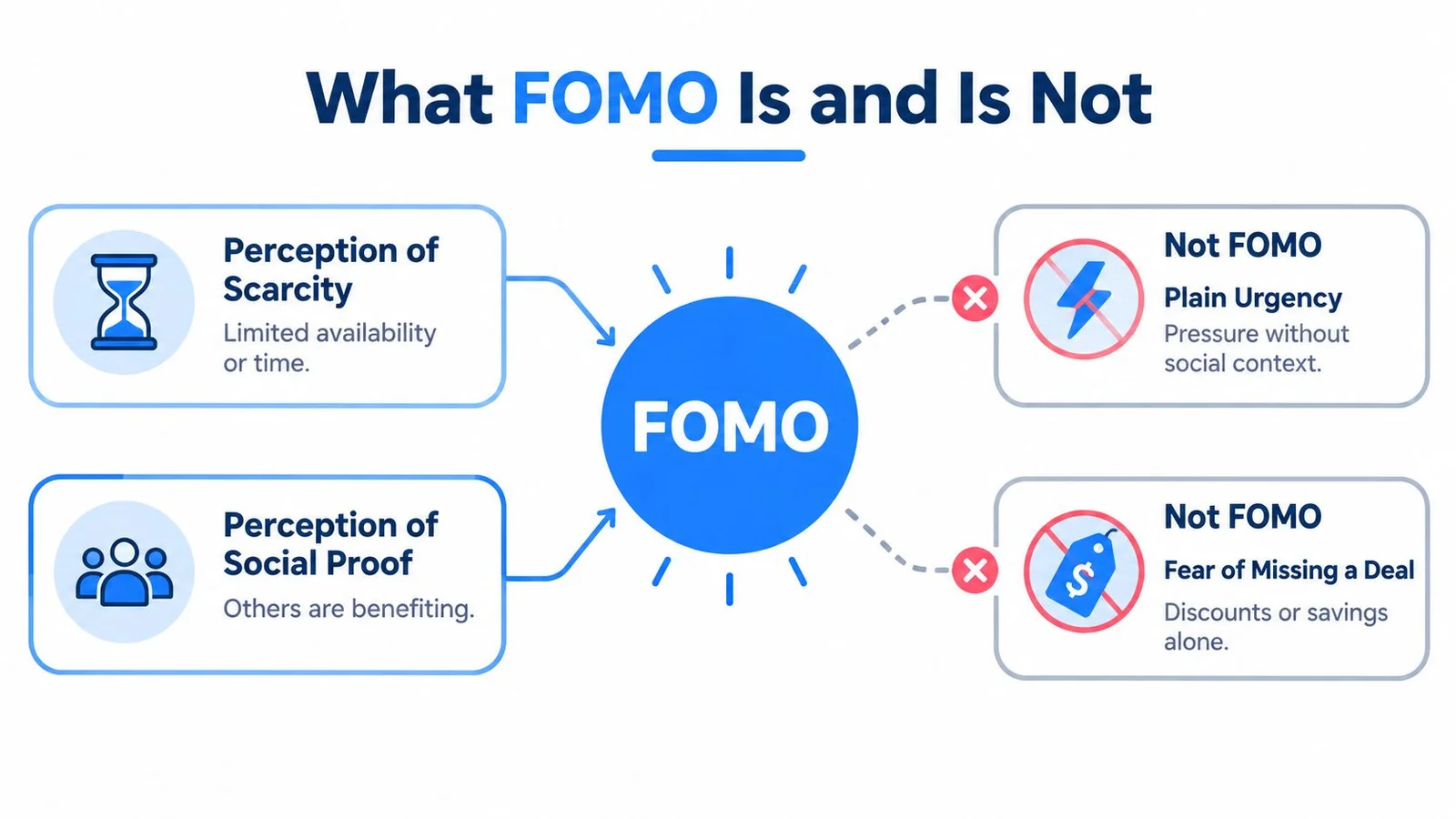
Fear of missing out (FOMO) is the perception that other people are experiencing or gaining access to something desirable while you may be left out. For marketers, that means the message needs two parts: an opportunity the visitor values, and credible evidence that others can participate or are already benefiting.
A 2023 systematic literature review examined 42 empirical studies indexed in Scopus and Web of Science. It found consistent connections between FOMO and social-media use, social comparison, consumption behavior, and negative psychological states. The review also noted that systematic marketing scholarship expanded mainly during the decade before its publication, while the concept has older roots in research on social comparison and belonging (the 2023 FOMO literature review).
Separate FOMO from urgency and popularity
Urgency says a decision has a time constraint. “Enrollment closes Friday” can be urgent without invoking FOMO, especially if the message gives no reason the visitor should care about what other people are doing.
Social proof shows that other people are participating, asking questions, or finding value. That can reassure a visitor without any deadline. Popularity by itself isn't proof of fit, and a crowd isn't a substitute for information about the offer.
Scarcity means access is limited by time, quantity, or eligibility. A genuine seat limit can create urgency, but scarcity alone doesn't establish that the opportunity is valuable or that others are taking it.
FOMO appears when these cues combine into a personally relevant possibility of exclusion: other people may get access to something the visitor wants, and the visitor may miss it. That's why “Only a few spots left” feels hollow when the visitor can't verify the constraint or see why the offer matters. If you want the mechanics of an honest deadline, our guide on how to create urgency in sales walks through it.
For a practical companion on displaying peer participation, see FOMOchat's guide to social proof in marketing. The useful test is simple: does the message help a visitor understand the opportunity and their options, or does it only pressure them to act?
Why Scarcity and Social Proof Are Not the Same Lever
Scarcity and social proof often appear together in campaigns, but treating them as a single tactic makes results difficult to interpret. Scarcity communicates a limit. Social proof communicates other people's activity or experience. They may both contribute to FOMO, but they don't tell a visitor the same thing.
A dual-mediation study found that perceived scarcity had a strong, statistically significant effect on urgency, while social proof had a weaker but still meaningful effect. Urgency then increased both general FOMO and its socially oriented component (the dual-mediation study on scarcity, social proof, and FOMO). The practical takeaway is to test the cues separately instead of adding a countdown and a chat widget at once, then guessing which one earned the conversion.
Test the limit and the crowd separately
For a scarcity test, keep the page and proof content steady while changing the communication of a real deadline, seat limit, or plan change. Watch whether visitors click through, start checkout, or complete registration during the deadline period. Those actions show whether the constraint helps people decide.
For a social-proof test, hold the deadline messaging steady and vary the peer content. Try showing authentic questions, clear answers, or verified participation signals. Track whether visitors open the conversation, view questions, or respond. These measures reveal whether the social cue attracts attention and helps people engage.
| Lever | What it changes in the visitor | Metric to watch | Example in a SaaS or course flow |
|---|---|---|---|
| Scarcity | Awareness of a real time or access limit | Deadline-period clicks, checkout initiation, or conversion | State when a plan change takes effect or when enrollment closes |
| Social proof | Sense that peers are participating or finding answers | Chat opens, question views, or response rates | Show product questions on a pricing page or student questions on a course page |
The metric should match the lever. A chat opening doesn't prove a deadline works, and a conversion increase doesn't tell you whether visitors were reassured by other people's questions or hurried by a cutoff. Keep those interpretations separate.
See real-life scarcity examples for ideas to adapt, but use only examples that map to a verifiable constraint. A deadline is useful when it tells the truth. When it's invented, it turns an otherwise persuasive cue into a credibility problem.
Campaign Strategies That Work in SaaS, Courses, and Webinars
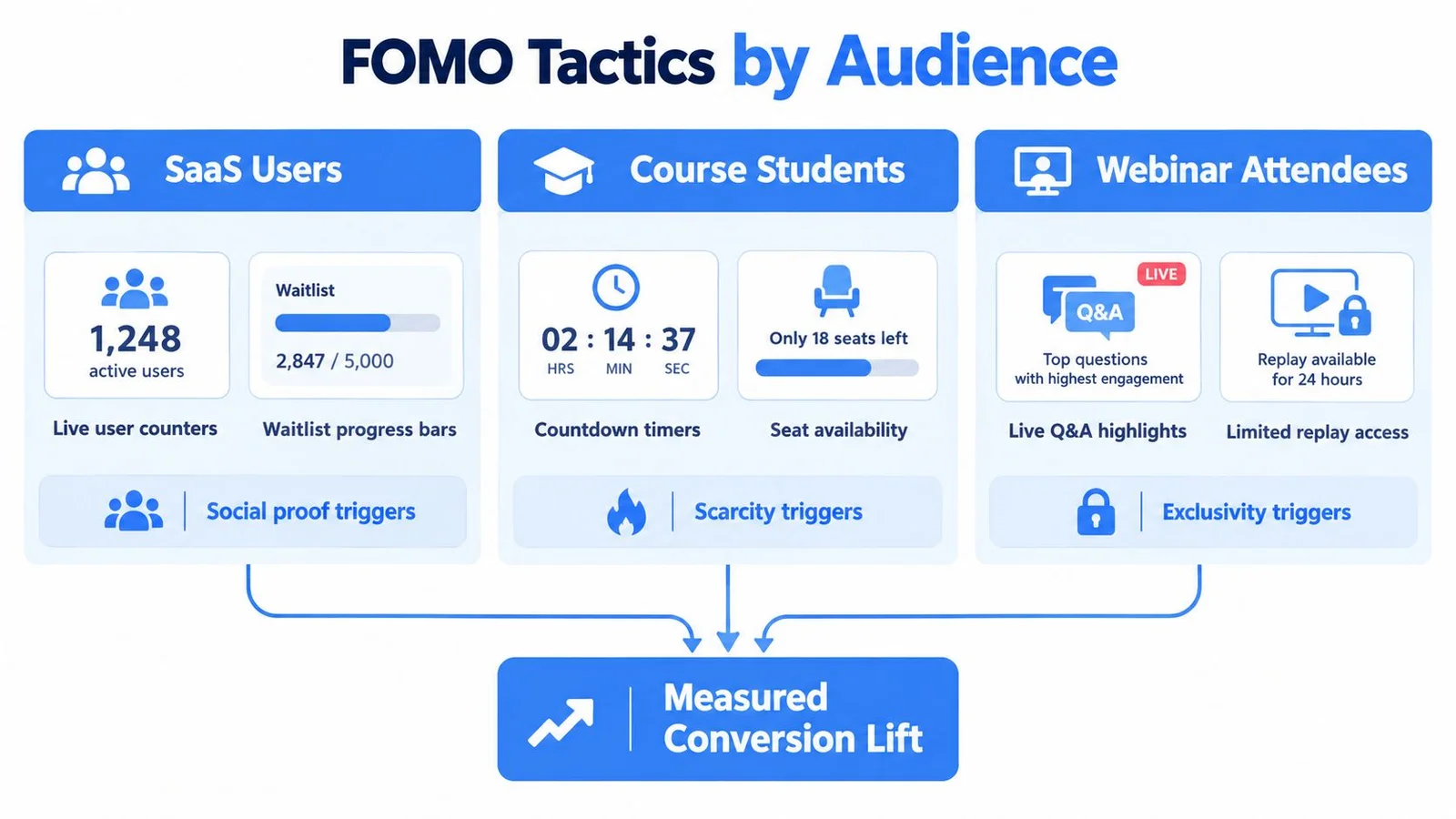
A useful campaign starts with the actual reason access or timing changes, then puts that information where a visitor has to make a decision. Don't paste the same “ending soon” banner onto every page. Match the trigger to the audience and the moment.
A 2025 study of 199 Generation Z respondents in Jambi City, Indonesia found that FOMO positively affected impulsive buying, and that social-media advertising increased FOMO. The direct effect of advertising on impulsive buying was statistically non-significant, while its indirect effect through FOMO was significant (the study of social-media advertising, FOMO, and impulse buying). The sample is specific, so it isn't a universal performance forecast. It does underline a useful distinction: exposure to a message and the perception of a meaningful opportunity are not the same thing.
SaaS product pages
Use a launch-batch cutoff when access changes after a launch phase, or a plan-change date when pricing or included features will change. Place the detail beside the relevant plan or CTA, not in a distant banner a visitor may miss.
Pair the deadline with useful peer context: common product-fit questions, honest answers about setup, or verified customer activity. Copy should explain the actual constraint and what the visitor gets by acting before it. Avoid invented user counters or a deadline that keeps moving.
Teams refining their sales motion can also review Creem's 2026 software sales strategies, especially when deciding where urgency belongs in a longer SaaS buying process.
Course launches
A cohort start date gives learners a clear timing reason to enroll. Put it near the enrollment decision, explain what happens after registration closes, and show the course's real structure: who it's for, what the cohort includes, and how participants get support.
An expiring bonus can work if it really ends with the enrollment window. Visible enrollment counts should reflect actual registrations and stay current. Don't claim seats are nearly gone just to make a course feel popular.
Webinars and events
Use the registration deadline and the live-session schedule to set expectations. On a landing page or during a recorded pitch, timely questions and answers can make the discussion more useful by surfacing the objections a buyer may also have.
The failure mode is simulated activity presented as live attendance. If the interaction is generated or replayed, label it. Visitors should be able to distinguish actual participation from illustrative dialogue before they rely on it to make a decision. For evergreen replays, FOMOchat keeps visitor questions and answers beside the pitch moment instead of relying on a fake attendee counter, and our roundup of webinar engagement tools covers other ways to keep a recorded session interactive.
The Trust Trap and the AI Disclosure Problem
A message can increase immediate purchases and still leave buyers anxious, regretful, or unwilling to return. That's the cost growth teams miss when they judge FOMO only by the signup or checkout event.
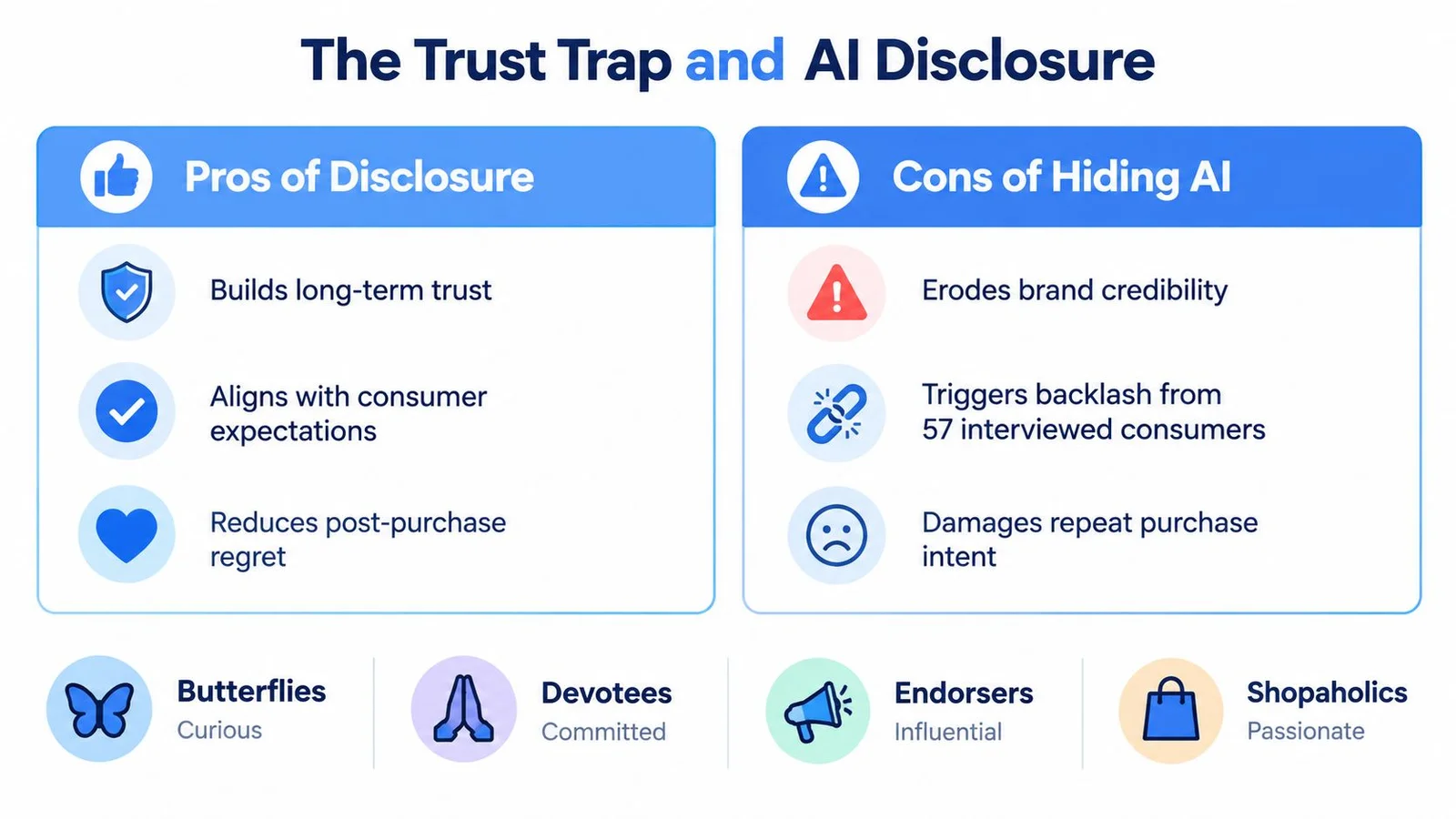
A 2025 interview study of 57 FOMO-prone consumers identified four segments: Butterflies, Devotees, Endorsers, and Shopaholics. The study found that FOMO appeals may generate immediate purchases and positive short-term intentions while often producing negative cognitive and emotional effects afterward (the study of FOMO-prone consumer segments). The same message won't land the same way with every buyer. Some may advocate for an experience; others may regret acting under pressure or disengage.
That makes the highest-converting message in the moment a poor stand-in for the highest-value customer over time. Track refunds, cancellations, repeat purchases, support complaints, and customer trust alongside conversion. A campaign that gains clicks but increases buyer's remorse deserves a redesign, not a victory lap.
Disclose what the visitor is seeing
AI-assisted social proof introduces a related credibility challenge. Survey reporting in the available research says 75% of consumers favor disclosure when advertising uses AI, while disclosure can still reduce trust (the survey reporting on AI disclosure and consumer trust). That tension isn't a reason to hide automation. It's a reason to be specific about what's real.
When a tool generates example dialogue, label it as generated. Keep real customer comments distinct from simulated scenarios, and never imply that someone purchased, attended, or asked a question if they didn't. If an answer depends on context or could be uncertain, say so instead of writing with false confidence. Clear rules make that much easier to enforce, which is the whole point of guardrails for AI answers.
For a conversational widget, the key distinction is between useful objection-handling and fabricated popularity. An AI representative can answer product-fit, implementation, pricing, or course-level questions based on clear source material. Generated questions can illustrate concerns visitors commonly have, but they shouldn't masquerade as actual customer activity.
FOMOchat combines an AI company representative trained on website content with interactive group conversations and configurable facts, guardrails, and confidence qualifiers. If you use any system that generates or assists with social proof, audit how it labels simulated content and how clearly it separates that content from verified activity. For more on making that judgment, see FOMOchat's guide to ethical AI in marketing.
Measuring FOMO the Right Way
A conversion number alone can tell you that something changed, but not why. Treat FOMO as a potential mediator: a message may change how visitors perceive an opportunity, which may affect what they do next. The team needs to see where that chain holds up and where visitors stall.
A study of 543 active social-media users found that marketing-relevant FOMO significantly affects decision-making, while fear of better options and fear of doing anything can inhibit commitment (the study of FOMO and purchase intention). For your funnel, that means pressure isn't a substitute for resolving uncertainty. A visitor may still hesitate if they don't know whether the product fits, what happens after signup, or which choice is right for them. Fewer, clearer options help here too. That's the idea behind reducing decision fatigue.

Build a funnel that reveals the cause
Track the same sequence across tests: widget exposure → conversation engagement → question resolution → CTA click → signup or registration. Compare separate cohorts for urgency language, peer-dialogue content, and a neutral experience. Keep the offer and audience consistent enough that you can tell which cue changed behavior.
Add post-purchase measures to the dashboard: refunds, cancellations, repeat purchases, support complaints, and a straightforward trust pulse. For urgency, watch clicks, checkout starts, and behavior around the actual deadline. For social proof, watch chat opens, question views, and response rates. If you need a way to connect dashboard questions with reporting workflows, this guide on how AI surfaces key metrics offers useful context.
Don't accept a single blended uplift as the whole story. It can hide a weak social-proof experience, a deadline that does all the work, or a conversion gain that comes with more cancellations later. Use a disciplined A/B testing process, and report results by lever as well as by outcome.
A Practical FOMO Playbook You Can Use This Week
The highest-converting message in the moment isn't always the highest-value message over time. Your job is to help the right visitor act with confidence, not to turn the wrong visitor into a regretful buyer.
Start with five rules:
- Split the levers: Test scarcity and social proof separately.
- Use real constraints: Tie every deadline or limit to an actual schedule, inventory, or offer change.
- Audit provenance: Mark AI-generated dialogue clearly and keep it distinct from verified customer activity.
- Check the aftereffects: Track refunds, cancellations, repeat purchases, complaints, and trust.
- Report two outcomes: Show conversion performance and the customer-quality signals beside it.
Does a countdown create FOMO on its own? No. It signals urgency; the visitor also needs a reason to value the opportunity and credible context about participation or access.
Can social proof work without scarcity? Yes. Peer questions and real participation can reduce uncertainty even when there's no deadline.
Should AI-generated social proof be disclosed? Yes. Label simulations clearly, and don't present generated dialogue as real customer activity.
FOMOchat combines an AI company representative with interactive group conversations, helping visitors get answers while seeing product questions and responses in context. If you're building a more transparent social-proof experience for a product page, course launch, or webinar, visit FOMOchat to explore how it works.