
Picture this: you're running a business and need more customers. The big question is, how much can you actually afford to spend to get each one without tanking your profits?
That’s precisely the question target cost per acquisition (CPA) is designed to answer. It’s more than just a metric. It's your strategic spending limit that keeps your marketing efforts profitable.
What Is Target Cost Per Acquisition and Why It Matters

Think about your marketing budget as a full tank of gas. Your target CPA is the miles-per-gallon (MPG) you need to hit to make sure you reach your destination, profitability, before the tank runs dry. It’s the absolute maximum you're willing to pay to land a new customer and keep your business financially healthy.
This isn’t a number you just pull out of thin air. A well-calculated target CPA acts as a financial guardrail. It's what turns your marketing from a simple expense into a predictable, scalable engine for growth.
Without a target CPA, you're essentially advertising with a blindfold on, throwing money at campaigns and just hoping for the best. With one, you can tell ad platforms like Google or Snapchat exactly what a conversion is worth to you, letting their algorithms do the heavy lifting to find customers who fit your budget.
Target CPA vs Actual CPA
It's really important not to get your target CPA and your actual CPA mixed up. They work hand-in-hand, but they tell two very different parts of your marketing story.
- Target CPA (The Goal): This is the number you set ahead of time. It's your ideal cost for acquiring a customer, based on your profit margins and how much a customer is worth over their lifetime (LTV). It's your benchmark for success.
- Actual CPA (The Reality): This is what you really end up spending, on average, for each new customer. You find this by dividing your total campaign spend by the number of new customers you brought in.
Your main job is to get your actual CPA to match, or even dip below. Your target CPA. If your actual costs are consistently higher than your target, your campaigns aren't profitable and need a tune-up. But if your costs are consistently lower, you've found a winner and have a green light to scale up your spending and grow even faster.
The Difference Between CPA and CAC
Another common tripwire for marketers is the difference between Cost Per Acquisition (CPA) and Customer Acquisition Cost (CAC). They sound almost identical, but they measure very different things. For a great breakdown, check out Keywordme's post on What Is Cost Per Acquisition.
To put it simply, CPA is usually a more granular metric you use at the campaign level. It tracks the cost of a specific action, like a lead, a free trial sign-up, or a sale. CAC, on the other hand, is the big-picture metric. It includes every single cost that goes into getting a new customer, from ad spend to sales team salaries and marketing tool subscriptions.
Here's a quick table to help clarify the two.
CPA vs CAC A Quick Comparison
| Metric | What It Measures | Primary Use |
|---|---|---|
| CPA | The cost to achieve a specific action (e.g., a lead, signup, or sale) from a specific marketing campaign. | Optimizing the performance and efficiency of individual advertising campaigns. |
| CAC | The total cost to acquire a new customer, including all sales and marketing expenses (salaries, tools, ad spend). | Assessing the overall profitability and sustainability of the business's customer acquisition strategy. |
Understanding these distinctions is key. Your target CPA helps you make smart, day-to-day decisions on your ad campaigns, while your CAC gives you a bird's-eye view of your business's financial health. Nailing this is the first real step toward building a truly profitable marketing machine in 2026.
How to Calculate Your Target CPA
So, how do we turn the idea of a target CPA into a hard number you can actually use? It's much simpler than you might think. It really just comes down to knowing what a customer is truly worth to your business and then deciding how much of that value you can afford to reinvest to get the next one.
The formula itself is refreshingly simple. It’s designed to anchor your marketing spend in real profitability, not just flashy revenue numbers.
Target CPA = Customer Lifetime Value (LTV) x Profit Margin x Marketing Reinvestment Rate
Let's unpack this. Think of it like a recipe. Each ingredient is crucial. Get one part wrong, and the whole thing can fall flat.
Step 1: Determine Your Customer Lifetime Value
Customer Lifetime Value (LTV) is your starting point. It's the total profit you expect to earn from an average customer over their entire time with you. Frankly, it’s the most important metric you need for setting a smart target cost per acquisition.
If you run a subscription business, the math is pretty direct:
- Average monthly subscription price: $50
- Average customer lifespan: 18 months
- Your LTV: $50 x 18 = $900
For an e-commerce store that relies on repeat business, it looks a little different:
- Average order value: $80
- Average number of purchases per year: 3
- Average customer lifespan (years): 2.5
- Your LTV: $80 x 3 x 2.5 = $600
Getting this number right is everything. You'll want to dig into your historical sales data to make sure it's accurate. If you need help finding these numbers, our guide to the analytics dashboard is a great place to start.
Step 2: Calculate Your Profit Margin
Next up is your profit margin. This is the slice of revenue you have left after paying for the cost of goods sold (COGS). It’s the actual profit from a sale before you account for overhead like marketing or salaries.
The formula is easy: Profit Margin = (Revenue - COGS) / Revenue
For instance, if you sell a product for $100 and it costs you $60 to make and ship, your gross profit is $40. That gives you a 40% profit margin ($40 / $100). This margin is the pool of cash you have to work with for your acquisition budget.
Step 3: Decide on Your Marketing Reinvestment Rate
The final piece of the puzzle is deciding how much of your profit you're willing to put back into acquiring new customers. This is your Marketing Reinvestment Rate.
A startup in aggressive growth mode might reinvest 50% or more. A more established company might feel comfortable with 20-30%. There’s no single right answer. It depends entirely on your goals.
Let's tie this all together with an example. Say you run an online course platform.
- LTV: The average student buys a course bundle for $1,000.
- Profit Margin: After paying your instructors and platform fees, you have a healthy 60% profit margin. That means your gross profit per customer is $600 ($1,000 x 0.60).
- Reinvestment Rate: You're aiming for fast growth, so you decide to reinvest 40% of that profit back into marketing.
Now, we just plug those numbers into our formula: Target CPA = $1,000 (LTV) x 0.60 (Profit Margin) x 0.40 (Reinvestment Rate) Target CPA = $240
That $240 is your new North Star. It's the absolute maximum you should spend to get a new student while hitting your profit and growth targets. For SaaS companies, where it’s common to see CAC ratios of $1.18-$1.50 for every $1 of annual recurring revenue, this kind of calculation isn't just helpful. It's essential for survival.
Here’s a fresh take on that section, written to sound like a seasoned marketing pro sharing their experience.
Key Factors That Influence Your Target CPA
Setting your target CPA isn't a "one-size-fits-all" deal. The number that works wonders for an e-commerce sneaker brand could sink a B2B software company. Your ideal target cost per acquisition is a custom-fit figure, shaped by a handful of factors that are unique to your business.
Think of it like this: you wouldn't expect a freight truck and a hybrid car to have the same MPG. They're built for different jobs and run in different conditions. Your target CPA is no different. It has to match your specific business reality.
Nailing these factors is how you move from just guessing to setting a target that’s both realistic and profitable. It’s about getting strategic.
Industry and Business Model
The biggest thing that will shape your target CPA is your industry and, frankly, how you make money. What a customer is worth varies wildly from one sector to another, and that directly dictates what you can afford to spend to get them in the door.
For example, just look at the difference between an online store and a SaaS company:
- E-commerce: A customer might buy a pair of shoes for $75. If your profit margin is 30%, you’ve just made $22.50. In this world, a $15 target CPA might feel a bit tight, but it's definitely in the realm of possibility.
- B2B SaaS: A new client signs a $10,000 annual contract. Even with higher costs, the long-term value is massive. Spending $1,500 or even more to acquire that client makes perfect sense.
This logic holds up everywhere. A mobile game that relies on tiny, frequent in-app purchases needs a super low CPA. On the other hand, a high-end wealth management firm can justify spending thousands to land one new long-term client.
Sales Cycle Length
How long it takes for a curious lead to become a paying customer also has a huge impact. Longer sales cycles almost always mean you need a higher target CPA. Why? Because you’re investing more time, effort, and touchpoints to guide that person to a decision.
A business with a quick sales process, like an online clothing shop, can turn a visitor into a customer in just a few minutes. But an enterprise software company might be looking at a 6-12 month cycle filled with demos, stakeholder meetings, and legal reviews.
All that complexity means the B2B company has to invest more in every single lead over a much longer period. Their marketing needs to keep the conversation going, which justifies a higher acquisition cost than the simple impulse buy at the clothing store. This is exactly why it’s so critical to start collecting visitor information early and continue nurturing them all the way through the funnel.
Market Competition and Company Maturity
Your spot in the market matters. Are you the new kid on the block trying to get noticed, or are you the established leader everyone already knows? The answer changes your CPA strategy completely.
New Entrants vs. Established Brands
A new company usually has to spend more aggressively just to build brand awareness and carve out some market share. This often means setting a higher initial target CPA to get some traction, even if it hurts short-term profits. Just look at Headspace, once they figured out their strategy, their CPA became 47% more efficient.
On the flip side, an established brand with a strong reputation and tons of organic traffic can often get away with a lower actual CPA. Their name does a lot of the work for them, bringing in customers through loyalty and word-of-mouth.
Competitive Landscape
Finally, how crowded is your industry? In hyper-competitive fields like insurance or law, ad costs are through the roof. The bidding wars for keywords naturally push the cost per acquisition up for everyone. Your target CPA has to be realistic and account for those high baseline costs. But if you’re in a quiet niche with few competitors, you might be able to set a much lower, more efficient target CPA.
Finding Realistic Benchmarks for Your Industry
Okay, you’ve done the internal math and have a target CPA in mind. But here’s the million-dollar question: is that number actually realistic? Setting a goal without looking at what your competitors are doing is like driving with your eyes closed. You need some context to know if your target is aggressive, way too conservative, or just plain impossible for your market.
This is where industry benchmarks come into play. Think of it like training for a marathon. You might have a personal goal, say, finishing in under four hours. But you’d also check out the average finishing times for your age group to see what’s truly achievable. In marketing, customer acquisition cost (CAC) benchmarks do the same thing. They keep your strategy grounded in reality.
For instance, the right target CPA can look wildly different depending on your business model. Just look at the difference between a typical e-commerce store and a SaaS company.
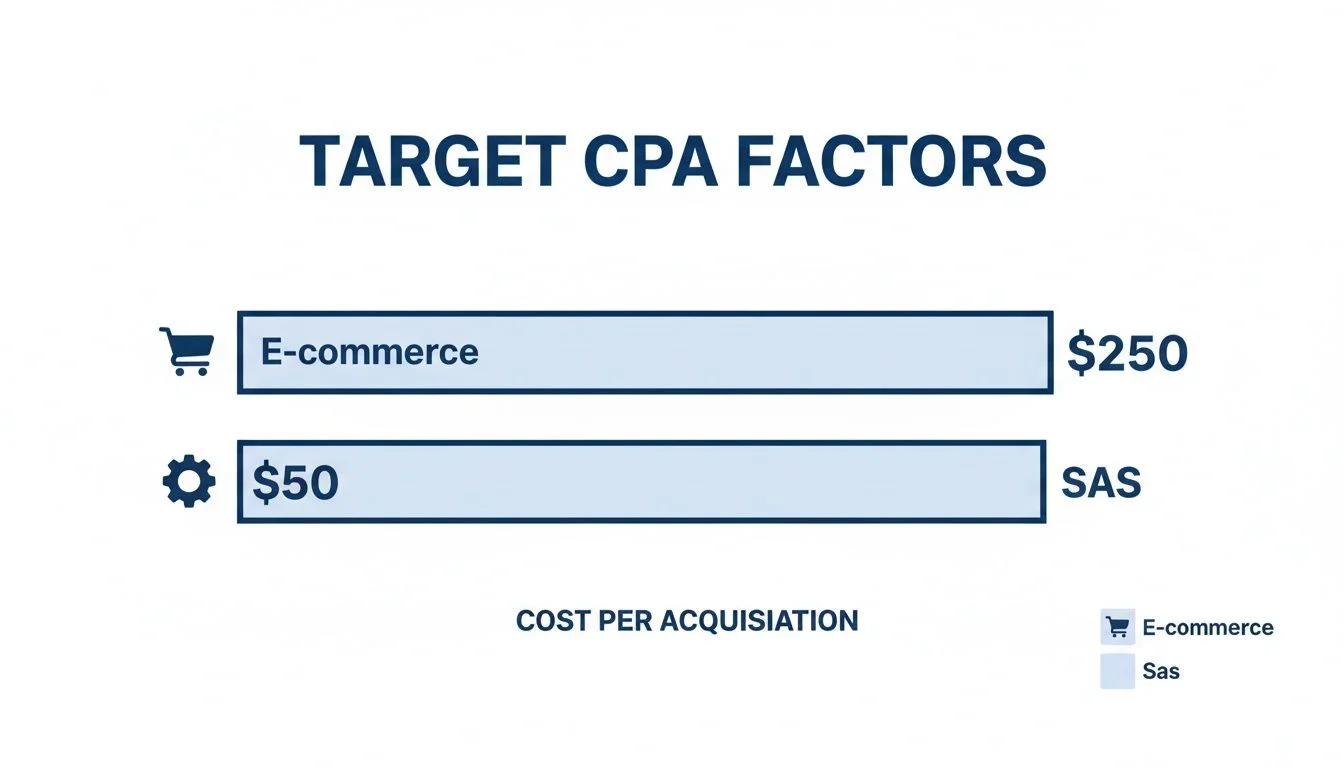
As you can see, SaaS companies can often justify spending a lot more to land a single customer. That's because the long-term, recurring revenue from a subscriber is usually much higher than from a one-time e-commerce purchase.
Industry Averages as a Starting Point
Every industry plays by its own set of rules, and that directly impacts how much it costs to win a new customer. It’s simple economics. A business selling $20 t-shirts just can't afford to spend as much on ads as a company selling $20,000 enterprise software licenses. So, the first step is to get a feel for your sector’s average CAC.
The numbers don't lie. In the hyper-competitive world of B2B SaaS, the average CAC recently hit $702 per customer. But it gets even more granular. Fintech SaaS companies going after small businesses are staring down an average CAC of $1,461, while their counterparts in eCommerce SaaS have a more manageable $299 average. You can see more SaaS benchmarks and breakdowns to get a feel for your specific niche.
Remember, these aren't hard-and-fast rules. They're guideposts. If your target cost per acquisition is way below your industry’s average, you might not have enough firepower to compete for ad space. But if your target is much higher, it could be a red flag that your business model has some leaks or your profit margin estimates are too optimistic.
The Golden LTV to CAC Ratio
Beyond just looking at averages, the most crucial benchmark for a healthy business is the ratio of Lifetime Value (LTV) to Customer Acquisition Cost (CAC). This isn't just another metric; it’s the ultimate test of whether your business can actually last.
As a rule of thumb, a healthy, sustainable business should aim for an LTV to CAC ratio of at least 3:1. For every dollar you spend to get a customer, you should make at least three dollars back over their lifetime.
Let's unpack what the different ratios are really telling you:
- 1:1 Ratio: This is a danger zone. You’re essentially losing money on every new customer because you’re spending just as much to acquire them as you'll ever get back. And that’s before you even pay for your products or your team. This model is a sinking ship.
- Below 3:1 Ratio: You might be breaking even or turning a tiny profit, but you have no room for error. Your marketing isn’t a growth engine yet, and trying to scale could easily become unprofitable.
- 3:1 Ratio: This is the sweet spot. You're acquiring customers profitably and have a healthy margin to reinvest in growth, cover all your costs, and actually make money.
- 4:1+ Ratio: You have a fantastic acquisition machine! While that’s great news, a very high ratio could also suggest you're not investing aggressively enough in growth. You might be leaving money on the table by not scaling faster.
Getting a handle on this ratio is absolutely critical. It forces you to look beyond just hitting a specific target cost per acquisition and instead focus on building a genuinely viable business. If your current ratio isn't close to that 3:1 benchmark, it's a clear signal to either find ways to increase your LTV or get serious about optimizing your campaigns to bring that acquisition cost down.
Actionable Strategies to Lower Your Cost Per Acquisition
Alright, you've done the math and set your target CPA. That’s your north star. Now comes the real work: getting your actual CPA down to meet, or even beat. That number. This isn’t about guesswork; it's about making specific, tactical moves that make every ad dollar pull its weight.
The good news is you have more control than you might think. By focusing your efforts on a few key areas, you can systematically drive down acquisition costs. Let's dig into the strategies that will actually move the needle.
Optimize Your Conversion Rate
If you do only one thing, make it this. Improving your website's conversion rate is the single most powerful way to lower your CPA. Just think it through: if you can get more of your existing visitors to convert, your CPA automatically drops without you spending a penny more on ads.
Double your conversion rate, and you’ve just cut your CPA in half.
Start by walking through the entire customer journey, from the moment they click your ad to the final checkout. Every bit of friction is a leaky hole in your bucket.
- Simplify Your Forms: Is your signup form asking for a life story? Each extra field you require is another reason for someone to give up and leave.
- Sharpen Your Call-to-Action (CTA): Is it painfully obvious what you want people to do? Your main CTA button needs to be bold, compelling, and impossible to miss.
- Boost Your Page Speed: A slow landing page is a certified conversion killer. Even a one-second delay can send your conversion rates plummeting. Use free tools to test your speed and fix what’s slowing you down.
Sharpen Your Ad Targeting
Casting a wide, unfocused net with your ads is the fastest way to burn your budget and end up with a sky-high CPA. You’re essentially paying to bother people who have zero interest in what you're selling. The secret is to zero in on high-intent audiences who are already looking for a solution like yours.
This means getting way more specific than basic demographics. Use retargeting campaigns to bring back people who browsed your site but didn't buy. Create lookalike audiences from your best customers to find more people just like them.
For instance, instead of targeting "small business owners," you could get granular and target "owners of e-commerce stores with 10-50 employees who have visited your pricing page in the last 30 days." That level of precision focuses your spending on your absolute best prospects.
When your ads reach a more relevant audience, they're far more likely to click and convert. That's a direct path to a lower CPA.
Enhance the Landing Page Experience
Your ad makes a promise, and your landing page is where you deliver on it. This is the critical moment where the conversion happens, or doesn't. A weak landing page will kill your momentum and send your CPA through the roof.
A truly effective landing page nails these three things:
- Message Match: The headline on your landing page must echo the message in your ad. If your ad promises "50% off running shoes," that offer better be the first thing people see on the page. Any disconnect creates instant confusion.
- Clear Value Proposition: Someone should land on your page and know what you offer and why it matters within five seconds. A strong headline, a quick summary, and a few benefit-oriented bullet points are all you need.
- Social Proof: Nothing builds trust faster than seeing that other people have already bought in. Testimonials, customer reviews, and case studies are pure gold here because they dissolve doubt.
This is where a tool like FOMOchat can make a huge impact. It creates trust by showing website visitors that other real people are asking questions and engaging with your brand right now. By embedding this kind of live, interactive experience, you aren't just telling visitors your product is valuable. You're showing them, which helps reduce hesitation and lower your target cost per acquisition.
You can learn more about how FOMOchat helps with generating conversations that build this crucial trust.
Implement Smarter Bidding Strategies
Today's ad platforms are incredibly smart. Using their automated bidding strategies can be a trust signals for hitting your CPA goals. Instead of manually tweaking bids, you can simply tell the platform your target cost per acquisition, and its algorithm will get to work finding you conversions at or below that price.
For example, platforms like Snapchat have poured resources into this. Recent updates to their Target Cost bidding strategy led to a 21% decrease in cost-per-purchase for advertisers using it. You're effectively outsourcing the complex job of bid management to a machine that can analyze thousands of signals in real time. It's a fantastic way to scale your campaigns without letting costs get out of control.
Common CPA Mistakes and How to Avoid Them
Even with a perfectly calculated target CPA, it’s easy to fall into a few common traps that send costs spiraling. Nailing your number is just the starting point; skillfully sidestepping these costly mistakes is what separates a successful campaign from a failed one.
Let’s get real about the most frequent blunders I see and, more importantly, how you can steer clear of them.
Setting Targets Based on Guesswork
One of the quickest ways to burn through your budget is to set a target CPA without solid data. A target based on a hunch is just a random number, and one based on a shaky Customer Lifetime Value (LTV) calculation is even worse. If you overestimate what a customer is actually worth, you'll set your CPA way too high and acquire new customers at a loss. All while thinking you're hitting your goals.
This isn't a small problem. With SaaS customer acquisition costs already jumping 60% in the last five years, there’s no room for error. Some reports even show brands are losing an average of $29 for every new customer they bring in through sloppy, inefficient strategies.
The One-Size-Fits-All CPA
Another classic mistake is applying one single target CPA across every single marketing activity you run. This completely ignores the reality that different channels, campaigns, and audiences all behave differently. A prospecting campaign targeting a brand-new, cold audience will naturally cost more per acquisition than a retargeting campaign aimed at people who are already familiar with your brand.
It helps to think about it in terms of the marketing funnel:
- Top of Funnel (Awareness): You're introducing yourself to new people. Expect a higher CPA here. It's the cost of entry.
- Middle of Funnel (Consideration): You’re warming up interested leads. The CPA should start to come down as engagement grows.
- Bottom of Funnel (Conversion): These folks are ready to buy. This is where your CPA should be the lowest.
By setting unique target CPAs for each stage and channel, like Google Search versus TikTok. You get a much smarter way to allocate your budget and see what's truly driving results. This granular view gives you a much clearer picture of what’s actually working.
Chasing a Low CPA at All Costs
This might sound strange, but obsessing over the lowest possible CPA can actually kill your growth. While you always want to be efficient, an overly strict and low target CPA can starve your campaigns of the volume they need to scale. You end up throttling your own reach, cutting yourself off from valuable new audiences that might cost a bit more to acquire but have a much higher lifetime value.
The goal isn't just to find the cheapest customers; it's to find the most profitable ones. Sometimes, paying a little more upfront for a high-LTV customer is the smartest investment you can make.
Instead of fixating on a number, focus on your LTV-to-CAC ratio. As long as you’re maintaining a healthy ratio (the ideal is often cited as 3:1), you have the green light to increase your target CPA to capture more of the market. This shifts your focus from pure cost-cutting to strategic, profitable growth. And remember, everything from your bidding to your ad creative impacts your costs. To really lower your CPA, you have to tackle issues like ad burnout. Getting good at crafting effective ad scripts to combat creative fatigue will help keep performance strong and your metrics in line.
Forgetting to Track What Happens After the Conversion
Your work isn't finished when someone clicks "submit." A huge and costly mistake is optimizing for that first action, like a free trial signup, without ever tracking what happens next. Do those free trials actually convert to paid plans? Do they stick around, or do they churn after 30 days?
A campaign that brings in cheap leads is worthless if none of them ever generate revenue. You might have one campaign with a dirt-cheap CPA that produces leads who never upgrade, and another with a higher CPA that consistently delivers high-value customers. You can learn a lot about user intent by simply viewing visitor conversations and seeing what real people are asking about.
To avoid this pitfall, you have to track the entire funnel. Connect your ad platforms to your CRM so you can see which campaigns and ads are driving not just signups, but actual paying customers with a high LTV. That deeper insight lets you optimize for what really matters: profitable, long-term growth.
Common Questions About Target CPA
Alright, you've got the basics down. But as you start putting target CPA into practice, a few common questions always pop up. Let's tackle them.
How Often Should I Mess With My Target CPA?
This is a classic balancing act. You don't want to change your target CPA every week. The ad platforms need time to gather data and learn. Constant adjustments will just send the algorithm into a tailspin.
On the other hand, you can't just "set it and forget it" for a year. A good rule of thumb is to review your target CPA every quarter. You should also revisit it anytime your business fundamentals shift, like if you change your pricing or see a big swing in your profit margins.
Should I Have More Than One Target CPA?
Yes, absolutely. In fact, you should. A one-size-fits-all target CPA is a recipe for wasted ad spend.
Think about it: a campaign aimed at acquiring high-value, enterprise-level customers can justify a much higher CPA than a campaign for a low-cost introductory offer. The same goes for prospecting versus retargeting. It's always going to cost more to win over a brand new customer than to bring back someone who already knows you.
Ready to lower your CPA by improving conversions? FOMOchat turns visitor curiosity into social proof, encouraging more signups and sales. Start converting more visitors today.