
You're watching session replays at midnight. A visitor lands on your pricing page, scrolls to the plans, opens chat, and types I Need Proof. You answer with a wall of five-star quotes. She leaves anyway. That moment is rarely a request for more praise. It's a risk check, and visitors believe evidence they can trace to a source, a date, and a person like them.
Match Each Proof Type to the Objection
A visitor on your pricing page types I Need Proof because a claim leaves a practical question unanswered: will this work for a company like mine, and what could go wrong after I buy? Match the evidence to that risk. A case study cannot answer every concern, and a stack of unrelated testimonials can make the page harder to assess.
Online reviews deserve scrutiny as well as attention. The 2022 eye-tracking study in PMC found that consumers paid significantly more attention to negative comments than positive ones. A page showing only uniform praise may therefore leave visitors wondering what the evidence leaves out.
Rank by independence first
Start with evidence visitors can check outside your own site, then assess its specificity, recency, and applicability. The Omniscient x Wynter 2025 research reports that 85% of B2B buyers trusted peer recommendations and 78% trusted third-party reviews. Those figures make independent sources useful to consider, but they do not make every review relevant to every buyer. A recent, named result from a similar company may address a concern better than a vague endorsement from a recognizable brand. For the psychology behind why that specificity lands, see social proof psychology and what social proof means in marketing.
| Proof type | Objection it answers | Strength | Where to show it | Watch-out |
|---|---|---|---|---|
| Named case study with metrics | Does this work for a company like mine? | High when client-approved | Case study page, sales call | Needs written permission and a date |
| Third-party review (G2, Capterra, Trustpilot) | Are these results real? | High when linked and recent | Pricing and signup pages | Check review count and recency |
| Live customer Q&A (real questions) | What happens after I buy? | Medium-high | Product page, webinar replay | Remove personal details; do not reword answers |
| Anonymous testimonial with role and company | Is this a real person? | Medium | Landing page | Cannot be verified without a link |
| Illustrative AI dialogue | How might this look for me? | Low as evidence | Explainer sections | Must be labeled as illustrative |
| Live usage count (signups, enrollments) | Is anyone else doing this? | Medium | Launch banner | State the source and date of the count |
Treat illustrative AI dialogue as an explanation, not proof of customer experience. Likewise, a live usage count only helps when its source and date are visible. For third-party endorsements, where they fit depends on the objection and the page context. To build confidence beyond a single claim, prove credibility through consistent shipping.
Put the most independent, applicable evidence near the decision point, then support it with one specific example. Count less. Check who stands behind each claim, how concrete it is, how recent it is, and whether it fits the visitor's situation.
Practical rule: If a visitor can't tell who said it, when, and where to check it, don't call it proof.
How to Collect Proof Visitors Can Check
A testimonial can sound convincing and still be impossible to verify. Start by auditing the claims already on your pages, then gather evidence a visitor can inspect. In 2025, 66% of European consumers reported encountering fake reviews as an unfair online commercial practice, according to the European Commission's key consumer data. That context makes traceability more useful than just adding more praise.
Use the three-stage process below to turn scattered claims into evidence you can defend.
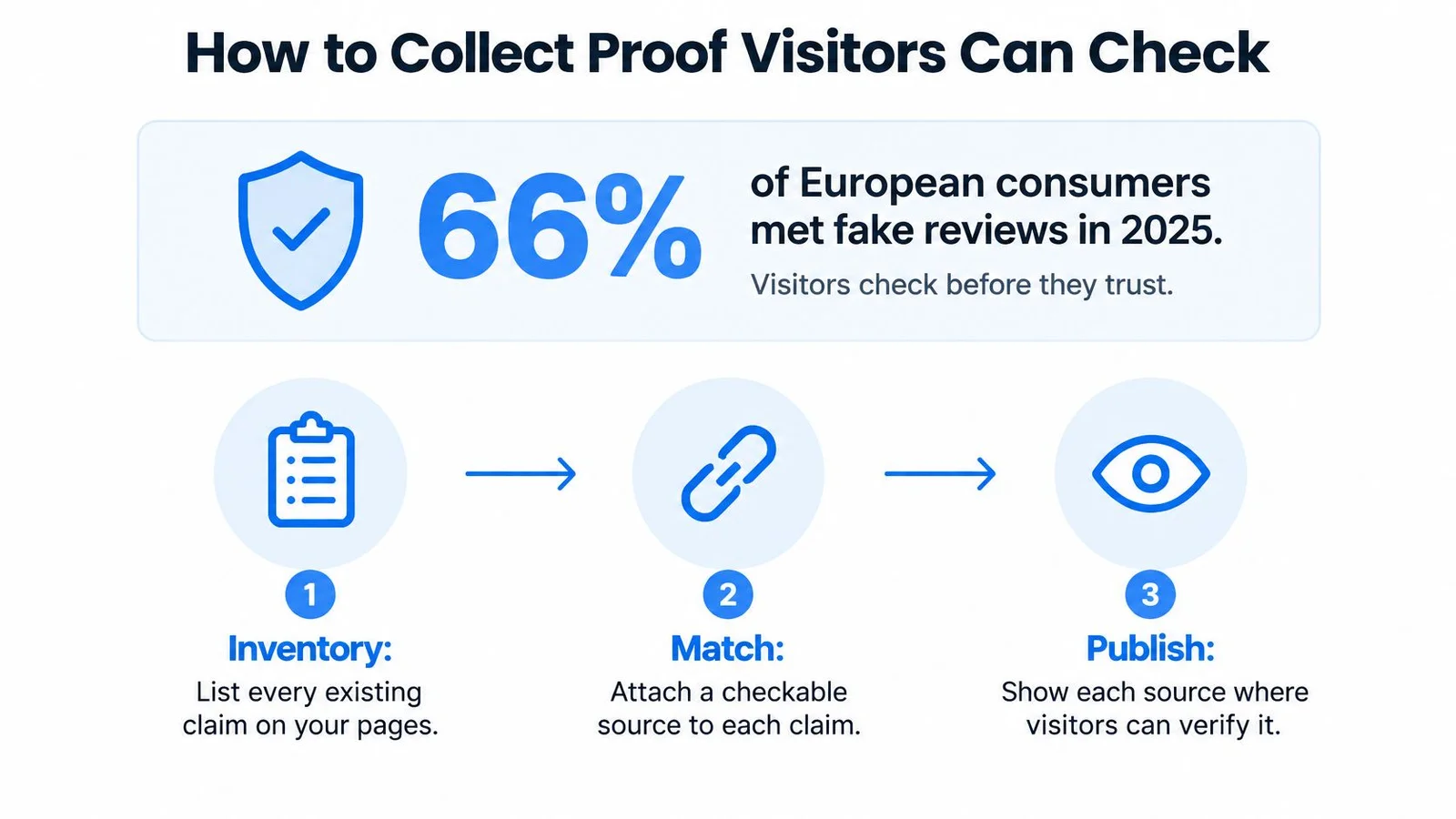
Seven steps from claim to checkable source
- List every claim. Inventory conversion lifts, time saved, and prices across your pages, and record each claim's source. An incomplete inventory leaves claims you cannot check.
- Get written permission. Ask to publish the exact wording with the person's name, role, company, and date. That gives the customer and your team a chance to review the attribution.
- Capture third-party reviews properly. Keep the live link and a screenshot showing the date. A cropped quote without a source is difficult to verify.
- Collect real questions. Pull wording from sales emails, support chats, and webinar Q&A. Remove personal details, but retain the original phrasing so the questions remain credible.
- Tag each item. Record source type, date, and sample size in a simple sheet. These details help you judge whether a claim still applies and when it should be retired.
- Score from 1 to 3. Rate independence, specificity, recency, and applicability separately. A high total with any single score of 1 still fails, because a weak dimension can make evidence hard to trust or irrelevant to the visitor.
- Delete or downgrade untraceable items. If no one can find the origin, remove the claim or label it clearly as an example.
The process takes more care than collecting logos, but it gives sales teams material they can reuse in conversations and in customer success stories that hold up to scrutiny. Keep the source, wording, and context together so the proof remains checkable wherever it appears.
Compare these claims: “Customers love it” has no source, number, or date, so a visitor cannot assess it. “14 of 40 trial users upgraded within 30 days, survey closed March 2026” gives the sample, time window, and result. A reader can judge whether those details apply to their decision.
How to Set Up Live Conversations Without Faking Them
A visitor opens a pricing page and asks whether the advertised price includes everything. A useful conversation gives a direct answer and shows that other visitors raise similar questions. If either the answer or the apparent activity is invented and presented as real, the conversation stops being proof.
The landing page below shows an AI representative alongside a group conversation. The distinction between generated dialogue and live activity should remain clear to visitors.
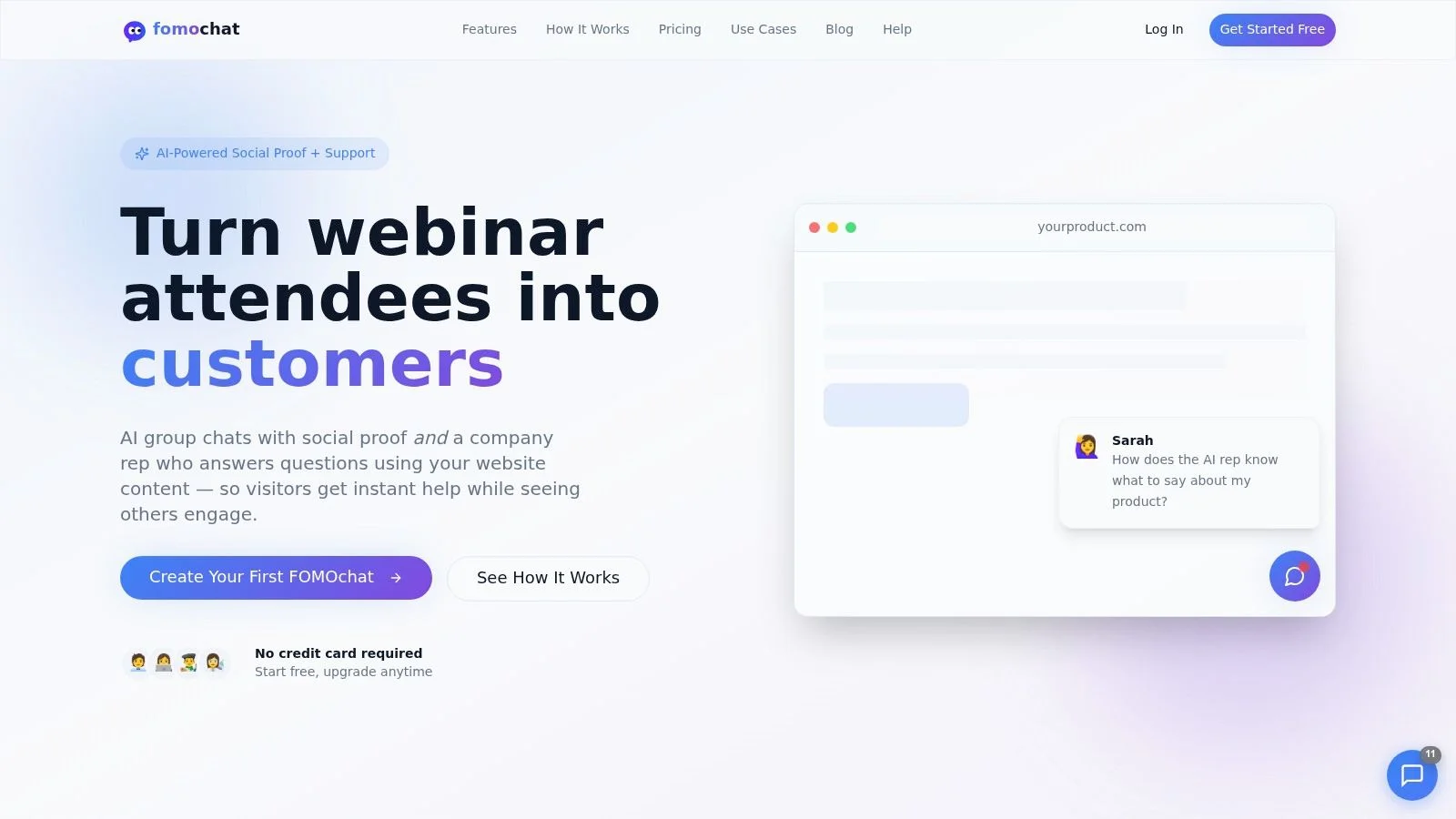
Build it in seven steps
- Load approved sources only. Use current pricing, refund policies, product documentation, and FAQs. An old blog post can give the representative an outdated price.
- Lock the facts. Keep price, trial length, and cancellation terms exact. A warmer paraphrase must not make the terms sound more generous.
- Set guardrails and handoffs. Route billing, legal, and security questions to a person when the system cannot answer safely. Explain the handoff plainly.
- Require confidence qualifiers. If the source does not cover a question, the representative should say so rather than guess.
- Build personas from real roles. Use roles such as agency owner or course buyer. Do not invent named customers or fake headshots.
- Generate dialogue from collected questions. Label generated conversations as illustrative. Visitors should not mistake them for live events.
- Embed, preview on mobile, and audit. Check the first 20 answers against their sources before putting them in front of visitors.
FOMOchat combines an AI representative trained on website content with interactive group conversations. That pattern sits closer to group chat for websites than to popup toasts — the same reason many teams pick conversations over ProveSource-style notifications when the product needs real explanation. Teams can set facts, guardrails, and confidence qualifiers, then embed the widget with a small snippet. The conversations can support objections, but generated examples should not be presented as independent, current visitor activity. A visitor can verify a dated customer comment or a linked policy; a simulated exchange cannot offer the same evidence.
Disclosure is part of making the interaction checkable. The Ipsos AI Monitor 2025 reports that 79% of adults across 30 countries agree that companies using AI should disclose that use. Label the representative “AI-assisted answers,” state what it cannot verify, and keep a visible route to a person. The label sets expectations; the underlying source and any human handoff determine whether an answer holds up.
Where Proof Works on Pages and Webinars
Take the webinar price reveal. The presenter names the fee, and doubt spikes in that exact second. If a synced conversation surfaces a real question about refunds at that timestamp, with an answer tied to the same claim, it lands. The same testimonial pasted in the footer an hour earlier does nothing. For tooling that keeps Q&A next to the pitch timeline, see webinar engagement tools.
Proof belongs where the doubt appears, not on every page. The image below captures that pricing moment, where cost, features, and risk collide.

| Placement | Objection at that point | Proof to show | Timing or trigger |
|---|---|---|---|
| Pricing page | Is there a refund or cancellation catch? | Refund policy plus a dated customer Q&A | Visible when visitor scrolls to plan details |
| Signup or trial page | How long does setup take? | Setup-time figures from real customers | Shown after first form field |
| Feature page | Does it connect to my tools? | Integration questions from real users | Triggered on integration section |
| Course sales page | Will I finish and see results? | Completion rate and time to first result | Shown near enrollment button |
| Webinar pitch | Is this worth the price? | Live reactions on the same claim | Synced to the presenter's price reveal |
| Webinar replay | What did attendees actually ask? | Replay Q&A with timestamps | Shown when the video reaches each claim |
| Launch page | Are early buyers real? | Dated count and early-buyer questions | Shown in the first 10 seconds |
Repeating one testimonial sitewide teaches visitors to ignore it. I would limit each page to one proof item per objection, with a dated source, and test placement before adding volume. For methodical ways to spot friction at these moments, see the conversion-focused usability insights from Uxia. Our guide to social proof widgets and placement options compares formats for each page type.
Measuring Whether Proof Changes Conversions
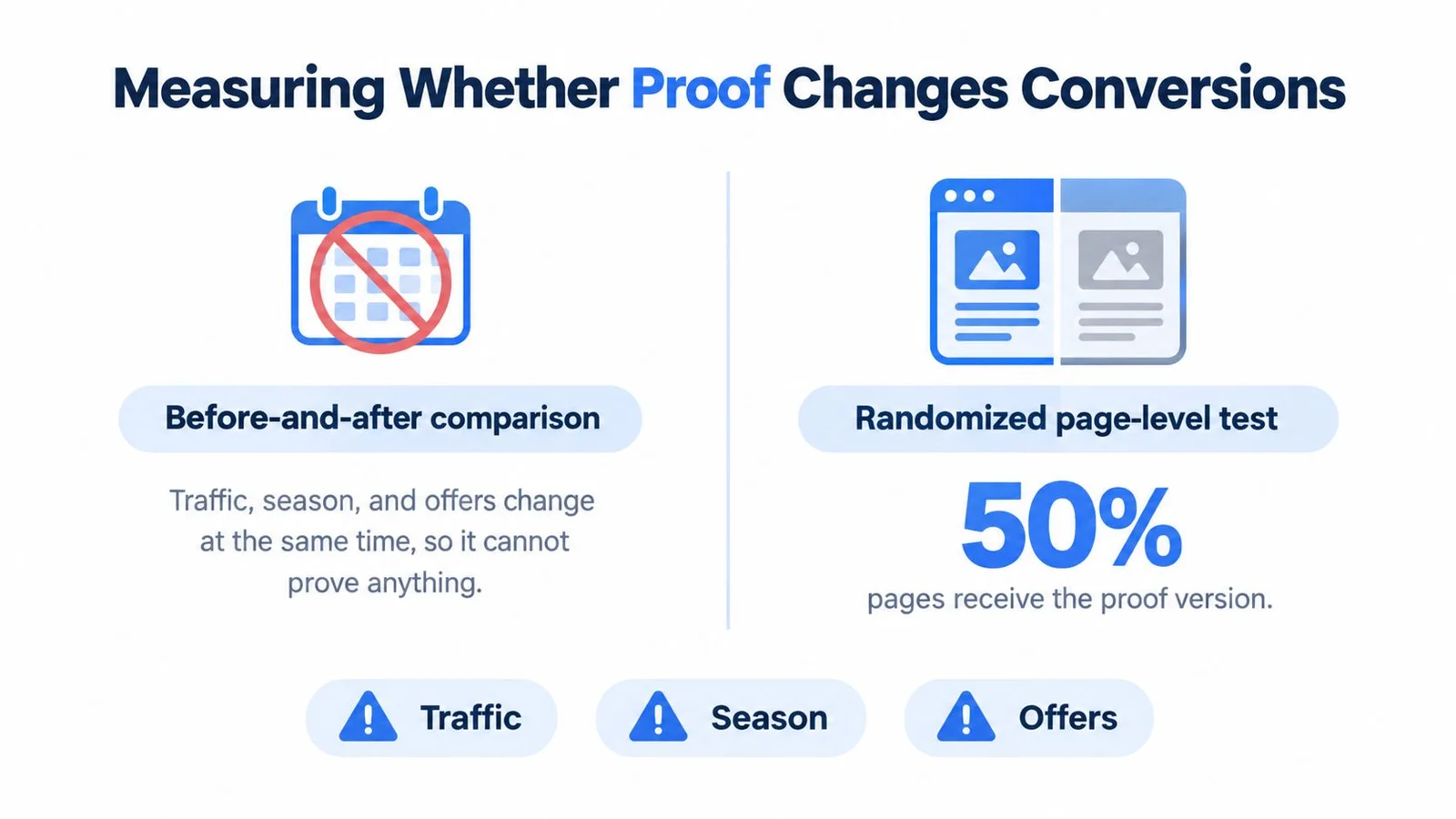
A before-and-after comparison cannot isolate proof's effect. Traffic mix, season, ad spend, and the offer may change at the same time, so a lift could come from warmer visitors rather than the proof itself.
Randomly assign eligible visitors to a control page or a version with proof. Keep targeting and checkout consistent, and choose the metrics before launch. Size the test using your own baseline conversion rate and the smallest lift that would change a decision. Run a standard power calculation before launch, so the test is large enough to detect that lift.
The diagram contrasts a before-and-after comparison with randomized page-level testing.
| Metric | What it reveals | How to read it |
|---|---|---|
| Conversion rate per visitor | Whether proof lifts signups or enrollments | Compare treatment and control with a 95% confidence interval |
| Revenue per visitor | Whether extra conversions are high value | Read alongside conversion rate, not alone |
| Qualified-lead rate | Whether sales-ready leads increase | Count leads that reach your CRM's qualified stage |
| Refund or cancellation rate | Whether proof sets wrong expectations | Compare rates over the same post-purchase period |
| Support escalations | Whether chat answers reduce or add tickets | Count tickets that mention the same topics |
| Misinformation incidents | Whether AI answers conflict with approved facts | Log and review each incident regularly |
Report the treatment effect with a 95% confidence interval, plus visitor and conversion counts for each arm. Don't stop early because early results look good, and avoid counting repeat visitors in both arms. A conversion lift is not a win if refunds or support escalations rise. Proof should also be judged by whether visitors can verify it: a specific, recent item from an independent source may matter more than adding more testimonials.
This short video explains how to read test results without mistaking noise for a useful result.
For a practical framework for smaller teams, read ELECTE's guida alla CRO per PMI alongside these A/B and multivariate testing basics.
Fix Weak Proof and Decide What Stays Live
When visitors ask the same question again and again, your chat isn't broken. Your source material is missing the answer, and the conversation keeps improvising around the gap. Treat repeated questions as a content bug report, not an engagement win.
| Symptom | Likely cause | Fix |
|---|---|---|
| Same question asked again and again | Answer missing from source material | Add the answer to approved facts and retest |
| Conversion flat after two weeks | Proof shown where no doubt exists | Move proof to the objection's placement |
| Refund requests rising | Dialogue overpromises results | Rewrite persona answers and add confidence qualifiers |
| Chat answer contradicts pricing page | Source not updated | Update the fact, then retest the affected answers |
| Visitors leave when chat opens | Chat blocks content or looks staged | Reduce messages, show the label, check mobile layout |
| Every review is five stars | Cherry-picked proof | Add a dated critical review with a public reply |
Balanced proof converts better because visitors inspect negative signals deliberately. One dated critical review with a calm, public reply often does more work than ten perfect scores. It shows the review set wasn't filtered. Pair that with concrete 5-star review examples that still name who, when, and where to check — and remember why social proof notifications don't work for complex products when a floating toast can't carry the evidence a buyer needs.
Test discipline decides what stays
Don't assert accuracy, demonstrate it. Proof for an AI widget should come through a documented test, evaluation, validation, and verification process, reporting correct answers, unsupported claims, and appropriate escalations as separate rates rather than one blended score, per the NIST AI Risk Management Framework playbook on measurement. Build a held-out set with normal, ambiguous, and adversarial questions. Retest after every website or prompt change, because a pricing edit can invalidate yesterday's passing answers without any warning.
A fluent answer isn't evidence. A fluent answer traced to an approved source, retested after the last change, is.
Close with a hard gate. Keep proof items scoring 2 or higher on independence, specificity, recency, and applicability. Retire the rest, no matter how good the quote sounds. Then retest the live chat after each change, since removing weak proof alters which questions visitors ask next.
When a visitor types I Need Proof, you need checkable evidence in the conversation, not another testimonial carousel. FOMOchat lets you load approved facts, set guardrails and confidence qualifiers, label illustrative dialogue, and surface real questions synced to your pages and webinar timelines. Visit the site to configure a free preview, audit the first answers against your sources, and test it against a clean control before you roll it out.