
You're three tabs deep into a pricing comparison, and both tools cost about the same. You scroll to the testimonials looking for a reason to pick one, and find five quotes in a row that say "Great product, highly recommend!" in slightly different fonts. None of them mention your team size, your stack, or the thing you're worried about.
So you scroll past. Almost everyone does.
The loss is bigger than it looks. In 2024, 98% of online shoppers across 24 countries said customer reviews influenced them, according to DHL's 2024 Online Shopper Trends report. Testimonials aren't the problem. The way they're written is.
What follows are eight client testimonials examples, and each one is judged on a single question. What specific detail makes this believable? A named role. A verifiable number. A timestamp, a screenshot, a baseline. Formats are cheap to copy. The details are the work.
You'll also see where each format fails, because a polished video that says nothing converts worse than three plain sentences with a number. If a competitor is burying you with a wall of positive quotes, the fix isn't more quotes. It's cleaning up what's already out there, including removing unfair reviews responsibly, then replacing volume with evidence.
Pick the format that matches where your buyer hesitates.
1. Short Text Quote Testimonials
The short quote is the workhorse. One to three sentences from a real customer, set beside a headshot, a full name, a job title, and a company. It fits next to a pricing table, under a sign-up form, or inside a checkout flow, and it costs the customer about ninety seconds to give you.
It's also the format buyers read in bulk. BrightLocal's 2019 Local Consumer Review Survey, based on 1,005 U.S. consumers, found that 82% read online reviews for local businesses, that the average consumer read 10 reviews before feeling able to trust a business, and that 91% said positive reviews made them more likely to use a business. One glowing sentence doesn't clear that bar. A set of specific ones does.
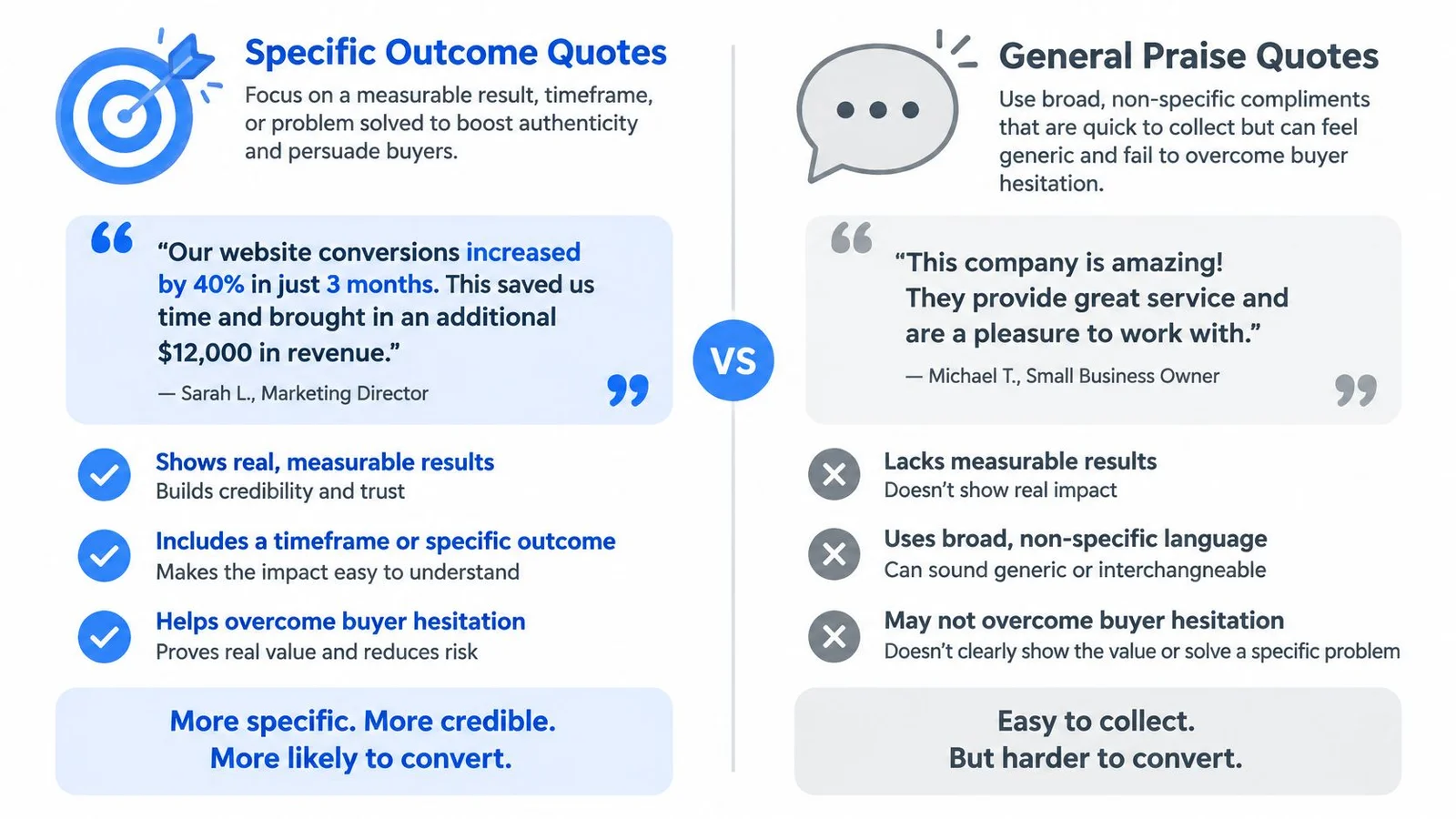
The difference between a quote that works and one that gets skimmed is almost always a single fact:
What Makes a Short Quote Believable
- Lead with an outcome, not an adjective. "Cut onboarding from three weeks to four days" is a claim. "Saved us so much time" is filler.
- Name the role and the context. "Head of Growth, 12-person SaaS" tells a reader whether the result could happen to them.
- Place it at the objection. The quote about setup friction belongs next to the setup section, not in a carousel near the footer.
- Retire stale quotes. Praise for a feature you killed last year tells careful buyers nobody maintains the page.
Quantity only helps when each quote does a different job. A reported WikiJob landing-page test found that adding three brief customer quotes lifted conversions by 34%, though the published summary gave no sample size, so treat it as directional rather than a number you can promise your boss. The CRO case study collection has the full write-up.
The reason a few plain sentences move people that much is mostly psychological. Our breakdown of social proof psychology explains the wiring.
Practical rule: If a quote could be pasted onto a competitor's site without anyone noticing, it isn't evidence yet.
Say a SaaS page puts "we were live in a single day" from a named ops manager directly under the free-trial button. That's one sentence doing the job of a whole feature page.
2. Video Testimonials
A clip of 30 seconds to three minutes, filmed with the customer speaking to camera, carries something text can't. It holds the pause before someone admits the first month was hard, and the shift in their voice when they reach the result. For launches, webinars, and course sales, where the buyer is deciding whether to trust a person as much as a product, that matters more than production value.
The evidence supports testing it, with an honest caveat. In a MarketingExperiments registration-path test for a consumer credit-counseling service, a page using a video testimonial converted 34.96% against 11.62% for the control, a 201% relative increase, as reported in the MarketingExperiments testimonial study. The researchers note the variation was a radical redesign, so the format can't take full credit. Run it as a real split test on your traffic before you rebuild a page around it.
What separates a clip that converts from one that feels like a commercial is usually the first ten seconds.

Production Rules That Keep It Real
- Send prompts a week ahead. Ask for the problem before the purchase, the result after it, and one thing that annoyed them.
- Fix audio first. A phone in a quiet room beats a lavalier next to a fan.
- Cut two lengths. Thirty seconds for paid social, 90 seconds for the landing page.
- Caption it and set a poster frame. Most viewers start muted, and a black first frame kills play rate.
A graduate recording on a laptop in her kitchen, saying she finished the program in eleven weeks while working full time, beats a studio shoot with a scripted voiceover. Buyers can hear rehearsal, and rehearsal reads as advertising.
3. Long-Form Case Study Testimonials
A buyer comparing two similar options needs evidence they can apply to their own situation. A long-form case study runs roughly 500 to 1,500 words and traces the customer's starting problem, constraints, solution, and results. Include a verifiable number and the timeframe it covers.
Put case studies on pricing or comparison pages, where buyers are weighing options. A clear process helps keep the story focused; this guide to creating a case study covers structure and interview questions.
Structure It From the Objection Backwards
- Start with the customer's problem in their own words. Use two sentences, then move into the solution.
- Show the result early. Put the approved metric and its timeframe in the first paragraph.
- Make the outcome relatable. Name the role and constraints, such as a small marketing team without engineering support.
- Get metric approval early, since legal review often delays publication.
A strong case study links the customer's starting point to the intervention and measurable change. For example, DTC subscription growth through creators shows that arc. Apply the same structure whether the product is software, a course, or coffee.
Long-form stories take more time to read than short quotes. Use them to answer detailed buying questions, and pair them with a concise testimonial for visitors who need the takeaway quickly. Want to see the arc done well? Our roundup of customer success stories has plenty to borrow from.
4. Star Ratings and Third-Party Review Platform Testimonials
Before a buyer shortlists anything, they check a platform you don't control. G2, Capterra, Trustpilot, and app marketplaces carry aggregated scores and review counts, and they carry more weight than anything on your own domain because a third party hosts them.
Buyers don't check once. BrightLocal's 2024 Local Consumer Review Survey, conducted among 1,141 U.S. consumers, found that 75% always or regularly read online reviews and 77% used at least two review platforms when researching a business. Two platforms means your G2 score gets checked against your Trustpilot page and whatever a search result throws up.
There's a price premium attached to that scrutiny. A 2024 Customer Alliance survey of 750 consumers in Germany, Austria, Switzerland, France, and Italy found that 46% would pay more for a local-business service with positive online reviews (Customer Alliance). The same instinct applies to a 4.7-star B2B profile. It buys you room on price.
Make the Score Earn Its Space
- Show the count, not just the stars. A 4.8 from 11 reviews reads weaker than a 4.5 from 400.
- Answer the negative ones in public. A calm, specific reply does more for trust than the score itself. These negative review examples show what a calm reply looks like.
- Pair the widget with a sentence. A star row with no context is decoration. Add the one-line quote that explains it.
- Follow each platform's solicitation rules. Some ban incentives outright, and getting flagged costs you the profile.
If Google is where your buyers look, this guide to getting more reviews on Google covers request timing and the follow-up sequence that produces them. Once the good ones roll in, here's how to respond to positive reviews so each thread keeps working for you.
5. Social Media and User-Generated Content Testimonials
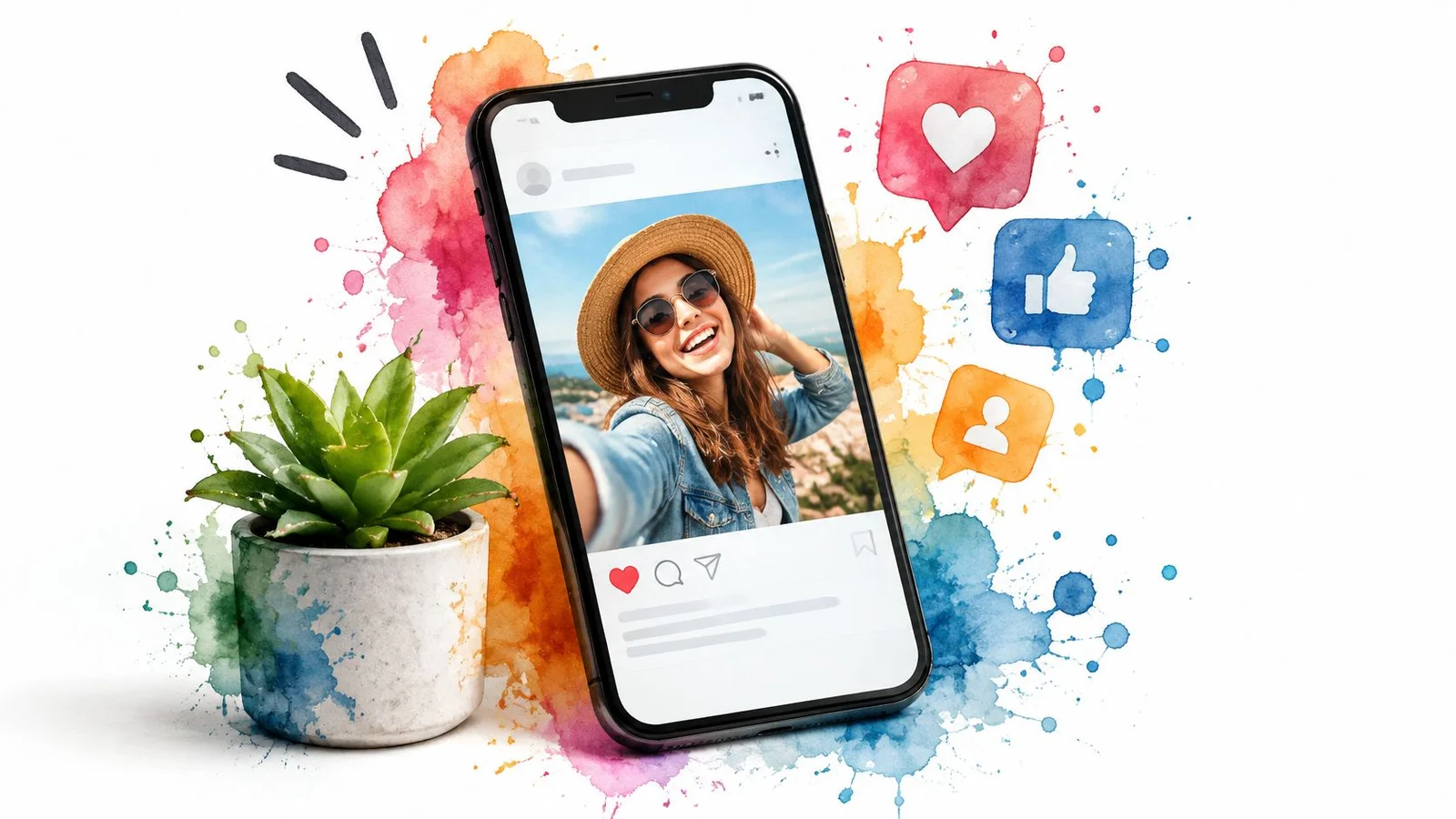
The best proof on your site may already exist in someone else's feed, written without your input. A LinkedIn post about finishing your certification, an Instagram story about a launch that worked, a TikTok about a feature nobody else talks about. Reposted with permission, that content reads as less scripted than anything your marketing team writes.
Peer voices carry unusual weight. Reputation.com's 2024 survey of 2,000 consumers found that 54% of U.S. consumers trusted online reviews more than friends and family, company claims, influencers, or media reviews. A customer's own caption sits closer to that category than a quote you designed.
Turn a Post Into Evidence
- Ask in writing and keep the reply. Screenshot the permission, not just the post.
- Credit the handle and the platform. Attribution is the credibility.
- Leave the chrome in the screenshot. The like count, the date, the platform interface. Cropping it out makes the post look fabricated.
- Don't rewrite the caption. If you edit it, it stops being user-generated content.
A course creator who reposts a student's LinkedIn post about passing a certification, screenshot intact, gives prospects something a testimonial page can't. It shows the student chose to say it publicly.
That public quality cuts both ways. Replies can turn hostile, edits erase context, and a deleted post leaves a dead screenshot on your site that nobody notices for a year. Check the archive quarterly, and read this guide to creator audience authenticity before you lean on a creator's post as proof.
6. Audio Testimonials
Audio is a format teams often skip, and it's the cheapest way to add a human voice to a page. A voice-only clip of 45 to 90 seconds, published as an embedded player with a transcript, takes a customer ten minutes to record on a phone. No lighting, no framing, no editor.
The trade-off is real. Nobody can skim a voice clip, and a visitor browsing on mute in an open-plan office gets nothing without the transcript. That's why audio works best where people already expect to listen: a welcome email, an onboarding sequence, a post-purchase thank-you, or a webinar follow-up the recipient opted into.
Record It Without a Studio
- Ask for a phone, not a microphone. A quiet room and a phone headset beat a cheap USB mic next to a laptop fan.
- Give one prompt and one outcome. "What changed in the first month?" produces a cleaner clip than "tell us about your experience."
- Cap it at 90 seconds. Anything longer belongs in a podcast interview.
- Publish the transcript. It serves accessibility, search indexing, and anyone reading with the sound off.
A voice clip lands in a follow-up email because nobody expects to hear a customer in their inbox, and surprise buys you thirty seconds of attention.
Say a webinar host sends the replay with a 40-second clip of an attendee describing the one tactic she used the next morning. That's more persuasive than a written recap, and it costs the host a single request.
Replays can go a step further. With FOMOchat webinar chat on a replay page, later viewers see the questions earlier attendees asked, which is basically a testimonial that talks back.
7. Results-Driven Metric Testimonials
A number turns a compliment into a claim someone can check. That's the appeal, and it's also the risk. A metric with no baseline, no timeframe, and no method invites the reader to assume it's decoration.
Skepticism is already high. A 2025 consumer survey found that 66% of respondents had encountered fake reviews, according to BEUC's report on making online reviews more reliable. A precise-looking number attached to a vague process lands in that same bucket.

Verify Before You Publish
- Get the baseline, not just the result. "2.1% to 3.4%" is checkable. "Almost doubled" is not.
- Pin the measurement window. "Over eight weeks, measured in the customer's own analytics" closes the loop.
- Document who confirmed it. A name and a date in your internal file protects you if the numbers get questioned later.
- Add the qualifier. "Individual results vary" isn't legal boilerplate, it's what keeps a big claim honest.
- Show the method when the number is large. The bigger the lift, the more readers want to know how it was counted.
A growth team publishing a customer's signup conversion change from 2.1% to 3.4% over eight weeks, with the customer's own explanation of what changed and a link to what a good conversion rate looks like, gives a reader two things at once: proof, and a way to judge it.
Test stat callouts against plain quotes on the same page. Sometimes the sentence without the number wins, because the number itself starts to read like a sales claim.
8. Conversational and Objection-Handling Testimonials
Conversions are lost at a specific moment: the buyer forms a silent objection and gets no answer. Conversational testimonials exist for that moment. You present the question they're holding and answer it with a customer, in a Q&A block, a chat-style exchange, or a short dialogue.
This is the format we care about most at FOMOchat, because it can happen live. Instead of a social proof widget flashing "Sarah just signed up," visitors see real questions get real answers while they browse. Our take on why notification popups fall flat for complex products explains the difference. Short version: conversations persuade, tickers decorate.
The format has a legal edge the others don't. The U.S. Federal Trade Commission's rule banning fake reviews and testimonials took effect in October 2024, and the U.K. Digital Markets, Competition and Consumers Act banned fake reviews from April 2025. Buyers are already wary: 85% of surveyed U.S. consumers said online reviews are sometimes or often fake or fraudulent, according to Metricuno's review statistics compilation. If a dialogue looks like a real customer exchange and isn't one, label it.
Build the Block From Real Objections
- Mine the transcripts first. Sales calls, support tickets, and chat logs produce objections in the buyer's own words.
- Answer with a fact, then a customer. The fact carries the claim. The customer carries the reassurance.
- Label anything simulated. "Illustrative example based on customer feedback" is honest and costs you nothing.
- Date the block. Pricing, features, and policies change, and an outdated answer is worse than no answer.
A SaaS pricing page with a chat-style exchange about migrating from a legacy tool, ending in a named customer's timeline and the one thing that broke, converts because it answers the question the buyer was about to leave the page to research. The technique works beyond a static block, and these objection handling techniques cover how to sequence the answers so each one lands before the next doubt appears.
How the Eight Testimonial Formats Compare
Choose a format based on the proof a buyer needs and the effort required to produce it. A named customer and a specific result can make a short quote credible; a case study needs enough context for readers to judge whether the result applies to them.
| Item | Best For | Typical Length | Production Effort | Main Credibility Lever |
|---|---|---|---|---|
| Short Text Quote Testimonials | Quick reassurance near calls to action | 15–50 words | Low | Named customer with a specific outcome |
| Video Testimonials | High-trust, high-consideration purchases | 30 seconds–3 minutes | High | Customer's tone, expressions, and story |
| Long-Form Case Study Testimonials | Detailed evaluation and B2B sales | 800–2,000 words | High | Real-world context and measurable results |
| Star Ratings and Third-Party Review Platform Testimonials | Product comparisons and shortlist decisions | Rating and review count; no fixed length | Medium | Independent platform and aggregated reviews |
| Social Media and User-Generated Content Testimonials | Community proof and social reach | One post or short clip, roughly 15 seconds to 2 minutes | Low | Organic, public customer posts |
| Audio Testimonials | Audiences who prefer listening | 45–90 seconds | Low to medium | Customer's authentic voice and personality |
| Results-Driven Metric Testimonials | Conversion-focused marketing and ROI evaluation | Quote with a specific metric; no fixed length | Medium | Verified, contextualized numbers |
| Conversational and Objection-Handling Testimonials | Addressing buyer concerns near a decision | Question-and-answer or dialogue; no fixed length | Medium | Relevant answers grounded in real customer experience |
Turn These Examples Into Your Next Testimonial
Eight formats, one rule. Each of them gets stronger the moment it contains a detail a stranger could check: a named role, a dated screenshot, a baseline number, a platform review count. The format decides where the proof goes. The detail decides whether anyone believes it.
Match the format to the buying stage. A short quote under the trial button handles a first look. A star rating and a review count handle the shortlist moment, when the buyer opens a second tab to confirm you're real. A case study handles the final comparison against one named competitor. A conversational block handles the last ten seconds before someone abandons a checkout.
Then fix the ask. The mistake is sending a form with five fields. Ask one question by email, thirty days after the customer gets their first result, and ask for specifics.
The ask that works: "What was the problem before you bought, and what changed in the first 30 days?"
Two sentences from that reply give you a quote, a case study opening, and a prompt for a video. If the customer names a number, ask permission to publish it with the measurement window attached.
Placement matters more than polish. A quote three screens below the pricing table does nothing. The same quote beside the plan a buyer is considering, or under the form they're hesitating over, does the work you collected it for.
Measure it properly. Randomize traffic, keep the control page unchanged, and define the primary conversion as a completed registration or purchase, not a click. Segment by device, traffic source, and visitor intent, because a testimonial that lifts signups from organic search can do nothing for paid traffic that arrived expecting a demo.
Put a quarterly sweep on the calendar. Retire quotes about features you've changed, recheck numbers against the customer's current data, and remove any dialogue you can no longer source. Trust built with specifics fades when the specifics go out of date.
Start with one format this month, collect one verifiable outcome, and place it where your buyer hesitates. If you want to test objection-focused social proof without rebuilding a page, you can book a demo of FOMOchat to see how it works.
FOMOchat turns static testimonials into a live conversation: an AI rep trained on your website answers questions about pricing, setup, and results while visitors see other people asking the same things, so the proof arrives at the exact moment of hesitation. Preview Mode is free, includes 100 lifetime visitors on all features, and needs no credit card, which makes one product page an easy place to start. Visit FOMOchat to generate your first conversation and see how it performs against your current testimonial section.