
Nearly half of the pushback you will ever hear is a brush-off, not a debate about your product. A 2024 analysis of more than 300 million cold calls put dismissive objections at 49.5%. That single share should change how you write an objection handling script. The visitor who never books a call is the normal case, not a leftover. Your lines have to work on a page, in a chat, and on a live call, without a long speech.
I would build the replies for people who will not reveal a role, a budget, or a buying process, then reuse the same wording when someone does pick up. A script that only works if a rep can ask five questions will fail the majority of visits.
Three Objection Types Every Script Must Cover
That 49.5% is the surprise. Almost one in two objections is a low-commitment exit, not a reasoned no. The same cold-call analysis split the rest into situational objections at 42.6% and existing-solution objections at 7.9%. Brush-offs include "not interested," "call me later," and "send information." Situational lines cover price, budget, and lack of time. Existing-solution lines name an internal system, a competitor, or a current contract.
A hard sell after a brush-off loses the largest slice of the conversation. Two-fifths of objections are real constraints, and those need a value conversation. Only a small share needs competitor positioning. One generic rebuttal cannot cover all three. If you want the bigger picture first, start with what objection handling actually is, then come back for the wording.
| Objection type | Share of objections | Example wording | Script goal |
|---|---|---|---|
| Dismissive | 49.5% | Not interested; call me later; send information | Acknowledge without pressure, then offer one small next step |
| Situational | 42.6% | Too expensive; no budget; no time | Diagnose the constraint, then quantify value |
| Existing solution | 7.9% | We already use a system; we are under contract | Clarify the switch point and show differentiation |
Write in this order
Dismissive first. These lines show up most, and pressure makes them final. Acknowledge the brush-off and offer one small step, such as a one-page note or a later date.
Situational second. Price, budget, and time are business limits. Diagnose which limit it is before you talk value.
Existing solution last. A contract or a current tool is real, but it is the smallest group. Ask what would make a switch worth the hassle, then show one difference that matters to them.
Collect the exact phrases your own prospects use for each type. Those phrases become the trigger lines in the script. "Circle back next quarter" is not the same objection as "call me later," even if both sound polite. Stuck for raw material? Our list of real sales objection examples is a decent place to borrow phrasing from.
How to Structure a Reply Step by Step
Four moves beat a memorized comeback. Gong Labs' March 2018 analysis of 67,149 recorded sales demonstrations found that stronger sellers paused longer, asked a question, and kept the talk two-way. Average representatives answered with a monologue of about 21.45 seconds. Winning representatives spoke for about 57% of the conversation, against 62% in lost deals.
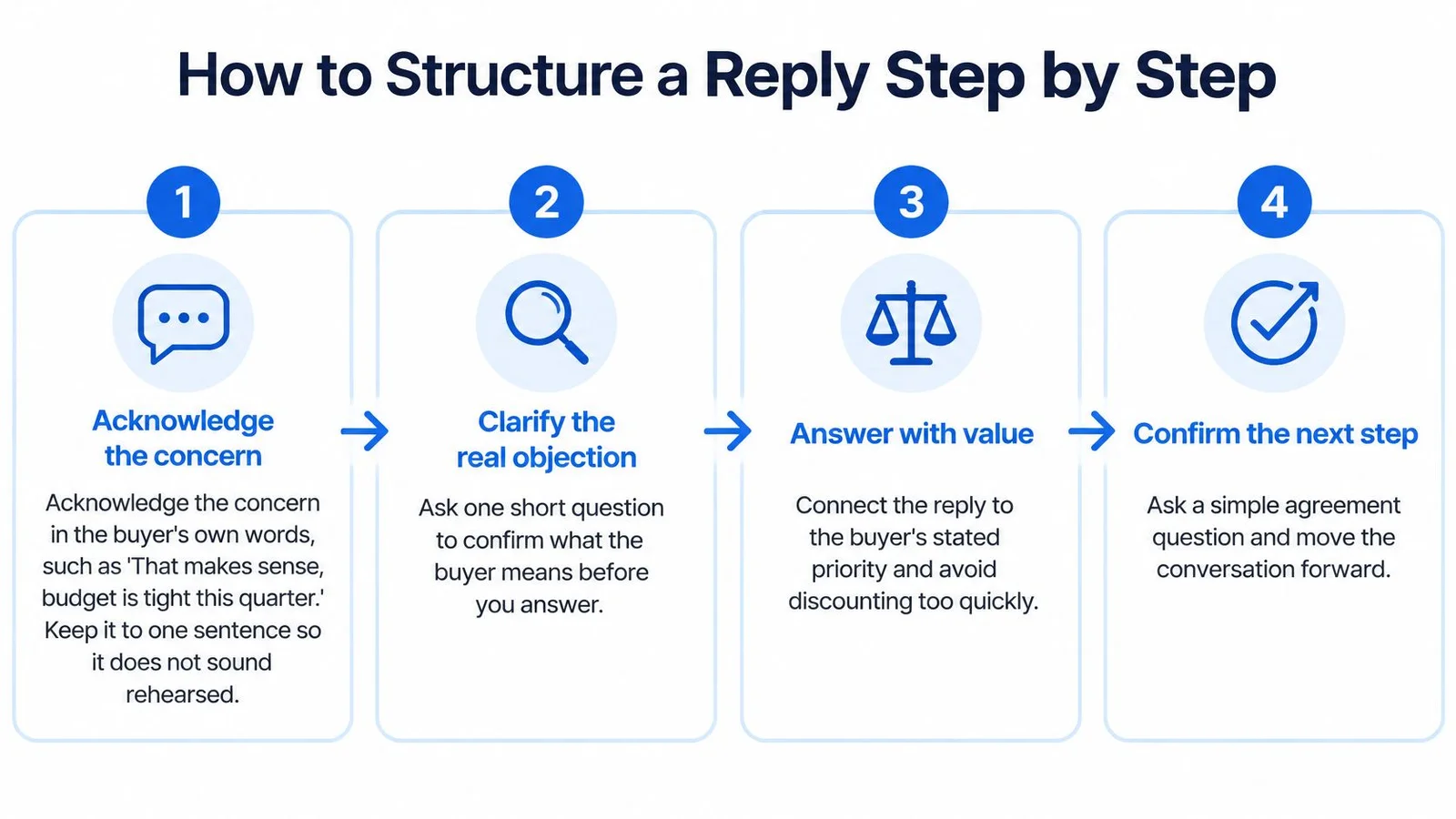
The same shape works for price, timing, and trust. That is why every reply later in this piece follows it. Grou's guide to sales objections is a useful companion if you want more live-call patterns beside this page-first version. If you are writing lines for a chat widget, pair the steps with solid conversation design so each branch stays short.
- Acknowledge in their words. One sentence, such as "That makes sense, budget is tight this quarter." It shows you heard them. The slip is turning the acknowledgement into a rebuttal.
- Pause for two or three seconds. Stop talking. The monologue is the failure mode, and reps rush this pause because silence feels like losing. On a page, the pause is a short line, not a paragraph.
- Ask one clarifying question. Try "What would have to be true for this to fit your plans?" Three questions feel like an interview. A yes-or-no question ends the talk.
- Tailor the answer, then offer one next step. Use what they just said. Offer a short guide, a demo link, or a follow-up date. The slip is answering with the full pitch.
Practical rule: After any reply, check one thing. Did the buyer speak again? If they went quiet, the reply was too long or the question was too closed.
Watch how a short pause changes the next line before you lock the wording.
Read every draft aloud. If you run out of breath, cut it. Simple as that. For the live-call side of the same four moves, these objection handling techniques go deeper.
Word-for-Word Replies for Timing and Interest Objections
Each line below stays under 25 words and ends by handing the turn back.
| Objection | Reply line | Follow-up question |
|---|---|---|
| Not interested | Fair enough. Is it the problem that is not a priority, or the approach? | Which of those is closer to the truth? |
| Call me later | Sure, when would work? Before then, what would you want to have ready? | What would make that call worth your time? |
| Send information | Happy to. Which part would help most, pricing, setup or results? | Should I send one page or a short walkthrough? |
| We already use a tool | That is common. What does it do well, and where does it fall short for you? | What would make you consider switching? |
| I don't have time | Understood. Would a three-minute summary help, or is a later date better? | Which would fit your week? |
The two lines that go wrong fastest
"Not interested" is the riskiest because reps treat it as a door to kick. Accept the answer. Then ask whether the problem is not a priority or the approach is off. That split tells you whether to stop or to narrow the offer. A second pitch in the same breath undoes the acceptance.
"We already use a tool" is the other trap. Leading with your differences sounds like an attack on a choice they already made. Ask what the current tool does well before you ask where it falls short. People will name the gap. You do not have to invent it.
Gong data cited by Seamless.AI found that in 2024 the best salespeople responded to objections by asking questions 54.3% of the time, compared with 31% for average representatives. The follow-up question is not optional. The common mistake is adding a second pitch in the same reply. "Send information" becomes useful only when you ask whether they want pricing, setup, or results. "I don't have time" gets a real choice: a three-minute summary or a later date.
Rehearse two lines aloud until they sound like your own voice. A script that sounds read out loud loses trust fast.
Turning a Price Objection Into a Value Conversation
Say a course creator hears that a $497 course is too expensive. Do not offer a coupon. Ask what one more enrolled student would be worth, then set that number next to the price. If one signup covers the fee, the objection was unclear value, not a hard budget wall.

Price is often named when a deal is lost, while buyers themselves blame price for a smaller share of those losses. A compilation of sales research reports that establishing ROI before presenting pricing produced a 30% higher close rate on price-objection deals than presenting price first. Treat that 30% as an external average, not a result you can promise.
Four questions, in this order
The order matters. You cannot price a result the buyer has not named.
- "What result would make this worthwhile?" This forces a definition of value before any number fight.
- "How are you measuring that today?" A result with no measure cannot be compared with a price.
- "If the current gap persists, what does it cost in lost signups, time, or revenue?" The cost of waiting has to come from them.
- "Would a solution that addresses that gap justify further evaluation?" This asks for a next look, not a signature.
Use only numbers the buyer supplies, or figures your business has already verified. Never plant an ROI claim or a testimonial in the script. For a worked model of outcome language, see these value proposition examples. On technical deals, read when solution engineers should talk price before a specialist quotes a figure too early.
| Objection | Reply line | Follow-up question |
|---|---|---|
| It's too expensive | That makes sense. What result would make this worth it for you? | How are you measuring that result today? |
| No budget this quarter | Understood. If the current gap persists, what does it cost in lost signups, time or revenue? | Would a solution that closes that gap justify a later look? |
| It costs more than we planned | Fair point. Which part of the value matters most to you? | What would the outcome be worth if it worked? |
Three pitfalls sink this sequence. Answering before the buyer defines value. Dropping in social proof that has nothing to do with price. Treating "no budget" as permission to discount.
Replies for Visitors Who Never Talk to Sales
The usual script assumes a rep can diagnose across several turns. Most visitors will not give you that. In the 2025 B2B buyer benchmark, 84% of B2B buyers say self-service tools are critical when choosing a vendor, 39% cite unclear pricing, and 24% cite slow vendor responses. Separate 2025 reporting in that same benchmark says 61% of B2B buyers prefer a rep-free buying experience.
Asking more discovery questions can cut conversion here. The objection is often a request for proof, not an invitation to start a sales conversation. A gate that demands a role, a budget, and a decision process before any answer is the wrong default. That's the gap FOMOchat was built for: short, honest conversations on the page instead of a form or a pop-up notification. The same goes for webinar replay pages, where viewers raise the same price and timing doubts but there's no rep around to answer. If you do staff a chat, our guide to live chat for sales covers when a human should jump in.
Four paths, one pattern
Keep each answer short and tied to the page they are on. State your assumptions in the open. Link the claim to evidence already on the site. Offer a person as an option, not a tollgate.
- Anonymous visitors want one fact, such as price range or setup time, with no form in front of it.
- Evaluators are comparing you with another option, so show one difference and a source, not a tour of every feature.
- Finance stakeholders are checking cost against an outcome, so show what is included and what is not.
- Technical reviewers want security and setup, so point at the doc, not a calendar link.
In FOMOchat, generated scripts can be reviewed and edited to set the tone of the chat's brand voice, which matters when these four paths share one widget. An AI chatbot for sales should still refuse to invent a number it does not have.
This is probably not a fit if your team needs a signed contract before seeing any product detail.
A clear boundary builds more trust than reassurance that promises the product works for everyone.
Test and Launch Your Script
Ship a small set you have read aloud. A full library that never leaves a doc does not handle a single objection.
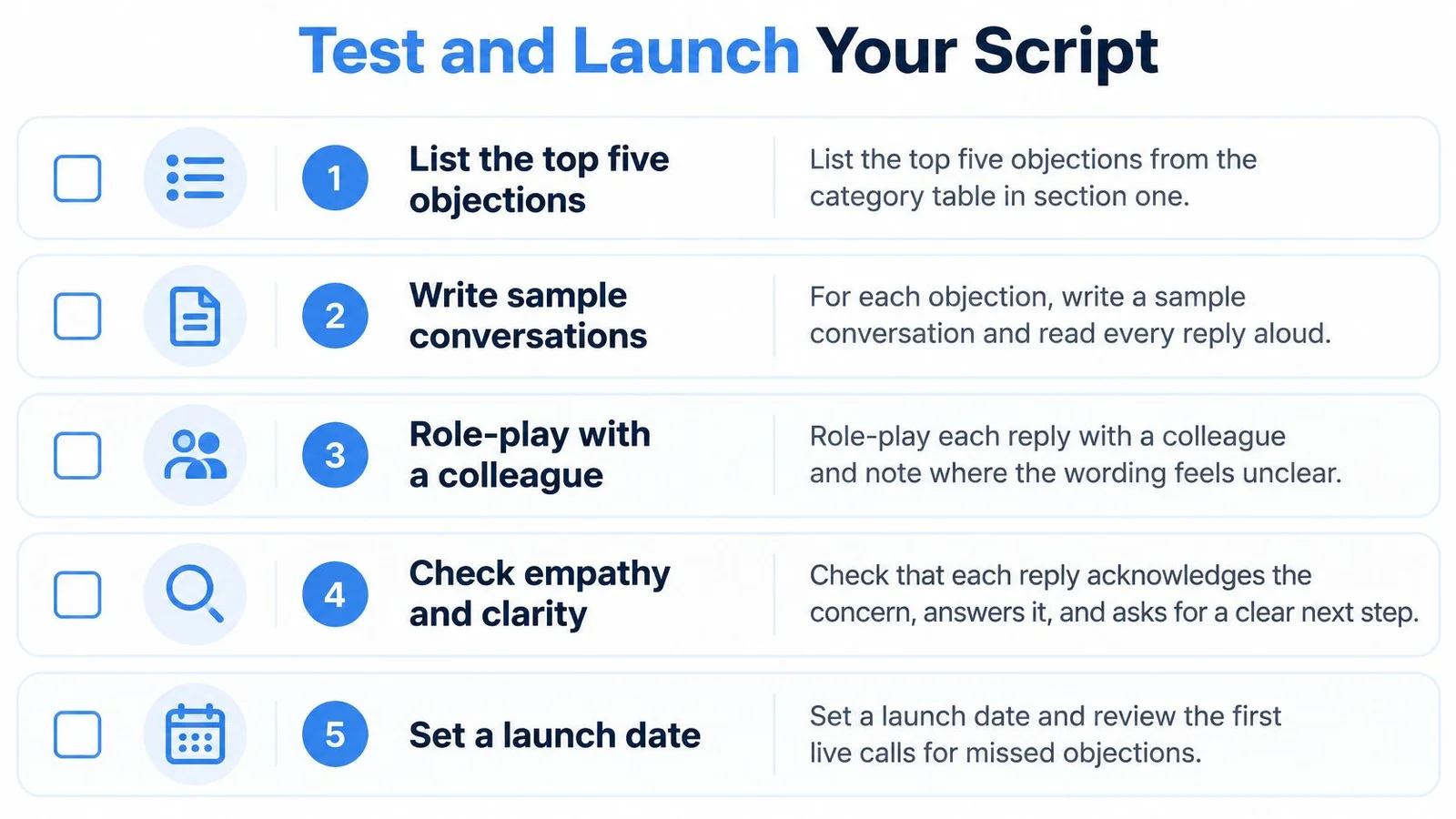
Five checks before you go live
- List the top five objections from the three types, starting with brush-offs. If "send information" is what you hear, do not practice a competitor battlecard first.
- Write a sample conversation for each and read every reply aloud. Keep it under 40 words, ask one question, and make no claim you cannot support.
- Run two colleagues through it, one playing a skeptical buyer. Note the exact word where they interrupt or stall, and rewrite that sentence only.
- Log objection type, branch, and outcome, marked booked, replied, or left. After two to four weeks, compare branches. The same review habit you use to test landing pages applies to reply branches.
- Apply one checklist to every line. One question, no invented testimonials, one next step, and a boundary where the offer does not fit.
In FOMOchat's Generate step, the AI creates realistic multi-person conversations that address common questions and objections. Owners can set facts that must be accurate, and the AI rep adds qualifiers when unsure. That stops a polished line from stating a price or a security claim you have not approved.
A three-day launch
Day one. Write the reply sets for dismissive, timing, existing-tool, and price objections. Do not add new categories.
Day two. Add the "not a fit if" line, plus short answers for pricing and security, each linked to a page that proves it.
Day three. Run the checklist with colleagues and go live. To install the FOMOchat widget, paste the script just before the closing </body> tag of your website's HTML.
Each month, pull the weakest branch, rewrite one reply, and test it again. Treat any external benchmark as an average to aim near, not a promised result.
Write the single objection your team hears most often, and test that line first. One tested line beats a library that never ships.
FOMOchat turns these reply patterns into on-page conversations that answer price, timing, and fit questions while visitors are still deciding. You can set the facts the replies must keep, generate dialogues around the objections you hear most, and review the tone before anything goes live. See how it works at FOMOchat.